roof KIA Soul 2015 2.G Owner's Guide
[x] Cancel search | Manufacturer: KIA, Model Year: 2015, Model line: Soul, Model: KIA Soul 2015 2.GPages: 492, PDF Size: 15.93 MB
Page 239 of 492
4159
Features of your vehicle
Voice Recognition
When using the voice recognitionfeature, only commands listed
within the user's manual are sup-
ported.
Be aware that during the operation of the voice recognition system,
pressing any key other than the
For superior voice recognition per- formance, position the microphone
used for voice recognition above
the head of the driver’s seat and
maintain a proper position when
saying commands.
Within the following situations, voice recognition may not function
properly due to external sound.
- When the windows and sunroof are open
- When the blower AC/heater is set to high
- When entering and passing through tunnels
(Continued)(Continued)
- When driving on rugged and uneven roads
- During severe rain (heavy rains, windstorms)
Phone related voice commands can be used only when a
Bluetooth®Wireless Technology
device is connected.
When making calls by stating a name, the corresponding contact
must be downloaded and stored
within the audio system.
After downloading the
Bluetooth®
Wireless Technology phone book,
it takes some times to convert the
phone book data into voice infor-
mation. During this time, voice
recognition may not properly oper-
ate.
Pronounce the voice commands naturally and clearly as if in a nor-
mal conversation.
Page 250 of 492
Features of your vehicle
170
4
Satellite Radio channels:
SiriusXMTMSatellite Radio offers
150+ channels with 100% commer-
cial-free music, plus sports, news,
talk and entertainment, available
nationwide in your vehicle. For more
information and a complete list of
SiriusXM
TMSatellite Radio channels,
visit www
.siriusxm.comin the United
States, sir
ius-canada.cain Canada,
or call SiriusXMTMat 1-800-643-2112.
Satellite Radio reception factors:
To receive the satellite signal, your
vehicle has been equipped with a
satellite radio antenna located on the
roof of your vehicle. The vehicle roof
provides the best location for an
unobstructed, open view of the sky, a
requirement of a satellite radio sys-
tem. Like AM/FM, there are several
factors that can affect satellite radio
reception performance:
Antenna obstructions: For optimal reception performance, keep the
antenna clear of snow and ice build-
up and keep luggage and other
material as far away from the anten-
na as possible. Terrain: Hills, mountains, tall build-
ings, bridges, tunnels, freeway over-
passes, parking garages, dense
tree foliage and thunderstorms can
interfere with your reception.
SiriusXM
TMSatellite Radio service:
SiriusXMTMSatellite Radio is a sub-
scription-based satellite radio service
that broadcasts music, sports, news
and entertainment programming to
radio receivers, which are available for
installation in motor vehicles or factory
installed, as well as for the home,
portable and wireless devices, and
through an Internet connection on per-
sonal computer.
Vehicles that are equipped with a fac-
tory installed SiriusXM
TMSatellite
Radio system include:
Hardware and an introductory trial
subscription term, which begins on
the date of sale or lease of the vehicle.
For a small upgrade fee, access to SiriusXM
TMmusic channels, and other
select channels over the Internet
using any computer connected to the
Internet (U.S. customers only).
For information on extended sub-
scription terms, contact SiriusXMTM
at 1-866-635-2349. NOTE:
All SiriusXM
TMservices require a
subscription, sold separately or
as a package, after 3-month trial
included with vehicle purchase or
lease. If you decide to continue
your SiriusXM
TMservice at the end
of your trial subscription, the plan
you choose will automatically
renew and bill at then-current
rates until you call us at 1-866-
635-2349 to cancel. See our
Customer Agreement for com-
plete terms at www
.siriusxm.com.
Other fees and taxes apply. All
fees and programming are subject
to change. Sirius satellite service
is available only to those at least
18 and older in the 48 contiguous
USA, D.C., and PR (with coverage
limitations). Our Internet radio
service is available throughout
our satellite service area and in
AK and HI. Certain channels are
not available on our Internet radio
service or on mobile devices.
© 2013 Sirius XM Radio Inc. Sirius,
XM and all related marks and logos
are trademarks of SiriusXM
TM
Radio Inc. All rights reserved
SiriusXMTMSatellite Radio information
Page 333 of 492
Driving your vehicle
50
5
Hazardous driving conditions
When hazardous driving conditions
are encountered such as water,
snow, ice, mud, sand, or similar haz-
ards, follow these suggestions:
Drive cautiously and allow extra
distance for braking.
Avoid sudden braking or steering.
When braking with non-ABS brakes pump the brake pedal with
a light up-and-down motion until
the vehicle is stopped.
Do not pump the brake pedal on a
vehicle equipped with ABS. If stalled in snow, mud, or sand,
use second gear. Accelerate slow-
ly to avoid spinning the drive
wheels.
Use sand, rock salt, or other non- slip material under the drive
wheels to provide traction when
stalled in ice, snow, or mud.
Reducing the risk of a rollover
This multi-purpose passenger vehi-
cle is defined as a Crossover Utility
Vehicle (CUV). CUV’s have higher
ground clearance and a narrower
track to make them capable of per-
forming in a wide variety of off-road
applications. Specific design charac-
teristics give them a higher center of
gravity than ordinary vehicles. An
advantage of the higher ground
clearance is a better view of the
road, which allows you to anticipate
problems. They are not designed for
cornering at the same speeds as
conventional passenger vehicles,
any more than low-slung sports vehi-
cles are designed to perform satis-
factorily in off-road conditions. Due to
this risk, driver and passengers are
strongly recommended to buckle
their seat belts. In a rollover crash,
an unbelted person is more likely to
die than a person wearing a seat
belt. There are steps that a driver can
make to reduce the risk of a rollover.
If at all possible, avoid sharp turns or
abrupt maneuvers, do not load your
roof rack with heavy cargo, and
never modify your vehicle in any way.
SPECIAL DRIVING CONDITIONS
WARNING- Downshifting
Do not downshift with an auto-
matic transaxle while driving on
slippery surfaces. The sudden
change in tire speed could
cause the tires to skid and
result in an accident.
Page 398 of 492
Maintenance
22
7
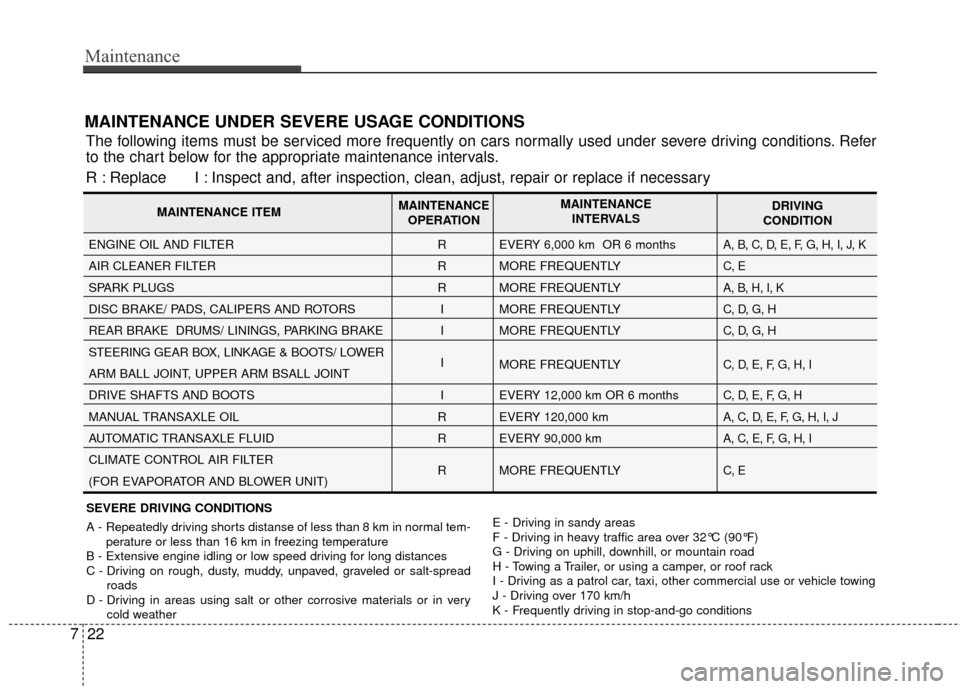
MAINTENANCE UNDER SEVERE USAGE CONDITIONS
The following items must be serviced more frequently on cars normally used under severe driving conditions. Refer
to the chart below for the appropriate maintenance intervals.
R : Replace I : Inspect and, after inspection, clean, adjust, repair or replace if neces\
sary
R
R
R
I
I
I
I
R
R
R EVERY 6,000 km OR 6 months
MORE FREQUENTLY
MORE FREQUENTLY
MORE FREQUENTLY
MORE FREQUENTLY
MORE FREQUENTLY
EVERY 12,000 km OR 6 months
EVERY 120,000 km
EVERY 90,000 km
MORE FREQUENTLYA, B, C, D, E, F, G, H, I, J, K
C, E
A, B, H, I, K
C, D, G, H
C, D, G, H
C, D, E, F, G, H, I
C, D, E, F, G, H
A, C, D, E, F, G, H, I, J
A, C, E, F, G, H, I
C, EENGINE OIL AND FILTER
AIR CLEANER FILTER
SPARK PLUGS
DISC BRAKE/ PADS, CALIPERS AND ROTORS
REAR BRAKE DRUMS/ LININGS, PARKING BRAKE
STEERING GEAR BOX, LINKAGE & BOOTS/ LOWER
ARM BALL JOINT, UPPER ARM BSALL JOINT
DRIVE SHAFTS AND BOOTS
MANUAL TRANSAXLE OIL
AUTOMATIC TRANSAXLE FLUID
CLIMATE CONTROL AIR FILTER
(FOR EVAPORATOR AND BLOWER UNIT)
MAINTENANCE ITEM
MAINTENANCE
OPERATION MAINTENANCE
INTERVALS DRIVING
CONDITION
SEVERE DRIVING CONDITIONS
A - Repeatedly driving shorts distanse of less than 8 km in normal tem- perature or less than 16 km in freezing temperature
B - Extensive engine idling or low speed driving for long distances
C - Driving on rough, dusty, muddy, unpaved, graveled or salt-spread roads
D - Driving in areas using salt or other corrosive materials or in very cold weather E - Driving in sandy areas
F - Driving in heavy traffic area over 32°C (90°F)
G - Driving on uphill, downhill, or mountain road
H - Towing a Trailer, or using a camper, or roof rack
I - Driving as a patrol car, taxi, other commercial use or vehicle towing
J - Driving over 170 km/h
K - Frequently driving in stop-and-go conditions
Page 422 of 492
Maintenance
46
7
When recharging the battery,
observe the following precautions:
The battery must be removed from
the vehicle and placed in an area
with good ventilation.
Do not allow cigarettes, sparks, or flame near the battery.
Watch the battery during charging, and stop or reduce the charging
rate if the battery cells begin
gassing (boiling) violently or if the
temperature of the electrolyte of
any cell exceeds 49°C (120°F).
Wear eye protection when check- ing the battery during charging.
Disconnect the battery charger in the following order.
1. Turn off the battery charger main switch.
2. Unhook the negative clamp from the negative battery terminal.
3. Unhook the positive clamp from the positive battery terminal. Before performing maintenance or
recharging the battery, turn off all
accessories and stop the engine.
The negative battery cable must be removed first and installed last
when the battery is disconnected.Reset items
Items should be reset after the bat-
tery has been discharged or the bat-
tery has been disconnected.
Auto up/down window (See chapter 4)
Sunroof (See chapter 4)
Trip computer (See chapter 4)
Climate control system (See chapter 4)
Clock (See chapter 4)
Audio (See chapter 4)
Page 444 of 492
Maintenance
68
7
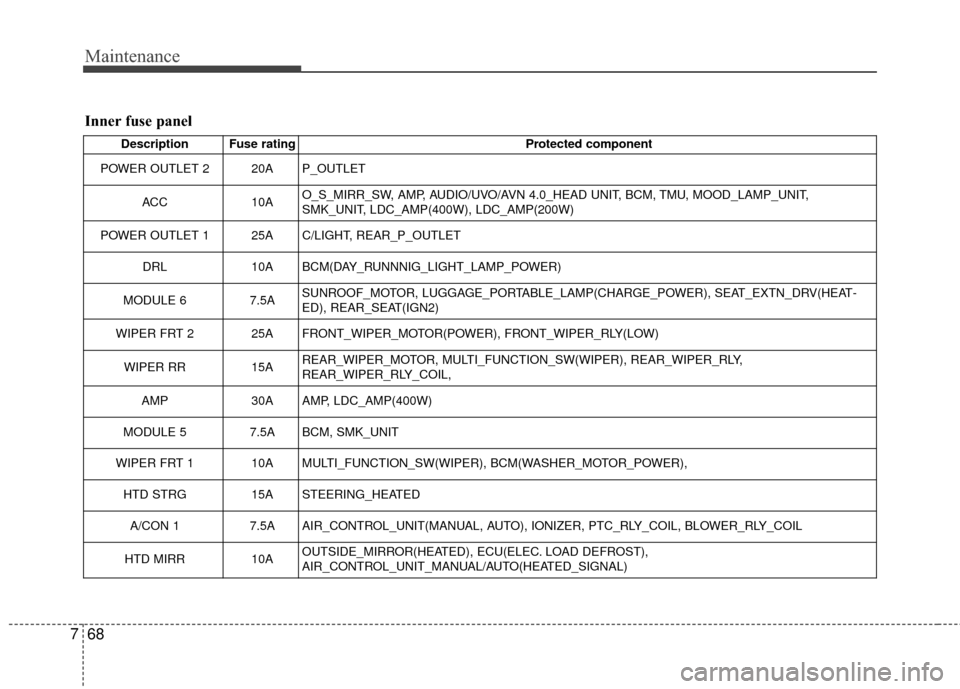
Inner fuse panel
Description Fuse rating Protected component
POWER OUTLET 2 20A P_OUTLET
ACC 10AO_S_MIRR_SW, AMP, AUDIO/UVO/AVN 4.0_HEAD UNIT, BCM, TMU, MOOD_LAMP_UNIT,
SMK_UNIT, LDC_AMP(400W), LDC_AMP(200W)
POWER OUTLET 1 25A C/LIGHT, REAR_P_OUTLET
DRL 10A BCM(DAY_RUNNNIG_LIGHT_LAMP_POWER)
MODULE 6 7.5ASUNROOF_MOTOR, LUGGAGE_PORTABLE_LAMP(CHARGE_POWER), SEAT_EXTN_DRV(HEAT-
ED), REAR_SEAT(IGN2)
WIPER FRT 2 25A FRONT_WIPER_MOTOR(POWER), FRONT_WIPER_RLY(LOW)
WIPER RR 15AREAR_WIPER_MOTOR, MULTI_FUNCTION_SW(WIPER), REAR_WIPER_RLY,
REAR_WIPER_RLY_COIL,
AMP 30A AMP, LDC_AMP(400W)
MODULE 5 7.5A BCM, SMK_UNIT
WIPER FRT 1 10A MULTI_FUNCTION_SW(WIPER), BCM(WASHER_MOTOR_POWER), HTD STRG 15A STEERING_HEATED
A/CON 1 7.5A AIR_CONTROL_UNIT(MANUAL, AUTO), IONIZER, PTC_RLY_COIL, BLOWER_RLY_COIL
HTD MIRR 10AOUTSIDE_MIRROR(HEATED), ECU(ELEC. LOAD DEFROST),
AIR_CONTROL_UNIT_MANUAL/AUTO(HEATED_SIGNAL)
Page 446 of 492
Maintenance
70
7
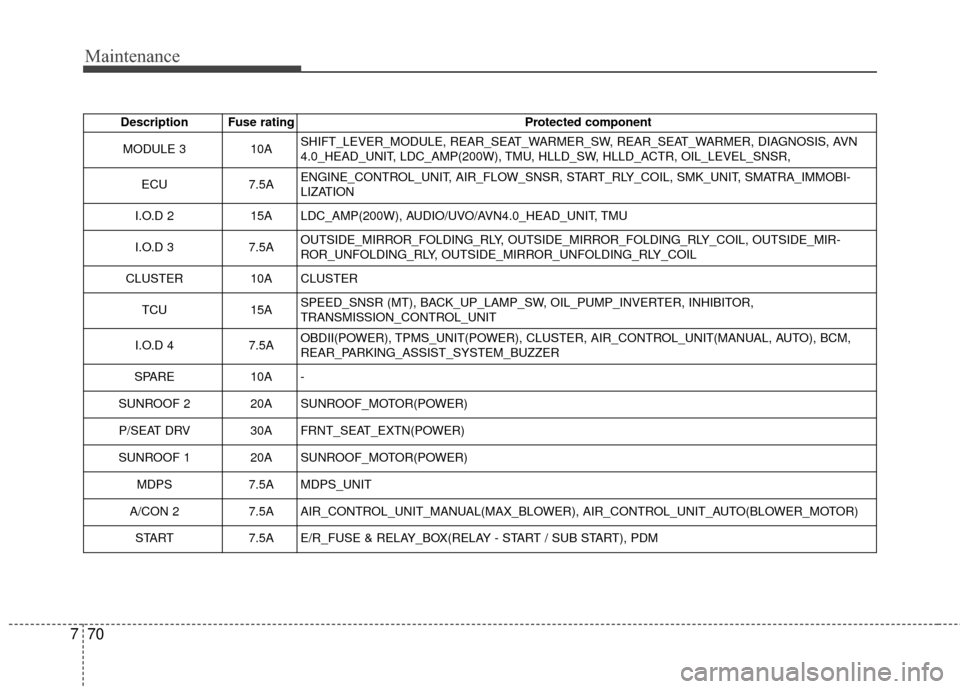
Description Fuse rating Protected component
MODULE 3 10ASHIFT_LEVER_MODULE, REAR_SEAT_WARMER_SW, REAR_SEAT_WARMER, DIAGNOSIS, AVN
4.0_HEAD_UNIT, LDC_AMP(200W), TMU, HLLD_SW, HLLD_ACTR, OIL_LEVEL_SNSR,
ECU 7.5AENGINE_CONTROL_UNIT, AIR_FLOW_SNSR, START_RLY_COIL, SMK_UNIT, SMATRA_IMMOBI-
LIZATION
I.O.D 2 15A LDC_AMP(200W), AUDIO/UVO/AVN4.0_HEAD_UNIT, TMU
I.O.D 3 7.5AOUTSIDE_MIRROR_FOLDING_RLY, OUTSIDE_MIRROR_FOLDING_RLY_COIL, OUTSIDE_MIR-
ROR_UNFOLDING_RLY, OUTSIDE_MIRROR_UNFOLDING_RLY_COIL
CLUSTER 10A CLUSTER
TCU 15ASPEED_SNSR (MT), BACK_UP_LAMP_SW, OIL_PUMP_INVERTER, INHIBITOR,
TRANSMISSION_CONTROL_UNIT
I.O.D 4 7.5AOBDII(POWER), TPMS_UNIT(POWER), CLUSTER, AIR_CONTROL_UNIT(MANUAL, AUTO), BCM,
REAR_PARKING_ASSIST_SYSTEM_BUZZER
SPARE 10A -
SUNROOF 2 20A SUNROOF_MOTOR(POWER) P/SEAT DRV 30A FRNT_SEAT_EXTN(POWER)
SUNROOF 1 20A SUNROOF_MOTOR(POWER) MDPS 7.5A MDPS_UNIT
A/CON 27.5AAIR_CONTROL_UNIT_MANUAL(MAX_BLOWER), AIR_CONTROL_UNIT_AUTO(BLOWER_MOTOR)
START 7.5AE/R_FUSE & RELAY_BOX(RELAY - START / SUB START), PDM
Page 475 of 492
Specifications & Consumer information
28
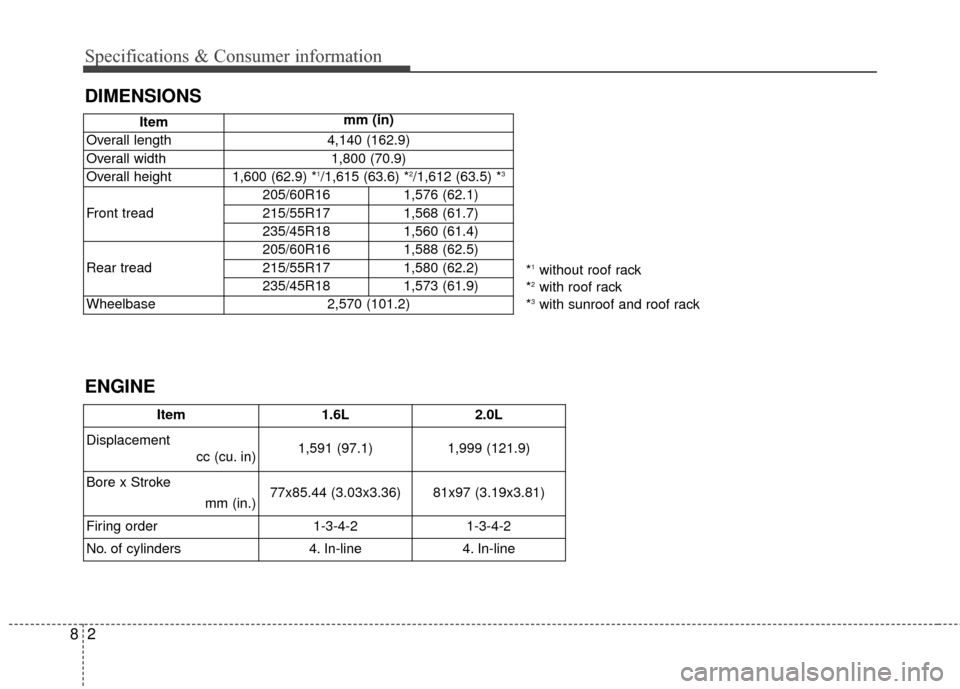
DIMENSIONS
Itemmm (in)
Overall length
4,140 (162.9)
Overall width
1,800 (70.9)
Overall height
1,600 (62.9) *1/1,615 (63.6) *2/1,612 (63.5) *3
Front tread
205/60R161,576 (62.1)
215/55R171,568 (61.7)
235/45R181,560 (61.4)
Rear tread
205/60R161,588 (62.5)
215/55R171,580 (62.2)
235/45R181,573 (61.9)
Wheelbase
2,570 (101.2)
*1without roof rack
*2with roof rack
*3with sunroof and roof rack
Item 1.6L 2.0L
Displacement cc (cu. in) 1,591 (97.1) 1,999 (121.9)
Bore x Stroke mm (in.)77x85.44 (3.03x3.36) 81x97 (3.19x3.81)
Firing order 1-3-4-2 1-3-4-2
No. of cylinders 4. In-line4. In-line
ENGINE
Page 478 of 492
85
Specifications & Consumer information
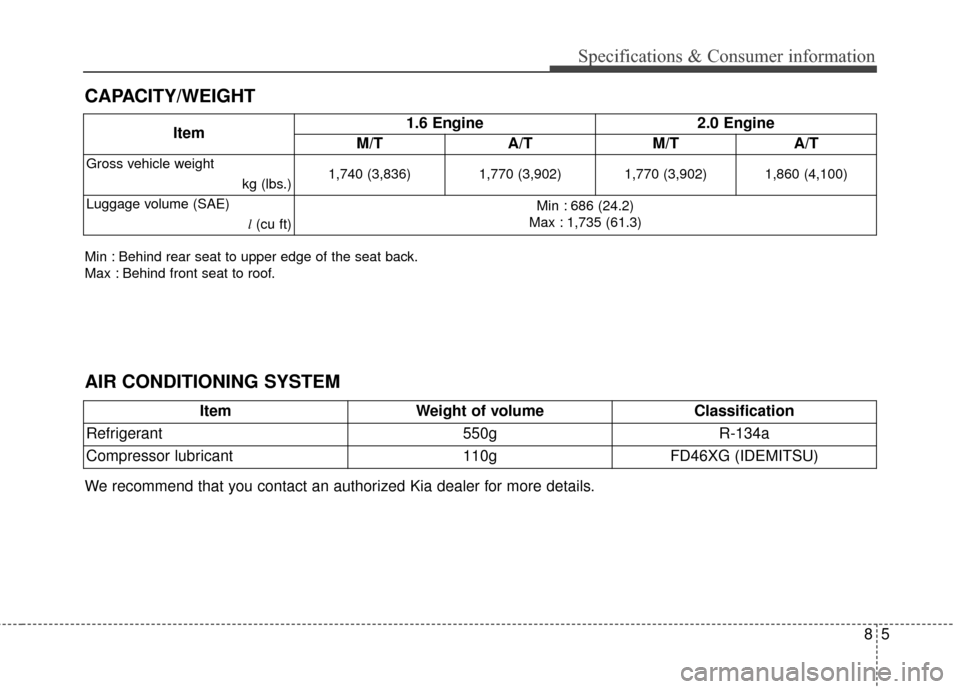
CAPACITY/WEIGHT
Item1.6 Engine 2.0 Engine
M/T A/T M/T A/T
Gross vehicle weight
kg (lbs.)1,740 (3,836) 1,770 (3,902) 1,770 (3,902) 1,860 (4,100)
Luggage volume (SAE) l(cu ft) Min : 686 (24.2)
Max : 1,735 (61.3)
Min : Behind rear seat to upper edge of the seat back.
Max : Behind front seat to roof.
AIR CONDITIONING SYSTEM
ItemWeight of volume Classification
Refrigerant
550g R-134a
Compressor lubricant
110g FD46XG (IDEMITSU)
We recommend that you contact an authorized Kia dealer for more details.
Page 487 of 492

Index
4I
Engine number . . . . . . . . . . . . . . . . . . . . . . . . . . . . . . . 8-10
Engine oil . . . . . . . . . . . . . . . . . . . . . . . . . . . . . . . . . . . 7-\
27Changing the engine oil and filter . . . . . . . . . . . . . . 7-28
Checking the engine oil level . . . . . . . . . . . . . . . . . . 7-27
Engine start/stop button . . . . . . . . . . . . . . . . . . . . . . . . . 5-9 Engine start/stop button position . . . . . . . . . . . . . . . . 5-9
Illuminated engine start/stop button. . . . . . . . . . . . . . 5-9
Starting the engine with a smart key . . . . . . . . . . . . 5-11
Explanation of scheduled maintenance items . . . . . . . 7-23
Exterior features . . . . . . . . . . . . . . . . . . . . . . . . . . . . . 4-144 Mounting bracket for roof carrier . . . . . . . . . . . . . 4-144
Exterior overview . . . . . . . . . . . . . . . . . . . . . . . . . . . . . . 2-2
Fuel filler lid . . . . . . . . . . . . . . . . . . . . . . . . . . . . . . . . . 4-34 Closing the fuel filler lid . . . . . . . . . . . . . . . . . . . . . 4-34
Opening the fuel filler lid. . . . . . . . . . . . . . . . . . . . . 4-34
Fuel requirements . . . . . . . . . . . . . . . . . . . . . . . . . . . . . . 1-3 Do not use methanol . . . . . . . . . . . . . . . . . . . . . . . . . 1-4
Fuel Additives . . . . . . . . . . . . . . . . . . . . . . . . . . . . . . 1-5
Gasoline containing alcohol and methanol . . . . . . . . 1-3
Gasoline containing MMT . . . . . . . . . . . . . . . . . . . . . 1-4
Use of MTBE . . . . . . . . . . . . . . . . . . . . . . . . . . . . . . . 1-4
Fuses . . . . . . . . . . . . . . . . . . . . . . . . . . . . . . . . . . . . \
. . . 7-62 Fuse/relay panel description. . . . . . . . . . . . . . . . . . . 7-67 Hood . . . . . . . . . . . . . . . . . . . . . . . . . . . . . . . . . . . . \
. . . 4-32
Closing the hood . . . . . . . . . . . . . . . . . . . . . . . . . . . 4-32
Opening the hood . . . . . . . . . . . . . . . . . . . . . . . . . . 4-32
How to use this manual . . . . . . . . . . . . . . . . . . . . . . . . . 1-2
If the engine overheats . . . . . . . . . . . . . . . . . . . . . . . . . . 6-8
If the engine will not start . . . . . . . . . . . . . . . . . . . . . . . 6-4 If engine doesn’t turn over or turns over slowly . . . . 6-4
If engine turns over normally but does not start . . . . 6-4
If you have a flat tire (with Spare Tire) . . . . . . . . . . . . . 6-9 Changing tires . . . . . . . . . . . . . . . . . . . . . . . . . . . . . 6-10
Jack and tools . . . . . . . . . . . . . . . . . . . . . . . . . . . . . . . 6-9
Jack label . . . . . . . . . . . . . . . . . . . . . . . . . . . . . . . . . 6-17
Removing and storing the spare tire . . . . . . . . . . . . 6-10
Use of temporary compact spare tire . . . . . . . . . . . . 6-15
If you have a flat tire (with Tire Mobility Kit). . . . . . . 6-18 Checking the tire inflation pressure . . . . . . . . . . . . . 6-23
Components of the Tire Mobility Kit . . . . . . . . . . . 6-20
Distributing the sealant . . . . . . . . . . . . . . . . . . . . . . 6-22
Introduction . . . . . . . . . . . . . . . . . . . . . . . . . . . . . . . 6-18
Notes on the safe use of the Tire Mobility Kit . . . . 6-23
Technical Data . . . . . . . . . . . . . . . . . . . . . . . . . . . . . 6-24
Using the Tire Mobility Kit . . . . . . . . . . . . . . . . . . . 6-21
F
H
I