check oil KIA SOUL 2017 User Guide
[x] Cancel search | Manufacturer: KIA, Model Year: 2017, Model line: SOUL, Model: KIA SOUL 2017Pages: 589, PDF Size: 13.3 MB
Page 449 of 589
Maintenance
88
OWNER MAINTENANCE
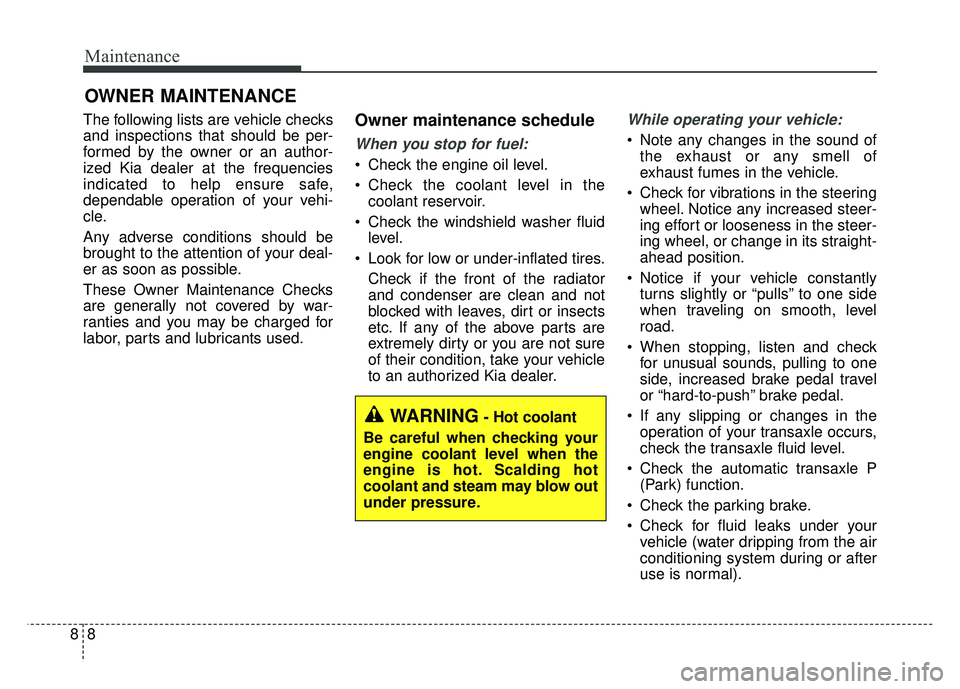
The following lists are vehicle checks
and inspections that should be per-
formed by the owner or an author-
ized Kia dealer at the frequencies
indicated to help ensure safe,
dependable operation of your vehi-
cle.
Any adverse conditions should be
brought to the attention of your deal-
er as soon as possible.
These Owner Maintenance Checks
are generally not covered by war-
ranties and you may be charged for
labor, parts and lubricants used.Owner maintenance schedule
When you stop for fuel:
Check the engine oil level.
Check the coolant level in thecoolant reservoir.
Check the windshield washer fluid level.
Look for low or under-inflated tires. Check if the front of the radiator
and condenser are clean and not
blocked with leaves, dirt or insects
etc. If any of the above parts are
extremely dirty or you are not sure
of their condition, take your vehicle
to an authorized Kia dealer.
While operating your vehicle:
Note any changes in the sound ofthe exhaust or any smell of
exhaust fumes in the vehicle.
Check for vibrations in the steering wheel. Notice any increased steer-
ing effort or looseness in the steer-
ing wheel, or change in its straight-
ahead position.
Notice if your vehicle constantly turns slightly or “pulls” to one side
when traveling on smooth, level
road.
When stopping, listen and check for unusual sounds, pulling to one
side, increased brake pedal travel
or “hard-to-push” brake pedal.
If any slipping or changes in the operation of your transaxle occurs,
check the transaxle fluid level.
Check the automatic transaxle P (Park) function.
Check the parking brake.
Check for fluid leaks under your vehicle (water dripping from the air
conditioning system during or after
use is normal).
WARNING- Hot coolant
Be careful when checking your
engine coolant level when the
engine is hot. Scalding hot
coolant and steam may blow out
under pressure.
Page 472 of 589
831
Maintenance
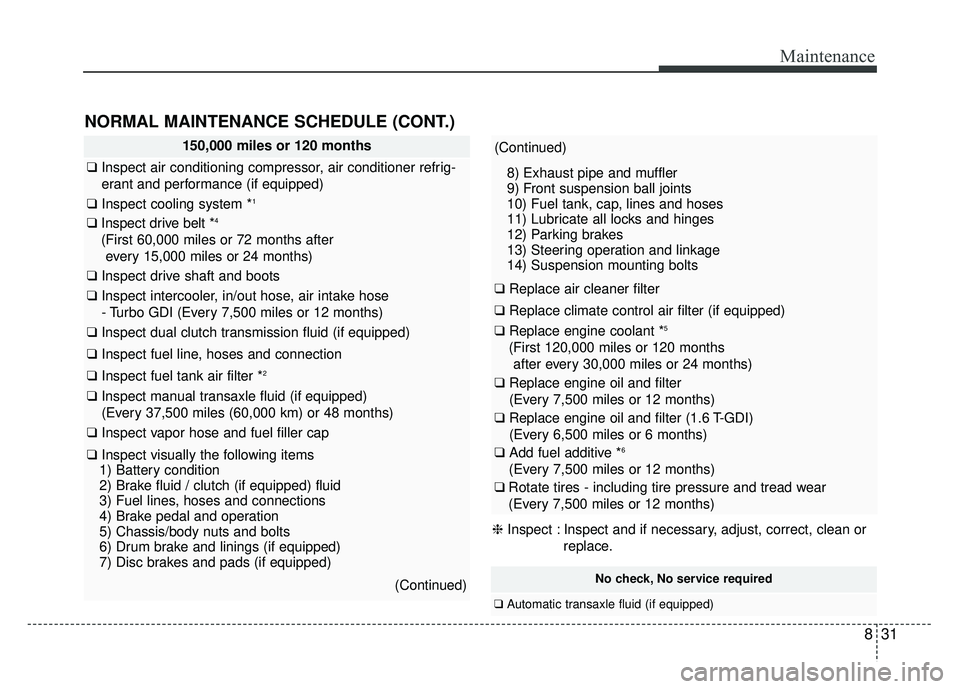
150,000 miles or 120 months
❑Inspect air conditioning compressor, air conditioner refrig-
erant and performance (if equipped)
❑ Inspect cooling system *1
❑Inspect drive belt *4
(First 60,000 miles or 72 months after
every 15,000 miles or 24 months)
❑ Inspect drive shaft and boots
❑Inspect intercooler, in/out hose, air intake hose
- Turbo GDI (Every 7,500 miles or 12 months)
❑Inspect dual clutch transmission fluid (if equipped)
❑ Inspect fuel line, hoses and connection
❑Inspect fuel tank air filter *2
❑Inspect manual transaxle fluid (if equipped)
(Every 37,500 miles (60,000 km) or 48 months)
❑ Inspect vapor hose and fuel filler cap
❑Inspect visually the following items
1) Battery condition
2) Brake fluid / clutch (if equipped) fluid
3) Fuel lines, hoses and connections
4) Brake pedal and operation
5) Chassis/body nuts and bolts
6) Drum brake and linings (if equipped)
7) Disc brakes and pads (if equipped)
(Continued)
(Continued)
8) Exhaust pipe and muffler
9) Front suspension ball joints
10) Fuel tank, cap, lines and hoses
11) Lubricate all locks and hinges
12) Parking brakes
13) Steering operation and linkage
14) Suspension mounting bolts
❑ Replace air cleaner filter
❑Replace climate control air filter (if equipped)
❑Replace engine coolant *5
(First 120,000 miles or 120 months
after every 30,000 miles or 24 months)
❑ Replace engine oil and filter
(Every 7,500 miles or 12 months)
❑Replace engine oil and filter (1.6 T-GDI)
(Every 6,500 miles or 6 months)
❑Add fuel additive *6
(Every 7,500 miles or 12 months)
❑Rotate tires - including tire pressure and tread wear
(Every 7,500 miles or 12 months)
NORMAL MAINTENANCE SCHEDULE (CONT.)
No check, No service required
❑ Automatic transaxle fluid (if equipped)
❈ Inspect : Inspect and if necessary, adjust, correct, clean or
replace.
Page 475 of 589
Maintenance
34
8
EXPLANATION OF SCHEDULED MAINTENANCE ITEMS
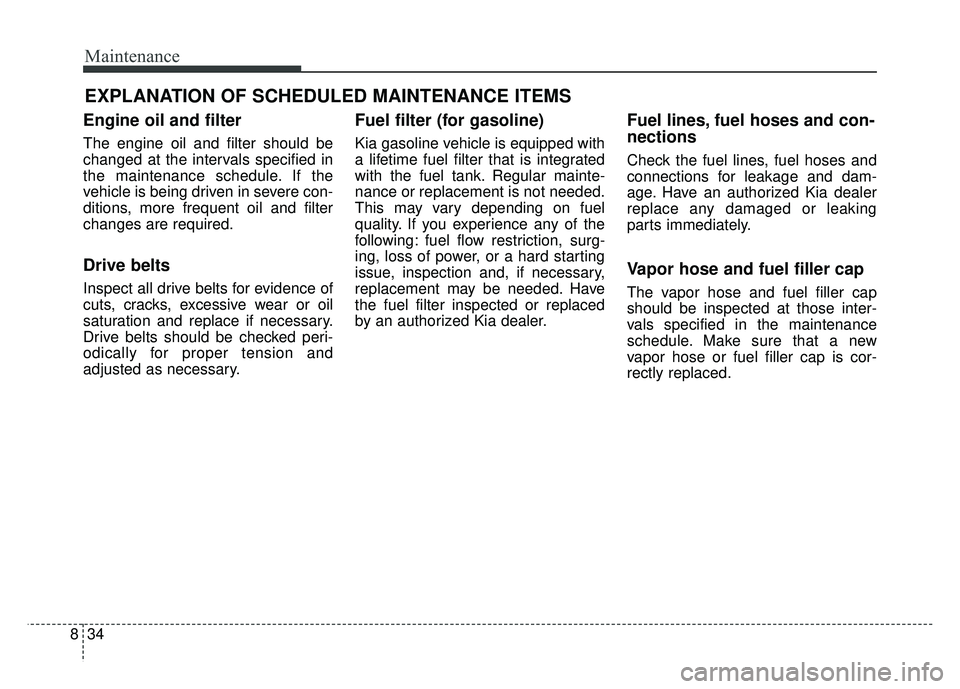
Engine oil and filter
The engine oil and filter should be
changed at the intervals specified in
the maintenance schedule. If the
vehicle is being driven in severe con-
ditions, more frequent oil and filter
changes are required.
Drive belts
Inspect all drive belts for evidence of
cuts, cracks, excessive wear or oil
saturation and replace if necessary.
Drive belts should be checked peri-
odically for proper tension and
adjusted as necessary.
Fuel filter (for gasoline)
Kia gasoline vehicle is equipped with
a lifetime fuel filter that is integrated
with the fuel tank. Regular mainte-
nance or replacement is not needed.
This may vary depending on fuel
quality. If you experience any of the
following: fuel flow restriction, surg-
ing, loss of power, or a hard starting
issue, inspection and, if necessary,
replacement may be needed. Have
the fuel filter inspected or replaced
by an authorized Kia dealer.
Fuel lines, fuel hoses and con-
nections
Check the fuel lines, fuel hoses and
connections for leakage and dam-
age. Have an authorized Kia dealer
replace any damaged or leaking
parts immediately.
Vapor hose and fuel filler cap
The vapor hose and fuel filler cap
should be inspected at those inter-
vals specified in the maintenance
schedule. Make sure that a new
vapor hose or fuel filler cap is cor-
rectly replaced.
Page 480 of 589
839
Maintenance
ENGINE OIL
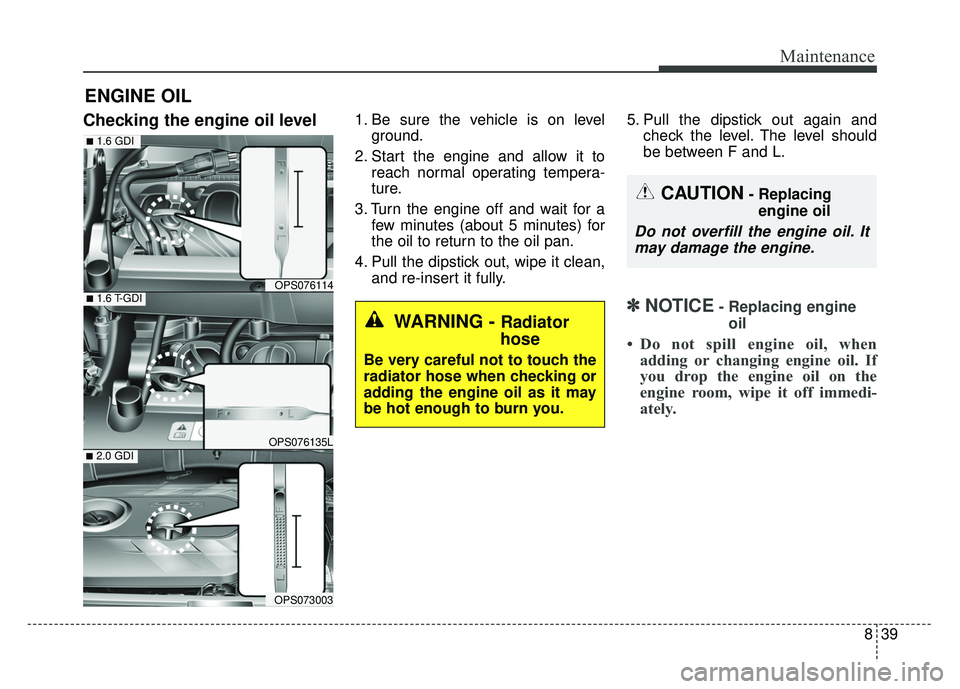
Checking the engine oil level 1. Be sure the vehicle is on levelground.
2. Start the engine and allow it to reach normal operating tempera-
ture.
3. Turn the engine off and wait for a few minutes (about 5 minutes) for
the oil to return to the oil pan.
4. Pull the dipstick out, wipe it clean, and re-insert it fully. 5. Pull the dipstick out again and
check the level. The level should
be between F and L.
✽ ✽NOTICE- Replacing engine
oil
• Do not spill engine oil, when adding or changing engine oil. If
you drop the engine oil on the
engine room, wipe it off immedi-
ately.
WARNING - Radiator
hose
Be very careful not to touch the
radiator hose when checking or
adding the engine oil as it may
be hot enough to burn you.
CAUTION- Replacing
engine oil
Do not overfill the engine oil. Itmay damage the engine.
■1.6 T-GDI
■1.6 GDI
OPS076135L■2.0 GDI
OPS073003
OPS076114
Page 486 of 589
845
Maintenance
BRAKE/CLUTCH FLUID
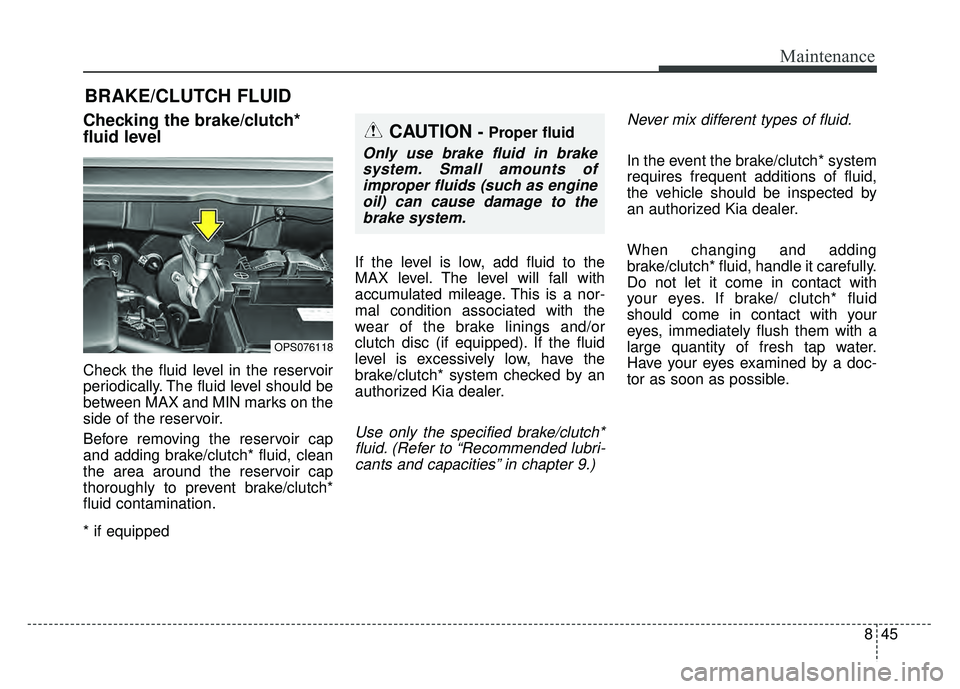
Checking the brake/clutch*
fluid level
Check the fluid level in the reservoir
periodically. The fluid level should be
between MAX and MIN marks on the
side of the reservoir.
Before removing the reservoir cap
and adding brake/clutch* fluid, clean
the area around the reservoir cap
thoroughly to prevent brake/clutch*
fluid contamination.
* if equippedIf the level is low, add fluid to the
MAX level. The level will fall with
accumulated mileage. This is a nor-
mal condition associated with the
wear of the brake linings and/or
clutch disc (if equipped). If the fluid
level is excessively low, have the
brake/clutch* system checked by an
authorized Kia dealer.
Use only the specified brake/clutch*
fluid. (Refer to “Recommended lubri-cants and capacities” in chapter 9.) Never mix different types of fluid.
In the event the brake/clutch* system
requires frequent additions of fluid,
the vehicle should be inspected by
an authorized Kia dealer.
When changing and adding
brake/clutch* fluid, handle it carefully.
Do not let it come in contact with
your eyes. If brake/ clutch* fluid
should come in contact with your
eyes, immediately flush them with a
large quantity of fresh tap water.
Have your eyes examined by a doc-
tor as soon as possible.
OPS076118
CAUTION - Proper fluid
Only use brake fluid in brake
system. Small amounts ofimproper fluids (such as engineoil) can cause damage to thebrake system.
Page 499 of 589
Maintenance
58
8
When recharging the battery,
observe the following precautions:
The battery must be removed from
the vehicle and placed in an area
with good ventilation.
Do not allow cigarettes, sparks, or flame near the battery.
Watch the battery during charging, and stop or reduce the charging
rate if the battery cells begin
gassing (boiling) violently or if the
temperature of the electrolyte of
any cell exceeds 120°F (49°C).
Wear eye protection when check- ing the battery during charging.
Disconnect the battery charger in the following order. 1.Turn off the battery charger main
switch.
2.Unhook the negative clamp from the negative battery terminal.
3.Unhook the positive clamp from the positive battery terminal.
Before performing maintenance or recharging the battery, turn off all
accessories and stop the engine.
The negative battery cable must be removed first and installed last
when the battery is disconnected.Reset items
Items should be reset after the bat-
tery has been discharged or the bat-
tery has been disconnected.
Auto up/down window (See chapter 4)
Sunroof (See chapter 4)
Trip computer (See chapter 4)
Climate control system (See chapter 4)
Clock (See chapter 4)
Audio (See chapter 5)
Page 515 of 589
Maintenance
74
8
FUSES
A vehicle’s electrical system is pro-
tected from electrical overload dam-
age by fuses.
This vehicle has 2 (or 3) fuse panels,
one located in the driver’s side panel
bolster, the other in the engine com-
partment near the battery.
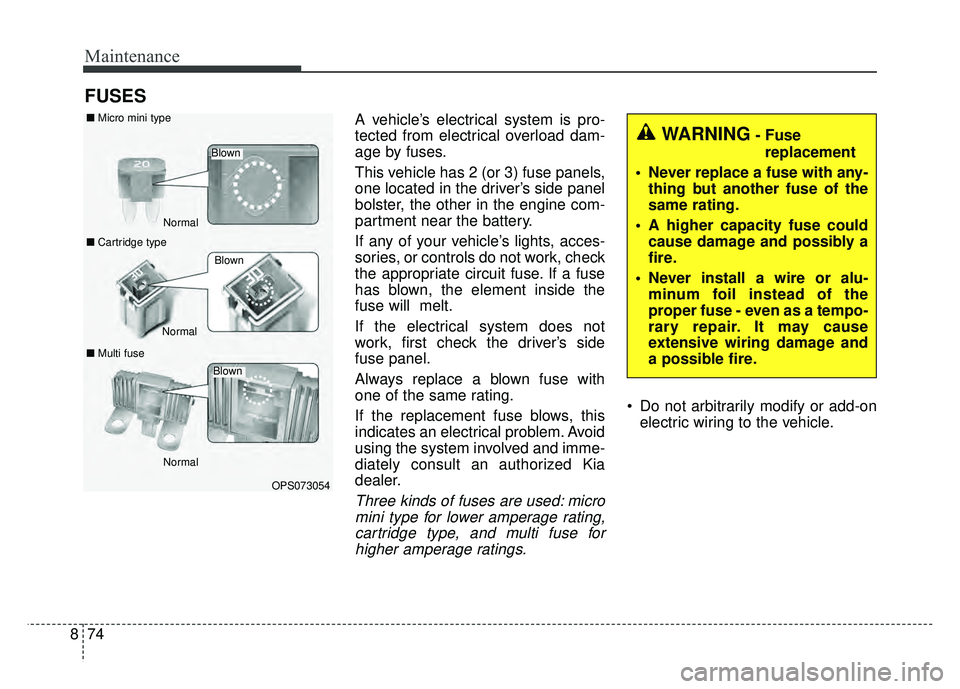
If any of your vehicle’s lights, acces-
sories, or controls do not work, check
the appropriate circuit fuse. If a fuse
has blown, the element inside the
fuse will melt.
If the electrical system does not
work, first check the driver’s side
fuse panel.
Always replace a blown fuse with
one of the same rating.
If the replacement fuse blows, this
indicates an electrical problem. Avoid
using the system involved and imme-
diately consult an authorized Kia
dealer.
Three kinds of fuses are used: micro
mini type for lower amperage rating,cartridge type, and multi fuse forhigher amperage ratings.
Do not arbitrarily modify or add-on electric wiring to the vehicle.
WARNING- Fuse
replacement
Never replace a fuse with any- thing but another fuse of the
same rating.
A higher capacity fuse could cause damage and possibly a
fire.
Never install a wire or alu- minum foil instead of the
proper fuse - even as a tempo-
rary repair. It may cause
extensive wiring damage and
a possible fire.
OPS073054
Normal
Normal
■
Micro mini type
■ Cartridge type
■ Multi fuse
Blown
Blown
Normal
Blown
Page 567 of 589
99
Specifications, Consumer information, Reporting safety defects
Recommended SAE viscosity
number
Always be sure to clean the area
around any filler plug, drain plug, or
dipstick before checking or draining
any lubricant. This is especially
important in dusty or sandy areas
and when the vehicle is used on
unpaved roads. Cleaning the plug
and dipstick areas will prevent dirt
and grit from entering the engine and
other mechanisms that could be
damaged.Engine oil viscosity (thickness) has
an effect on fuel economy and cold
weather operating (engine start and
engine oil flowability). Lower viscosi-
ty engine oils can provide better fuel
economy and cold weather perform-
ance, however, higher viscosity
engine oils are required for satisfac-
tory lubrication in hot weather.
Using oils of any viscosity other than
those recommended could result in
engine damage.
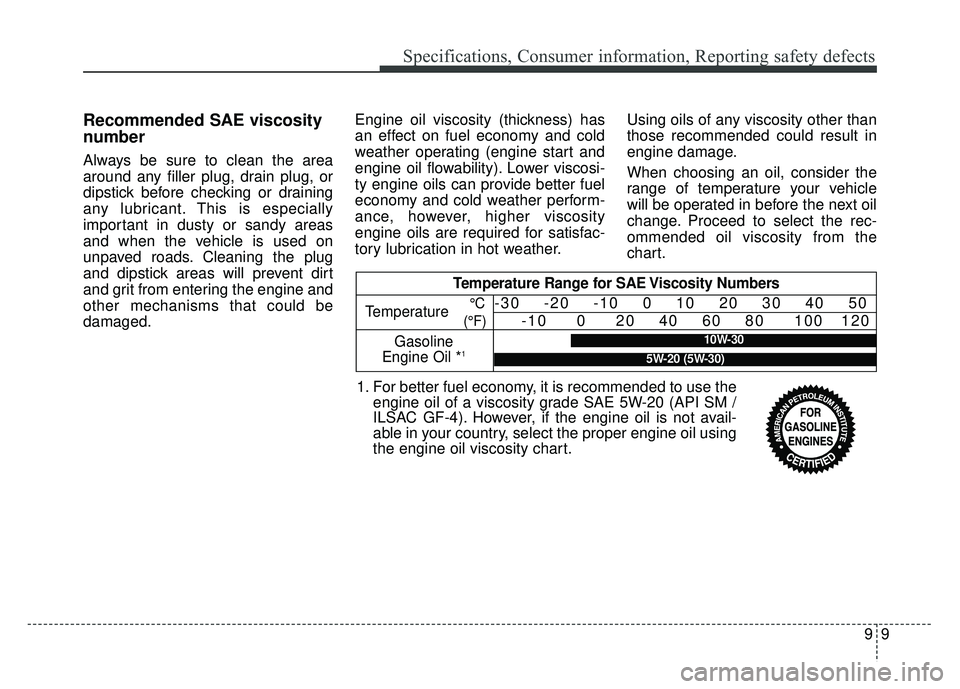
When choosing an oil, consider the
range of temperature your vehicle
will be operated in before the next oil
change. Proceed to select the rec-
ommended oil viscosity from the
chart.
Temperature Range for SAE Viscosity Numbers
Temperature
Gasoline
Engine Oil *
1
°C
(°F)-30 -20 -10 0 10 20 30 40 50 -10 0 20 40 60 80 100 120
1. For better fuel economy, it is recommended to use theengine oil of a viscosity grade SAE 5W-20 (API SM /
ILSAC GF-4). However, if the engine oil is not avail-
able in your country, select the proper engine oil using
the engine oil viscosity chart.
10W-30
5W-20 (5W-30)
Page 579 of 589
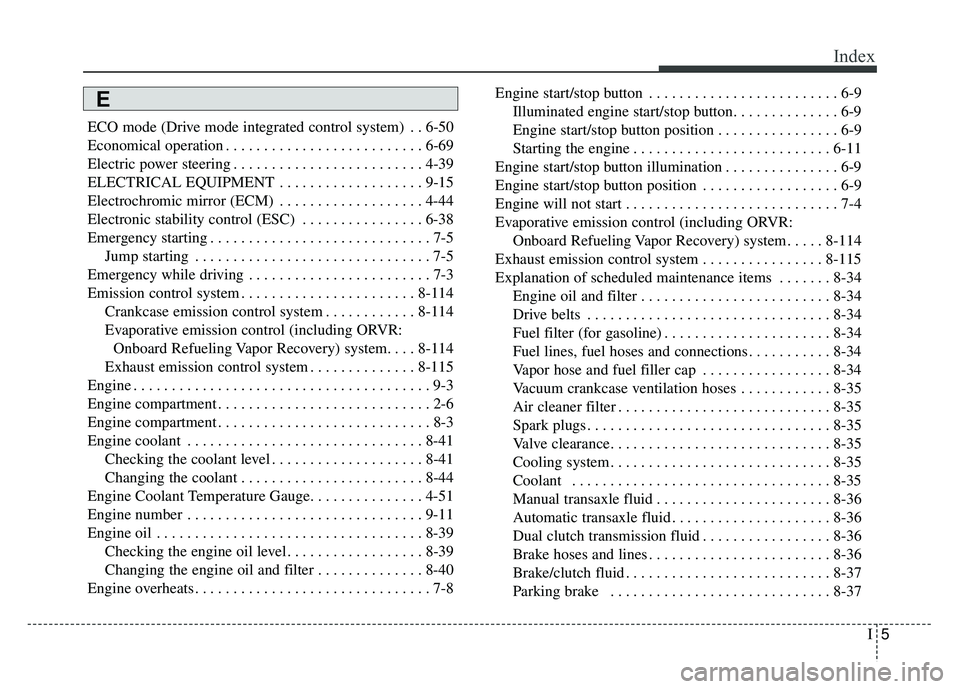
I5
Index
ECO mode (Drive mode integrated control system) . . 6-50
Economical operation . . . . . . . . . . . . . . . . . . . . . . . . . . 6-69
Electric power steering . . . . . . . . . . . . . . . . . . . . . . . . . 4-39
ELECTRICAL EQUIPMENT . . . . . . . . . . . . . . . . . . . 9-15
Electrochromic mirror (ECM) . . . . . . . . . . . . . . . . . . . 4-44
Electronic stability control (ESC) . . . . . . . . . . . . . . . . 6-38
Emergency starting . . . . . . . . . . . . . . . . . . . . . . . . . . . . . 7-5Jump starting . . . . . . . . . . . . . . . . . . . . . . . . . . . . . . . 7-5
Emergency while driving . . . . . . . . . . . . . . . . . . . . . . . . 7-3
Emission control system . . . . . . . . . . . . . . . . . . . . . . . 8-114 Crankcase emission control system . . . . . . . . . . . . 8-114
Evaporative emission control (including ORVR:Onboard Refueling Vapor Recovery) system. . . . 8-114
Exhaust emission control system . . . . . . . . . . . . . . 8-115
Engine . . . . . . . . . . . . . . . . . . . . . . . . . . . . . . . . . . . . \
. . . 9-3
Engine compartment . . . . . . . . . . . . . . . . . . . . . . . . . . . . 2-6
Engine compartment . . . . . . . . . . . . . . . . . . . . . . . . . . . . 8-3
Engine coolant . . . . . . . . . . . . . . . . . . . . . . . . . . . . . . . 8-41 Checking the coolant level . . . . . . . . . . . . . . . . . . . . 8-41
Changing the coolant . . . . . . . . . . . . . . . . . . . . . . . . 8-44
Engine Coolant Temperature Gauge. . . . . . . . . . . . . . . 4-51
Engine number . . . . . . . . . . . . . . . . . . . . . . . . . . . . . . . 9-11
Engine oil . . . . . . . . . . . . . . . . . . . . . . . . . . . . . . . . . . . 8-\
39 Checking the engine oil level . . . . . . . . . . . . . . . . . . 8-39
Changing the engine oil and filter . . . . . . . . . . . . . . 8-40
Engine overheats . . . . . . . . . . . . . . . . . . . . . . . . . . . . . . . 7-8 Engine start/stop button . . . . . . . . . . . . . . . . . . . . . . . . . 6-9
Illuminated engine start/stop button. . . . . . . . . . . . . . 6-9
Engine start/stop button position . . . . . . . . . . . . . . . . 6-9
Starting the engine . . . . . . . . . . . . . . . . . . . . . . . . . . 6-11
Engine start/stop button illumination . . . . . . . . . . . . . . . 6-9
Engine start/stop button position . . . . . . . . . . . . . . . . . . 6-9
Engine will not start . . . . . . . . . . . . . . . . . . . . . . . . . . . . 7-4
Evaporative emission control (including ORVR: Onboard Refueling Vapor Recovery) system . . . . . 8-114
Exhaust emission control system . . . . . . . . . . . . . . . . 8-115
Explanation of scheduled maintenance items . . . . . . . 8-34 Engine oil and filter . . . . . . . . . . . . . . . . . . . . . . . . . 8-34
Drive belts . . . . . . . . . . . . . . . . . . . . . . . . . . . . . . . . 8-34
Fuel filter (for gasoline) . . . . . . . . . . . . . . . . . . . . . . 8-34
Fuel lines, fuel hoses and connections . . . . . . . . . . . 8-34
Vapor hose and fuel filler cap . . . . . . . . . . . . . . . . . 8-34
Vacuum crankcase ventilation hoses . . . . . . . . . . . . 8-35
Air cleaner filter . . . . . . . . . . . . . . . . . . . . . . . . . . . . 8-35
Spark plugs . . . . . . . . . . . . . . . . . . . . . . . . . . . . . . . . 8-35
Valve clearance. . . . . . . . . . . . . . . . . . . . . . . . . . . . . 8-35
Cooling system . . . . . . . . . . . . . . . . . . . . . . . . . . . . . 8-35
Coolant . . . . . . . . . . . . . . . . . . . . . . . . . . . . . . . . . . 8-35\
Manual transaxle fluid . . . . . . . . . . . . . . . . . . . . . . . 8-36
Automatic transaxle fluid . . . . . . . . . . . . . . . . . . . . . 8-36
Dual clutch transmission fluid . . . . . . . . . . . . . . . . . 8-36
Brake hoses and lines . . . . . . . . . . . . . . . . . . . . . . . . 8-36
Brake/clutch fluid . . . . . . . . . . . . . . . . . . . . . . . . . . . 8-37
Parking brake . . . . . . . . . . . . . . . . . . . . . . . . . . . . . 8-37
E
Page 584 of 589

Index
10I
Good driving practices . . . . . . . . . . . . . . . . . . . . . . . 6-17
Map lamp . . . . . . . . . . . . . . . . . . . . . . . . . . . . . . . . . . . 4-\
96
Map lamp bulb replacement . . . . . . . . . . . . . . . . . . . . 8-102
Mirrors . . . . . . . . . . . . . . . . . . . . . . . . . . . . . . . . . . . . \
. 4-43 Inside rearview mirror . . . . . . . . . . . . . . . . . . . . . . . 4-43
Day/night rearview mirror . . . . . . . . . . . . . . . . . . . . 4-43
Electrochromic mirror (ECM) . . . . . . . . . . . . . . . . 4-44
Outside rearview mirror . . . . . . . . . . . . . . . . . . . . . . 4-45
Remote control . . . . . . . . . . . . . . . . . . . . . . . . . . . . . 4-46
Folding the outside rearview mirror. . . . . . . . . . . . . 4-46
Occupant Detection System . . . . . . . . . . . . . . . . . . . . . 3-49
Odometer . . . . . . . . . . . . . . . . . . . . . . . . . . . . . . . . . . . 4-\
52
Oil (Engine) . . . . . . . . . . . . . . . . . . . . . . . . . . . . . . . . . 8-39
ONLINE FACTORY AUTHORIZED MANUALS . . . 9-16
Outside rearview mirror . . . . . . . . . . . . . . . . . . . . . . . . 4-45
Overheats . . . . . . . . . . . . . . . . . . . . . . . . . . . . . . . . . . . . \
7-8
Owner maintenance . . . . . . . . . . . . . . . . . . . . . . . . . . . . 8-8 Owner maintenance schedule. . . . . . . . . . . . . . . . . . . 8-8
Parking brake . . . . . . . . . . . . . . . . . . . . . . . . . . . . . . . . 6-34 Checking the parking brake . . . . . . . . . . . . . . . . . . . 8-48
Parking light position . . . . . . . . . . . . . . . . . . . . . . . . . . 4-89 Portable lamp . . . . . . . . . . . . . . . . . . . . . . . . . . . . . . . . 4-98
Position lamp + DRL (LED type) bulb replacement . . 8-96
Power outlet . . . . . . . . . . . . . . . . . . . . . . . . . . . . . . . . 4-141
Power window lock button . . . . . . . . . . . . . . . . . . . . . . 4-28
Precautions . . . . . . . . . . . . . . . . . . . . . . . . . . . . . . . . . . 3-24\
Pre-tensioner seat belt. . . . . . . . . . . . . . . . . . . . . . . . . . 3-26
Rear camera display . . . . . . . . . . . . . . . . . . . . . . . . . . . 4-87
Rear seat adjustment . . . . . . . . . . . . . . . . . . . . . . . . . . . 3-13
Rear turn signal lamp bulb Replacement . . . . . . . . . . . 8-98
Recommended lubricants and capacities . . . . . . . . . . . . 9-7
Recommended SAE viscosity number. . . . . . . . . . . . 9-9
Record your key number . . . . . . . . . . . . . . . . . . . . . . . . 4-4
Reducing the risk of a rollover . . . . . . . . . . . . . . . . . . . 6-71
Refrigerant label . . . . . . . . . . . . . . . . . . . . . . . . . . . . . . 9-11
Remote control (outside rear view mirror) . . . . . . . . . . 4-46
REPORTING SAFETY DEFECTS . . . . . . . . . . . . . . . 9-16
Resetting the sunroof . . . . . . . . . . . . . . . . . . . . . . . . . . 4-38
Road warning . . . . . . . . . . . . . . . . . . . . . . . . . . . . . . . . . 7-2
Rocking the vehicle . . . . . . . . . . . . . . . . . . . . . . . . . . . 6-72
Room lamp . . . . . . . . . . . . . . . . . . . . . . . . . . . . . . . . . . 4-97\
Room lamp bulb replacement . . . . . . . . . . . . . . . . . . . 8-103
Rotation (Tire) . . . . . . . . . . . . . . . . . . . . . . . . . . . . . . . 8-61
O
P
R