wheel KIA SOUL 2018 Owners Manual
[x] Cancel search | Manufacturer: KIA, Model Year: 2018, Model line: SOUL, Model: KIA SOUL 2018Pages: 620, PDF Size: 13.29 MB
Page 547 of 620
Maintenance
72
8
When driving on roads covered
with snow or ice, drive at less than
20 mph (30 km/h).
Use the SAE “S” class or wire chains.
If you hear noise caused by chains contacting the body, retighten the
chain to avoid contact with the
vehicle body.
To prevent body damage, retighten the chains after driving 0.3~0.6
miles (0.5~1.0 km).
Do not use tire chains on vehicles equipped with aluminum wheels.
In unavoidable circumstance, use
a wire type chain.
Use wire chains less than 0.59 inches (15 mm) to prevent damage
to the chain’s connection.Radial-ply tires
Radial-ply tires provide improved
tread life, road hazard resistance and
smoother high speed ride. The radi-
al-ply tires used on this vehicle are of
belted construction, and are selected
to complement the ride and handling
characteristics of your vehicle.
Radial-ply tires have the same load
carrying capacity, as bias-ply or bias
belted tires of the same size, and use
the same recommended inflation
pressure. Mixing of radial-ply tires
with bias-ply or bias belted tires is
not recommended. Any combina-
tions of radial-ply and bias-ply or bias
belted tires when used on the same
vehicle will seriously deteriorate
vehicle handling. The best rule to fol-
low is: Identical radial-ply tires should
always be used as a set of four. Longer wearing tires can be more
susceptible to irregular tread wear. It
is very important to follow the tire
rotation interval shown in this section
to achieve the tread life potential of
these tires. Cuts and punctures in
radial-ply tires are repairable only in
the tread area, because of sidewall
flexing. Consult your tire dealer for
radial-ply tire repairs.
Page 548 of 620
873
Maintenance
Low aspect ratio tire
(if equipped)
Low aspect ratio tires, whose aspect
ratio is lower than 50, are provided
for sporty looks.
Because the low aspect ratio tires
are optimized for handling and brak-
ing, it may be more uncomfortable to
ride in and there is more noise com-
pare with normal tires. It is not easy to recognize the tire
damage with your own eyes. But if
there is the slightest hint of tire
damage, even though you cannot
see the tire damage with your own
eyes, have the tire checked or
replaced because the tire damage
may cause air leakage from the
tire.
If the tire is damaged by driving on a rough road, off road, pothole,
manhole, or curb stone, it will not
be covered by the warranty.
You can find out the tire information on the tire sidewall.
CAUTION
Because the sidewall of the lowaspect ratio tire is shorter thanthe normal, the wheel and tire ofthe low aspect ratio tire is easi-er to be damaged. So, follow theinstructions below.
- When driving on a rough road or off road, drive cautiouslybecause tires and wheels maybe damaged. And after driving,inspect tires and wheels.
- When passing over a pothole, speed bump, manhole, or curbstone, drive slowly so that thetires and wheels are not dam-aged.
- If the tire is impacted, we rec- ommend that you inspect thetire condition or contact anauthorized Kia dealer.
- To prevent damage to the tire, inspect the tire condition andpressure every 1,900 miles(3,000 km).
Page 584 of 620
8109
Maintenance
Immediately seek an inspection ofyour vehicle if you become visually
aware of corrosion flaking or scal-
ing or if you become aware of a
change in vehicle performance,
such as soft or spongey brakes,
fluids leaking, impairment of direc-
tional control, suspension noises
or rattling metal straps.
Aluminum wheel maintenance
The aluminum wheels are coated
with a clear protective finish.
Do not use any abrasive cleaner,polishing compound, solvent, or
wire brushes on aluminum wheels.
They may scratch the finish.
Clean the wheel when it has cooled. Use only a mild soap or neutral
detergent, and rinse thoroughly with
water. Also, be sure to clean the
wheels after driving on salted roads.
This helps prevent corrosion.
Avoid washing the wheels with highspeed vehicle wash brushes.
Do not use any alkaline or acid detergents It may damage and cor-
rode the aluminum wheels coated
with a clear protective finish.
Corrosion protection
Protecting your vehicle from corro-
sion
By using the most advanced design
and construction practices to combat
corrosion, we produce vehicles of
the highest quality. However, this is
only part of the job. To achieve the
long-term corrosion resistance your
vehicle can deliver, the owner's
cooperation and assistance is also
required.
Common causes of corrosion
The most common causes of corro-
sion on your vehicle are:
Road salt, dirt and moisture that isallowed to accumulate underneath
the vehicle.
Removal of paint or protective coatings by stones, gravel, abra-
sion or minor scrapes and dents
which leave unprotected metal
exposed to corrosion.
WARNING
After washing the vehicle, test
the brakes while driving slowly
to see if they have been affected
by water. If braking performance
is impaired, dry the brakes by
applying them lightly while main-
taining a slow forward speed.
Page 587 of 620
Maintenance
112
8
Cleaning the upholstery and inte-
rior trim
Vinyl
Remove dust and loose dirt from
vinyl with a whisk broom or vacuum
cleaner. Clean vinyl surfaces with a
vinyl cleaner.
Fabric
Remove dust and loose dirt from fab-
ric with a whisk broom or vacuum
cleaner. Clean with a mild soap solu-
tion recommended for upholstery or
carpets. Remove fresh spots imme-
diately with a fabric spot cleaner. If
fresh spots do not receive immediate
attention, the fabric can be stained
and its color can be affected. Also, its
fire-resistant properties can be
reduced if the material is not proper-
ly maintained.
Using anything but recommended
cleaners and procedures may affect
the fabric’s appearance and fire-
resistant properties.
Cleaning the lap/shoulder beltwebbing
Clean the belt webbing with any mild
soap solution recommended for
cleaning upholstery or carpet. Follow
the instructions provided with the
soap. Do not bleach or re-dye the
webbing because this may weaken
it.
Cleaning the interior window glass
If the interior glass surfaces of the
vehicle become fogged (that is, cov-
ered with an oily, greasy or waxy
film), they should be cleaned with a
glass cleaner. Follow the directions
on the glass cleaner container.
CAUTION- Electrical components
Never allow water or other liq-uids to come in contact withelectrical/electronic compo-nents inside the vehicle as thismay damage them.
CAUTION- Leather
When cleaning leather products(steering wheel, seats etc.), useneutral detergents or low alco-hol content solutions. If you usehigh alcohol content solutionsor acid/alkaline detergents, thecolor of the leather may fade orthe surface may get stripped off.
CAUTION- Rear window
Do not scrape or scratch theinside of the rear window. Thismay result in damage of the rearwindow defroster grid.
Page 593 of 620
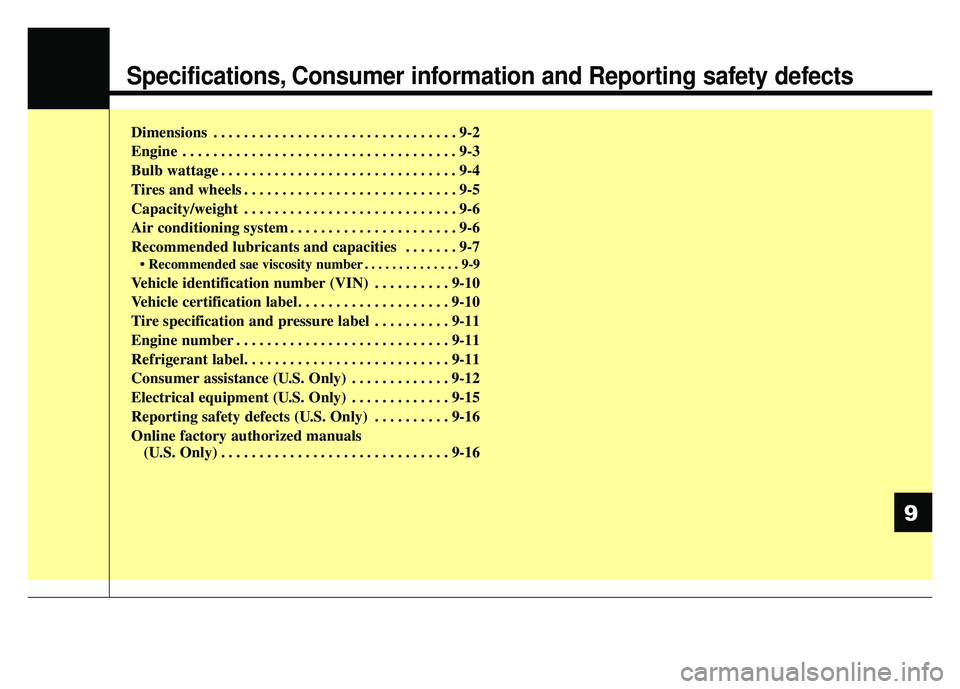
Specifications, Consumer information and Reporting safety defects
Dimensions . . . . . . . . . . . . . . . . . . . . . . . . . . . . . . . . 9-2
Engine . . . . . . . . . . . . . . . . . . . . . . . . . . . . . . . . . . . . \
9-3
Bulb wattage . . . . . . . . . . . . . . . . . . . . . . . . . . . . . . . 9-4
Tires and wheels . . . . . . . . . . . . . . . . . . . . . . . . . . . . 9-5
Capacity/weight . . . . . . . . . . . . . . . . . . . . . . . . . . . . 9-6
Air conditioning system . . . . . . . . . . . . . . . . . . . . . . 9-6
Recommended lubricants and capacities . . . . . . . 9-7
• Recommended sae viscosity number . . . . . . . . . . . . . . 9-9
Vehicle identification number (VIN) . . . . . . . . . . 9-10
Vehicle certification label. . . . . . . . . . . . . . . . . . . . 9-10
Tire specification and pressure label . . . . . . . . . . 9-11
Engine number . . . . . . . . . . . . . . . . . . . . . . . . . . . . 9-11
Refrigerant label. . . . . . . . . . . . . . . . . . . . . . . . . . . 9-11
Consumer assistance (U.S. Only) . . . . . . . . . . . . . 9-12
Electrical equipment (U.S. Only) . . . . . . . . . . . . . 9-15
Reporting safety defects (U.S. Only) . . . . . . . . . . 9-16
Online factory authorized manuals (U.S. Only) . . . . . . . . . . . . . . . . . . . . . . . . . . . . . . 9-16
9
Page 594 of 620
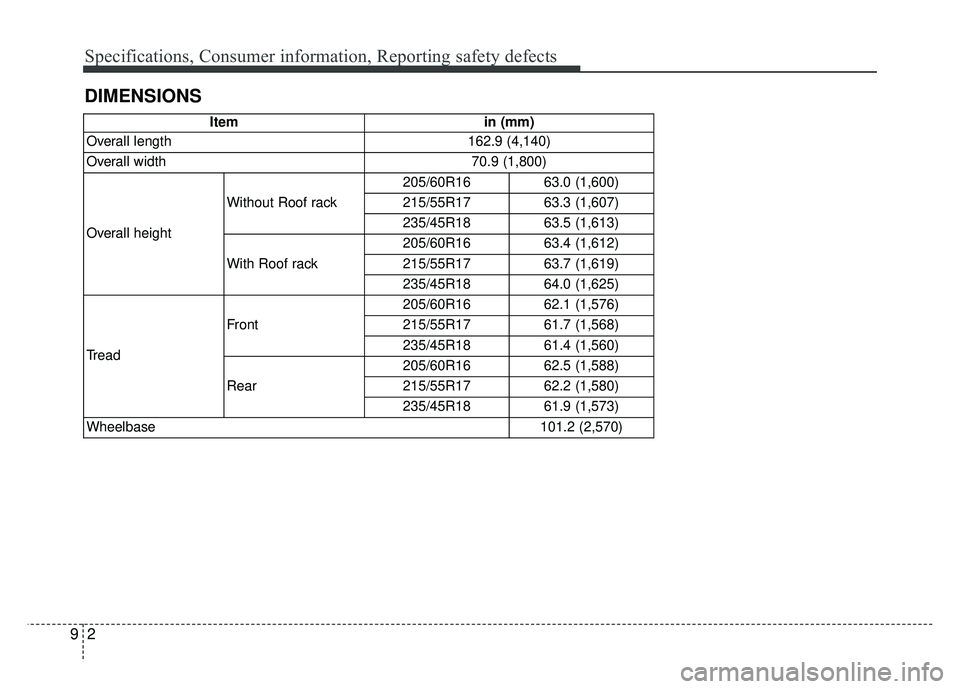
Specifications, Consumer information, Reporting safety defects
29
DIMENSIONS
Itemin (mm)
Overall length
162.9 (4,140)
Overall width
70.9 (1,800)
Overall height Without Roof rack
205/60R1663.0 (1,600)
215/55R1763.3 (1,607)
235/45R1863.5 (1,613)
With Roof rack
205/60R1663.4 (1,612)
215/55R1763.7 (1,619)
235/45R1864.0 (1,625)
Tread Front
205/60R1662.1 (1,576)
215/55R1761.7 (1,568)
235/45R1861.4 (1,560)
Rear
205/60R1662.5 (1,588)
215/55R1762.2 (1,580)
235/45R1861.9 (1,573)
Wheelbase
101.2 (2,570)
Page 597 of 620
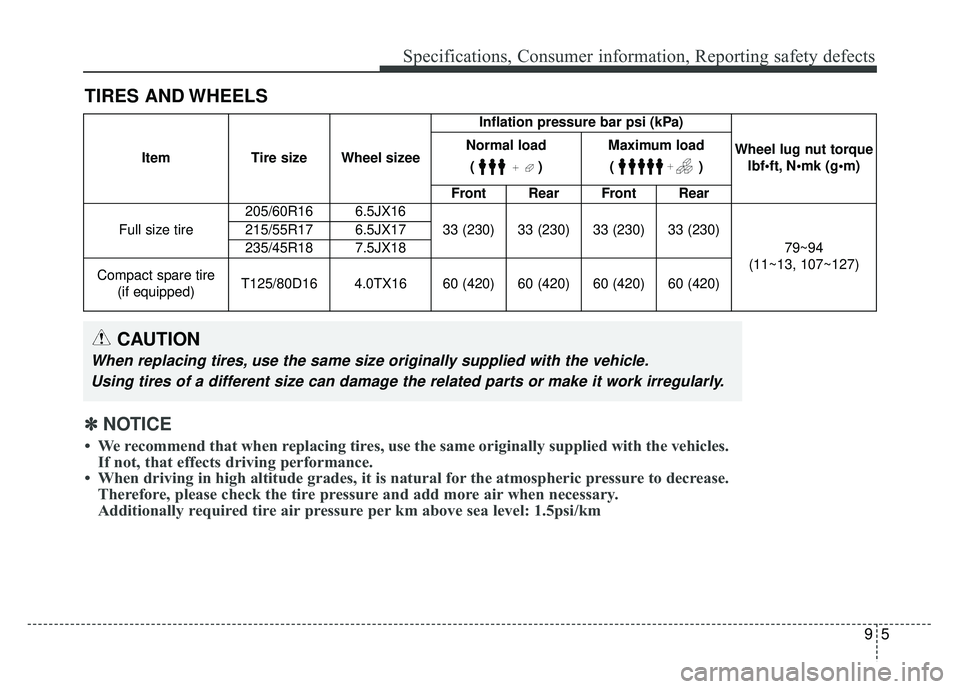
95
Specifications, Consumer information, Reporting safety defects
TIRES AND WHEELS
ItemTire size Wheel sizee Inflation pressure bar psi (kPa)
Wheel lug nut torque lbf•ft,
Normal load
()Maximum load()
Front Rear Front Rear
Full size tire 205/60R16 6.5JX16
33 (230) 33 (230) 33 (230) 33 (230)
79~94
(11~13, 107~127)
215/55R17 6.5JX17
235/45R18 7.5JX18
Compact spare tire (if equipped) T125/80D16 4.0TX16 60 (420) 60 (420) 60 (420) 60 (420)
CAUTION
When replacing tires, use the same size originally supplied with the vehicle.
Using tires of a different size can damage the related parts or make it work irregularly.
✽ ✽ NOTICE
• We recommend that when replacing tires, use the same originally supplied with the vehicles.
If not, that effects driving performance.
• When driving in high altitude grades, it is natural for the atmospheric pressure to decrease. Therefore, please check the tire pressure and add more air when necessary.
Additionally required tire air pressure per km above sea level: 1.5psi/km
Page 617 of 620
I9
Index
Special driving conditions . . . . . . . . . . . . . . . . . . . . . 6-105Driving at night . . . . . . . . . . . . . . . . . . . . . . . . . . . 6-107
Driving in flooded areas. . . . . . . . . . . . . . . . . . . . . 6-108
Driving in the rain . . . . . . . . . . . . . . . . . . . . . . . . . 6-108
Driving off-road . . . . . . . . . . . . . . . . . . . . . . . . . . . 6-109
Hazardous driving conditions . . . . . . . . . . . . . . . . 6-105
Highway driving . . . . . . . . . . . . . . . . . . . . . . . . . . . 6-109
Reducing the risk of a rollover. . . . . . . . . . . . . . . . 6-105
Rocking the vehicle . . . . . . . . . . . . . . . . . . . . . . . . 6-106
Smooth cornering . . . . . . . . . . . . . . . . . . . . . . . . . . 6-107
Steering wheel . . . . . . . . . . . . . . . . . . . . . . . . . . . . . . . 4-39 Electric power steering (EPS) . . . . . . . . . . . . . . . . . 4-39
Flex steer . . . . . . . . . . . . . . . . . . . . . . . . . . . . . . . . . 4-42
Heated steering wheel . . . . . . . . . . . . . . . . . . . . . . . 4-41
Horn . . . . . . . . . . . . . . . . . . . . . . . . . . . . . . . . . . . . \
. 4-41
Tilt and telescopic steering. . . . . . . . . . . . . . . . . . . . 4-40
Storage compartment . . . . . . . . . . . . . . . . . . . . . . . . . 4-133 Center console storage . . . . . . . . . . . . . . . . . . . . . . 4-133
Cool box . . . . . . . . . . . . . . . . . . . . . . . . . . . . . . . . . 4-134
Glove box . . . . . . . . . . . . . . . . . . . . . . . . . . . . . . . . 4-133
Luggage box . . . . . . . . . . . . . . . . . . . . . . . . . . . . . . 4-135
Sunglass holder . . . . . . . . . . . . . . . . . . . . . . . . . . . 4-134
Tire Pressure Monitoring System (TPMS) . . . . . . . . . . . 7-9 Changing a tire with TPMS . . . . . . . . . . . . . . . . . . . 7-12
This device complies with Part 15 of the FCC rules. 7-14 Tire specification and pressure label . . . . . . . . . . . . . . 9-11
Tires and wheels . . . . . . . . . . . . . . . . . . . . . . . . . . . . . . 8-59
All season tires . . . . . . . . . . . . . . . . . . . . . . . . . . . . . 8-71
Checking tire inflation pressure . . . . . . . . . . . . . . . . 8-60
Low aspect ratio tire. . . . . . . . . . . . . . . . . . . . . . . . . 8-73
Radial-ply tires . . . . . . . . . . . . . . . . . . . . . . . . . . . . . 8-72
Recommended cold tire inflation pressures . . . . . . . 8-59
Snow tires . . . . . . . . . . . . . . . . . . . . . . . . . . . . . . . . . 8-71
Summer tires . . . . . . . . . . . . . . . . . . . . . . . . . . . . . . 8-71
Tire care . . . . . . . . . . . . . . . . . . . . . . . . . . . . . . . . . . 8-59\
Tire chains . . . . . . . . . . . . . . . . . . . . . . . . . . . . . . . . 8-71
Tire maintenance . . . . . . . . . . . . . . . . . . . . . . . . . . . 8-64
Tire replacement . . . . . . . . . . . . . . . . . . . . . . . . . . . . 8-63
Tire rotation . . . . . . . . . . . . . . . . . . . . . . . . . . . . . . . 8-61
Tire sidewall labeling . . . . . . . . . . . . . . . . . . . . . . . . 8-64
Tire traction . . . . . . . . . . . . . . . . . . . . . . . . . . . . . . . 8-64
Wheel alignment and tire balance . . . . . . . . . . . . . . 8-62
Wheel replacement . . . . . . . . . . . . . . . . . . . . . . . . . . 8-64
Tires and wheels . . . . . . . . . . . . . . . . . . . . . . . . . . . . . . . 9-5
Towing . . . . . . . . . . . . . . . . . . . . . . . . . . . . . . . . . . . . \
. 7-32 Emergency towing . . . . . . . . . . . . . . . . . . . . . . . . . . 7-34
Removable towing hook (front) . . . . . . . . . . . . . . . . 7-33
Towing service . . . . . . . . . . . . . . . . . . . . . . . . . . . . . 7-32
Trip computer . . . . . . . . . . . . . . . . . . . . . . . . . . . . . . . . 4-68 Accumulated info display (for Type B cluster) . . . . 4-71
Drive info display (for Type B cluster) . . . . . . . . . . 4-72
Fuel economy . . . . . . . . . . . . . . . . . . . . . . . . . . . . . . 4-70
T