flat tire KIA SOUL 2018 Owner's Guide
[x] Cancel search | Manufacturer: KIA, Model Year: 2018, Model line: SOUL, Model: KIA SOUL 2018Pages: 620, PDF Size: 13.29 MB
Page 544 of 620
869
Maintenance
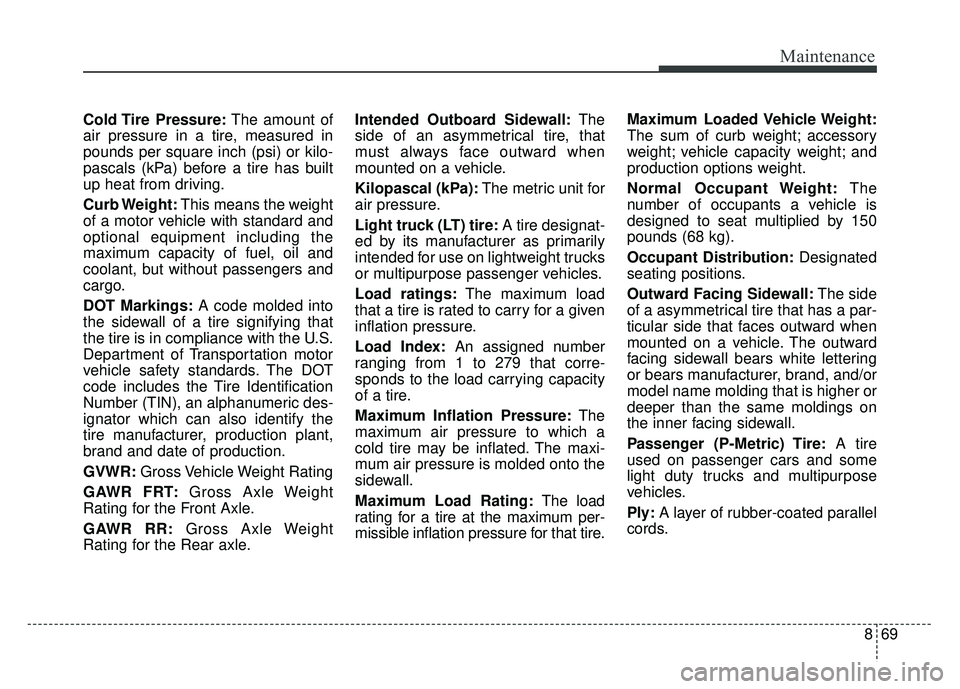
Cold Tire Pressure:The amount of
air pressure in a tire, measured in
pounds per square inch (psi) or kilo-
pascals (kPa) before a tire has built
up heat from driving.
Curb Weight: This means the weight
of a motor vehicle with standard and
optional equipment including the
maximum capacity of fuel, oil and
coolant, but without passengers and
cargo.
DOT Markings: A code molded into
the sidewall of a tire signifying that
the tire is in compliance with the U.S.
Department of Transportation motor
vehicle safety standards. The DOT
code includes the Tire Identification
Number (TIN), an alphanumeric des-
ignator which can also identify the
tire manufacturer, production plant,
brand and date of production.
GVWR: Gross Vehicle Weight Rating
GAWR FRT: Gross Axle Weight
Rating for the Front Axle.
GAWR RR: Gross Axle Weight
Rating for the Rear axle. Intended Outboard Sidewall:
The
side of an asymmetrical tire, that
must always face outward when
mounted on a vehicle.
Kilopascal (kPa): The metric unit for
air pressure.
Light truck (LT) tire: A tire designat-
ed by its manufacturer as primarily
intended for use on lightweight trucks
or multipurpose passenger vehicles.
Load ratings: The maximum load
that a tire is rated to carry for a given
inflation pressure.
Load Index: An assigned number
ranging from 1 to 279 that corre-
sponds to the load carrying capacity
of a tire.
Maximum Inflation Pressure: The
maximum air pressure to which a
cold tire may be inflated. The maxi-
mum air pressure is molded onto the
sidewall.
Maximum Load Rating: The load
rating for a tire at the maximum per-
missible inflation pressure for that tire. Maximum Loaded Vehicle Weight:
The sum of curb weight; accessory
weight; vehicle capacity weight; and
production options weight.
Normal Occupant Weight:
The
number of occupants a vehicle is
designed to seat multiplied by 150
pounds (68 kg).
Occupant Distribution: Designated
seating positions.
Outward Facing Sidewall: The side
of a asymmetrical tire that has a par-
ticular side that faces outward when
mounted on a vehicle. The outward
facing sidewall bears white lettering
or bears manufacturer, brand, and/or
model name molding that is higher or
deeper than the same moldings on
the inner facing sidewall.
Passenger (P-Metric) Tire: A tire
used on passenger cars and some
light duty trucks and multipurpose
vehicles.
Ply: A layer of rubber-coated parallel
cords.
Page 545 of 620
Maintenance
70
8
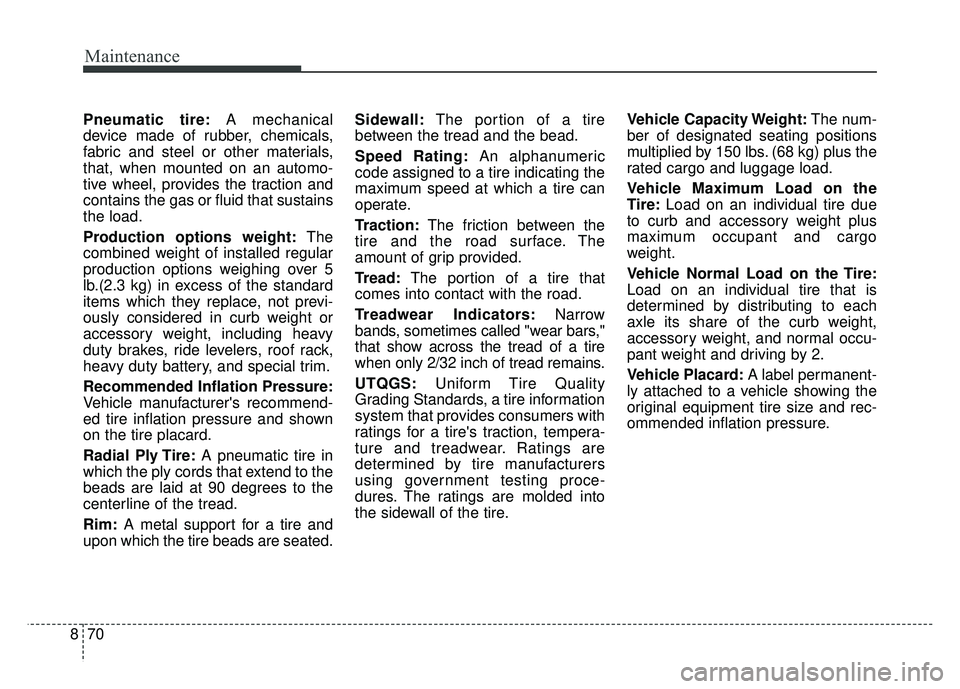
Pneumatic tire: A mechanical
device made of rubber, chemicals,
fabric and steel or other materials,
that, when mounted on an automo-
tive wheel, provides the traction and
contains the gas or fluid that sustains
the load.
Production options weight: The
combined weight of installed regular
production options weighing over 5
lb.(2.3 kg) in excess of the standard
items which they replace, not previ-
ously considered in curb weight or
accessory weight, including heavy
duty brakes, ride levelers, roof rack,
heavy duty battery, and special trim.
Recommended Inflation Pressure:
Vehicle manufacturer's recommend-
ed tire inflation pressure and shown
on the tire placard.
Radial Ply Tire: A pneumatic tire in
which the ply cords that extend to the
beads are laid at 90 degrees to the
centerline of the tread.
Rim: A metal support for a tire and
upon which the tire beads are seated. Sidewall:
The portion of a tire
between the tread and the bead.
Speed Rating: An alphanumeric
code assigned to a tire indicating the
maximum speed at which a tire can
operate.
Traction: The friction between the
tire and the road surface. The
amount of grip provided.
Tread: The portion of a tire that
comes into contact with the road.
Treadwear Indicators: Narrow
bands, sometimes called "wear bars,"
that show across the tread of a tire
when only 2/32 inch of tread remains.
UTQGS: Uniform Tire Quality
Grading Standards, a tire information
system that provides consumers with
ratings for a tire's traction, tempera-
ture and treadwear. Ratings are
determined by tire manufacturers
using government testing proce-
dures. The ratings are molded into
the sidewall of the tire. Vehicle Capacity Weight:
The num-
ber of designated seating positions
multiplied by 150 lbs. (68 kg) plus the
rated cargo and luggage load.
Vehicle Maximum Load on the
Tire: Load on an individual tire due
to curb and accessory weight plus
maximum occupant and cargo
weight.
Vehicle Normal Load on the Tire:
Load on an individual tire that is
determined by distributing to each
axle its share of the curb weight,
accessory weight, and normal occu-
pant weight and driving by 2.
Vehicle Placard: A label permanent-
ly attached to a vehicle showing the
original equipment tire size and rec-
ommended inflation pressure.
Page 547 of 620
Maintenance
72
8
When driving on roads covered
with snow or ice, drive at less than
20 mph (30 km/h).
Use the SAE “S” class or wire chains.
If you hear noise caused by chains contacting the body, retighten the
chain to avoid contact with the
vehicle body.
To prevent body damage, retighten the chains after driving 0.3~0.6
miles (0.5~1.0 km).
Do not use tire chains on vehicles equipped with aluminum wheels.
In unavoidable circumstance, use
a wire type chain.
Use wire chains less than 0.59 inches (15 mm) to prevent damage
to the chain’s connection.Radial-ply tires
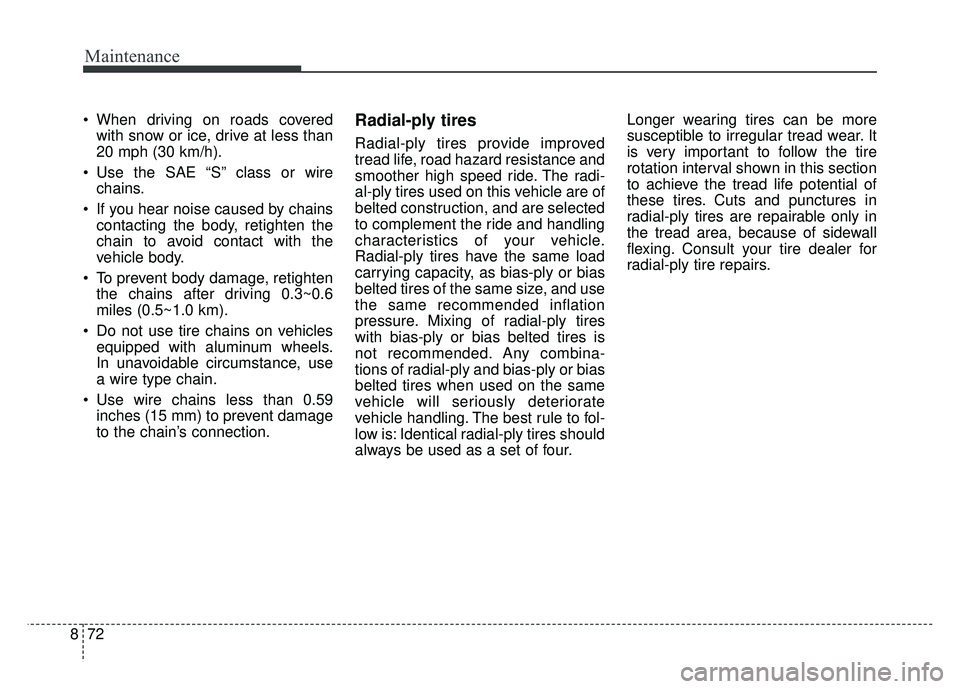
Radial-ply tires provide improved
tread life, road hazard resistance and
smoother high speed ride. The radi-
al-ply tires used on this vehicle are of
belted construction, and are selected
to complement the ride and handling
characteristics of your vehicle.
Radial-ply tires have the same load
carrying capacity, as bias-ply or bias
belted tires of the same size, and use
the same recommended inflation
pressure. Mixing of radial-ply tires
with bias-ply or bias belted tires is
not recommended. Any combina-
tions of radial-ply and bias-ply or bias
belted tires when used on the same
vehicle will seriously deteriorate
vehicle handling. The best rule to fol-
low is: Identical radial-ply tires should
always be used as a set of four. Longer wearing tires can be more
susceptible to irregular tread wear. It
is very important to follow the tire
rotation interval shown in this section
to achieve the tread life potential of
these tires. Cuts and punctures in
radial-ply tires are repairable only in
the tread area, because of sidewall
flexing. Consult your tire dealer for
radial-ply tire repairs.
Page 597 of 620
95
Specifications, Consumer information, Reporting safety defects
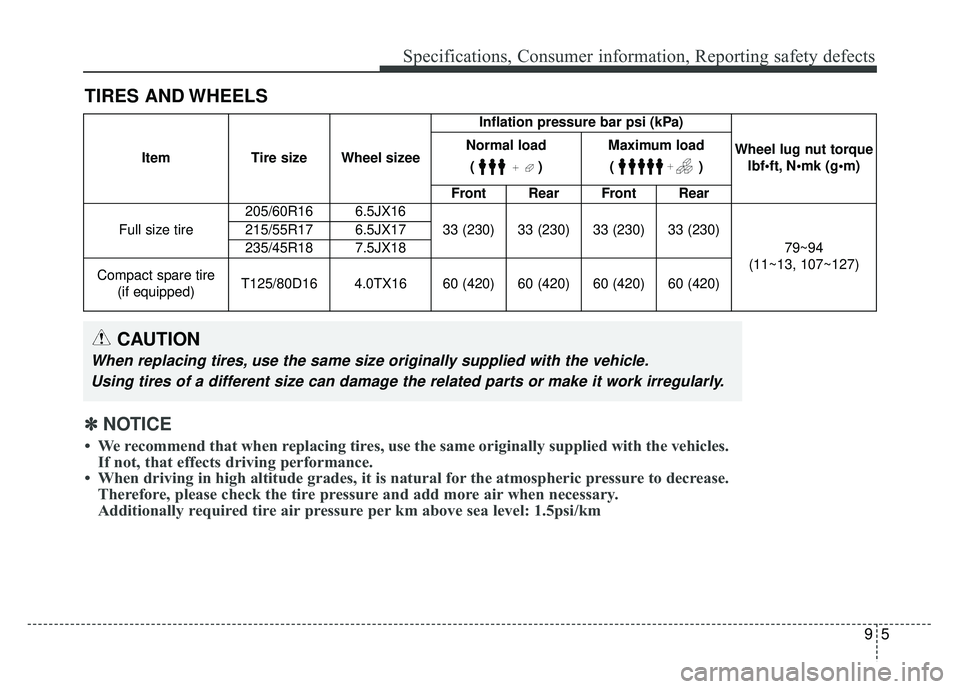
TIRES AND WHEELS
ItemTire size Wheel sizee Inflation pressure bar psi (kPa)
Wheel lug nut torque lbf•ft,
Normal load
()Maximum load()
Front Rear Front Rear
Full size tire 205/60R16 6.5JX16
33 (230) 33 (230) 33 (230) 33 (230)
79~94
(11~13, 107~127)
215/55R17 6.5JX17
235/45R18 7.5JX18
Compact spare tire (if equipped) T125/80D16 4.0TX16 60 (420) 60 (420) 60 (420) 60 (420)
CAUTION
When replacing tires, use the same size originally supplied with the vehicle.
Using tires of a different size can damage the related parts or make it work irregularly.
✽ ✽ NOTICE
• We recommend that when replacing tires, use the same originally supplied with the vehicles.
If not, that effects driving performance.
• When driving in high altitude grades, it is natural for the atmospheric pressure to decrease. Therefore, please check the tire pressure and add more air when necessary.
Additionally required tire air pressure per km above sea level: 1.5psi/km
Page 604 of 620
Specifications, Consumer information, Reporting safety defects
12
9
Roadside Assistance is provided on all new current
model year Kia Vehicles from the date the vehicle is deliv-
ered to the first retail buyer or otherwise put into use (in-
service date), whichever is earlier, for a period of 60
months or 60,000 miles, whichever is earlier, subject to
the terms, conditions and exclusions set forth in the Kia
Warranty and Consumer Information Manual applicable
to your model year vehicle.
KMA reserves the right to limit or deny services or other
benefits to any owner or driver when, in KMA's judgment,
the claims and/or service requests are excessive in fre-
quency or type of occurrence.
Toll free consumer assistance
Kia's toll-free Consumer Assistance hot line is staffed
from 5:00 AM to 6:00 PM PST, Monday through Friday
and is accessible by dialing 1-800-333-4Kia (4542).
For more information regarding assistance available,
please refer to your Kia Warranty & Consumer
Information Manual.
Emergency roadside assistance
Kia's toll free Roadside Assistance hot line is staffed 24
hours a day, 365 days a year and is accessible by dialing
1-800-333-4Kia (4542).
Please note that you must provide your Vehicle
Identification Number (VIN) to verify coverage at the time
of your call. The VIN can be found on the dash of your
vehicle on the driver’s side, on the door jamb of the dri-
ver’s door, your vehicle’s registration or proof of insur-
ance card.
Kia utilizes a network of over 17,000 roadside assistance
providers. Should you accidentally run out of fuel, require
a battery jump, or need help changing a tire, a Kia
Roadside Assistance Representative will dispatch some-
one to deliver a small quantity of gas, change a flat tire
with your inflated spare, or arrange a battery jump to
allow you to proceed to your destination. We have access
to a network of over 10,000 locksmiths to help you should
you become locked out of your Kia.
In the event that mechanical difficulty renders your vehi-
cle undriveable due to a warranty-related concern, Kia’s
Roadside Assistance Representative will arrange to
transport your vehicle to the nearest Kia dealer or to an
alternative service location.
CONSUMER ASSISTANCE (U.S. ONLY)
Page 613 of 620
I5
Index
Foward collision warning system (FCWS) . . . . . . . . . 6-99FCWS Operation . . . . . . . . . . . . . . . . . . . . . . . . . . . 6-99
Limitations of the System . . . . . . . . . . . . . . . . . . . 6-101
Fuel filler lid . . . . . . . . . . . . . . . . . . . . . . . . . . . . . . . . . 4-31 Closing the fuel filler lid . . . . . . . . . . . . . . . . . . . . . 4-31
Opening the fuel filler lid. . . . . . . . . . . . . . . . . . . . . 4-31
Fuel requirements . . . . . . . . . . . . . . . . . . . . . . . . . . . . . . 1-3 Do not use methanol . . . . . . . . . . . . . . . . . . . . . . . . . 1-5
Fuel Additives . . . . . . . . . . . . . . . . . . . . . . . . . . . . . . 1-5
Gasoline containing alcohol and methanol . . . . . . . . 1-3
Fuses . . . . . . . . . . . . . . . . . . . . . . . . . . . . . . . . . . . . \
. . . 8-74 Engine compartment fuse replacement . . . . . . . . . . 8-77
Fuse/relay panel description. . . . . . . . . . . . . . . . . . . 8-79
Inner panel fuse replacement . . . . . . . . . . . . . . . . . . 8-76
Hood . . . . . . . . . . . . . . . . . . . . . . . . . . . . . . . . . . . . \
. . . 4-29 Closing the hood . . . . . . . . . . . . . . . . . . . . . . . . . . . 4-29
Opening the hood . . . . . . . . . . . . . . . . . . . . . . . . . . . 4-29
How to use this manual . . . . . . . . . . . . . . . . . . . . . . . . . 1-2 If the engine overheats . . . . . . . . . . . . . . . . . . . . . . . . . . 7-8
If the engine will not start . . . . . . . . . . . . . . . . . . . . . . . 7-4
If engine doesn't turn over or turns over slowly . . . . 7-4
If engine turns over normally but does not start . . . . 7-4
If you have a flat tire (with Spare Tire) . . . . . . . . . . . . 7-15 Changing tires . . . . . . . . . . . . . . . . . . . . . . . . . . . . . 7-16
Jack and tools . . . . . . . . . . . . . . . . . . . . . . . . . . . . . . 7-15
Jack label . . . . . . . . . . . . . . . . . . . . . . . . . . . . . . . . . 7-23
Removing and storing the spare tire . . . . . . . . . . . . 7-16
If you have a flat tire (with Tire Mo bility Kit) . . . . . . 7-24 Components of the Tire Mobility Kit . . . . . . . . . . . 7-26
Distributing the sealant . . . . . . . . . . . . . . . . . . . . . . 7-29
Introduction . . . . . . . . . . . . . . . . . . . . . . . . . . . . . . . 7-24
Notes on the suggested use of the Tire Mobility Kit . 7-25
Using the Tire Mobility Kit . . . . . . . . . . . . . . . . . . . 7-27
Important safety precautions . . . . . . . . . . . . . . . . . . . . . 3-2 Air bag hazards . . . . . . . . . . . . . . . . . . . . . . . . . . . . . 3-2
Always wear your seat belt . . . . . . . . . . . . . . . . . . . . 3-2
Control your speed . . . . . . . . . . . . . . . . . . . . . . . . . . 3-3
Driver distraction . . . . . . . . . . . . . . . . . . . . . . . . . . . . 3-2
Keep your vehicle in safe condition. . . . . . . . . . . . . . 3-3
Restrain all children . . . . . . . . . . . . . . . . . . . . . . . . . . 3-2
In case of an emergency while driving . . . . . . . . . . . . . . 7-3 If the engine stalls at a crossroad or crossing . . . . . . 7-3
If the engine stalls while driving . . . . . . . . . . . . . . . . 7-3
If you have a flat tire while driving . . . . . . . . . . . . . . 7-3
F
H
I
Page 617 of 620
I9
Index
Special driving conditions . . . . . . . . . . . . . . . . . . . . . 6-105Driving at night . . . . . . . . . . . . . . . . . . . . . . . . . . . 6-107
Driving in flooded areas. . . . . . . . . . . . . . . . . . . . . 6-108
Driving in the rain . . . . . . . . . . . . . . . . . . . . . . . . . 6-108
Driving off-road . . . . . . . . . . . . . . . . . . . . . . . . . . . 6-109
Hazardous driving conditions . . . . . . . . . . . . . . . . 6-105
Highway driving . . . . . . . . . . . . . . . . . . . . . . . . . . . 6-109
Reducing the risk of a rollover. . . . . . . . . . . . . . . . 6-105
Rocking the vehicle . . . . . . . . . . . . . . . . . . . . . . . . 6-106
Smooth cornering . . . . . . . . . . . . . . . . . . . . . . . . . . 6-107
Steering wheel . . . . . . . . . . . . . . . . . . . . . . . . . . . . . . . 4-39 Electric power steering (EPS) . . . . . . . . . . . . . . . . . 4-39
Flex steer . . . . . . . . . . . . . . . . . . . . . . . . . . . . . . . . . 4-42
Heated steering wheel . . . . . . . . . . . . . . . . . . . . . . . 4-41
Horn . . . . . . . . . . . . . . . . . . . . . . . . . . . . . . . . . . . . \
. 4-41
Tilt and telescopic steering. . . . . . . . . . . . . . . . . . . . 4-40
Storage compartment . . . . . . . . . . . . . . . . . . . . . . . . . 4-133 Center console storage . . . . . . . . . . . . . . . . . . . . . . 4-133
Cool box . . . . . . . . . . . . . . . . . . . . . . . . . . . . . . . . . 4-134
Glove box . . . . . . . . . . . . . . . . . . . . . . . . . . . . . . . . 4-133
Luggage box . . . . . . . . . . . . . . . . . . . . . . . . . . . . . . 4-135
Sunglass holder . . . . . . . . . . . . . . . . . . . . . . . . . . . 4-134
Tire Pressure Monitoring System (TPMS) . . . . . . . . . . . 7-9 Changing a tire with TPMS . . . . . . . . . . . . . . . . . . . 7-12
This device complies with Part 15 of the FCC rules. 7-14 Tire specification and pressure label . . . . . . . . . . . . . . 9-11
Tires and wheels . . . . . . . . . . . . . . . . . . . . . . . . . . . . . . 8-59
All season tires . . . . . . . . . . . . . . . . . . . . . . . . . . . . . 8-71
Checking tire inflation pressure . . . . . . . . . . . . . . . . 8-60
Low aspect ratio tire. . . . . . . . . . . . . . . . . . . . . . . . . 8-73
Radial-ply tires . . . . . . . . . . . . . . . . . . . . . . . . . . . . . 8-72
Recommended cold tire inflation pressures . . . . . . . 8-59
Snow tires . . . . . . . . . . . . . . . . . . . . . . . . . . . . . . . . . 8-71
Summer tires . . . . . . . . . . . . . . . . . . . . . . . . . . . . . . 8-71
Tire care . . . . . . . . . . . . . . . . . . . . . . . . . . . . . . . . . . 8-59\
Tire chains . . . . . . . . . . . . . . . . . . . . . . . . . . . . . . . . 8-71
Tire maintenance . . . . . . . . . . . . . . . . . . . . . . . . . . . 8-64
Tire replacement . . . . . . . . . . . . . . . . . . . . . . . . . . . . 8-63
Tire rotation . . . . . . . . . . . . . . . . . . . . . . . . . . . . . . . 8-61
Tire sidewall labeling . . . . . . . . . . . . . . . . . . . . . . . . 8-64
Tire traction . . . . . . . . . . . . . . . . . . . . . . . . . . . . . . . 8-64
Wheel alignment and tire balance . . . . . . . . . . . . . . 8-62
Wheel replacement . . . . . . . . . . . . . . . . . . . . . . . . . . 8-64
Tires and wheels . . . . . . . . . . . . . . . . . . . . . . . . . . . . . . . 9-5
Towing . . . . . . . . . . . . . . . . . . . . . . . . . . . . . . . . . . . . \
. 7-32 Emergency towing . . . . . . . . . . . . . . . . . . . . . . . . . . 7-34
Removable towing hook (front) . . . . . . . . . . . . . . . . 7-33
Towing service . . . . . . . . . . . . . . . . . . . . . . . . . . . . . 7-32
Trip computer . . . . . . . . . . . . . . . . . . . . . . . . . . . . . . . . 4-68 Accumulated info display (for Type B cluster) . . . . 4-71
Drive info display (for Type B cluster) . . . . . . . . . . 4-72
Fuel economy . . . . . . . . . . . . . . . . . . . . . . . . . . . . . . 4-70
T