High voltage KIA Soul EV 2017 2.G User Guide
[x] Cancel search | Manufacturer: KIA, Model Year: 2017, Model line: Soul EV, Model: KIA Soul EV 2017 2.GPages: 470, PDF Size: 16.76 MB
Page 142 of 470
Features of your vehicle
72
4
Indicator Lights
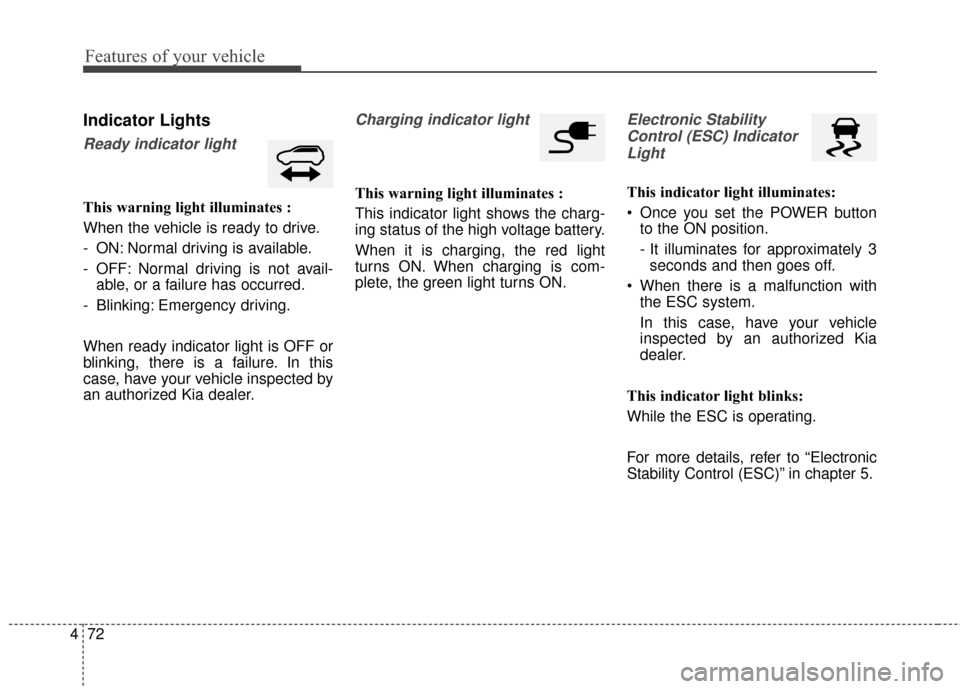
Ready indicator light
This warning light illuminates :
When the vehicle is ready to drive.
- ON: Normal driving is available.
- OFF: Normal driving is not avail-
able, or a failure has occurred.
- Blinking: Emergency driving.
When ready indicator light is OFF or
blinking, there is a failure. In this
case, have your vehicle inspected by
an authorized Kia dealer.
Charging indicator light
This warning light illuminates :
This indicator light shows the charg-
ing status of the high voltage battery.
When it is charging, the red light
turns ON. When charging is com-
plete, the green light turns ON.
Electronic Stability Control (ESC) IndicatorLight
This indicator light illuminates:
Once you set the POWER button to the ON position.
- It illuminates for approximately 3seconds and then goes off.
When there is a malfunction with the ESC system.
In this case, have your vehicle
inspected by an authorized Kia
dealer.
This indicator light blinks:
While the ESC is operating.
For more details, refer to “Electronic
Stability Control (ESC)” in chapter 5.
Page 179 of 470
4109
Features of your vehicle
Checking the amount of air
conditioner refrigerant and
compressor lubricant
When the amount of refrigerant is
low, the performance of the air con-
ditioning is reduced. Overfilling also
has a negative impact on the air con-
ditioning system.
(Heater performance as well as air
conditioner performance can be
deteriorated on the vehicle that is
equipped with a heat pump.)
Therefore, if abnormal operation is
found, have the system inspected by
an authorized Kia dealer.
WARNING
The air conditioning system for
the Electric Vehicle (EV) should
be serviced by an authorized
Kia dealer. The Electric Vehicle
(EV) air conditioning system is
connected to the high voltage
system and requires special flu-
ids, tools and service proce-
dures. Improperly servicing the
Electric Vehicle (EV) air condi-
tioning system could result in
electrical shock, serious injury,
or even death.
WARNING
The oil and refrigerant in your
vehicle's air conditioning sys-
tem is under very high pres-
sure. If proper service proce-
dures are not followed an explo-
sion may result. To reduce the
risk of serious injury or death,
the air conditioning system in
your vehicle should only be
serviced by trained and certi-
fied technicians.
CAUTION - AC Repair
It is important that the correcttype and amount of oil andrefrigerant is used, otherwisedamage to the vehicle and injurymay occur. To prevent damage,the air conditioning system inyour vehicle should only beserviced by trained and certifiedtechnicians.
Page 315 of 470
619
What to do in an emergency
Checking the tire inflation pres-
sure
1. After driving approximately 7~10km(4~6miles or about 10min), stop at
a safety location.
2. Connect connection hose (9) of the compressor directly to the tire
valve.
3. Plug the compressor power cord into the vehicle power outlet.
4. Adjust the tire inflation pressure to the recommended tire inflation.
With the ignition switched on, pro- ceed as follows.
- To increase the inflation pres- sure : Switch on the compres-
sor, position I. To check the cur-
rent inflation pressure setting,
briefly switch off the compressor.✽ ✽ NOTICE
The pressure gauge may show high-
er than actual reading when the
compressor is running. To get an
accurate tire pressure, the compres-
sor needs to be turned off.
- To reduce the inflation pres-
sure: Loosen the screw cap (8)
on the compressor hose. Technical Data
System voltage: DC 12 V
Working voltage: DC 10 - 15 V
Amperage rating: max. 15 A
Suitable for use at temperatures:
-30 ~ +70°C (-22 ~ +158°F)
Max. working pressure: 6 bar (87 psi)
Size
Compressor: 170 x 150 x 60 mm (6.7 x 5.9 x 2.4 in.)
Sealant bottle: 85 x 70 ø mm (3.3 x 2.8 ø in.)
Compressor weight: 0.8 kg (1.77 lbs)
Sealant volume: 200 ml (12.2 cu. in.)
CAUTION - Tire pressuresensor
When you use the Tire MobilityKit including sealant notapproved by Kia, the tire pres-sure sensors may be damagedby sealant. The sealant on thetire pressure sensor and wheelshould be removed when youreplace the tire with a new oneand inspect the tire pressuresensors in authorized dealer.
Page 351 of 470
Maintenance
32
7
✽ ✽
NOTICE
If you connect unauthorized elec-
tronic devices to the battery, the bat-
tery may be discharged. Never use
unauthorized devices.
Battery recharging
Your vehicle has a maintenance-free,
calcium-based battery.
If the battery becomes discharged
in a short time (because, for exam-
ple, the headlights or interior lights
were left on while the vehicle was
not in use), recharge it by slow
charging (trickle) for 10 hours.
If the battery gradually discharges because of high electric load while
the vehicle is being used, recharge
it at 20-30A for two hours. When recharging the battery,
observe the following precautions:
The battery must be removed from
the vehicle and placed in an area
with good ventilation.
Do not allow cigarettes, sparks, or flame near the battery.
Watch the battery during charging, and stop or reduce the charging
rate if the battery cells begin
gassing (boiling) violently or if the
temperature of the electrolyte of
any cell exceeds 49°C (120°F).
Wear eye protection when check- ing the battery during charging.WARNING- Risk of elec-
trocution
Never touch the electrical igni-
tion system while the vehicle is
running. This system works
with high voltage which can
"zap" you.
WARNING- Recharging battery
Never attempt to recharge the
battery when the battery cables
are connected.
Page 411 of 470
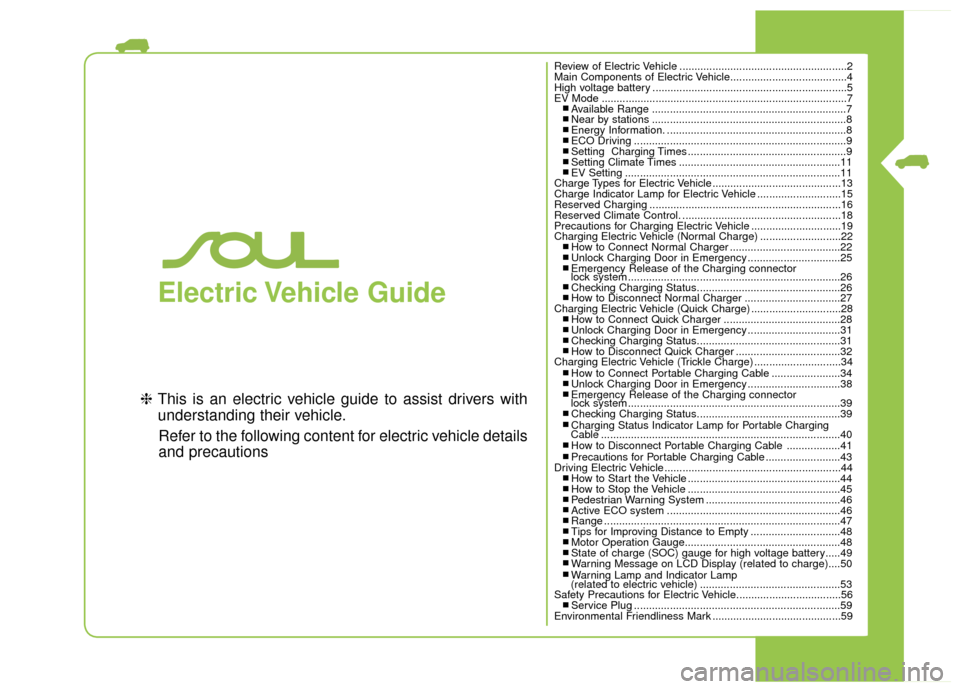
Electric Vehicle Guide
❈This is an electric vehicle guide to assist drivers with
understanding their vehicle.
Refer to the following content for electric vehicle details
and precautions
Review of Electric Vehicle ........................................................2
Main Components of Electric Vehicle.......................................4
High voltage battery .................................................................5
EV Mode ........................................................................\
..........7
■ Available Range .................................................................7■ Near by stations .................................................................8■ Energy Information. ............................................................8■ ECO Driving .......................................................................9\
■ Setting Charging Times .....................................................9■ Setting Climate Times ......................................................11■ EV Setting ........................................................................\
11
Charge Types for Electric Vehicle...........................................13
Charge Indicator Lamp for Electric Vehicle ............................15
Reserved Charging ................................................................16
Reserved Climate Control. .....................................................18
Precautions for Charging Electric Vehicle ..............................19
Charging Electric Vehicle (Normal Charge) ...........................22
■ How to Connect Normal Charger .....................................22■ Unlock Charging Door in Emergency ...............................25■ Emergency Release of the Charging connector
lock system .......................................................................2\
6
■ Checking Charging Status................................................26■ How to Disconnect Normal Charger ................................27
Charging Electric Vehicle (Quick Charge) ..............................28
■ How to Connect Quick Charger .......................................28■ Unlock Charging Door in Emergency ...............................31■ Checking Charging Status................................................31■ How to Disconnect Quick Charger ...................................32
Charging Electric Vehicle (Trickle Charge) .............................34
■ How to Connect Portable Charging Cable .......................34■ Unlock Charging Door in Emergency ...............................38■ Emergency Release of the Charging connector
lock system .......................................................................3\
9
■ Checking Charging Status................................................39■ Charging Status Indicator Lamp for Portable Charging
Cable ........................................................................\
........40
■ How to Disconnect Portable Charging Cable ..................41■ Precautions for Portable Charging Cable .........................43
Driving Electric Vehicle ...........................................................44
■ How to Start the Vehicle ...................................................44■ How to Stop the Vehicle ...................................................45■ Pedestrian Warning System .............................................46■ Active ECO system ..........................................................46■ Range ........................................................................\
.......47■ Tips for Improving Distance to Empty ..............................48■ Motor Operation Gauge....................................................48■ State of charge (SOC) gauge for high voltage battery.....49■ Warning Message on LCD Display (related to charge)....50■ Warning Lamp and Indicator Lamp
(related to electric vehicle) ...............................................53
Safety Precautions for Electric Vehicle...................................56
■ Service Plug .....................................................................59
Environmental Friendliness Mark ...........................................59
Page 412 of 470
2
An electric vehicle is driven using a
battery and an electric motor. While
general vehicles use an internal
combustion engine and gasoline as
fuel, electric vehicles use electrical
energy that is stored inside the high
voltage battery. As a result, electric
vehicles are eco-friendly in that they
do not require fuel and do not emit
exhaust gases.1. It is driven using the electrical ener-
gy that is stored inside the high
voltage battery. This method pre-
vents air pollution since fuel, like
gasoline, is not required, negating
the emission of exhaust gases.
2. A high performance motor is used in the vehicle as well. Compared
to standard, internal combustion
engine vehicles, engine noise and
vibrations are much more minimal
when driving.
3. When decelerating or driving down- hill, regenerative braking is utilized
to charge the high voltage battery.
This minimizes energy loss and
increases the distance to empty.
4. When the battery charge is not sufficient, normal charge, quick
charge and trickle charge are
available. (Refer to “Charge Types
for Electric Vehicle” for details.)
REVIEW OF ELECTRIC VEHICLE
Review of Electric Vehicle Characteristics of Electric
Vehicles
What does regenerative braking
do?
It uses an electric motor when
decelerating and braking and
transforms kinetic energy to elec-
trical energy in order to charge the
high voltage battery. (Torque is
applied in the opposite direction
when decelerating to generate
braking force and electric energy.)
Note
Page 413 of 470
3
The vehicle is composed of a highvoltage battery that drives the
motor and air-conditioner, and an
auxiliary battery (12 V) that drives
the lamps, wipers, and audio sys-
tem.
The auxiliary battery is automati- cally charged when the vehicle is
in the ready ( ) mode or the high
voltage battery is being charged.
REVIEW OF ELECTRIC VEHICLE
Battery Information
Page 414 of 470
4
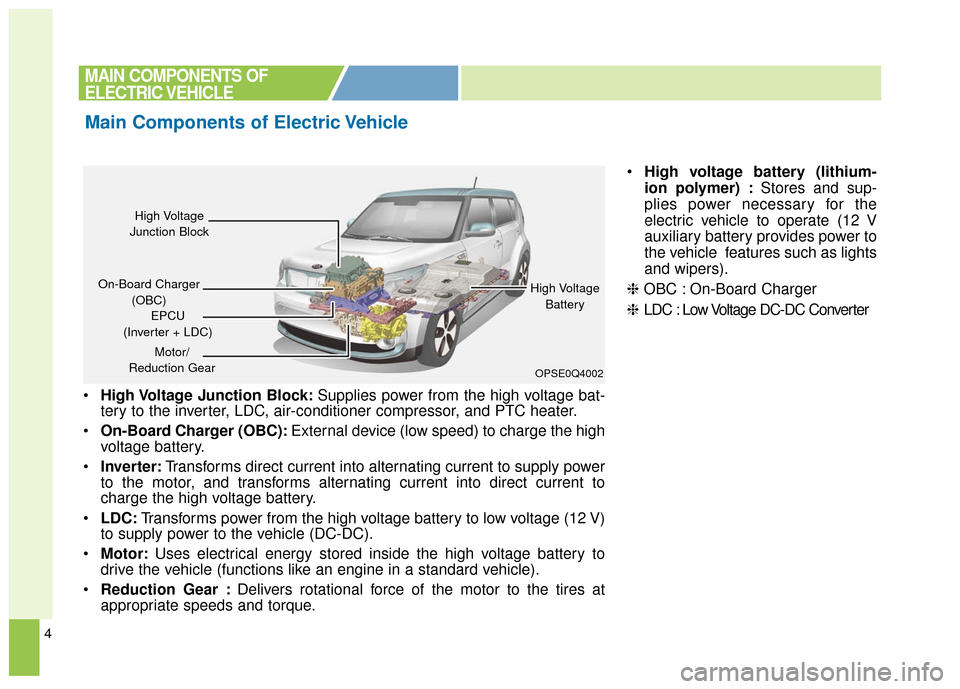
High Voltage Junction Block: Supplies power from the high voltage bat-
tery to the inverter, LDC, air-conditioner compressor, and PTC heater.
On-Board Charger (OBC): External device (low speed) to charge the high
voltage battery.
Inverter: Transforms direct current into alternating current to supply power
to the motor, and transforms alternating current into direct current to
charge the high voltage battery.
LDC: Transforms power from the high voltage battery to low voltage (12 V)
to supply power to the vehicle (DC-DC).
Motor: Uses electrical energy stored inside the high voltage battery to
drive the vehicle (functions like an engine in a standard vehicle).
Reduction Gear : Delivers rotational force of the motor to the tires at
appropriate speeds and torque.
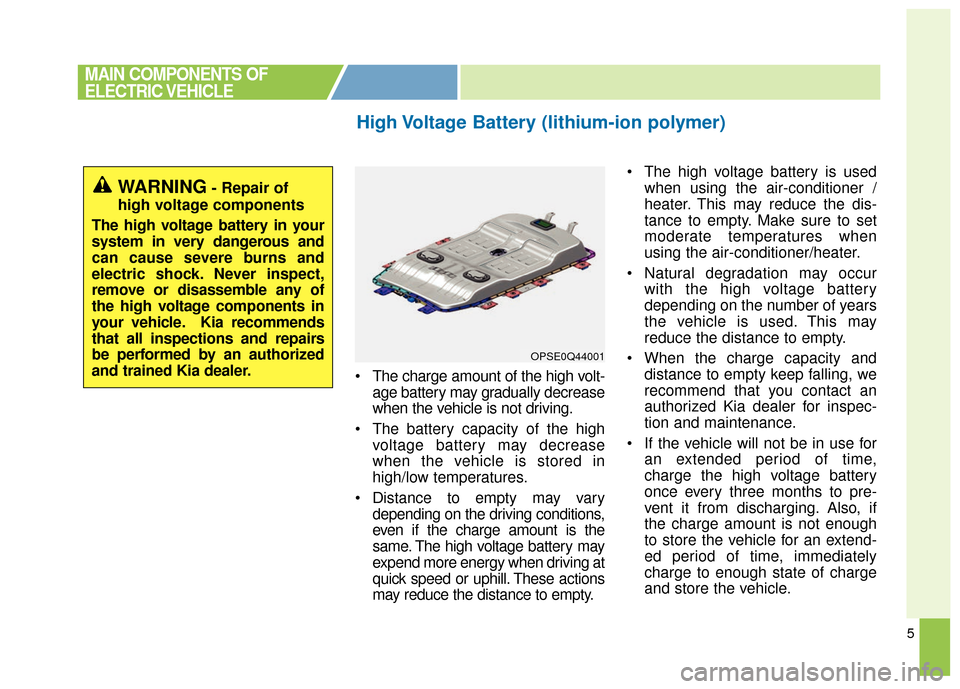
High voltage battery (lithium-
ion polymer) : Stores and sup-
plies power necessary for the
electric vehicle to operate (12 V
auxiliary battery provides power to
the vehicle features such as lights
and wipers).
❈ OBC : On-Board Charger
❈ LDC : Low Voltage DC-DC Converter
MAIN COMPONENTS OF
ELECTRIC VEHICLE
Main Components of Electric Vehicle
OPSE0Q4002
High Voltage
Junction Block
On-Board Charger (OBC) High Voltage
Battery
EPCU
(Inverter + LDC)
Motor/
Reduction Gear
Page 415 of 470
5
The charge amount of the high volt-age battery may gradually decrease
when the vehicle is not driving.
The battery capacity of the high voltage battery may decrease
when the vehicle is stored in
high/low temperatures.
Distance to empty may vary depending on the driving conditions,
even if the charge amount is the
same. The high voltage battery may
expend more energy when driving at
quick speed or uphill. These actions
may reduce the distance to empty. The high voltage battery is used
when using the air-conditioner /
heater. This may reduce the dis-
tance to empty. Make sure to set
moderate temperatures when
using the air-conditioner/heater.
Natural degradation may occur with the high voltage battery
depending on the number of years
the vehicle is used. This may
reduce the distance to empty.
When the charge capacity and distance to empty keep falling, we
recommend that you contact an
authorized Kia dealer for inspec-
tion and maintenance.
If the vehicle will not be in use for an extended period of time,
charge the high voltage battery
once every three months to pre-
vent it from discharging. Also, if
the charge amount is not enough
to store the vehicle for an extend-
ed period of time, immediately
charge to enough state of charge
and store the vehicle.
High Voltage Battery (lithium-ion polymer)
MAIN COMPONENTS OF
ELECTRIC VEHICLE
OPSE0Q44001
WARNING- Repair of
high voltage components
The high voltage battery in your
system in very dangerous and
can cause severe burns and
electric shock. Never inspect,
remove or disassemble any of
the high voltage components in
your vehicle. Kia recommends
that all inspections and repairs
be performed by an authorized
and trained Kia dealer.
Page 416 of 470
6
Normal charge is recommendedto keep the high voltage battery in
optimal condition.
If the high voltage battery charge
amount is below 20%, you can
keep the high voltage battery per-
formance in optimal condition if
you charge the high voltage bat-
tery to 100%. (Once a month or
more is recommended.)
If the vehicle is in a collision, we recommend that you contact an
authorized Kia dealer to inspect
whether the high voltage battery
is still connected. The high voltage battery warmer
system prevents reduction of battery
output when battery temperature is
low. If the charging connector is con-
nected, the warmer system automat-
ically operate according to the bat-
tery temperature.
Charging time may shorten compare
to vehicles without the high voltage
battery warmer system. But, electric-
ity charge may increase because of
high voltage battery warmer system
operation.
The high voltage battery warmer sys-
tem operates when the charging con-
nector is connected to the vehicle.
However, the high voltage warmer
system may not operate when bat-
tery temperature drops below -35°C
(-31°F)
High Voltage Battery
Warmer System
MAIN COMPONENTS OF
ELECTRIC VEHICLE
CAUTION- Damaging
high voltage battery
• Make sure to use a designated charger when charging thehigh voltage battery. Using dif-ferent types of chargers mayhave a serious impact on vehi-cle durability.
Make sure that the high volt- age battery charger gaugedoes not reach SOC 0% oncluster gauge. If the vehicle iskept at SOC 0% for a long peri-od, it may damage the highvoltage battery and the highvoltage battery may have to bereplaced depending on thelevel of degradation.