tailgate KIA Soul EV 2017 2.G User Guide
[x] Cancel search | Manufacturer: KIA, Model Year: 2017, Model line: Soul EV, Model: KIA Soul EV 2017 2.GPages: 470, PDF Size: 16.76 MB
Page 141 of 470
471
Features of your vehicle
This warning light remains on after
blinking for approximately 60 seconds
or repeats blinking and off at the
intervals of approximately 3 seconds:
When there is a malfunction withthe TPMS.
In this case, have your vehicle
inspected by an authorized Kia
dealer as soon as possible.
For more details, refer to “Tire
Pressure Monitoring System
(TPMS)” in chapter 6.
The TPMS cannot alert you tosevere and sudden tire damage
caused by external factors.
If you notice any vehicle instability, immediately take your foot off the
accelerator pedal, apply the brakes
gradually with light force, and slow-
ly move to a safe position off the
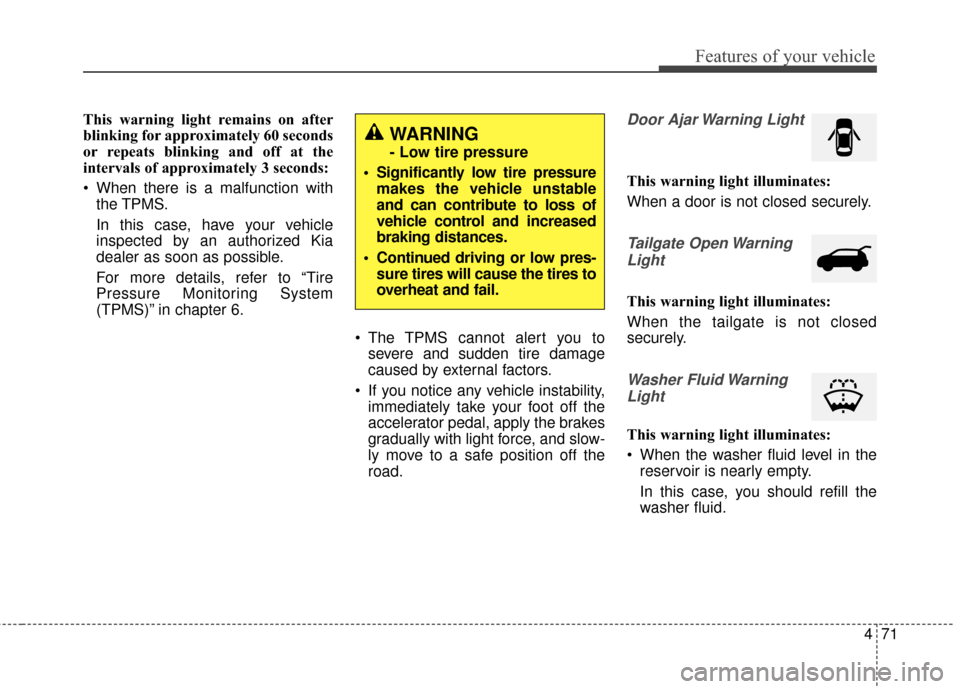
road.Door Ajar Warning Light
This warning light illuminates:
When a door is not closed securely.
Tailgate Open Warning
Light
This warning light illuminates:
When the tailgate is not closed
securely.
Washer Fluid WarningLight
This warning light illuminates:
When the washer fluid level in the reservoir is nearly empty.
In this case, you should refill the
washer fluid.
WARNING
- Low tire pressure
Significantly low tire pressure makes the vehicle unstable
and can contribute to loss of
vehicle control and increased
braking distances.
Continued driving or low pres- sure tires will cause the tires to
overheat and fail.
Page 162 of 470
Features of your vehicle
92
4
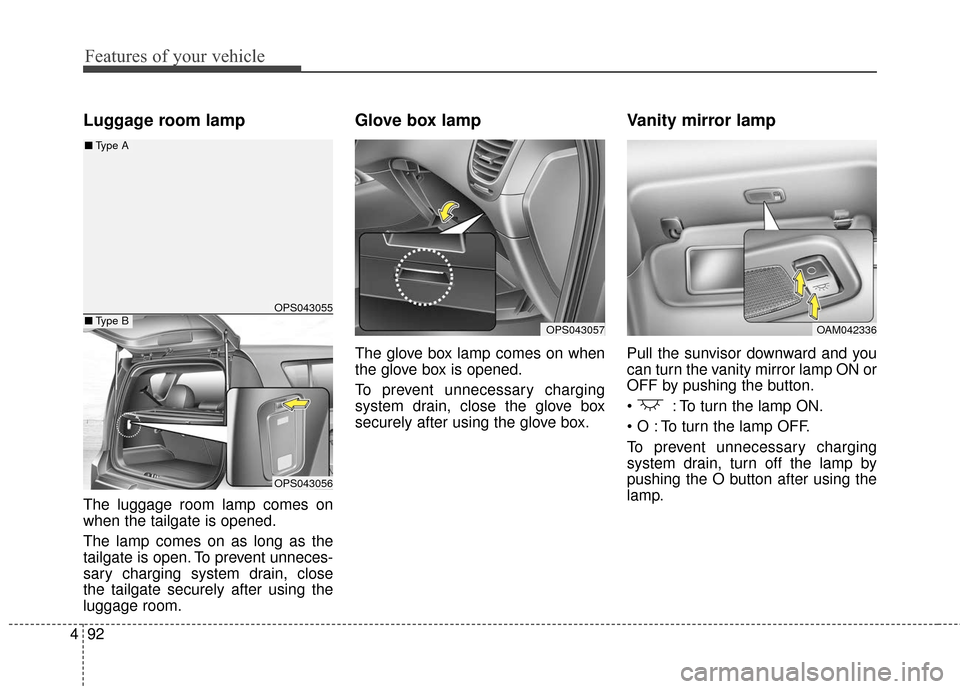
Luggage room lamp
The luggage room lamp comes on
when the tailgate is opened.
The lamp comes on as long as the
tailgate is open. To prevent unneces-
sary charging system drain, close
the tailgate securely after using the
luggage room.
Glove box lamp
The glove box lamp comes on when
the glove box is opened.
To prevent unnecessary charging
system drain, close the glove box
securely after using the glove box.
Vanity mirror lamp
Pull the sunvisor downward and you
can turn the vanity mirror lamp ON or
OFF by pushing the button.
: To turn the lamp ON.
To turn the lamp OFF.
To prevent unnecessary charging
system drain, turn off the lamp by
pushing the O button after using the
lamp.
OPS043057OAM042336
OPS043055
OPS043056
■ Type B
■Type A
Page 264 of 470
519
Driving your vehicle
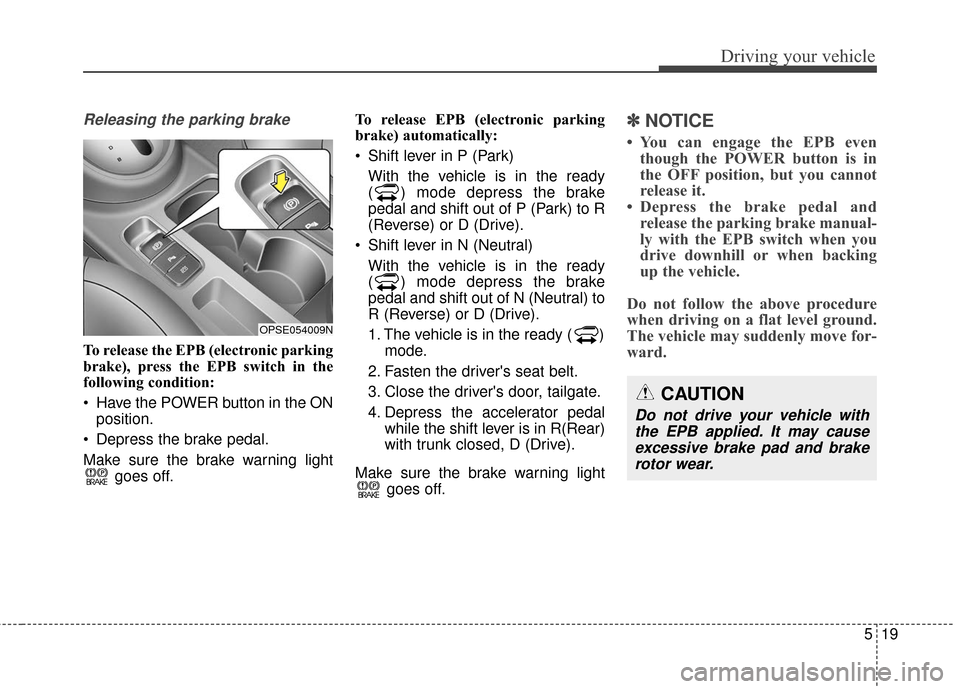
Releasing the parking brake
To release the EPB (electronic parking
brake), press the EPB switch in the
following condition:
Have the POWER button in the ONposition.
Depress the brake pedal.
Make sure the brake warning light goes off. To release EPB (electronic parking
brake) automatically:
Shift lever in P (Park)
With the vehicle is in the ready
( ) mode depress the brake
pedal and shift out of P (Park) to R
(Reverse) or D (Drive).
Shift lever in N (Neutral) With the vehicle is in the ready
( ) mode depress the brake
pedal and shift out of N (Neutral) to
R (Reverse) or D (Drive).
1. The vehicle is in the ready ( ) mode.
2. Fasten the driver's seat belt.
3. Close the driver's door, tailgate.
4. Depress the accelerator pedal while the shift lever is in R(Rear)
with trunk closed, D (Drive).
Make sure the brake warning light goes off.
✽ ✽NOTICE
• You can engage the EPB even
though the POWER button is in
the OFF position, but you cannot
release it.
• Depress the brake pedal and release the parking brake manual-
ly with the EPB switch when you
drive downhill or when backing
up the vehicle.
Do not follow the above procedure
when driving on a flat level ground.
The vehicle may suddenly move for-
ward.
OPSE054009N
CAUTION
Do not drive your vehicle with the EPB applied. It may causeexcessive brake pad and brakerotor wear.
Page 265 of 470
Driving your vehicle
20
5
✽ ✽
NOTICE
If the parking brake warning light
is still on even though the EPB
has been released, have the system
checked by an authorized Kia dealer.
EPB (electronic parking brake) may
be automatically applied when:
Requested by other systems.
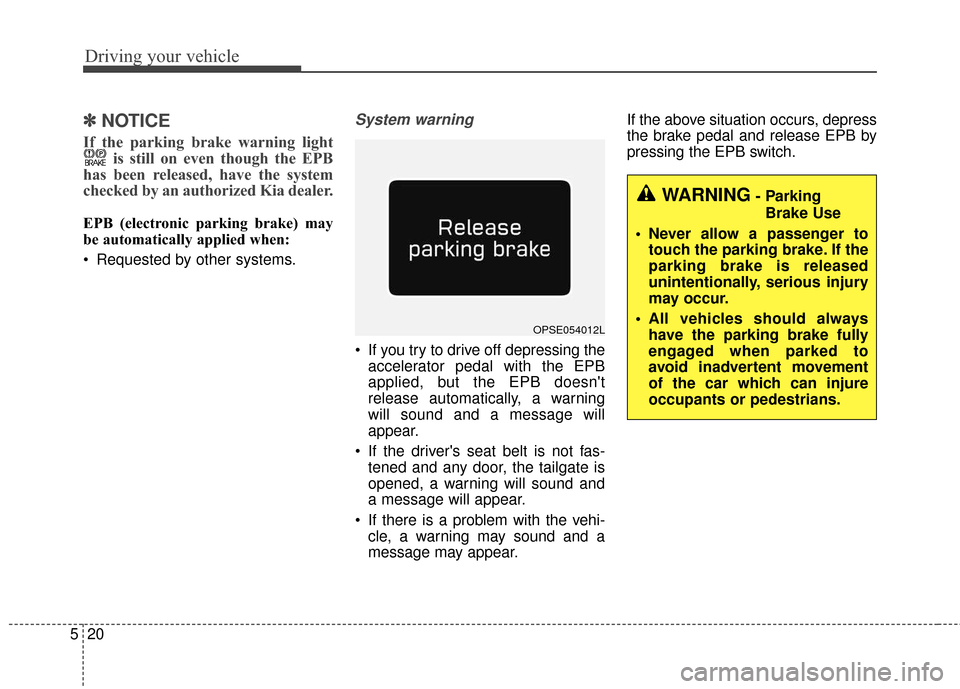
System warning
If you try to drive off depressing the
accelerator pedal with the EPB
applied, but the EPB doesn't
release automatically, a warning
will sound and a message will
appear.
If the driver's seat belt is not fas- tened and any door, the tailgate is
opened, a warning will sound and
a message will appear.
If there is a problem with the vehi- cle, a warning may sound and a
message may appear. If the above situation occurs, depress
the brake pedal and release EPB by
pressing the EPB switch.
OPSE054012L
WARNING- Parking
Brake Use
Never allow a passenger to touch the parking brake. If the
parking brake is released
unintentionally, serious injury
may occur.
All vehicles should always have the parking brake fully
engaged when parked to
avoid inadvertent movement
of the car which can injure
occupants or pedestrians.
Page 383 of 470
Maintenance
64
7
Side repeater light bulb
replacement (if equipped)
If the light bulb is not operating, have
the vehicle checked by an authorized
Kia dealer.
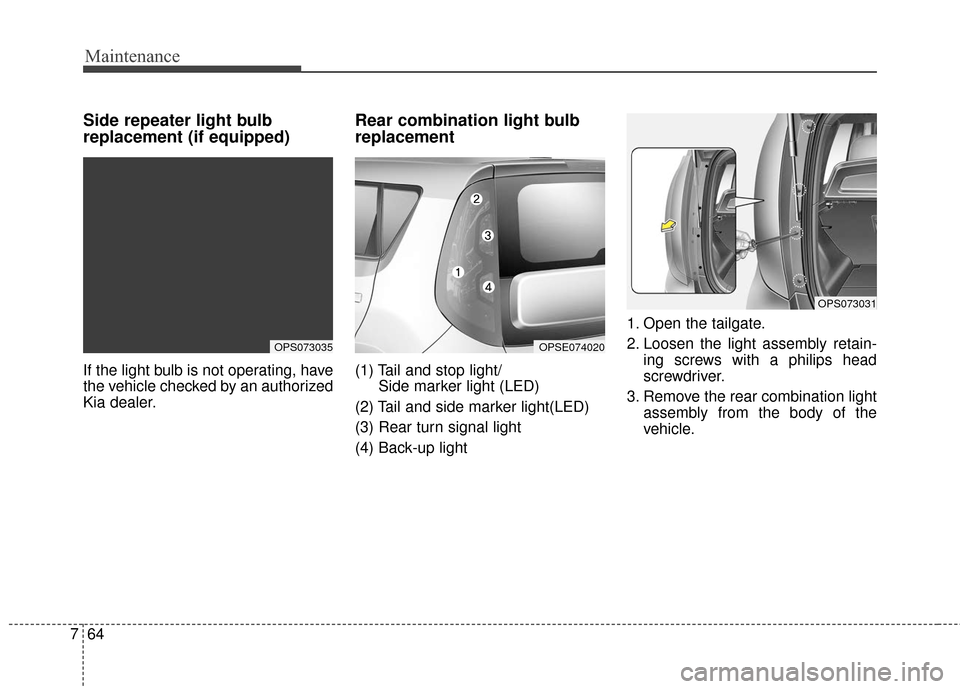
Rear combination light bulb
replacement
(1) Tail and stop light/
Side marker light (LED)
(2) Tail and side marker light(LED)
(3) Rear turn signal light
(4) Back-up light 1. Open the tailgate.
2. Loosen the light assembly retain-
ing screws with a philips head
screwdriver.
3. Remove the rear combination light assembly from the body of the
vehicle.
OPS073035OPSE074020
OPS073031
Page 385 of 470
Maintenance
66
7
Tail,stop light and side marker light
(LED type)
If the light does not operate, have the
system be checked by an authorized
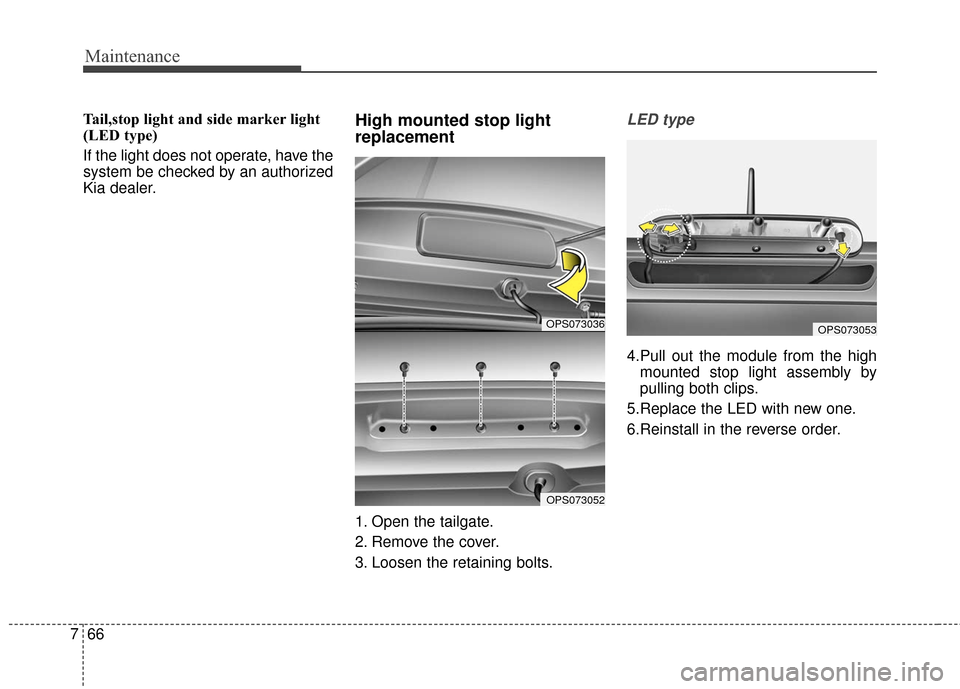
Kia dealer.High mounted stop light
replacement
1. Open the tailgate.
2. Remove the cover.
3. Loosen the retaining bolts.
LED type
4.Pull out the module from the high
mounted stop light assembly by
pulling both clips.
5.Replace the LED with new one.
6.Reinstall in the reverse order.
OPS073036
OPS073052
OPS073053
Page 409 of 470
I7
Index
Glove box . . . . . . . . . . . . . . . . . . . . . . . . . . . . . . . . 4-115
Luggage box . . . . . . . . . . . . . . . . . . . . . . . . . . . . . . 4-116
Sunglass holder . . . . . . . . . . . . . . . . . . . . . . . . . . . 4-116
Tailgate . . . . . . . . . . . . . . . . . . . . . . . . . . . . . . . . . . . . \
. 4-15 Closing the tailgate. . . . . . . . . . . . . . . . . . . . . . . . . . 4-15
Emergency tailgate safety release . . . . . . . . . . . . . . 4-16
Opening the tailgate . . . . . . . . . . . . . . . . . . . . . . . . . 4-15
Tire Pressure Monitoring System (TPMS) . . . . . . . . . . . 6-9 Changing a tire with TPMS . . . . . . . . . . . . . . . . . . . 6-12
Low tire pressure indicator . . . . . . . . . . . . . . . . . . . 6-10
TPMS malfunction indicator . . . . . . . . . . . . . . . . . . 6-11
Tire specification and pressure label . . . . . . . . . . . . . . . 8-8
Tires and wheels . . . . . . . . . . . . . . . . . . . . . . . . . . . . . . . 8-5
Tires and wheels . . . . . . . . . . . . . . . . . . . . . . . . . . . . . . 7-34 Checking tire inflation pressure . . . . . . . . . . . . . . . . 7-35
Recommended cold tire inflation pressures . . . . . . . 7-34
Tire care . . . . . . . . . . . . . . . . . . . . . . . . . . . . . . . . . . 7-34\
Tire maintenance . . . . . . . . . . . . . . . . . . . . . . . . . . . 7-38
Tire replacement . . . . . . . . . . . . . . . . . . . . . . . . . . . . 7-37
Tire rotation . . . . . . . . . . . . . . . . . . . . . . . . . . . . . . . 7-36
Tire sidewall labeling . . . . . . . . . . . . . . . . . . . . . . . . 7-38
Tire traction . . . . . . . . . . . . . . . . . . . . . . . . . . . . . . . 7-38
Wheel alignment and tire balance . . . . . . . . . . . . . . 7-37
Wheel replacement . . . . . . . . . . . . . . . . . . . . . . . . . . 7-38
Towing . . . . . . . . . . . . . . . . . . . . . . . . . . . . . . . . . . . . \
. 6-20 Emergency towing . . . . . . . . . . . . . . . . . . . . . . . . . . 6-22
Removable towing hook (front) . . . . . . . . . . . . . . . . 6-21
Towing service . . . . . . . . . . . . . . . . . . . . . . . . . . . . . 6-20
Trailer Towing. . . . . . . . . . . . . . . . . . . . . . . . . . . . . . . . 5-46
Trip computer . . . . . . . . . . . . . . . . . . . . . . . . . . . . . . . . 4-61 Energy consumption. . . . . . . . . . . . . . . . . . . . . . . . . 4-61
Overview . . . . . . . . . . . . . . . . . . . . . . . . . . . . . . . . . 4-61
Range . . . . . . . . . . . . . . . . . . . . . . . . . . . . . . . . . . . . \
4-64
Trip A/B . . . . . . . . . . . . . . . . . . . . . . . . . . . . . . . . . . 4-62\
Vehicle certification label . . . . . . . . . . . . . . . . . . . . . . . . 8-7
Vehicle Data Collection and Event Data Recorders . . . . 1-2
Vehicle identification number (VIN) . . . . . . . . . . . . . . . 8-7
Vehicle load limit . . . . . . . . . . . . . . . . . . . . . . . . . . . . . 5-47 Certification label . . . . . . . . . . . . . . . . . . . . . . . . . . . 5-50
Tire and loading information label. . . . . . . . . . . . . . 5-47
Vehicle weight glossary . . . . . . . . . . . . . . . . . . . . . . . . 5-51 Base curb weight . . . . . . . . . . . . . . . . . . . . . . . . . . . 5-51
Cargo weight . . . . . . . . . . . . . . . . . . . . . . . . . . . . . . 5-51
GAW (Gross axle weight) . . . . . . . . . . . . . . . . . . . . 5-51
GAWR (Gross axle weight rating) . . . . . . . . . . . . . . 5-51
GVW (Gross vehicle weight). . . . . . . . . . . . . . . . . . 5-51
GVWR (Gross vehicle weight rating) . . . . . . . . . . . 5-51
Vehicle curb weight . . . . . . . . . . . . . . . . . . . . . . . . . 5-51
V
T