towing KIA Soul EV 2017 2.G User Guide
[x] Cancel search | Manufacturer: KIA, Model Year: 2017, Model line: Soul EV, Model: KIA Soul EV 2017 2.GPages: 470, PDF Size: 16.76 MB
Page 316 of 470
What to do in an emergency
20
6
TOWING
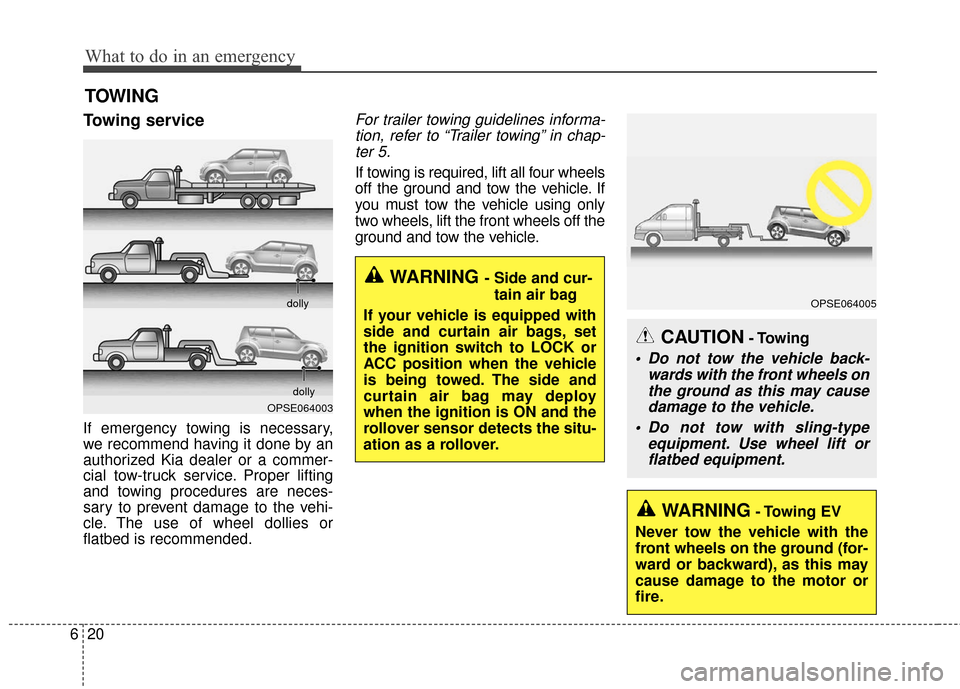
Towing service
If emergency towing is necessary,
we recommend having it done by an
authorized Kia dealer or a commer-
cial tow-truck service. Proper lifting
and towing procedures are neces-
sary to prevent damage to the vehi-
cle. The use of wheel dollies or
flatbed is recommended.
For trailer towing guidelines informa-
tion, refer to “Trailer towing” in chap-ter 5.
If towing is required, lift all four wheels
off the ground and tow the vehicle. If
you must tow the vehicle using only
two wheels, lift the front wheels off the
ground and tow the vehicle.
OPSE064003 dolly
dolly
WARNING- Towing EV
Never tow the vehicle with the
front wheels on the ground (for-
ward or backward), as this may
cause damage to the motor or
fire.
OPSE064005
CAUTION- Towing
Do not tow the vehicle back- wards with the front wheels onthe ground as this may causedamage to the vehicle.
Do not tow with sling-type equipment. Use wheel lift orflatbed equipment.
WARNING - Side and cur-
tain air bag
If your vehicle is equipped with
side and curtain air bags, set
the ignition switch to LOCK or
ACC position when the vehicle
is being towed. The side and
curtain air bag may deploy
when the ignition is ON and the
rollover sensor detects the situ-
ation as a rollover.
Page 317 of 470
621
What to do in an emergency
When towing your vehicle in an
emergency without wheel dollies :
1. Set the ignition switch in the ACCposition.
2. Place the transaxle shift lever in N (Neutral).
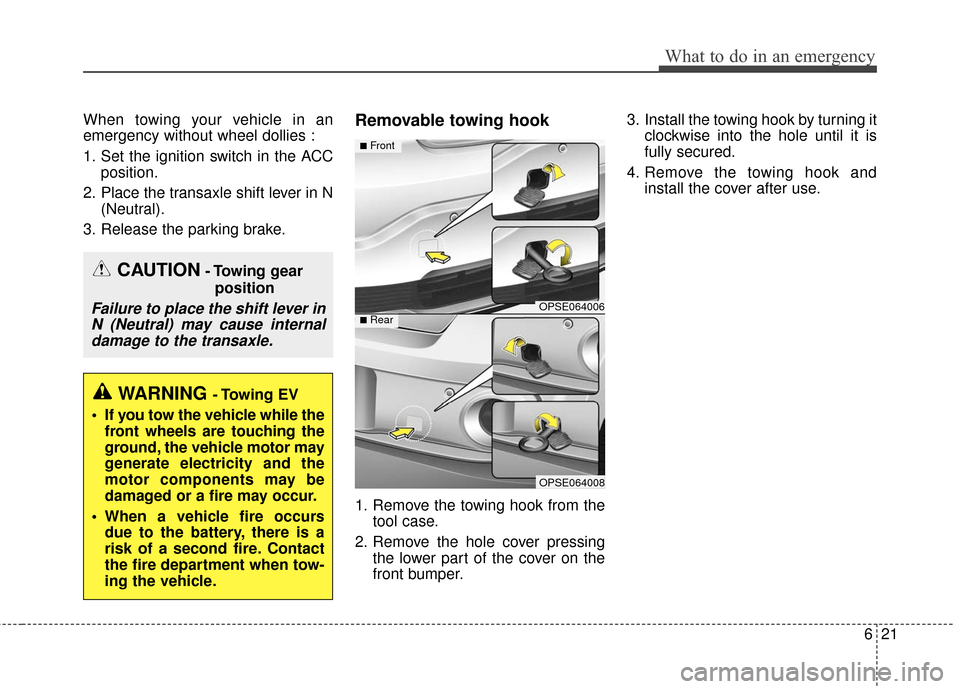
3. Release the parking brake.Removable towing hook
1. Remove the towing hook from the tool case.
2. Remove the hole cover pressing the lower part of the cover on the
front bumper. 3. Install the towing hook by turning it
clockwise into the hole until it is
fully secured.
4. Remove the towing hook and install the cover after use.
CAUTION- Towing gear
position
Failure to place the shift lever inN (Neutral) may cause internaldamage to the transaxle.
WARNING - Towing EV
If you tow the vehicle while the front wheels are touching the
ground, the vehicle motor may
generate electricity and the
motor components may be
damaged or a fire may occur.
When a vehicle fire occurs due to the battery, there is a
risk of a second fire. Contact
the fire department when tow-
ing the vehicle.
OPSE064006
OPSE064008
■Front
■Rear
Page 318 of 470
What to do in an emergency
22
6
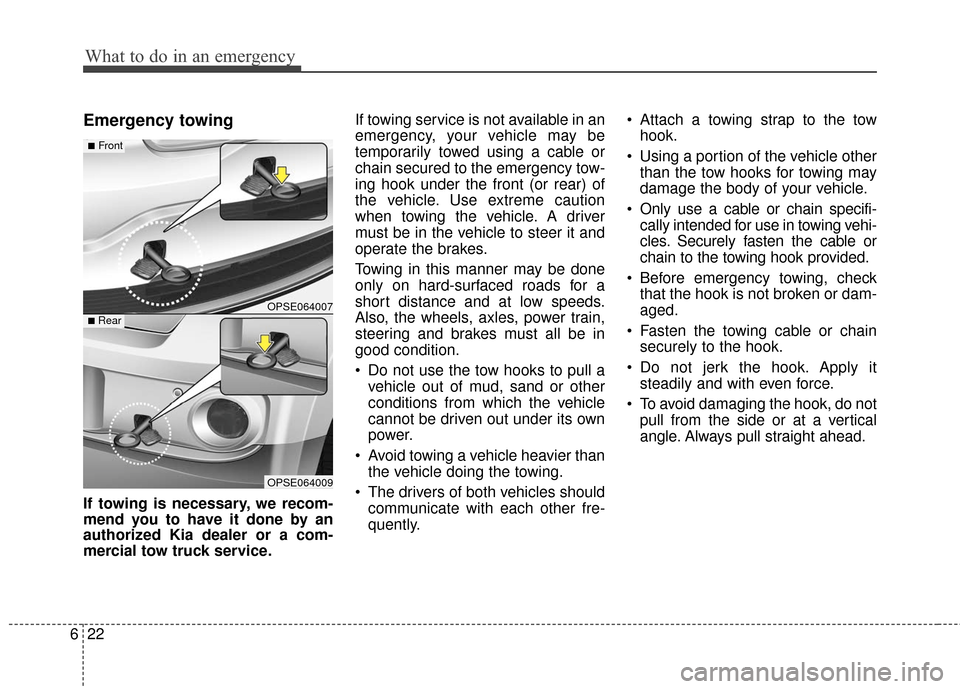
Emergency towing
If towing is necessary, we recom-
mend you to have it done by an
authorized Kia dealer or a com-
mercial tow truck service. If towing service is not available in an
emergency, your vehicle may be
temporarily towed using a cable or
chain secured to the emergency tow-
ing hook under the front (or rear) of
the vehicle. Use extreme caution
when towing the vehicle. A driver
must be in the vehicle to steer it and
operate the brakes.
Towing in this manner may be done
only on hard-surfaced roads for a
short distance and at low speeds.
Also, the wheels, axles, power train,
steering and brakes must all be in
good condition.
Do not use the tow hooks to pull a
vehicle out of mud, sand or other
conditions from which the vehicle
cannot be driven out under its own
power.
Avoid towing a vehicle heavier than the vehicle doing the towing.
The drivers of both vehicles should communicate with each other fre-
quently. Attach a towing strap to the tow
hook.
Using a portion of the vehicle other than the tow hooks for towing may
damage the body of your vehicle.
Only use a cable or chain specifi- cally intended for use in towing vehi-
cles. Securely fasten the cable or
chain to the towing hook provided.
Before emergency towing, check that the hook is not broken or dam-
aged.
Fasten the towing cable or chain securely to the hook.
Do not jerk the hook. Apply it steadily and with even force.
To avoid damaging the hook, do not pull from the side or at a vertical
angle. Always pull straight ahead.
OPSE064007
OPSE064009
■Front
■Rear
Page 319 of 470
623
What to do in an emergency
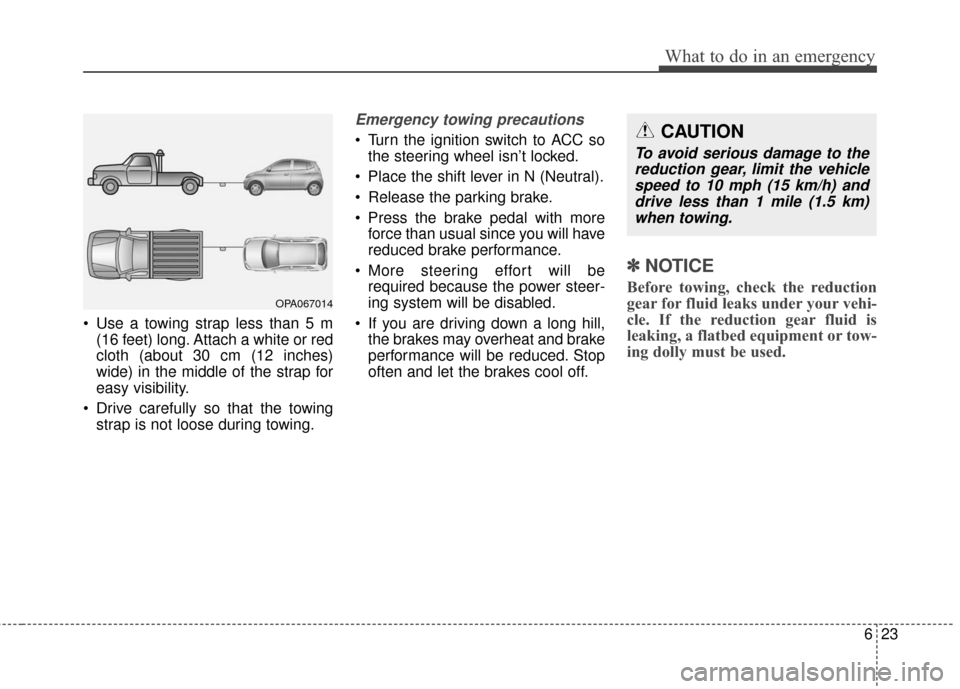
Use a towing strap less than 5 m(16 feet) long. Attach a white or red
cloth (about 30 cm (12 inches)
wide) in the middle of the strap for
easy visibility.
Drive carefully so that the towing strap is not loose during towing.
Emergency towing precautions
Turn the ignition switch to ACC sothe steering wheel isn’t locked.
Place the shift lever in N (Neutral).
Release the parking brake.
Press the brake pedal with more force than usual since you will have
reduced brake performance.
More steering effort will be required because the power steer-
ing system will be disabled.
If you are driving down a long hill, the brakes may overheat and brake
performance will be reduced. Stop
often and let the brakes cool off.
✽ ✽ NOTICE
Before towing, check the reduction
gear for fluid leaks under your vehi-
cle. If the reduction gear fluid is
leaking, a flatbed equipment or tow-
ing dolly must be used.OPA067014
CAUTION
To avoid serious damage to the
reduction gear, limit the vehiclespeed to 10 mph (15 km/h) anddrive less than 1 mile (1.5 km)when towing.
Page 326 of 470
77
Maintenance
SCHEDULED MAINTENANCE SERVICE
Follow the Normal Maintenance
Schedule if the vehicle is usually
operated where none of the following
conditions apply. If any of the follow-
ing conditions apply, follow the
Maintenance Under Severe Usage
Conditions.
Repeated driving short distance ofless than 5 miles (8 km) in normal
temperature or less than 10 miles
(16 km)in freezing temperature
Extensive engine idling or low speed driving for long distances
Driving on rough, dusty, muddy, unpaved, graveled or salt-spread
roads
Driving in areas using salt or other corrosive materials or in very cold
weather
Driving in heavy dust condition
Driving in heavy traffic area
Driving on uphill, downhill, or mountain road repeatedly Towing a trailer or using a camper,
or roof rack
Driving as a patrol car, taxi, other commercial use of vehicle towing
Driving over 106 mile/h(170 km/h)
Frequently driving in stop-and-go conditionIf your vehicle is operated under theabove conditions, you shouldinspect, replace or refill more fre-quently than the following NormalMaintenance Schedule. After 120months or 240,000 km (150,000miles) continue to follow the pre-scribed maintenance intervals.
Page 337 of 470
Maintenance
18
7
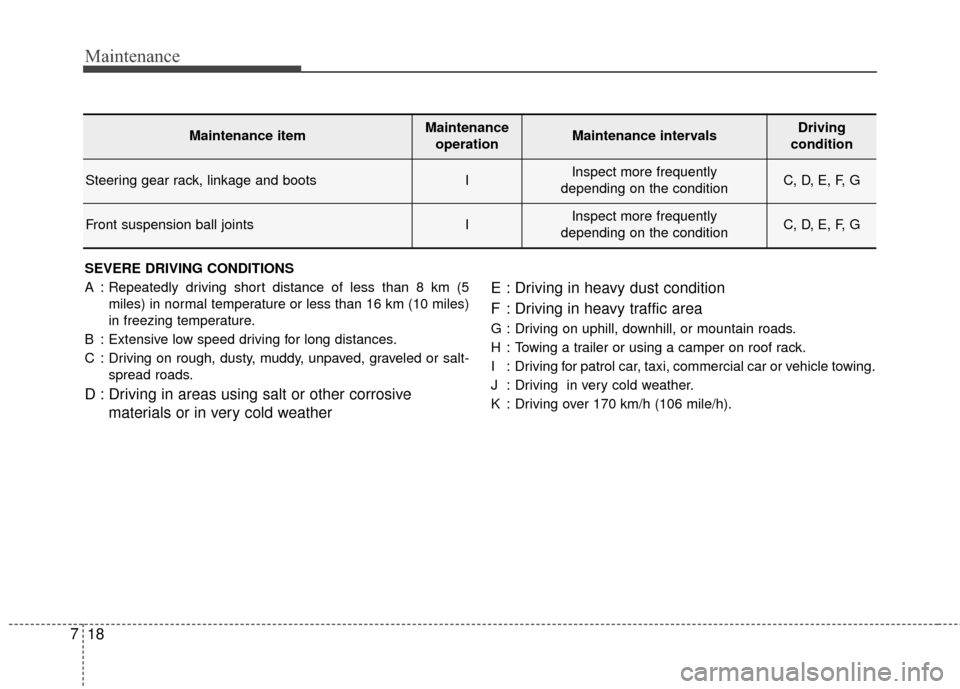
SEVERE DRIVING CONDITIONS
A : Repeatedly driving short distance of less than 8 km (5
miles) in normal temperature or less than 16 km (10 miles)
in freezing temperature.
B : Extensive low speed driving for long distances.
C : Driving on rough, dusty, muddy, unpaved, graveled or salt- spread roads.
D : Driving in areas using salt or other corrosive materials or in very cold weather E : Driving in heavy dust condition
F : Driving in heavy traffic area
G : Driving on uphill, downhill, or mountain roads.
H : Towing a trailer or using a camper on roof rack.
I : Driving for patrol car, taxi, commercial car or vehicle towing.
J : Driving in very cold weather.
K : Driving over 170 km/h (106 mile/h).
Maintenance itemMaintenance
operationMaintenance intervalsDriving
condition
Steering gear rack, linkage and bootsIInspect more frequently
depending on the conditionC, D, E, F, G
Front suspension ball jointsIInspect more frequently
depending on the conditionC, D, E, F, G
Page 409 of 470
I7
Index
Glove box . . . . . . . . . . . . . . . . . . . . . . . . . . . . . . . . 4-115
Luggage box . . . . . . . . . . . . . . . . . . . . . . . . . . . . . . 4-116
Sunglass holder . . . . . . . . . . . . . . . . . . . . . . . . . . . 4-116
Tailgate . . . . . . . . . . . . . . . . . . . . . . . . . . . . . . . . . . . . \
. 4-15 Closing the tailgate. . . . . . . . . . . . . . . . . . . . . . . . . . 4-15
Emergency tailgate safety release . . . . . . . . . . . . . . 4-16
Opening the tailgate . . . . . . . . . . . . . . . . . . . . . . . . . 4-15
Tire Pressure Monitoring System (TPMS) . . . . . . . . . . . 6-9 Changing a tire with TPMS . . . . . . . . . . . . . . . . . . . 6-12
Low tire pressure indicator . . . . . . . . . . . . . . . . . . . 6-10
TPMS malfunction indicator . . . . . . . . . . . . . . . . . . 6-11
Tire specification and pressure label . . . . . . . . . . . . . . . 8-8
Tires and wheels . . . . . . . . . . . . . . . . . . . . . . . . . . . . . . . 8-5
Tires and wheels . . . . . . . . . . . . . . . . . . . . . . . . . . . . . . 7-34 Checking tire inflation pressure . . . . . . . . . . . . . . . . 7-35
Recommended cold tire inflation pressures . . . . . . . 7-34
Tire care . . . . . . . . . . . . . . . . . . . . . . . . . . . . . . . . . . 7-34\
Tire maintenance . . . . . . . . . . . . . . . . . . . . . . . . . . . 7-38
Tire replacement . . . . . . . . . . . . . . . . . . . . . . . . . . . . 7-37
Tire rotation . . . . . . . . . . . . . . . . . . . . . . . . . . . . . . . 7-36
Tire sidewall labeling . . . . . . . . . . . . . . . . . . . . . . . . 7-38
Tire traction . . . . . . . . . . . . . . . . . . . . . . . . . . . . . . . 7-38
Wheel alignment and tire balance . . . . . . . . . . . . . . 7-37
Wheel replacement . . . . . . . . . . . . . . . . . . . . . . . . . . 7-38
Towing . . . . . . . . . . . . . . . . . . . . . . . . . . . . . . . . . . . . \
. 6-20 Emergency towing . . . . . . . . . . . . . . . . . . . . . . . . . . 6-22
Removable towing hook (front) . . . . . . . . . . . . . . . . 6-21
Towing service . . . . . . . . . . . . . . . . . . . . . . . . . . . . . 6-20
Trailer Towing. . . . . . . . . . . . . . . . . . . . . . . . . . . . . . . . 5-46
Trip computer . . . . . . . . . . . . . . . . . . . . . . . . . . . . . . . . 4-61 Energy consumption. . . . . . . . . . . . . . . . . . . . . . . . . 4-61
Overview . . . . . . . . . . . . . . . . . . . . . . . . . . . . . . . . . 4-61
Range . . . . . . . . . . . . . . . . . . . . . . . . . . . . . . . . . . . . \
4-64
Trip A/B . . . . . . . . . . . . . . . . . . . . . . . . . . . . . . . . . . 4-62\
Vehicle certification label . . . . . . . . . . . . . . . . . . . . . . . . 8-7
Vehicle Data Collection and Event Data Recorders . . . . 1-2
Vehicle identification number (VIN) . . . . . . . . . . . . . . . 8-7
Vehicle load limit . . . . . . . . . . . . . . . . . . . . . . . . . . . . . 5-47 Certification label . . . . . . . . . . . . . . . . . . . . . . . . . . . 5-50
Tire and loading information label. . . . . . . . . . . . . . 5-47
Vehicle weight glossary . . . . . . . . . . . . . . . . . . . . . . . . 5-51 Base curb weight . . . . . . . . . . . . . . . . . . . . . . . . . . . 5-51
Cargo weight . . . . . . . . . . . . . . . . . . . . . . . . . . . . . . 5-51
GAW (Gross axle weight) . . . . . . . . . . . . . . . . . . . . 5-51
GAWR (Gross axle weight rating) . . . . . . . . . . . . . . 5-51
GVW (Gross vehicle weight). . . . . . . . . . . . . . . . . . 5-51
GVWR (Gross vehicle weight rating) . . . . . . . . . . . 5-51
Vehicle curb weight . . . . . . . . . . . . . . . . . . . . . . . . . 5-51
V
T
Page 466 of 470
56
When a vehicle accident occurs,
move the vehicle to a safe place, turn
OFF the vehicle and remove the aux-
iliary battery (12 V) terminal to pre-
vent high voltage electricity from
flowing. Remove the auxiliary battery
(12 V) terminal and turn it OFF.When you suspect leakage of inflam-
mable gas and other harmful gases,
open the windows and evacuate to a
safe place. If any leaked fluid comes
in contact with your eyes or skin,
immediately clean the affected area
thoroughly with tap water or saline
solution and have doctors inspect it
as soon as possible.
SAFETY PRECAUTIONS FOR
ELECTRIC VEHICLE
Responding to Vehicle Accidents in your
Electric Vehicle
WARNING- Exposed
Wires & Electrical
Components
Do not touch electric wires that
may become exposed from
inside or outside the vehicle,
high voltage electric wires
(orange), connectors and all
electric components and
devices. Doing so may result in
electric shock and lead to
injuries.
WARNING- Damaged battery
Do not touch harmful gas and
electrolytes which may leak if
the high voltage battery is dam-
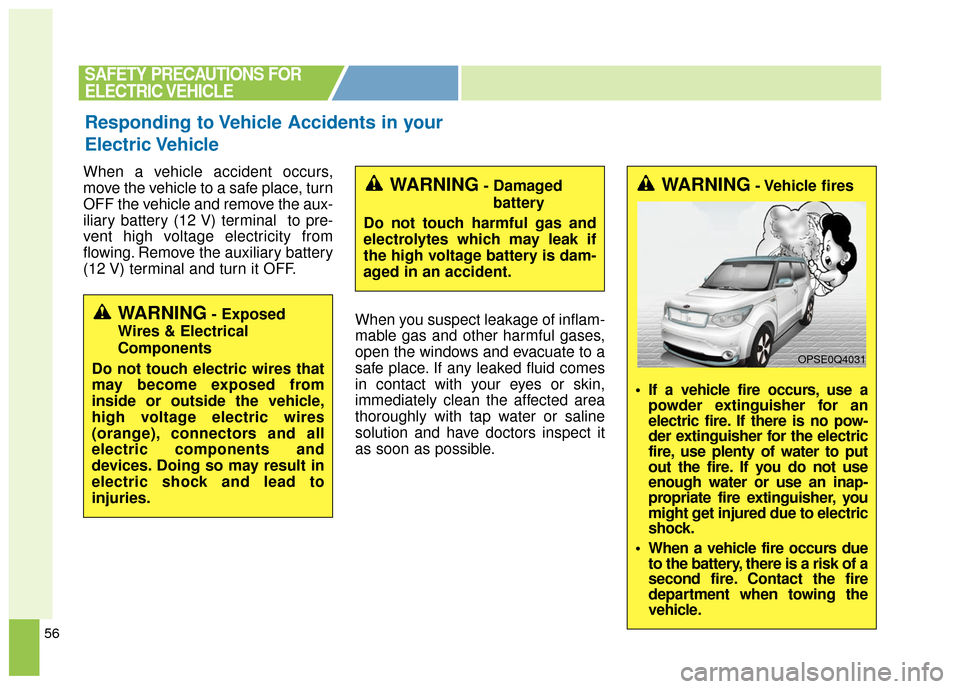
aged in an accident.WARNING- Vehicle fires
If a vehicle fire occurs, use a powder extinguisher for an
electric fire. If there is no pow-
der extinguisher for the electric
fire, use plenty of water to put
out the fire. If you do not use
enough water or use an inap-
propriate fire extinguisher, you
might get injured due to electric
shock.
When a vehicle fire occurs due to the battery, there is a risk of a
second fire. Contact the fire
department when towing the
vehicle.
OPSE0Q4031
Page 467 of 470
57
If the vehicle is flooded with water,
immediately turn OFF the vehicle
and evacuate to a safe place.
Contact the fire department or an
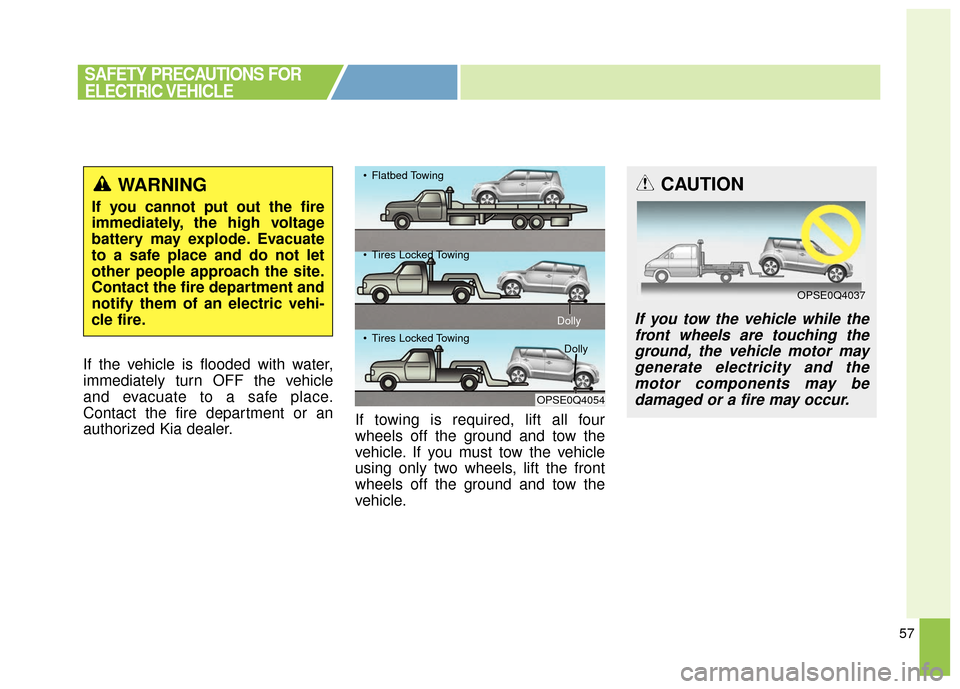
authorized Kia dealer.If towing is required, lift all four
wheels off the ground and tow the
vehicle. If you must tow the vehicle
using only two wheels, lift the front
wheels off the ground and tow the
vehicle.
SAFETY PRECAUTIONS FOR
ELECTRIC VEHICLE
OPSE0Q4054
Flatbed Towing
Tires Locked Towing
DollyDolly
Tires Locked Towing
WARNING
If you cannot put out the fire
immediately, the high voltage
battery may explode. Evacuate
to a safe place and do not let
other people approach the site.
Contact the fire department and
notify them of an electric vehi-
cle fire.
CAUTION
If you tow the vehicle while the
front wheels are touching theground, the vehicle motor maygenerate electricity and themotor components may bedamaged or a fire may occur.
OPSE0Q4037