impact KIA Spectra 2008 2.G User Guide
[x] Cancel search | Manufacturer: KIA, Model Year: 2008, Model line: Spectra, Model: KIA Spectra 2008 2.GPages: 298, PDF Size: 5.38 MB
Page 73 of 298

363
1
2
3
4
5
6
7
8
9
Knowing your vehicle
Curtain air bag (if equipped)
Curtain air bags are located along
both sides of the roof rails above the
front and rear doors.
They are designed to help protect the
heads of the front seat occupants
and the rear outboard seat occupants
in certain side impact collisions.• The curtain air bag deployment
occurs only on the side of the vehi-
cle affected by the impact.
• The side air bags (side and curtain
air bags) are not designed to
deploy during collisions from the
front or rear of the vehicle or in
most rollover situations.
• The curtain air bags are designed
to deploy only during certain side-
impact collisions, depending on the
crash severity, angle, speed and
impact.
WARNING
• Do not use any accessory
seat covers for the vehicle
equipped with side air bags.
Use of seat covers could inter-
fere with side air bag deploy-
ment.
If seat is damaged, have the
vehicle checked and repaired
by an authorized Kia dealer.
Inform them that your vehicle
is equipped with side air bags
and an occupant detection
system.
• Do not make modifications or
additions to the seats as they
may cause the air bag system
to malfunction resulting in
severe personal injury or
death.
1LDA2052
1LDA2057
Page 75 of 298

365
1
2
3
4
5
6
7
8
9
Knowing your vehicle
Why didn’t my air bag go off in
a collision?
(Inflation and non-inflation condi-
tions of the air bag)
There are many types of accidents in
which the air bag would not be
expected to provide additional pro-
tection.
These include rear impacts, second
or third collisions in multiple impact
accidents, as well as low speed
impacts. In other words, just because
your vehicle is damaged and even if
it is totally unusable, don’t be sur-
prised that the air bags did not
inflate.
1JBA3512A/OMG035052/OMG035054/OMG035053/OMG035055
123
Air bag collision sensors
(1)SRS control module
(2)Front impact sensor(3)Side impact sensor (if equipped)
Page 76 of 298
Knowing your vehicle
66 3
1
2
3
4
5
6
7
8
9
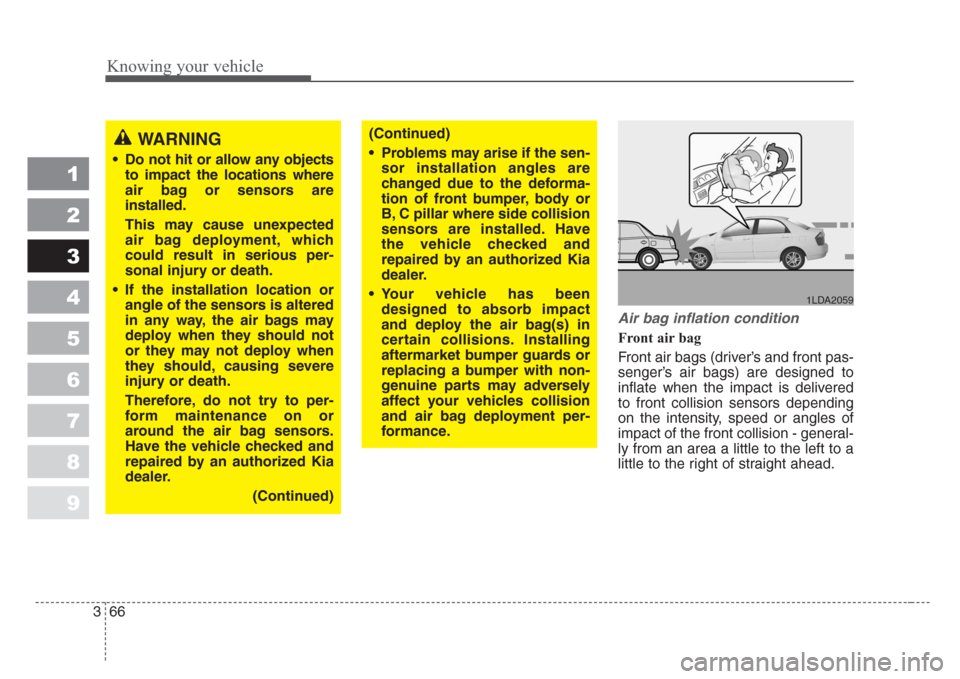
Air bag inflation condition
Front air bag
Front air bags (driver’s and front pas-
senger’s air bags) are designed to
inflate when the impact is delivered
to front collision sensors depending
on the intensity, speed or angles of
impact of the front collision - general-
ly from an area a little to the left to a
little to the right of straight ahead.
WARNING
• Do not hit or allow any objects
to impact the locations where
air bag or sensors are
installed.
This may cause unexpected
air bag deployment, which
could result in serious per-
sonal injury or death.
• If the installation location or
angle of the sensors is altered
in any way, the air bags may
deploy when they should not
or they may not deploy when
they should, causing severe
injury or death.
Therefore, do not try to per-
form maintenance on or
around the air bag sensors.
Have the vehicle checked and
repaired by an authorized Kia
dealer.
(Continued)
(Continued)
• Problems may arise if the sen-
sor installation angles are
changed due to the deforma-
tion of front bumper, body or
B, C pillar where side collision
sensors are installed. Have
the vehicle checked and
repaired by an authorized Kia
dealer.
• Your vehicle has been
designed to absorb impact
and deploy the air bag(s) in
certain collisions.Installing
aftermarket bumper guards or
replacing a bumper with non-
genuine parts may adversely
affect your vehicles collision
and air bag deployment per-
formance.
1LDA2059
Page 77 of 298

367
1
2
3
4
5
6
7
8
9
Knowing your vehicle
Side air bag (if equipped)
Side air bags (side and curtain air
bags) are designed to inflate when
an impact is detected by side colli-
sion sensors depending on the
strength, speed or angles of impact
of side impact collision or rollover by
the side impact.Although the front air bags (driver’s
and front passenger’s air bags) are
designed to inflate only in frontal col-
lision, it may inflate in any collision if
front impact sensors detect a suffi-
cient impact. Side air bags (side and
curtain air bags) are designed to
inflate only in side impact collision, it
may inflate in any collision if side
impact sensors detect a sufficient
impact.If the vehicle chassis is impacted by
bumps or objects on unimproved
roads or sidewalks, air bags may
deploy. Drive carefully on unim-
proved roads or on surfaces not
designed for vehicle traffic.
To protect occupants, front air bags
or pre-tensioner safety belts may
deploy in certain side impact colli-
sions.
1JBA3514
OUN026090
Page 78 of 298

Knowing your vehicle
68 3
1
2
3
4
5
6
7
8
9
Air bag non-inflation conditions
• In certain collisions, the vehicle
safety belts are sufficient to protect
the vehicle occupants and the air
bags may not deploy. In some
cases, deploying air bags in low-
speed collisions can cause a sec-
ondary impact to the occupants
(light abrasions, cuts, burns, etc.),
or loss of vehicle control.• Frontal air bags are not designed
to inflate in rear collisions, because
occupants are moved backward by
the force of the impact. In this case,
the air bags do not provide proper
protection.• Front air bags may not inflate in
side impact collision, because
occupants move to the direction of
the collision, and thus in side
impacts, frontal air bag deployment
does not provide occupant protec-
tion.
However, side or curtain air bags
may inflate depending on the inten-
sity, vehicle speed and angles of
impact.
1GHA22731LDA20611JBA3516
Page 79 of 298

369
1
2
3
4
5
6
7
8
9
Knowing your vehicle
• In a slant impact or collision, the
force delivered will be relatively
weaker than that of frontal colli-
sion. So, the air bags may not
inflate.• At the moment of an accident, driv-
ers often brake heavily with reflex.
In such heavy braking, the front
portion of the vehicle is lowered by
the force of the braking and the
vehicle can dive under a vehicle
with a higher ground clearance. Air
bags may not inflate in this situa-
tion because impacts may not be
delivered or may be delivered with
less intensity.• Air bags may not inflate in rollover
accidents because air bag deploy-
ment would not provide proper pro-
tection to the occupants.
However, side air bags may inflate
when the vehicle is rolled over by a
side impact collision, if the vehicle
is equipped with side air bags and
curtain air bags.
1GHA22701LDA20651LDA2066
Page 80 of 298

Knowing your vehicle
70 3
1
2
3
4
5
6
7
8
9
• Air bags may not inflate if the vehi-
cle collides with objects such as
utility poles or trees, where the
point of impact is concentrated to
one area and the full force of the
impact is not delivered to the sen-
sors.
How does the air bag system
operate
• Air bag only operates when the
ignition switch is turned to the ON
or START positions.
• Air bags inflate instantly in the
event of serious frontal or side col-
lision (if equipped with side air bag
or curtain air bag) in order to help
protect the occupants from serious
physical injury.
• There is no single speed at which
the air bags will inflate.
Generally, air bags are designed to
inflate by the severity of a collision
and its direction. These two factors
determine whether the sensors
send out an electronic deploy-
ment/inflation signal.• Air bag deployment depends on a
number of factors including vehicle
speed, angles of impact and the
density and stiffness of the vehi-
cles or objects which your vehicle
hits in the collision. Though, factors
are not limited to those mentioned
above.
• The front air bags will completely
inflate and deflate in an instant.
It is impossible for you to see the
air bags inflate during an accident.
It is much more likely that you will
simply see the deflated air bags
hanging out of their storage com-
partments after the collision.
1JBA3518
Page 81 of 298
371
1
2
3
4
5
6
7
8
9
Knowing your vehicle
• In order to help provide protection
in a severe collision, the air bags
must inflate rapidly. The speed of
air bag inflation is a consequence
of the extremely short time in which
a collision occurs and the need to
get the air bag between the occu-
pant and the vehicle structures
before the occupant impacts those
structures. This speed of inflation
reduces the risk of serious or life-
threatening injuries in a severe col-
lision and is thus a necessary part
of air bag design.
However, air bag inflation can also
cause injuries which normally can
include facial abrasions, bruises
and broken bones, and sometimes
more serious injuries because the
inflation speed also causes the air
bags to expand with a great deal of
force.
• There are even circumstances
under which contact with the
steering wheel air bag can cause
fatal injuries,especially if the
occupant is positioned exces-
sively close to the steering
wheel.Noise and smoke
When the air bags inflate, they make
a loud noise and they leave smoke
and powder in the air inside of the
vehicle. This is normal and is a result
of the ignition of the air bag inflator.
After the air bag inflates, you may
feel substantial discomfort in breath-
ing due to the contact of your chest
to both the safety belt and the air
bag, as well as from breathing the
smoke and powder.We strongly
urge you to open your doors
and/or windows as soon as possi-
ble after impact in order to reduce
discomfort and prevent prolonged
exposure to the smoke and pow-
der.
Though smoke and powder are non-
toxic, it may cause irritation to the
skin (eyes, nose and throat etc).
Wash and rinse with the cold water
immediately and consult the doctor if
the symptom persists.WARNING
• To avoid severe personal
injury or death caused by
deploying air bags in a colli-
sion, the driver should sit as
far back from the steering
wheel air bag as possible (at
least 250 mm (10 inches)
away). The front passenger
should always move their seat
as far back as possible and sit
back in their seat.
• Air bag inflates instantly in an
event of collision, passengers
may be injured by the air bag
expansion force if they are not
in proper position.
• Air bag inflation may cause
injuries which normally
include facial or bodily abra-
sions, injuries by the broken
glasses or burns by the explo-
sives.
Page 82 of 298
Knowing your vehicle
72 3
1
2
3
4
5
6
7
8
9
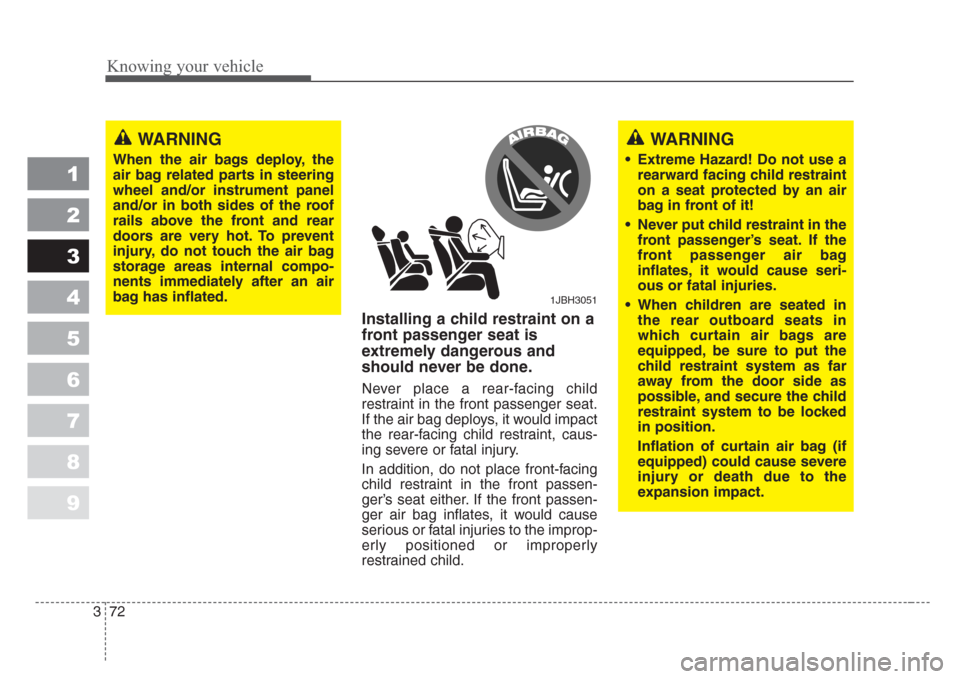
Installing a child restraint on a
front passenger seat is
extremely dangerous and
should never be done.
Never place a rear-facing child
restraint in the front passenger seat.
If the air bag deploys, it would impact
the rear-facing child restraint, caus-
ing severe or fatal injury.
In addition, do not place front-facing
child restraint in the front passen-
ger’s seat either. If the front passen-
ger air bag inflates, it would cause
serious or fatal injuries to the improp-
erly positioned or improperly
restrained child.
WARNING
• Extreme Hazard! Do not use a
rearward facing child restraint
on a seat protected by an air
bag in front of it!
• Never put child restraint in the
front passenger’s seat. If the
front passenger air bag
inflates, it would cause seri-
ous or fatal injuries.
• When children are seated in
the rear outboard seats in
which curtain air bags are
equipped, be sure to put the
child restraint system as far
away from the door side as
possible, and secure the child
restraint system to be locked
in position.
Inflation of curtain air bag (if
equipped) could cause severe
injury or death due to the
expansion impact.
WARNING
When the air bags deploy, the
air bag related parts in steering
wheel and/or instrument panel
and/or in both sides of the roof
rails above the front and rear
doors are very hot. To prevent
injury, do not touch the air bag
storage areas internal compo-
nents immediately after an air
bag has inflated.
1JBH3051
Page 115 of 298
3 105
Knowing your vehicle
1
2
3
4
5
6
7
8
9
4. AUTO SEEK Select Button
(Automatic Channel Selection)
Press the AUTO SEEK select button.
When the side is pressed, the unit
will automatically tune to the next
higher frequency and when the
side is pressed, it will automatically
tune to the next lower frequency.
5. SCAN Button
When you Press the button, frequen-
cy is changed and the next channel
is received automatically.
To stay on a station, press the SCAN
button again.
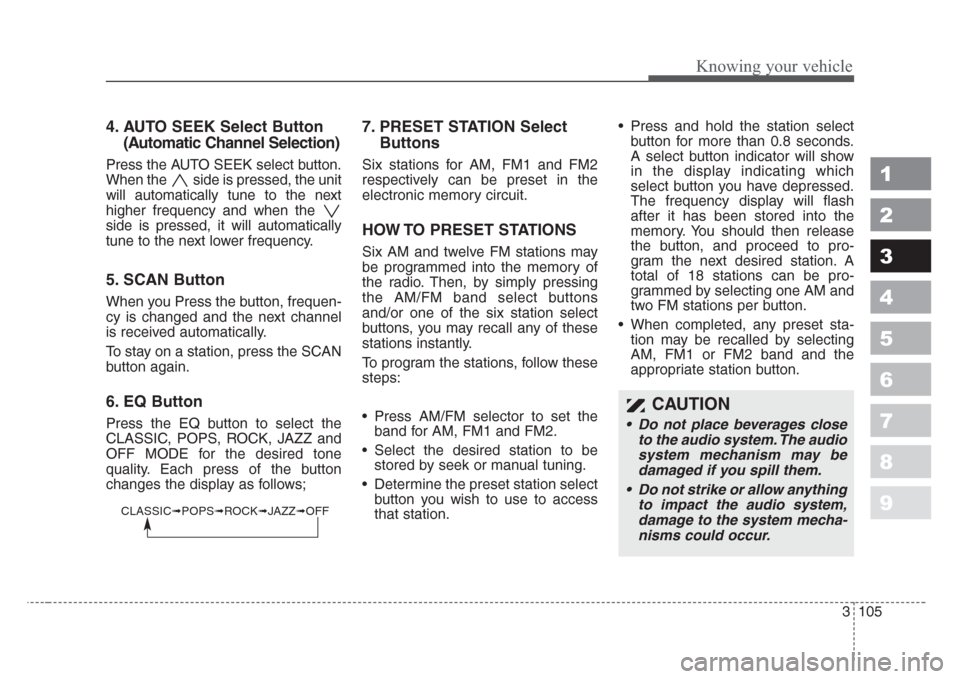
6. EQ Button
Press the EQ button to select the
CLASSIC, POPS, ROCK, JAZZ and
OFF MODE for the desired tone
quality. Each press of the button
changes the display as follows;
7. PRESET STATION Select
Buttons
Six stations for AM, FM1 and FM2
respectively can be preset in the
electronic memory circuit.
HOW TO PRESET STATIONS
Six AM and twelve FM stations may
be programmed into the memory of
the radio. Then, by simply pressing
the AM/FM band select buttons
and/or one of the six station select
buttons, you may recall any of these
stations instantly.
To program the stations, follow these
steps:
• Press AM/FM selector to set the
band for AM, FM1 and FM2.
• Select the desired station to be
stored by seek or manual tuning.
• Determine the preset station select
button you wish to use to access
that station.• Press and hold the station select
button for more than 0.8 seconds.
A select button indicator will show
in the display indicating which
select button you have depressed.
The frequency display will flash
after it has been stored into the
memory. You should then release
the button, and proceed to pro-
gram the next desired station. A
total of 18 stations can be pro-
grammed by selecting one AM and
two FM stations per button.
• When completed, any preset sta-
tion may be recalled by selecting
AM, FM1 or FM2 band and the
appropriate station button.
CAUTION
• Do not place beverages close
to the audio system. The audio
system mechanism may be
damaged if you spill them.
• Do not strike or allow anything
to impact the audio system,
damage to the system mecha-
nisms could occur.
CLASSIC➟POPS➟ROCK➟JAZZ➟OFF