seats KIA SPECTRA5 2006 User Guide
[x] Cancel search | Manufacturer: KIA, Model Year: 2006, Model line: SPECTRA5, Model: KIA SPECTRA5 2006Pages: 273, PDF Size: 2.83 MB
Page 60 of 273
349
1
2
3
4
5
6
7
8
9
Knowing your vehicle
Placing a passenger safety
belt into the auto lock modeThe use of the auto lock mode will
ensure that the normal movement of
the child in the vehicle does not
cause the safety belt to be pulled out
and loosen the firmness of its hold
on the child restraint system. To
secure a child restraint system, use
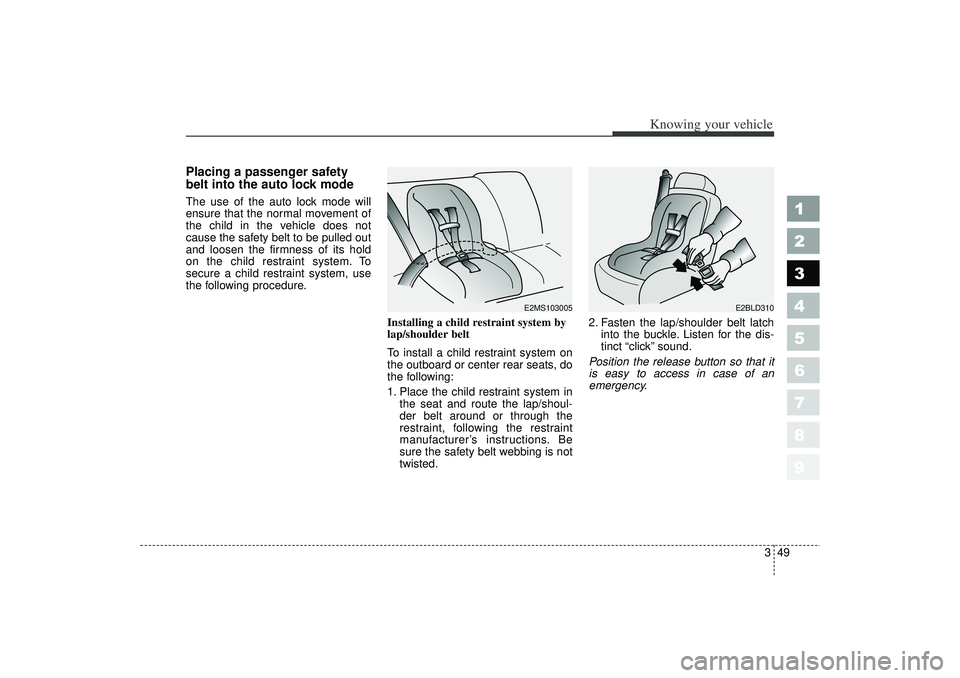
the following procedure.Installing a child restraint system by
lap/shoulder belt
To install a child restraint system on
the outboard or center rear seats, do
the following:
1. Place the child restraint system inthe seat and route the lap/shoul-
der belt around or through the
restraint, following the restraint
manufacturer’ s instructions. Be
sure the safety belt webbing is not
twisted. 2. Fasten the lap/shoulder belt latch
into the buckle. Listen for the dis-
tinct “click” sound.
Position the release button so that it
is easy to access in case of an
emergency.
E2MS103005
E2BLD310
LD CAN (ENG) new 3-1~.qxd 7/29/05 10:28 AM Page 49
Page 63 of 273

Knowing your vehicle52
3
1
2
3
4
5
6
7
8
9
WARNING
- Child
restraint
Check that the child restraint
system is secure by pushing
and pulling it in different direc-
tions. Incorrectly fitted child
restraints may swing, twist, tip
or come away causing death or
injury.
Securing a child restraint seat
with “Tether Anchor” system
Child restraint hook holders are
located on the shelf or floor behind
the rear seats.
1. Open the tether anchor cover on the shelf or floor behind the rear
seats. 2. Route the child restraint seat strap
over the seatback.
For vehicles with adjustable head-
rest, route the tether strap under
the headrest and between the
headrest posts, otherwise route
the tether strap over the top of the
seatback.
3. Connect the tether strap hook to the correct child restraint hook
holder and tighten to secure the
seat.
2GHN3300A
WARNING
If the tether strap is secured
incorrectly, the child restraint
seat may not be restrained
properly in the event of a colli-
sion.
1LDN3200/1LDN3200A
4 Door5 Door
LD CAN (ENG) new 3-1~.qxd 7/29/05 10:28 AM Page 52
Page 64 of 273
353
1
2
3
4
5
6
7
8
9
Knowing your vehicle
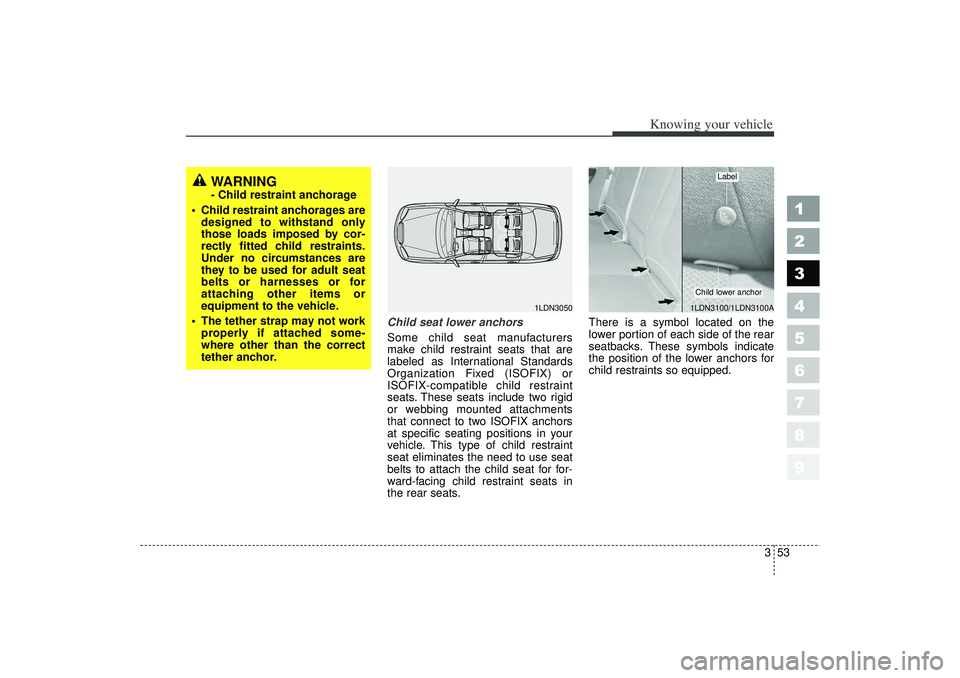
Child seat lower anchors
Some child seat manufacturers
make child restraint seats that are
labeled as International Standards
Organization Fixed (ISOFIX) or
ISOFIX-compatible child restraint
seats. These seats include two rigid
or webbing mounted attachments
that connect to two ISOFIX anchors
at specific seating positions in your
vehicle. This type of child restraint
seat eliminates the need to use seat
belts to attach the child seat for for-
ward-facing child restraint seats in
the rear seats.There is a symbol located on the
lower portion of each side of the rear
seatbacks. These symbols indicate
the position of the lower anchors for
child restraints so equipped.
1LDN3050
WARNING - Child restraint anchorage
Child restraint anchorages are designed to withstand only
those loads imposed by cor-
rectly fitted child restraints.
Under no circumstances are
they to be used for adult seat
belts or harnesses or for
attaching other items or
equipment to the vehicle.
The tether strap may not work properly if attached some-
where other than the correct
tether anchor.
1LDN3100/1LDN3100AChild lower anchor
Label
LD CAN (ENG) new 3-1~.qxd 7/29/05 10:28 AM Page 53
Page 65 of 273
Knowing your vehicle54
3
1
2
3
4
5
6
7
8
9
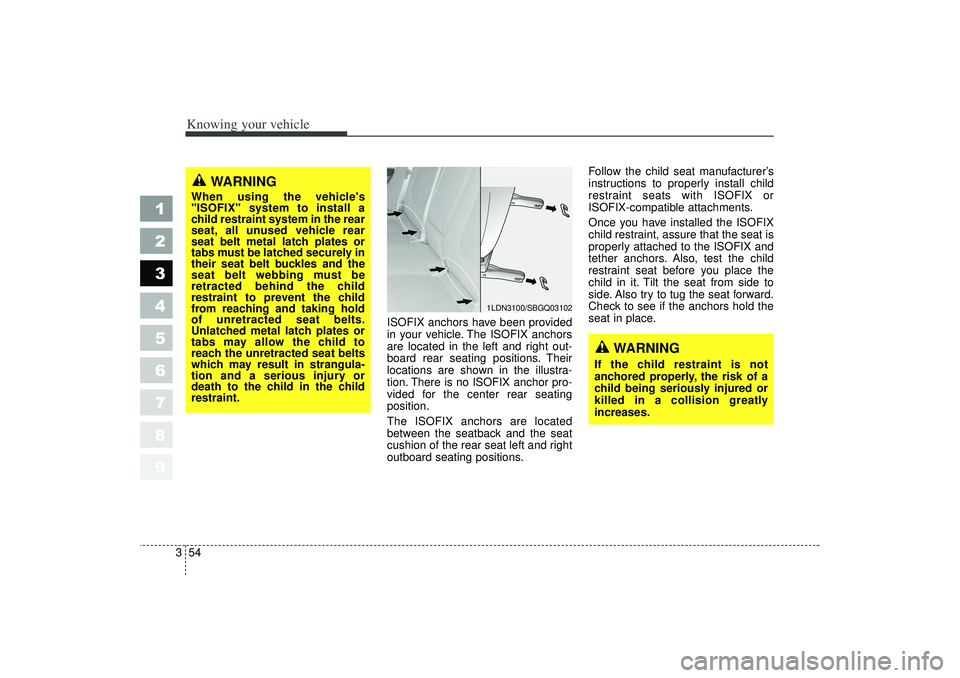
ISOFIX anchors have been provided
in your vehicle. The ISOFIX anchors
are located in the left and right out-
board rear seating positions. Their
locations are shown in the illustra-
tion. There is no ISOFIX anchor pro-
vided for the center rear seating
position.
The ISOFIX anchors are located
between the seatback and the seat
cushion of the rear seat left and right
outboard seating positions. Follow the child seat manufacturer
’s
instructions to properly install child
restraint seats with ISOFIX or
ISOFIX-compatible attachments.
Once you have installed the ISOFIX
child restraint, assure that the seat is
properly attached to the ISOFIX and
tether anchors. Also, test the child
restraint seat before you place the
child in it. Tilt the seat from side to
side. Also try to tug the seat forward.
Check to see if the anchors hold the
seat in place.
WARNING
If the child restraint is not
anchored properly, the risk of a
child being seriously injured or
killed in a collision greatly
increases.
1LDN3100/SBGQ03102
WARNING
When using the vehicle's
"ISOFIX" system to install a
child restraint system in the rear
seat, all unused vehicle rear
seat belt metal latch plates or
tabs must be latched securely in
their seat belt buckles and the
seat belt webbing must be
retracted behind the child
restraint to prevent the child
from reaching and taking hold
of unretracted seat belts.
Unlatched metal latch plates or
tabs may allow the child to
reach the unretracted seat belts
which may result in strangula-
tion and a serious injury or
death to the child in the child
restraint.
LD CAN (ENG) new 3-1~.qxd 7/29/05 10:28 AM Page 54
Page 70 of 273
359
1
2
3
4
5
6
7
8
9
Knowing your vehicle
The SRS uses a collection of sen-
sors to gather information about the
driver’s and front passenger’ s seat
position, the driver’ s and front pas-
senger’ s safety belt usage and
impact severity.
The driver’ s and front passenger’ s
seat position sensors, which are
installed on the seat track, determine
if the seats are fore or aft of a refer-
ence position. Similarly, the safety
belt usage sensors determine if the
driver and front passenger’ s safety
belts are fastened. These sensors
provide the ability to control the SRS
deployment based on how close the
driver’ s seat is to the steering wheel,
how close the passenger’ s seat is to
the instrument panel, whether or not
the safety belts are fastened, and
how severe is the impact. The advanced SRS offers the ability
to control the airbag inflation with two
levels. A first stage level is provided
for moderate-severity impacts. A sec-
ond stage level is provided for more
severe impacts.
The SRSCM (SRS Control Module)
controls the airbag inflation in accor-
dance with impact severity, seating
position and safety belt usage.
Additionally, your SRS is equipped
with an occupant classification sys-
tem in the front passenger’
s seat.
The occupant classification system
detects the presence of a passenger
in the front passenger’ s seat and will
turn off the front passenger ’s airbag
under certain conditions. For more
detail, see “Occupant Classification
System” later in this section.
CAUTION
If the seat position sensor is not
working properly, the SRS
airbag warning light ( ) on the
instrument panel will illuminate
even if there is no malfunction
of the SRS airbag system,
because the SRS airbag warn-
ing light is connected with the
seat position sensor. If the SRS
airbag warning light does not
illuminate when the ignition key
is turned to the "ON" position, if
it remains illuminated after
blinking for approximately 6
seconds, or if it illuminates
while the vehicle is being driv-
en, have an authorized Kia deal-
er inspect the seat position sen-
sor and the advanced SRS
airbag system as soon as possi-
ble.
LD CAN (ENG) new 3-1~.qxd 7/29/05 10:28 AM Page 59
Page 71 of 273
Knowing your vehicle60
3
1
2
3
4
5
6
7
8
9
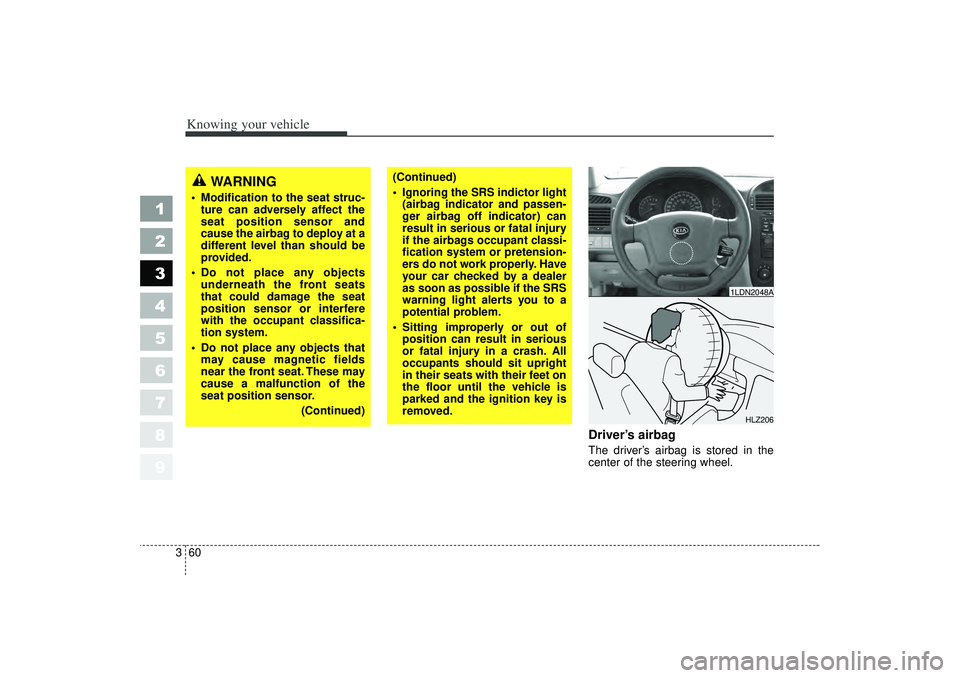
Driver’s airbagThe driver’ s airbag is stored in the
center of the steering wheel.
WARNING
Modification to the seat struc- ture can adversely affect the
seat position sensor and
cause the airbag to deploy at a
different level than should be
provided.
Do not place any objects underneath the front seats
that could damage the seat
position sensor or interfere
with the occupant classifica-
tion system.
Do not place any objects that may cause magnetic fields
near the front seat. These may
cause a malfunction of the
seat position sensor.
(Continued)
(Continued)
Ignoring the SRS indictor light(airbag indicator and passen-
ger airbag off indicator) can
result in serious or fatal injury
if the airbags occupant classi-
fication system or pretension-
ers do not work properly. Have
your car checked by a dealer
as soon as possible if the SRS
warning light alerts you to a
potential problem.
Sitting improperly or out of position can result in serious
or fatal injury in a crash. All
occupants should sit upright
in their seats with their feet on
the floor until the vehicle is
parked and the ignition key is
removed.
HLZ206
1LDN2048A
LD CAN (ENG) new 3-1~.qxd 7/29/05 10:28 AM Page 60
Page 77 of 273
Knowing your vehicle66
3
1
2
3
4
5
6
7
8
9
✽ ✽
NOTICE If luggage or other objects are
placed on the front passenger's
seat or if the temperature of the
seat changes while the seat is unoc-
cupied, the "PASSENGER
AIRBAG OFF" indicator may
blink. These conditions do not
indicate a problem.
Do not put heavy objects on the front
passenger's seat. This may cause
front passenger airbag deployment
in the event of an accident, thus
increasing your repair costs.
1KMN36651KMN3666
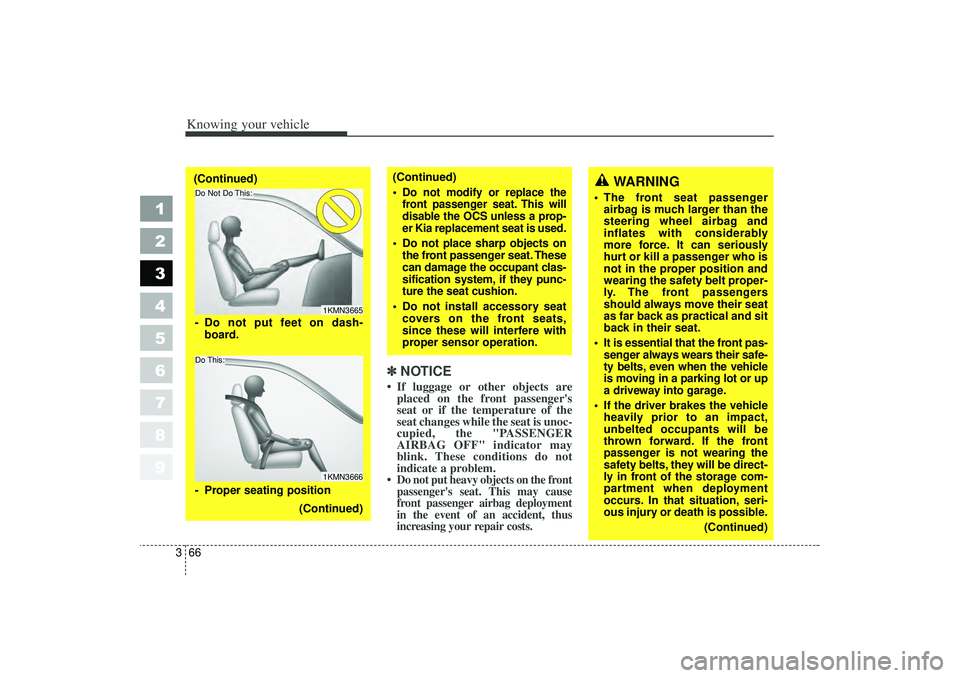
- Proper seating position
- Do not put feet on dash-
board.Do Not Do This:Do This:(Continued)
(Continued)
Do not modify or replace the
front passenger seat. This will
disable the OCS unless a prop-
er Kia replacement seat is used.Do not place sharp objects on
the front passenger seat. These
can damage the occupant clas-
sification system, if they punc-
ture the seat cushion. Do not install accessory seatcovers on the front seats,
since these will interfere with
proper sensor operation.
WARNING
The front seat passengerairbag is much larger than the
steering wheel airbag and
inflates with considerably
more force. It can seriously
hurt or kill a passenger who is
not in the proper position and
wearing the safety belt proper-
ly. The front passengers
should always move their seat
as far back as practical and sit
back in their seat.
It is essential that the front pas-
senger always wears their safe-
ty belts, even when the vehicle
is moving in a parking lot or up
a driveway into garage. If the driver brakes the vehicle heavily prior to an impact,
unbelted occupants will be
thrown forward. If the front
passenger is not wearing the
safety belts, they will be direct-
ly in front of the storage com-
partment when deployment
occurs. In that situation, seri-
ous injury or death is possible.
(Continued)
(Continued)
LD CAN (ENG) new 3-1~.qxd 7/29/05 10:29 AM Page 66
Page 78 of 273
367
1
2
3
4
5
6
7
8
9
Knowing your vehicle
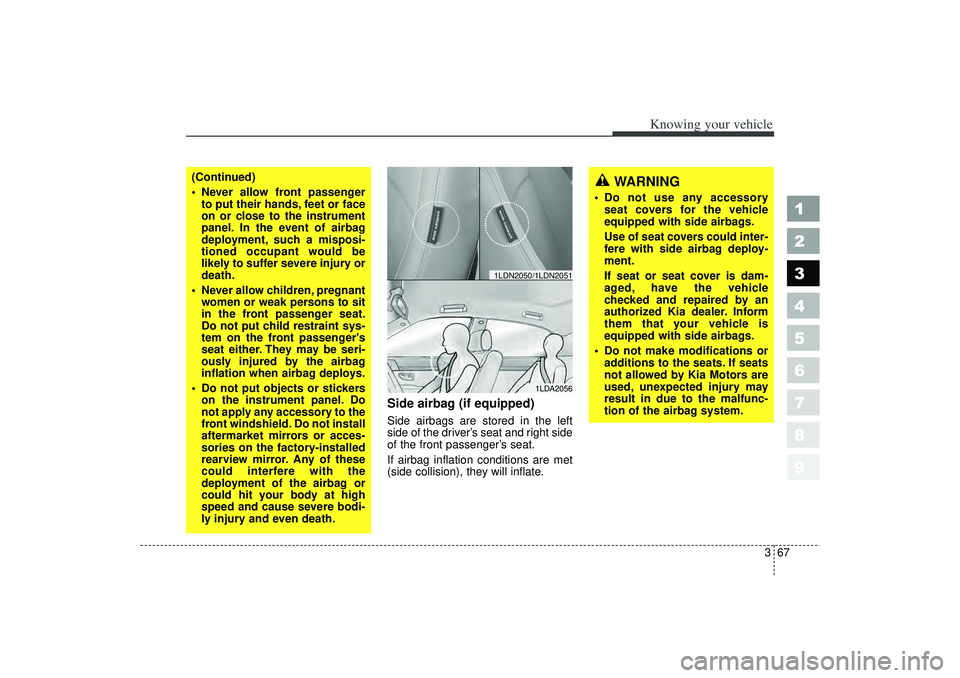
Side airbag (if equipped)Side airbags are stored in the left
side of the driver’s seat and right side
of the front passenger’ s seat.
If airbag inflation conditions are met
(side collision), they will inflate.
WARNING
Do not use any accessory seat covers for the vehicle
equipped with side airbags.
Use of seat covers could inter-
fere with side airbag deploy-
ment.
If seat or seat cover is dam-
aged, have the vehicle
checked and repaired by an
authorized Kia dealer. Inform
them that your vehicle is
equipped with side airbags.
Do not make modifications or additions to the seats. If seats
not allowed by Kia Motors are
used, unexpected injury may
result in due to the malfunc-
tion of the airbag system.
1LDA2056
1LDN2050/1LDN2051
(Continued)
Never allow front passengerto put their hands, feet or face
on or close to the instrument
panel. In the event of airbag
deployment, such a misposi-
tioned occupant would be
likely to suffer severe injury or
death.
Never allow children, pregnant women or weak persons to sit
in the front passenger seat.
Do not put child restraint sys-
tem on the front passenger's
seat either. They may be seri-
ously injured by the airbag
inflation when airbag deploys.
Do not put objects or stickers on the instrument panel. Do
not apply any accessory to the
front windshield. Do not install
aftermarket mirrors or acces-
sories on the factory-installed
rearview mirror. Any of these
could interfere with the
deployment of the airbag or
could hit your body at high
speed and cause severe bodi-
ly injury and even death.
LD CAN (ENG) new 3-1~.qxd 7/29/05 10:29 AM Page 67
Page 79 of 273

Knowing your vehicle68
3
1
2
3
4
5
6
7
8
9
Curtain airbag (if equipped)Curtain airbags are located along
both sides of the roof rails above the
front and rear doors.
They are designed to help protect the
heads of the front seat occupants
and the rear outboard seat occupants
in certain side impact collisions.
If the curtain airbag deploys, it
remains inflated for approximately 3
seconds. The curtain airbag deploy-
ment occurs only on the side of the
vehicle affected by the impact.
The side airbags (side and curtain
airbags) are not designed to deploy
during collisions from the front or
rear of the vehicle or in most rollover
situations.
The curtain airbags are designed to
deploy only during certain side-
impact collisions, depending on the
crash severity, angle, speed and
impact. The curtain airbags are not
designed to deploy in all side impact
situations.
WARNING
In order for side airbags (side
and curtain airbags) to pro-
vide its best protection, both
front seat occupants and both
outboard rear occupants
should sit in an upright posi-
tion with the seat belts proper-
ly fastened. Especially, chil-
dren should sit in a proper
child restraint system.
(Continued)
(Continued)
When children are seated inthe rear outboard seats, they
must be seated in the proper
child restraint system. Make
sure to put the child restraint
system as far away from the
door side as possible, and
secure the child restraint sys-
tem to be locked in position.
Do not allow the passengers to lean their heads or bodies
onto doors, put their arms on
the doors, stretch their arms
out of the window, or place
objects between the doors
and passengers when they are
seated on the seats where
side airbags are equipped.
Never try to open or repair any components of the side cur-
tain airbag system. This
should be done only by an
authorized Kia dealer.
Failure to follow the above men-
tioned instructions can result in
injury or death to the vehicle
occupants in an accident.
1LDA20521LDA2057
LD CAN (ENG) new 3-1~.qxd 7/29/05 10:29 AM Page 68
Page 87 of 273
Knowing your vehicle76
3
1
2
3
4
5
6
7
8
9
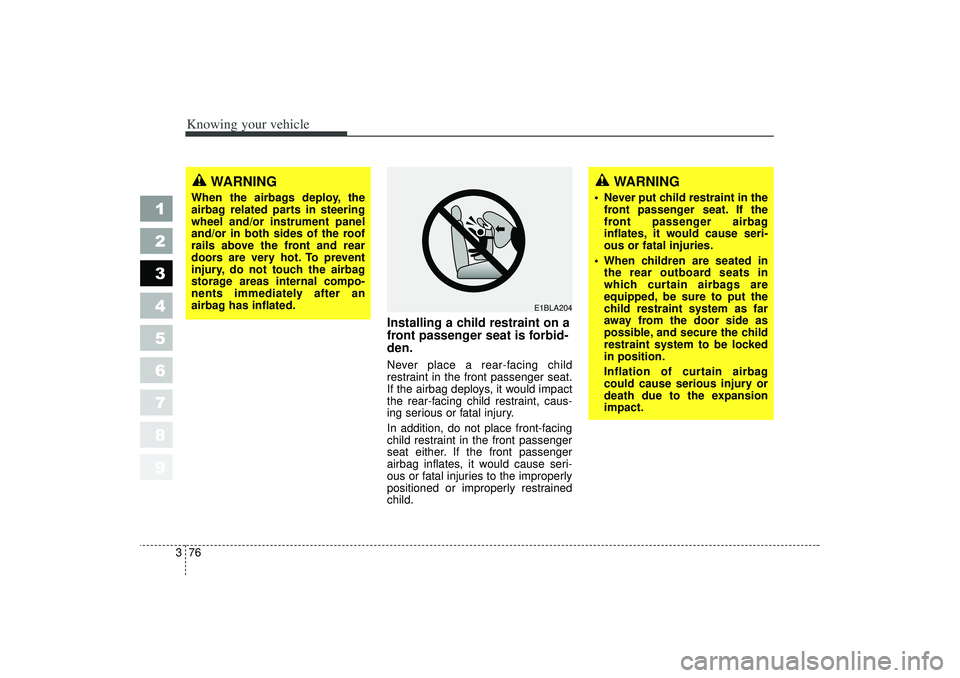
Installing a child restraint on a
front passenger seat is forbid-
den.Never place a rear-facing child
restraint in the front passenger seat.
If the airbag deploys, it would impact
the rear-facing child restraint, caus-
ing serious or fatal injury.
In addition, do not place front-facing
child restraint in the front passenger
seat either. If the front passenger
airbag inflates, it would cause seri-
ous or fatal injuries to the improperly
positioned or improperly restrained
child.
WARNING
Never put child restraint in the
front passenger seat. If the
front passenger airbag
inflates, it would cause seri-
ous or fatal injuries.
When children are seated in the rear outboard seats in
which curtain airbags are
equipped, be sure to put the
child restraint system as far
away from the door side as
possible, and secure the child
restraint system to be locked
in position.
Inflation of curtain airbag
could cause serious injury or
death due to the expansion
impact.
WARNING
When the airbags deploy, the
airbag related parts in steering
wheel and/or instrument panel
and/or in both sides of the roof
rails above the front and rear
doors are very hot. To prevent
injury, do not touch the airbag
storage areas internal compo-
nents immediately after an
airbag has inflated.
E1BLA204
LD CAN (ENG) new 3-1~.qxd 7/29/05 10:29 AM Page 76