warning KIA SPECTRA5 2006 Repair Manual
[x] Cancel search | Manufacturer: KIA, Model Year: 2006, Model line: SPECTRA5, Model: KIA SPECTRA5 2006Pages: 273, PDF Size: 2.83 MB
Page 113 of 273
Knowing your vehicle102
3
1
2
3
4
5
6
7
8
9
Tilting the sunroof Autotilt open
To use the autotilt feature, momen-
tarily (less than 0.5 second) press
the TILT UP ( ) button on the
overhead console. The sunroof will
tilt all the way open. To stop the sun-
roof tilting at any point, press any
sunroof control button.
Manual tilt open
Press the TILT UP ( ) button on
the overhead console for more than
0.5 second.
Close
To close the sunroof, press the
CLOSE ( ) button on the over-
head console and hold it until the
sunroof is closed.
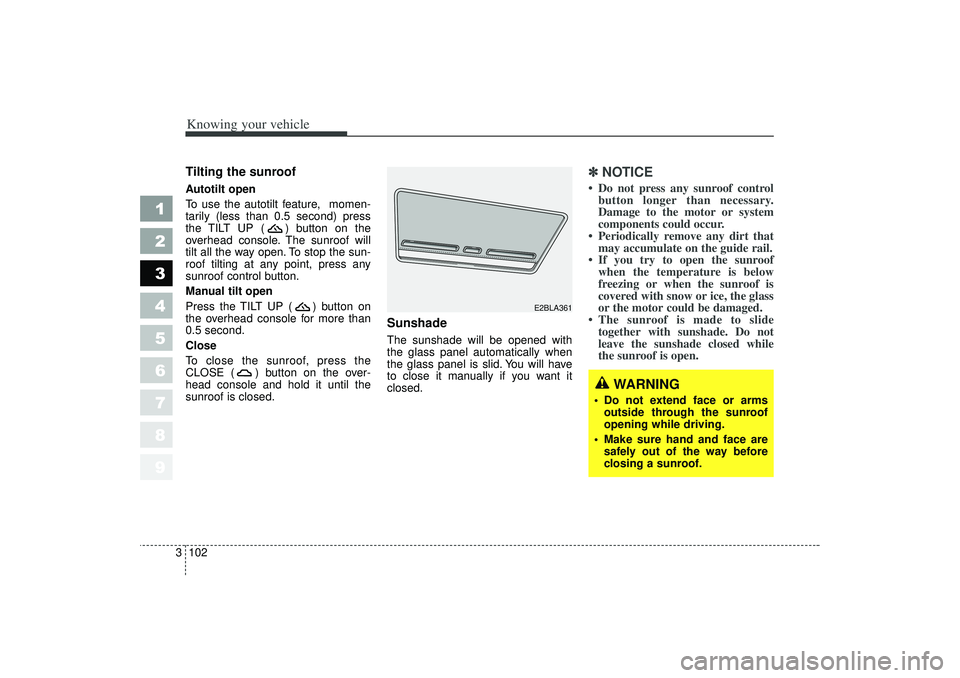
Sunshade The sunshade will be opened with
the glass panel automatically when
the glass panel is slid. You will have
to close it manually if you want it
closed.
✽ ✽
NOTICE Do not press any sunroof control
button longer than necessary.
Damage to the motor or system
components could occur.
Periodically remove any dirt that may accumulate on the guide rail.
If you try to open the sunroof when the temperature is below
freezing or when the sunroof is
covered with snow or ice, the glass
or the motor could be damaged.
The sunroof is made to slide together with sunshade. Do not
leave the sunshade closed while
the sunroof is open.
E2BLA361
WARNING
Do not extend face or arms
outside through the sunroof
opening while driving.
Make sure hand and face are safely out of the way before
closing a sunroof.
LD CAN (ENG) 3-84~.qxd 7/29/05 10:15 AM Page 102
Page 115 of 273
Knowing your vehicle104
3
1
2
3
4
5
6
7
8
9
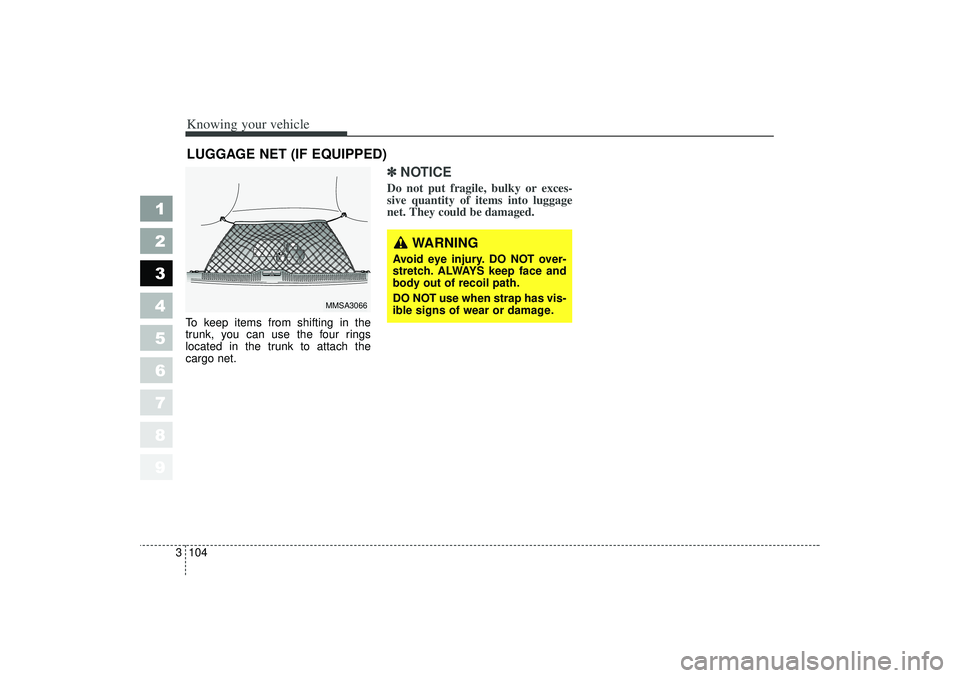
To keep items from shifting in the
trunk, you can use the four rings
located in the trunk to attach the
cargo net.
✽ ✽
NOTICEDo not put fragile, bulky or exces-
sive quantity of items into luggage
net. They could be damaged.
LUGGAGE NET (IF EQUIPPED)
MMSA3066
WARNING
Avoid eye injury. DO NOT over-
stretch. ALWAYS keep face and
body out of recoil path.
DO NOT use when strap has vis-
ible signs of wear or damage.
LD CAN (ENG) 3-84~.qxd 7/29/05 10:15 AM Page 104
Page 118 of 273
1
2
3
4
5
6
7
8
9
Ignition switch / 4-2
Starting the engine / 4-4
Manual transaxle / 4-5
Automatic transaxle / 4-6
Brake system / 4-12
Steering wheel / 4-19
Cruise control / 4-22
Traction control system / 4-27
Instrument cluster / 4-30
Gauges / 4-31
Warnings and indicators / 4-33
Lighting / 4-40
Wipers and washers / 4-44
Defroster / 4-47
Hazard warning flasher / 4-48
Manual climate control system / 4-49
Windshield defrosting and defogging / 4-58
Theft-alarm system / 4-60
Driving your vehicle
LD CAN (ENG) 4.qxd 7/29/05 10:16 AM Page 1
Page 119 of 273
Driving your vehicle24
1
2
3
4
5
6
7
8
9
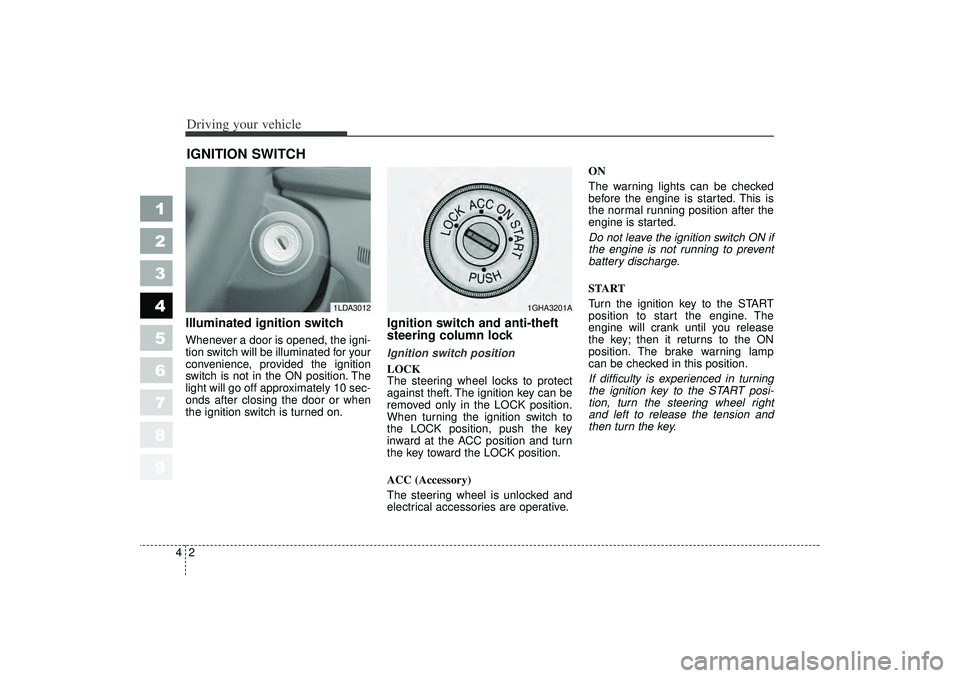
Illuminated ignition switchWhenever a door is opened, the igni-
tion switch will be illuminated for your
convenience, provided the ignition
switch is not in the ON position. The
light will go off approximately 10 sec-
onds after closing the door or when
the ignition switch is turned on.
Ignition switch and anti-theft
steering column lock Ignition switch position
LOCK
The steering wheel locks to protect
against theft. The ignition key can be
removed only in the LOCK position.
When turning the ignition switch to
the LOCK position, push the key
inward at the ACC position and turn
the key toward the LOCK position.
ACC (Accessory)
The steering wheel is unlocked and
electrical accessories are operative.ON
The warning lights can be checked
before the engine is started. This is
the normal running position after the
engine is started.
Do not leave the ignition switch ON if
the engine is not running to prevent
battery discharge.
START
Turn the ignition key to the START
position to start the engine. The
engine will crank until you release
the key; then it returns to the ON
position. The brake warning lamp
can be checked in this position.
If difficulty is experienced in turning
the ignition key to the START posi-
tion, turn the steering wheel right
and left to release the tension and
then turn the key.
IGNITION SWITCH
1LDA3012
1GHA3201A
LD CAN (ENG) 4.qxd 7/29/05 10:16 AM Page 2
Page 120 of 273
43
1
2
3
4
5
6
7
8
9
Driving your vehicle
Automatic transaxle
When turning the ignition switch to
the LOCK position, the shift lever
must be in the P (Park) position.
WARNING -
Ignition key
• Never turn the ignition switch to LOCK or ACC while the
vehicle is moving. This would
result in loss of directional
control and braking function,
which could cause an immedi-
ate accident.
The anti-theft steering column lock is not a substitute for the
parking brake. Before leaving
the driver’s seat, always make
sure the shift lever is engaged
in 1st gear for manual
transaxle or P (Park) for auto-
matic transaxle, set the park-
ing brake fully and shut the
engine off. Unexpected and
sudden vehicle movement
may occur if these precau-
tions are not taken.
(Continued)
(Continued)
Never reach for the ignitionswitch, or any other controls
through the steering wheel
while the vehicle is in motion.
The presence of your hand or
arm in this area could cause a
loss of vehicle control, an
accident and serious bodily
injury or death.
Do not place any movable objects around the driver’s
seat as they may move while
driving, interfere with the driv-
er and lead to an accident.
LD CAN (ENG) 4.qxd 7/29/05 10:16 AM Page 3
Page 122 of 273

45
1
2
3
4
5
6
7
8
9
Driving your vehicle
Manual transaxle operationThe manual transaxle has five for-
ward gears.
Press the clutch pedal down fully
while shifting, then release it slowly.
A special safety feature prevents
inadvertent shifting from 5 (Fifth) to
R (Reverse). The gearshift lever must
be returned to the neutral position
before shifting into R (Reverse).
Make sure the vehicle is completely
stopped before shifting into R
(Reverse).
Never operate the engine with the
tachometer (rpm) in the red zone.
✽ ✽NOTICETo avoid premature clutch wear and
damage, do not drive with your foot
resting on the clutch pedal. Also,
don’t use the clutch to hold the vehi-
cle stopped on an upgrade, while
waiting for a traffic light, etc.
Downshifting
When you must slow down in heavy
traffic or while driving up steep hills,
downshift before the engine starts to
“labor’’. Downshifting reduces the
chance of stalling and gives better
acceleration when you again need to
increase your speed. When the vehi-
cle is traveling down steep hills,
downshifting helps maintain safe
speed and prolongs brake life.
MANUAL TRANSAXLE (IF EQUIPPED)
1
2 4
R
3
S
N
135
R42
MMSA4002
WARNING
- Manualtransaxle
Before leaving the driver ’s seat,
always set the parking brake
fully and shut the engine off.
Then make sure the transaxle is
shifted into 1st gear when the
vehicle is parked on a level or
uphill grade, and shift into R
(Reverse) on a downhill grade.
Unexpected and sudden vehicle
movement can occur if these
precautions are not followed in
the order identified.
LD CAN (ENG) 4.qxd 7/29/05 10:16 AM Page 5
Page 124 of 273
47
1
2
3
4
5
6
7
8
9
Driving your vehicle
Automatic transaxle operationAll normal forward driving is done
with the shift lever in the D (Drive)
position.
To move the shift lever from the P
(Park) position, the brake pedal must
be depressed and the lock release
button must be depressed.For smooth operation, depress the
brake pedal when shifting from N
(Neutral) to a forward or reverse
gear.
✽ ✽
NOTICE To avoid damage to your
transaxle, do not accelerate the
engine in R (Reverse) or any for-
ward gear position with the
brakes on.
When stopped on an upgrade, do not hold the vehicle stationary
with engine power. Use the service
brake or the parking brake.
Do not shift from N (Neutral) or P (Park) into D (Drive), or R
(Reverse) when the engine is
above idle speed.
WARNING
- Automatic
transaxle
Before leaving the driver ’s seat,
always make sure the shift lever
is in the P (PARK) position; then
set the parking brake fully and
shut the engine off. Unexpected
and sudden vehicle movement
can occur if these precautions
are not followed in the order
identified.
LD CAN (ENG) 4.qxd 7/29/05 10:16 AM Page 7
Page 125 of 273

Driving your vehicle84
1
2
3
4
5
6
7
8
9
Transaxle rangesP (park)
This position locks the transaxle and
prevents the front wheels from rotat-
ing. Always come to a complete stop
before shifting into this position.
✽ ✽
NOTICEThe transaxle may be damaged if
you shift into P (Park) while the
vehicle is in motion.(Continued)
Before leaving the driver’ s
seat, always make sure the
shift lever is in the P (PARK)
position. Set the parking
brake fully, shut the engine off
and take the key with you.
Unexpected and sudden vehi-
cle movement can occur if you
do not follow these precau-
tions in the order specified.
Never leave a child unattend-
ed in a vehicle.
WARNING
Shifting into P (Park) while the
vehicle is in motion will cause
the drive wheels to lock which
will cause you to lose control
of the vehicle.
Do not use the P (Park) posi-
tion in place of the parking
brake. Always make sure the
shift lever is latched in the P
(Park) position so that it can-
not be moved unless the lock
release button is pushed in,
AND set the parking brake
fully.
(Continued)
LD CAN (ENG) 4.qxd 7/29/05 10:16 AM Page 8
Page 129 of 273
Driving your vehicle12
4
1
2
3
4
5
6
7
8
9
Power brakes Your vehicle has power-assisted
brakes that adjust automatically
through normal usage.
In the event that the power-assisted
brakes lose power because of a
stalled engine or some other reason,
you can still stop your vehicle by
applying greater force to the brake
pedal than you normally would. The
stopping distance, however, will be
longer.
When the engine is not running, the
reserve brake power is partially
depleted each time the brake pedal
is applied. Do not pump the brake
pedal when the power assist has
been interrupted.
Pump the brake pedal only when
necessary to maintain steering con-
trol on slippery surfaces.
In the event of brake failure If service brakes fail to operate while
the vehicle is in motion, you can
make an emergency stop with the
parking brake. The stopping dis-
tance, however, will be much greater
than normal.
BRAKE SYSTEM
WARNING
- Parking brake
Applying the parking brake
while the vehicle is moving at
normal speeds can cause a sud-
den loss of control of the vehi-
cle. If you must use the parking
brake to stop the vehicle, use
great caution in applying the
brake.
WARNING -
Brakes
Do not drive with your foot
resting on the brake pedal.
This will create abnormal high
brake temperatures, exces-
sive brake lining and pad
wear, and increased stopping
distances.
When descending a long or
steep hill, shift to a lower gear
and avoid continuous applica-
tion of the brakes. Continuous
brake application will cause
the brakes to overheat and
could result in a temporary
loss of braking performance.
(Continued)
LD CAN (ENG) 4.qxd 7/29/05 10:16 AM Page 12
Page 130 of 273
413
1
2
3
4
5
6
7
8
9
Driving your vehicle
Disc brakes wear indicator Your vehicle has disc brakes.
When your brake pads are worn and
it's time for new pads, you will hear a
high-pitched warning sound from
your front brakes or rear brakes (if
equipped). You may hear this sound
come and go or it may occur when-
ever you depress the brake pedal.
Please remember that some driving
conditions or climates may cause a
brake squeal when you first apply (or
lightly apply) the brakes. This is nor-
mal and does not indicate a problem
with your brakes.
✽ ✽NOTICETo avoid costly brake repairs, do not
continue to drive with worn brake
pads.
WARNING
- Brake wear
This brake wear warning sound
means your vehicle needs serv-
ice. If you ignore this audible
warning, you will eventually lose
braking performance, which
could lead to a serious accident.
CAUTION
Always replace brake pads as
complete front or rear axle sets.
(Continued)
Wet brakes may result in the
vehicle not slowing down at
the usual rate and pulling to
one side when the brakes are
applied. Applying the brakes
lightly will indicate whether
they have been affected in this
way. Always test your brakes
in this fashion after driving
through deep water. To dry the
brakes, apply them lightly
while maintaining a safe for-
ward speed until brake per-
formance returns to normal.
LD CAN (ENG) 4.qxd 7/29/05 10:16 AM Page 13