child restraint KIA SPECTRA5 2007 User Guide
[x] Cancel search | Manufacturer: KIA, Model Year: 2007, Model line: SPECTRA5, Model: KIA SPECTRA5 2007Pages: 312, PDF Size: 3.42 MB
Page 56 of 312
345
1
2
3
4
5
6
7
8
910
Knowing your vehicle
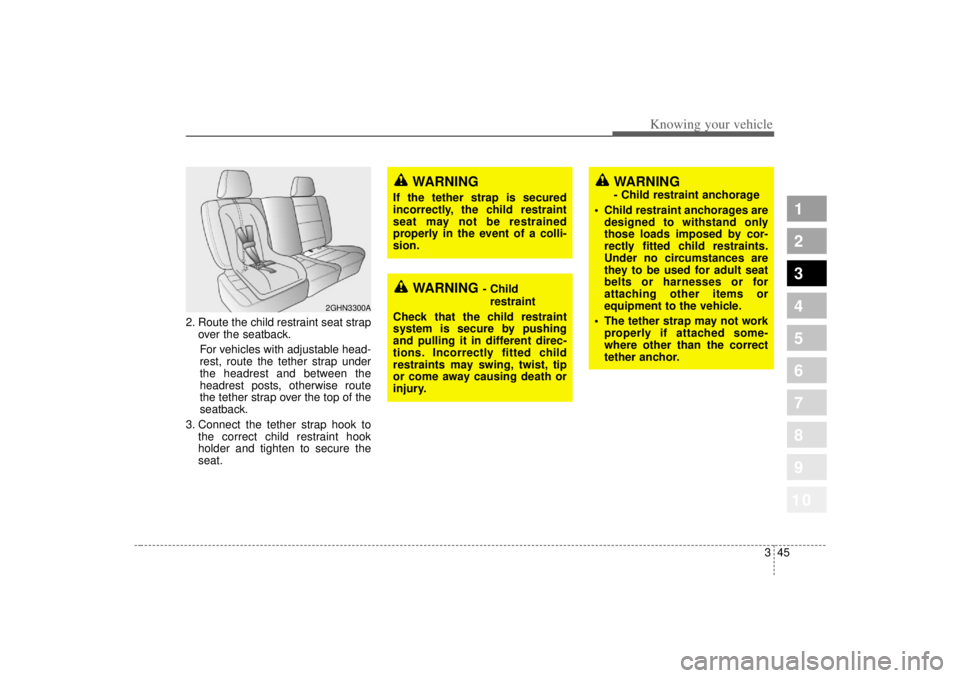
2. Route the child restraint seat strapover the seatback.
For vehicles with adjustable head-
rest, route the tether strap under
the headrest and between the
headrest posts, otherwise route
the tether strap over the top of the
seatback.
3. Connect the tether strap hook to the correct child restraint hook
holder and tighten to secure the
seat.
2GHN3300A
WARNING
If the tether strap is secured
incorrectly, the child restraint
seat may not be restrained
properly in the event of a colli-
sion.
WARNING
- Child
restraint
Check that the child restraint
system is secure by pushing
and pulling it in different direc-
tions. Incorrectly fitted child
restraints may swing, twist, tip
or come away causing death or
injury.
WARNING - Child restraint anchorage
Child restraint anchorages are designed to withstand only
those loads imposed by cor-
rectly fitted child restraints.
Under no circumstances are
they to be used for adult seat
belts or harnesses or for
attaching other items or
equipment to the vehicle.
The tether strap may not work properly if attached some-
where other than the correct
tether anchor.
Page 57 of 312
Knowing your vehicle46
3
1
2
3
4
5
6
7
8
910
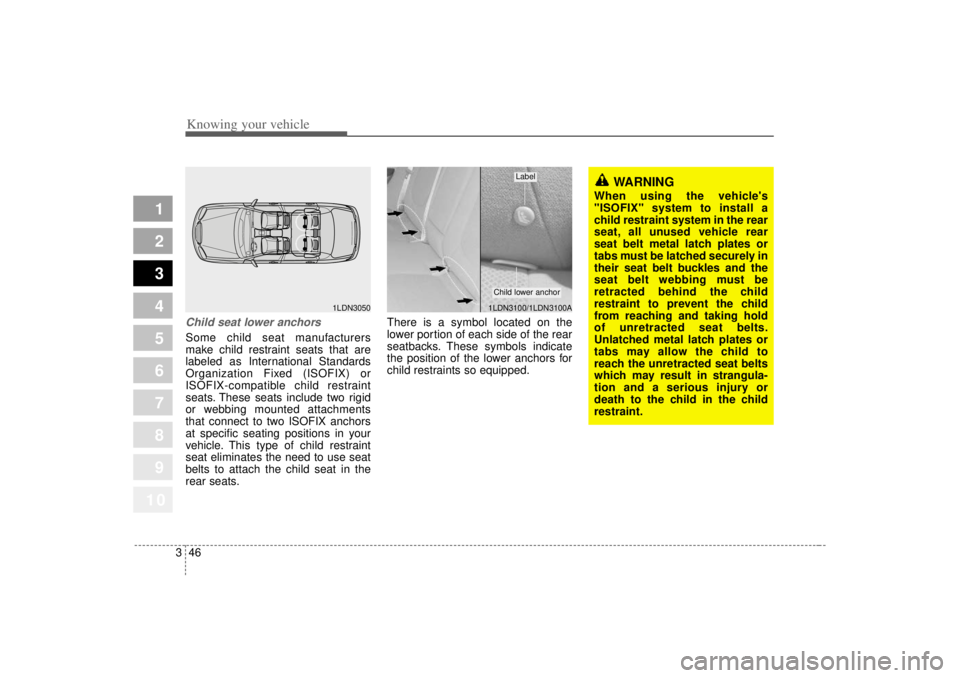
Child seat lower anchorsSome child seat manufacturers
make child restraint seats that are
labeled as International Standards
Organization Fixed (ISOFIX) or
ISOFIX-compatible child restraint
seats. These seats include two rigid
or webbing mounted attachments
that connect to two ISOFIX anchors
at specific seating positions in your
vehicle. This type of child restraint
seat eliminates the need to use seat
belts to attach the child seat in the
rear seats. There is a symbol located on the
lower portion of each side of the rear
seatbacks. These symbols indicate
the position of the lower anchors for
child restraints so equipped.
1LDN3050
1LDN3100/1LDN3100AChild lower anchor
Label
WARNING
When using the vehicle's
"ISOFIX" system to install a
child restraint system in the rear
seat, all unused vehicle rear
seat belt metal latch plates or
tabs must be latched securely in
their seat belt buckles and the
seat belt webbing must be
retracted behind the child
restraint to prevent the child
from reaching and taking hold
of unretracted seat belts.
Unlatched metal latch plates or
tabs may allow the child to
reach the unretracted seat belts
which may result in strangula-
tion and a serious injury or
death to the child in the child
restraint.
Page 58 of 312
347
1
2
3
4
5
6
7
8
910
Knowing your vehicle
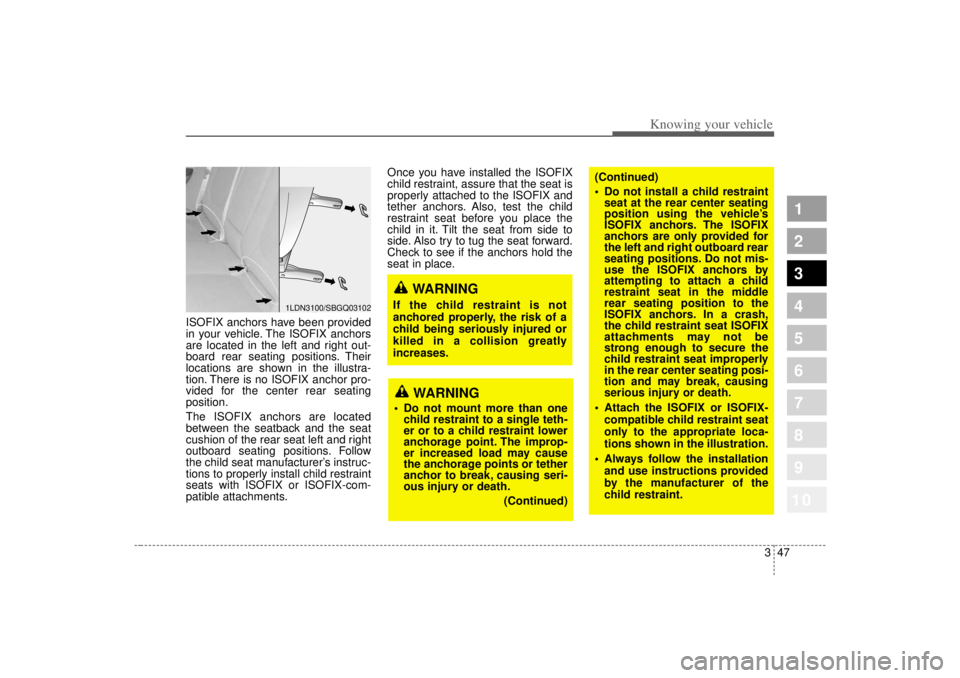
ISOFIX anchors have been provided
in your vehicle. The ISOFIX anchors
are located in the left and right out-
board rear seating positions. Their
locations are shown in the illustra-
tion. There is no ISOFIX anchor pro-
vided for the center rear seating
position.
The ISOFIX anchors are located
between the seatback and the seat
cushion of the rear seat left and right
outboard seating positions. Follow
the child seat manufacturer’s instruc-
tions to properly install child restraint
seats with ISOFIX or ISOFIX-com-
patible attachments. Once you have installed the ISOFIX
child restraint, assure that the seat is
properly attached to the ISOFIX and
tether anchors. Also, test the child
restraint seat before you place the
child in it. Tilt the seat from side to
side. Also try to tug the seat forward.
Check to see if the anchors hold the
seat in place.
WARNING
If the child restraint is not
anchored properly, the risk of a
child being seriously injured or
killed in a collision greatly
increases.
1LDN3100/SBGQ03102
WARNING
Do not mount more than one
child restraint to a single teth-
er or to a child restraint lower
anchorage point. The improp-
er increased load may cause
the anchorage points or tether
anchor to break, causing seri-
ous injury or death.
(Continued)
(Continued)
Do not install a child restraintseat at the rear center seating
position using the vehicle’s
ISOFIX anchors. The ISOFIX
anchors are only provided for
the left and right outboard rear
seating positions. Do not mis-
use the ISOFIX anchors by
attempting to attach a child
restraint seat in the middle
rear seating position to the
ISOFIX anchors. In a crash,
the child restraint seat ISOFIX
attachments may not be
strong enough to secure the
child restraint seat improperly
in the rear center seating posi-
tion and may break, causing
serious injury or death.
Attach the ISOFIX or ISOFIX- compatible child restraint seat
only to the appropriate loca-
tions shown in the illustration.
Always follow the installation and use instructions provided
by the manufacturer of the
child restraint.
Page 67 of 312
Knowing your vehicle56
3
1
2
3
4
5
6
7
8
910
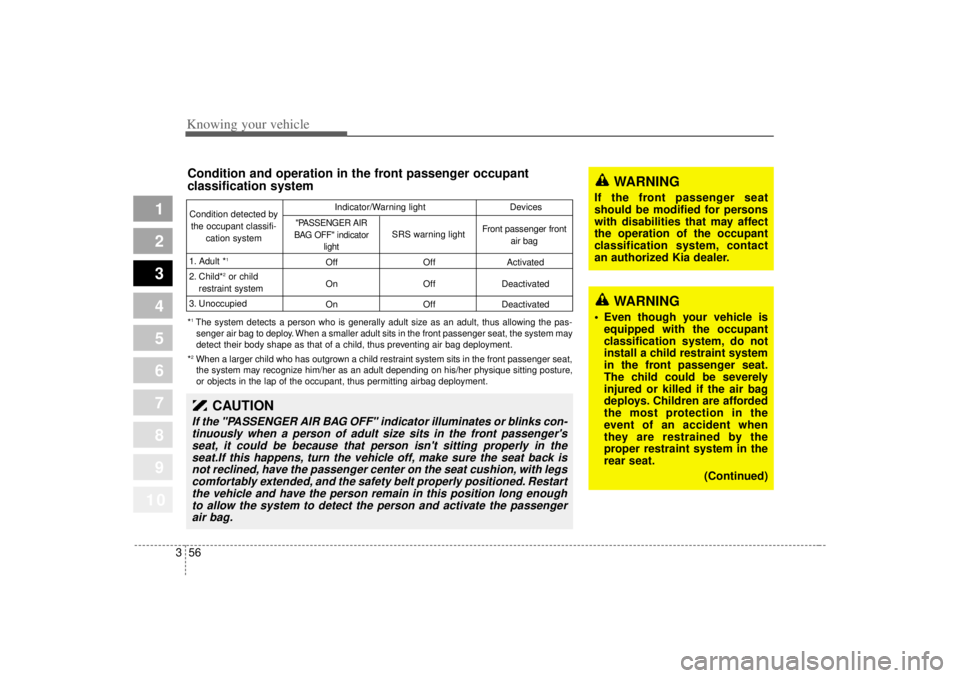
Condition and operation in the front passenger occupant
classification systemCondition detected by
the occupant classifi- cation system
1. Adult *
1
2. Child*
2or child
restraint system
3. Unoccupied Off
On
On Off
Off
OffActivated
Deactivated
Deactivated
"PASSENGER AIR
BAG OFF" indicator light
SRS warning light Front passenger front
air bag
Indicator/Warning light Devices
*1The system detects a person who is generally adult size as an adult, thus allowing the pas-
senger air bag to deploy. When a smaller adult sits in the front passenger seat, the system may
detect their body shape as that of a child, thus preventing air bag deployment.
*2When a larger child who has outgrown a child restraint system sits in the front passenger seat, the system may recognize him/her as an adult depending on his/her physique sitting posture,
or objects in the lap of the occupant, thus permitting airbag deployment.
CAUTION
If the "PASSENGER AIR BAG OFF" indicator illuminates or blinks con- tinuously when a person of adult size sits in the front passenger'sseat, it could be because that person isn't sitting properly in theseat.If this happens, turn the vehicle off, make sure the seat back isnot reclined, have the passenger center on the seat cushion, with legscomfortably extended, and the safety belt properly positioned. Restartthe vehicle and have the person remain in this position long enoughto allow the system to detect the person and activate the passengerair bag.
WARNING
If the front passenger seat
should be modified for persons
with disabilities that may affect
the operation of the occupant
classification system, contact
an authorized Kia dealer.
WARNING
Even though your vehicle is equipped with the occupant
classification system, do not
install a child restraint system
in the front passenger seat.
The child could be severely
injured or killed if the air bag
deploys. Children are afforded
the most protection in the
event of an accident when
they are restrained by the
proper restraint system in the
rear seat.
(Continued)
Page 71 of 312

Knowing your vehicle60
3
1
2
3
4
5
6
7
8
910
Side air bag (if equipped)Side air bags are stored in the left
side of the driver’ s seat and right side
of the front passenger’ s seat.
If air bag inflation conditions are met
(side collision), they will inflate.
1LDA2056
1LDN2050/1LDN2051
(Continued)
If the driver brakes the vehicle heavily prior to an impact,
unbelted occupants will be
thrown forward. If the front
passenger is not wearing the
safety belts, they will be
directly in front of the air bag
when deployment occurs. In
that situation, serious injury
or death is possible.
Never allow front passenger to put their hands, feet or face
on or close to the instrument
panel. In the event of air bag
deployment, such a misposi-
tioned occupant would be
likely to suffer severe injury or
death.
Never allow children, pregnant women or weak persons to sit
in the front passenger seat.
They may be seriously injured
by the air bag inflation when
air bag deploys.
(Continued)
(Continued)
Do not use child restraint sys-tems on the front passenger's
seat, as inflation may cause
death or severe personal
injury.
Do not put objects or stickers on the instrument panel. Do
not apply any accessory to the
front windshield. Do not install
aftermarket mirrors or acces-
sories on the factory-installed
rearview mirror. Any of these
could interfere with the
deployment of the air bag or
could hit your body at high
speed and cause severe bodi-
ly injury and even death.
Page 73 of 312
Knowing your vehicle62
3
1
2
3
4
5
6
7
8
910
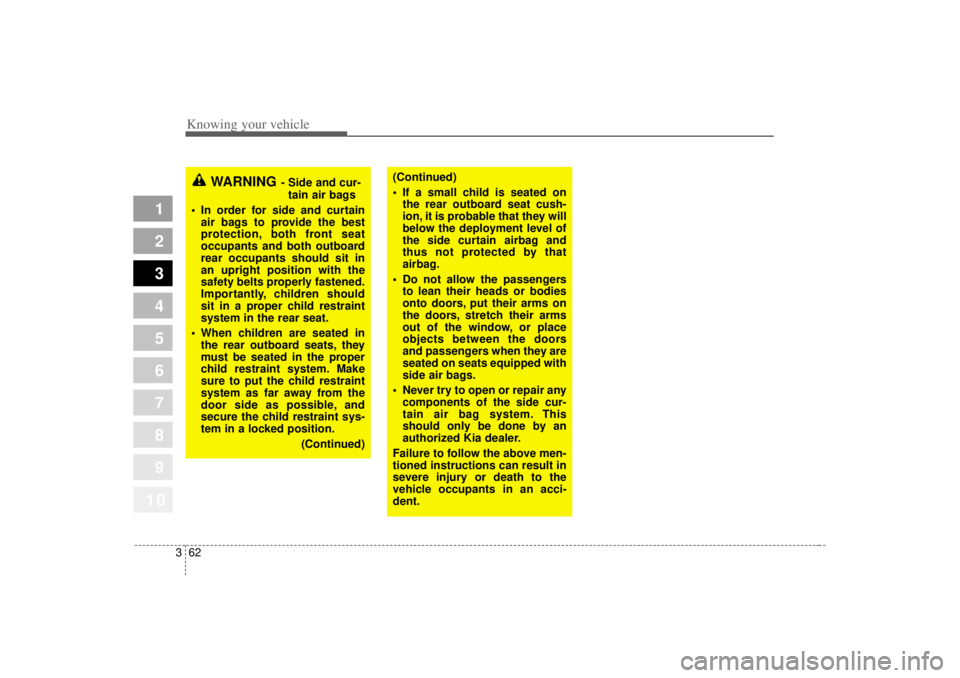
WARNING
- Side and cur-
tain air bags
In order for side and curtain air bags to provide the best
protection, both front seat
occupants and both outboard
rear occupants should sit in
an upright position with the
safety belts properly fastened.
Importantly, children should
sit in a proper child restraint
system in the rear seat.
When children are seated in the rear outboard seats, they
must be seated in the proper
child restraint system. Make
sure to put the child restraint
system as far away from the
door side as possible, and
secure the child restraint sys-
tem in a locked position.
(Continued)
(Continued)
If a small child is seated onthe rear outboard seat cush-
ion, it is probable that they will
below the deployment level of
the side curtain airbag and
thus not protected by that
airbag.
Do not allow the passengers to lean their heads or bodies
onto doors, put their arms on
the doors, stretch their arms
out of the window, or place
objects between the doors
and passengers when they are
seated on seats equipped with
side air bags.
Never try to open or repair any components of the side cur-
tain air bag system. This
should only be done by an
authorized Kia dealer.
Failure to follow the above men-
tioned instructions can result in
severe injury or death to the
vehicle occupants in an acci-
dent.
Page 81 of 312

Knowing your vehicle70
3
1
2
3
4
5
6
7
8
910
Installing a child restraint on a
front passenger seat is
extremely dangerous and
should never be done.Never place a rear-facing child
restraint in the front passenger seat.
If the air bag deploys, it would impact
the rear-facing child restraint, caus-
ing severe or fatal injury.
In addition, do not place front-facing
child restraint in the front passen-
ger’ s seat either. If the front passen-
ger air bag inflates, it would cause
serious or fatal injuries to the improp-
erly positioned or improperly
restrained child.
WARNING
Extreme Hazard! Do not use a rearward facing child restraint
on a seat protected by an air
bag in front of it!
Never put child restraint in the front passenger’s seat. If the
front passenger air bag
inflates, it would cause seri-
ous or fatal injuries.
When children are seated in the rear outboard seats in
which curtain air bags are
equipped, be sure to put the
child restraint system as far
away from the door side as
possible, and secure the child
restraint system to be locked
in position.
Inflation of curtain air bag (if
equipped) could cause severe
injury or death due to the
expansion impact.
WARNING
When the air bags deploy, the
air bag related parts in steering
wheel and/or instrument panel
and/or in both sides of the roof
rails above the front and rear
doors are very hot. To prevent
injury, do not touch the air bag
storage areas internal compo-
nents immediately after an air
bag has inflated.
1JBH3051
Page 207 of 312

Driving tips16
5
The label will help you decide how
much cargo and installed equipment
your vehicle can carry.
If you carry items inside your vehicle
- like suitcases, tools, packages, or
anything else - they are moving as
fast as the vehicle. If you have to stop
or turn quickly, or if there is a crash,
the items will keep going and can
cause an injury if they strike the driv-
er or a passenger.
1
2
3
4
5
6
7
8
910
WARNING -
Over loading
Never exceed the GVWR for your vehicle, the GAWR for
either the front or rear axle
and vehicle capacity weight.
Exceeding these ratings can
cause an accident or vehicle
damage. You can calculate the
weight of your load by weigh-
ing the items (or people)
before putting them in the
vehicle. Be careful not to over-
load your vehicle.
If you overload your vehicle, the tires can suddenly and
without warning fail. The over-
loading can also make your
vehicle unstable and dramati-
cally increase braking dis-
tance. This could cause you
to lose control and crash.
WARNING -
Loose cargo
Items you carry inside your
vehicle can strike and injure
occupants in a sudden stop or
sharp turn, or in a crash.
Put items in the trunk of your vehicle. Try to spread the
weight evenly.
Never stack items, like suit- cases, inside the occupant
compartment.
Do not leave an unsecured child restraint in your vehicle,
since it can injure occupants
in a crash.
When you carry something inside the vehicle, secure it.
CAUTION
Overloading your vehicle may cause damage. Repairs wouldnot be covered by your war-ranty. Do not overload yourvehicle.
Using heavier suspension components to get addeddurability might not changeyour weight ratings. Ask yourdealer to help you load yourvehicle the right way.ignored.