warning light KIA SPECTRA5 2007 User Guide
[x] Cancel search | Manufacturer: KIA, Model Year: 2007, Model line: SPECTRA5, Model: KIA SPECTRA5 2007Pages: 312, PDF Size: 3.42 MB
Page 82 of 312

371
1
2
3
4
5
6
7
8
910
Knowing your vehicle
Air bag warning lightThe purpose of air bag warning light
in your instrument panel is to alert
you of a potential problem with your
air bag - Supplemental Restraint
System (SRS).When the ignition switch is turned
ON, the indicator light should blink or
illuminate for approximately 6 sec-
onds, then go off.
Have the system checked if:
The light does not turn on briefly
when you turn the ignition ON.
The light stays on after the engine
starts.
The light comes on while the vehi-
cle is in motion.
Air bag (Supplemental
Restraint System) service Your Supplemental Restraint System
is virtually maintenance-free. There
are no parts which you can service.
You must have the system serviced
under the following circumstances:
If an air bag ever inflates, the air
bag must be replaced. Do not try to
remove or discard the air bag by
yourself. This must be done by an
authorized Kia dealer.
If the air bag warning indicator light
alerts you to a problem, have the
air bag system checked as soon as
possible. Otherwise, your air bag
system may be ineffective.
A-BAG-W
Page 88 of 312

377
1
2
3
4
5
6
7
8
910
Knowing your vehicle
Opening the hood:1. Pull the release lever on the lowerleft side of the instrument panel to
unlatch the hood. The hood should
pop open slightly. 2. Go to the front of the vehicle,
slightly raise the hood, push the
secondary latch ( 1) inside of the
hood center and lift ( 2) the hood. 3. Lift the hood and hold it open with
the prop rod by inserting the free
end of the rod into the slot in the
hood.HOOD
1LDA2020
1LDA2166
OLD026023
WARNING
Handle the support rod in the
area wrapped in rubber. The rub-
ber will help prevent you from
being burned by hot metal when
the engine is hot.
Page 89 of 312

Knowing your vehicle78
3
1
2
3
4
5
6
7
8
910
Closing the hood1. Before closing the hood, check the
following:
All filler caps in engine compart- ment must be correctly installed.
Gloves, rags or any other com- bustible material must be
removed from the engine com-
partment.
2. Secure the support rod in its clip.
3. Lower the hood to about 12 inches (30 cm) height and then let it drop
to properly lock in place.
Make sure the hood is properly
locked before driving. 1. Stop the engine.
2. To open the fuel filler lid, pull the
release lever. 3. Pull the fuel filler lid out to open.
4. To remove the cap, turn the fuel
tank cap counter-clockwise.
5. Refuel as needed.
6. To install the cap, turn it clockwise until it “clicks”. This indicates that
the cap is securely tightened.
7. Close the fuel filler lid and push it lightly and make sure that it is
securely closed.
FUEL FILLER LID
1LDA2019
OLD026018
WARNING
Before closing the hood, makesure that all engine parts and
tools have been removed from
the engine area and that no
one’s hands are near the hood
opening.
Do not leave gloves, rags or any other combustible materi-
al in the engine compartment.
Doing so may cause a heat-
induced fire.
WARNING
To avoid injury from sharp
edges, it is recommended that
protective gloves be worn if
there is a need to open the fuel
filler door manually.
Page 96 of 312

385
1
2
3
4
5
6
7
8
910
Knowing your vehicle
Map light Front (if equipped)The lights are turned ON or OFF by
pressing the corresponding switch.
Dome light (if equipped)(1) OFF - The light stays off evenwhen a door is open.
(2) DOOR - The light turns on when a door is opened or when a door is
unlocked by the transmitter (if
equipped). Interior light goes out
slowly after 30 seconds if the
door is closed. However if the
ignition switch is ON or all vehicle
doors are locked when the door is
closed, interior light will turn off
even within 30 seconds.
(3) ON - The light turns on and stays on even when the doors are all
closed. Door courtesy lamp (if equipped)
The door courtesy lamp comes ON
when the door is opened to assist
entering or exiting the vehicle. It also
serves as a warning to passing vehi-
cles that the vehicle door is open.
INTERIOR LIGHTS
1LDA2113
OLD026111OLD026112
Type AType B
1LDN3202
Page 97 of 312

Knowing your vehicle86
3
1
2
3
4
5
6
7
8
910
Center console storageTo open either of the console storage
compartments, push the button (1) or
pull up the lever (2).
These compartments can be used to
store small items required by the
driver or front passenger.
STORAGE COMPARTMENT
WARNING -
Flammable
materials
Do not store cigarette lighters,
propane cylinders, or other
flammable/explosive materials
in the vehicle. These items may
catch fire and/or explode if the
vehicle is exposed to hot tem-
peratures for extended periods.
OLD026151
CAUTION
• To avoid possible theft, do not leave valuables in the storagecompartment.
Always keep the storage com- partment covers closed whiledriving. Do not attempt toplace many items in the stor-age compartment that thestorage compartment covercan not close securely.
Page 99 of 312
Knowing your vehicle88
3
1
2
3
4
5
6
7
8
910
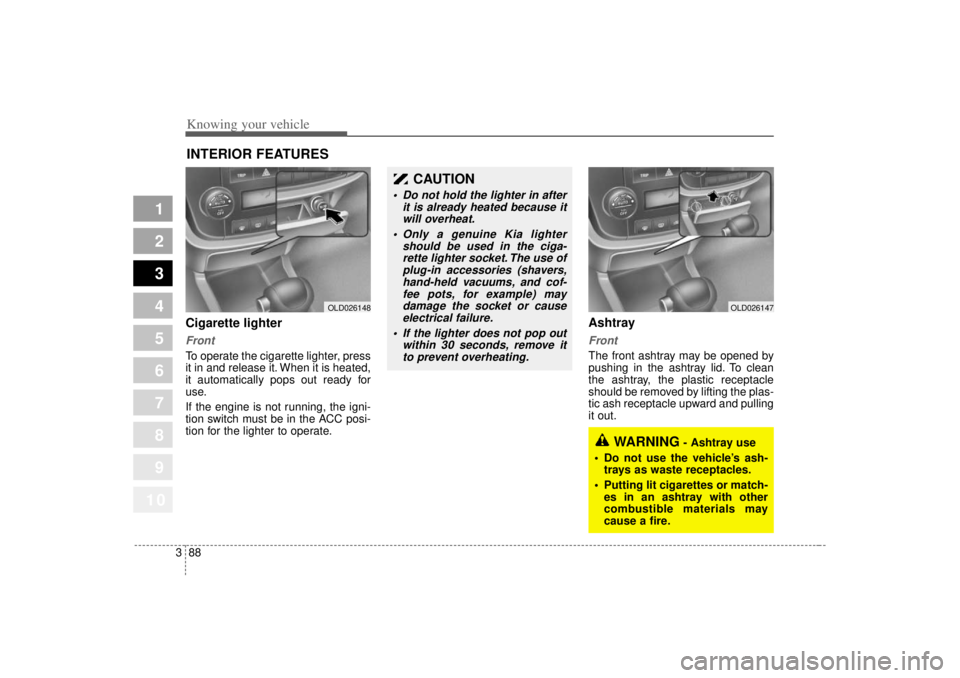
Cigarette lighterFrontTo operate the cigarette lighter, press
it in and release it. When it is heated,
it automatically pops out ready for
use.
If the engine is not running, the igni-
tion switch must be in the ACC posi-
tion for the lighter to operate.
AshtrayFront The front ashtray may be opened by
pushing in the ashtray lid. To clean
the ashtray, the plastic receptacle
should be removed by lifting the plas-
tic ash receptacle upward and pulling
it out.
INTERIOR FEATURES
WARNING
- Ashtray use
Do not use the vehicle’s ash- trays as waste receptacles.
Putting lit cigarettes or match- es in an ashtray with other
combustible materials may
cause a fire.
OLD026148
OLD026147
CAUTION
Do not hold the lighter in after it is already heated because itwill overheat.
Only a genuine Kia lighter should be used in the ciga-rette lighter socket. The use ofplug-in accessories (shavers,hand-held vacuums, and cof-fee pots, for example) maydamage the socket or causeelectrical failure.
If the lighter does not pop out within 30 seconds, remove itto prevent overheating.
Page 110 of 312

399
Knowing your vehicle
1
2
3
4
5
6
7
8
910
Using a cellular phone or a
two-way radio When a cellular phone is used inside
the vehicle, noise may be produced
from the audio equipment. This does
not mean that something is wrong
with the audio equipment. In such a
case, use the cellular phone at a
place as far as possible from the
audio equipment.
Care of cassette tapes
(if equipped) Because the thickness of a cas-sette tape with the total playback
time of over 60 minutes (C-60) are
too thin, we suggest that you do
not use any of them to avoid hav-
ing tapes being tangled.
To achieve better sound quality, periodically clean the tape head
using a cotton stick with colorless
alcohol (once per month).
If a tape is too loose, fasten it to reel by winding with objects like a
pencil.
Because dust or foreign objects on a cassette tape may damage the
playback head, always store tapes
in their cases when not in use.
Make sure cassette tapes are kept away from magnetic devices (TV,
stereo system, etc) in order to
achieve better sound quality.
Be certain that no objects or sub- stances other than cassette tapes
are inserted into the cassette tape
player. Because tape media can be dis-
torted when exposed to direct sun-
light, Do not leave cassette tapes
on the seats, dashboard or near
the back windshield.
WARNING -
Cellular
phones
Don’t use a cellular phone when
you are driving. The driver must
stop at a safe place to use a cel-
lular phone.
Page 133 of 312
1
2
3
4
5
6
7
8
9
Ignition switch / 4-2
Starting the engine / 4-4
Manual transaxle / 4-5
Automatic transaxle / 4-6
Brake system / 4-12
Steering wheel / 4-18
Cruise control / 4-21
Traction control system / 4-25
Instrument cluster / 4-28
Gauges / 4-29
Warnings and indicators / 4-31
Lighting / 4-39
Wipers and washers / 4-43
Defroster / 4-45
Hazard warning flasher / 4-46
Manual climate control system / 4-47
Windshield defrosting and defogging / 4-56
Theft-alarm system / 4-58
Driving your vehicle
10
Page 134 of 312

Driving your vehicle24
1
2
3
4
5
6
7
8
910
Illuminated ignition switchWhenever a door is opened, the igni-
tion switch will be illuminated for your
convenience, provided the ignition
switch is not in the ON position. The
light will go off approximately 30 sec-
onds after closing the door or when
the ignition switch is turned on.
Ignition switch and anti-theft
steering column lock Ignition switch positionLOCK
The steering wheel locks to protect
against theft. The ignition key can be
removed only in the LOCK position.
When turning the ignition switch to
the LOCK position, push the key
inward at the ACC position and turn
the key toward the LOCK position.
ACC (Accessory)
The steering wheel is unlocked and
electrical accessories are operative.ON
The warning lights can be checked
before the engine is started. This is
the normal running position after the
engine is started.
Do not leave the ignition switch ON if
the engine is not running to preventbattery discharge.START
Turn the ignition key to the START
position to start the engine. The
engine will crank until you release
the key; then it returns to the ON
position. The brake warning lamp
can be checked in this position.✽ ✽ NOTICEIf difficulty is experienced in turn-
ing the ignition key to the START
position, turn the steering wheel
right and left to release resistance
and then turn the key.
IGNITION SWITCH
1LDA3012
OUN036002
Page 137 of 312

45
1
2
3
4
5
6
7
8
910
Driving your vehicle
Manual Transaxle OperationThe manual transaxle has five for-
ward gears.
Press the clutch pedal down fully
while shifting, then release it slowly.
A special safety feature prevents
inadvertent shifting from 5 (Fifth) to
R (Reverse). The gearshift lever must
be returned to the neutral position
before shifting into R (Reverse).Make sure the vehicle is completelystopped before shifting into R(Reverse).
Never operate the engine with thetachometer (rpm) in the red zone. Downshifting
When you must slow down in heavy
traffic or while driving up steep hills,
downshift before the engine starts to
“labor’’. Downshifting reduces the
chance of stalling and gives better
acceleration when you again need to
increase your speed. When the vehi-
cle is traveling down steep hills,
downshifting helps maintain safe
speed and prolongs brake life.
MANUAL TRANSAXLE (IF EQUIPPED)
OLD046003N
WARNING
- Manual
transaxle
Before leaving the driver’s seat,
always set the parking brake
fully and shut the engine off.
Then make sure the transaxle is
shifted into 1st gear on level or
uphill ground or into R
(Reverse) gear on downhill
ground. Unexpected and sud-
den vehicle movement can
occur if these precautions are
not followed in the order identi-
fied.
CAUTION
To avoid premature clutch wear and damage, do not drive withyour foot resting on the clutchpedal. Also, don’t use the clutchto hold the vehicle stopped onan upgrade, while waiting for atraffic light, etc.