tow KIA SPECTRA5 2008 Owner's Guide
[x] Cancel search | Manufacturer: KIA, Model Year: 2008, Model line: SPECTRA5, Model: KIA SPECTRA5 2008Pages: 298, PDF Size: 5.38 MB
Page 210 of 298

Driving tips
20 5
1
2
3
4
5
6
7
8
9
Safety chains
You should always attach chains
between your vehicle and your trail-
er. Cross the safety chains under the
tongue of the trailer so that the
tongue will not drop to the road if it
becomes separated from the hitch.
Instructions about safety chains may
be provided by the hitch manufactur-
er or by the trailer manufacturer.
Follow the manufacturer’s recom-
mendation for attaching safety
chains. Always leave just enough
slack so you can turn with your trail-
er. And, never allow safety chains to
drag on the ground.
Trailer brakes
If your trailer weighs more than the
maximum weight for a trailer without
brakes, then the trailer needs its own
brakes. You must consult with a
knowledgeable and reputable trailer
vendor to determine which brake
equipped trailer is right for your
needs. Be sure to read and follow the
instructions for the trailer brakes so
you’ll be able to install, adjust and
maintain them properly.
Driving with a trailer
Towing a trailer requires experience.
You must gain that experience slow-
ly and carefully which practicing with
an unloaded or lightly loaded trailer.
Before setting out for the open road,
you must get to know your trailer.
Acquaint yourself with the feel of
handling and braking with the trailer.
And always keep in mind that the
vehicle you are driving is now a good
deal longer and not nearly so
responsive as your vehicle is by
itself.
Before you start, check the trailer
hitch and platform, safety chains,
electrical connector(s), lights, tires
and mirror adjustment. If the trailer
has electric brakes, start your vehicle
and trailer moving and then apply the
trailer brake controller by hand to be
sure the brakes are working. This lets
you check your electrical connection
at the same time.
During your trip, check occasionally
to be sure that the load is secure,
and that the lights and any trailer
brakes are still working.
WARNING
Do not use a trailer with its own
brakes unless you are absolute-
ly certain that you have properly
set up the brake system. This is
not a task for amateurs. Use an
experienced, competent trailer
shop for this work.
Page 211 of 298
521
Driving tips
1
2
3
4
5
6
7
8
9
Following distance
Stay at least twice as far behind the
vehicle ahead as you would when
driving your vehicle without a trailer.
This can help you avoid situations
that require heavy braking and sud-
den turns.
Passing
You’ll need more passing distance
up ahead when you’re towing a trail-
er. And, because you’re a good deal
longer, you’ll need to go much farther
beyond the passed vehicle before
you can return to your lane.
Backing up
The trailer will go in the opposite
direction of the rear of your vehicle
when backing up. This is very difficult
for an inexperienced trailer driver to
get used to. To help you avoid mis-
takes, hold the bottom of the steering
wheel with one hand. Then, to move
the trailer to the left, just hold the
steering wheel firmly and move your
hand to the left. To move the trailer to
the right, move your hand to the
right. Always back up slowly and, if
possible, have someone guide you.
Making turns
When you’re turning with a trailer,
make wider turns than normal. Do
this so your trailer won’t strike soft
shoulders, curbs, road signs, trees,
or other objects. Avoid jerky or sud-
den maneuvers. Signal well in
advance.
Turn signals when towing a trailer
When you tow a trailer, your vehicle
has to have a different turn signal
flasher and extra wiring. The green
arrows on your instrument panel will
flash whenever you signal a turn or
lane change. Properly connected,
the trailer lights will also flash to alert
other drivers you’re about to turn,
change lanes, or stop.
When towing a trailer, the green
arrows on your instrument panel will
flash for turns even if the bulbs on
the trailer are burned out. Thus, you
may think drivers behind you are
seeing your signals when, in fact,
they are not. It’s important to check
reqularly to be sure the trailer bulbs
are still working. You must also check
the lights every time you disconnect
and then reconnect the wires.
Page 212 of 298
Driving tips
22 5
1
2
3
4
5
6
7
8
9
Do not connect a trailer lighting sys-
tem directly to your vehicle’s lighting
system. Use only an approved trailer
wiring harness.
Your Authorized Kia Dealer can
assist you in installing the wiring har-
ness.Driving on grades
Reduce speed and shift to a lower
gear before you start down a long or
steep downgrade. If you don’t shift
down, you might have to use your
brakes so much that they would get
hot and no longer operate efficiently.
On a long uphill grade, shift down
and reduce your speed to around 70
km/h (45 mph) to reduce the possi-
bility of engine and transaxle over-
heating.
Operating your vehicle in D (Drive)
when towing a trailer will minimize
heat buildup and extend the life of
your transaxle.
WARNING - Trailer wiring
harness
Failure to use an approved trail-
er wiring harness could result in
damage to the vehicle's electri-
cal system, there by disabling
the brake light system resulting
in an accident.
CAUTION
When towing a trailer on steep
grades especially (in excess of
6%) pay close attention to the
engine coolant temperature
gauge to ensure the engine
does not overheat. If the needle
of the coolant temperature
gauge moves across the dial
towards “H” (HOT), pull over and
stop as soon as it is safe to do
so, and allow the engine to idle
until it cools down. You may pro-
ceed once the engine has
cooled sufficiently.
Page 214 of 298

Driving tips
24 5
1
2
3
4
5
6
7
8
9
Maintenance when trailer tow-
ing
Your vehicle will need service more
often when you regularly pull a trail-
er. Important items to pay particular
attention to include engine oil, auto-
matic transaxle fluid, axle lubricant
and cooling system fluid. Brake con-
dition is another important item to
frequently check. Each item is cov-
ered in this manual, and the Index
will help you find them quickly. If
you’re trailering, it’s a good idea to
review these sections before you
start your trip.
Don’t forget to also maintain your
trailer and hitch. Follow the mainte-
nance schedule that accompanied
your trailer and check it periodically.
Preferably, conduct the check at the
start of each day’s driving. Most
importantly, all hitch nuts and bolts
should be tight.
CAUTION
• Due to higher load during
trailer usage, overheating
might occur in hot days or
during uphill driving. If the
coolant gauge indicates over-
heating, switch off the A/C and
stop the vehicle in a safe area
to cool down the engine.
• When towing check transaxle
fluid more frequently.
• If your vehicle is not equipped
with the air conditioner, you
should install a condenser fan
for engine performance when
towing a trailer.
Page 217 of 298
1
2
3
4
5
6
7
8
91
2
3
4
5
6
7
8
9Road warning / 6-2
Tires pressure monitoring system (TPMS) / 6-3
Overheating / 6-8
Emergency starting / 6-9
Electrical circuit protection / 6-12
Towing / 6-19
If you have a flat tire / 6-24
In case of an emergency
Page 218 of 298
In case of an emergency
2 6
ROAD WARNING
Hazard warning flasher
The hazard warning flasher serves
as a warning to other drivers to exer-
cise extreme caution when
approaching, overtaking, or passing
your vehicle. It should be used when-
ever emergency repairs are being
made or when the vehicle is stopped
near the edge of a roadway.
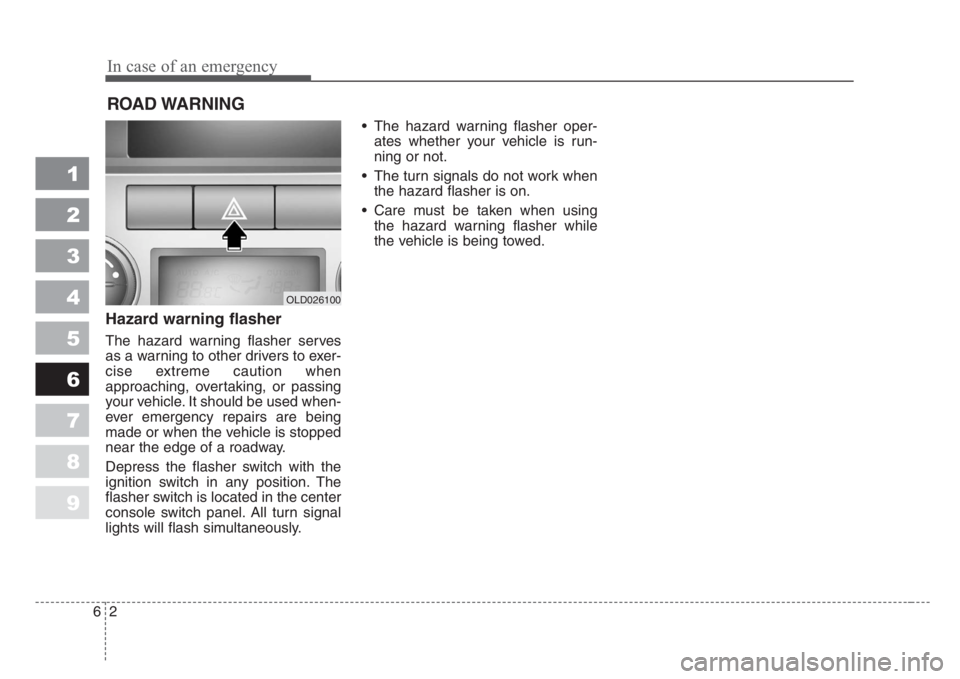
Depress the flasher switch with the
ignition switch in any position. The
flasher switch is located in the center
console switch panel. All turn signal
lights will flash simultaneously.• The hazard warning flasher oper-
ates whether your vehicle is run-
ning or not.
• The turn signals do not work when
the hazard flasher is on.
• Care must be taken when using
the hazard warning flasher while
the vehicle is being towed.
1
2
3
4
5
6
7
8
9
OLD026100
Page 221 of 298

65
In case of an emergency
TPMS (Tire pressure
monitoring system)
malfunction telltale
The TPMS malfunction indicator turns
on and stays on when there is a prob-
lem with the Tire Pressure Monitoring
System. If the system is able to cor-
rectly detect an under-inflation warning
at the same time as system failure then
it will illuminate both the TPMS mal-
function and the low tire pressure tell-
tale e. g. if Front Left sensor fails, the
TPMS malfunction indicator turns on,
but if Front Right, Rear Left, or Rear
Right tire is under-inflated, the low tire
pressure telltale may turn on at the
same time as the TPMS malfunction
indicator.
Have the system checked by an
authorized Kia dealer as soon as pos-
sible to determine the cause of the
problem.
✽
NOTICE
• The TPMS malfunction indicator
may be illuminated if the vehicle is
moving around electric power sup-
ply cable or radio transmitter such
as near police stations, government
and public offices, broadcasting sta-
tions, military installations, air-
ports, or transmitting tower, etc.
which can interfere with normal
operation of the Tire Pressure
Monitoring System (TPMS).
• The TPMS malfunction indicator
may be illuminated if some elec-
tronic devices, such as notebook
computers, are used in the vehicle.
This can interfere with normal
operation of the Tire Pressure
Monitoring System (TPMS).
(Continued)(Continued)
• If there is a failed tire sensor, it is
possible for the TPMS to tem-
porarily learn a replacement sen-
sor if closely driven to another
vehicle that is also equipped with
TPMS. In rare cases, this may
temporarily delay the TPMS mal-
function indicator from turning
on.
1
2
3
4
5
6
7
8
9
TPMS
Page 225 of 298

69
In case of an emergency
1
2
3
4
5
6
7
8
9
EMERGENCY STARTING
Jump starting
Jump starting can be dangerous if
done incorrectly. Therefore, to avoid
harm to yourself or damage to your
vehicle or battery, follow the jump
starting procedures listed on page
6-10. If in doubt, we strongly recom-
mend that you have a competent
technician or towing service jump
start your vehicle.WARNING- Battery
• Keep all flames or sparks
away from the battery. The bat-
tery produces hydrogen gas
which may explode if exposed
to flame or sparks.
• Do not attempt to jump start
the vehicle if the discharged
battery is frozen or if the elec-
trolyte level is low; the battery
may rupture or explode.
WARNING- Battery
Never attempt to check the elec-
trolyte level of the battery as
this may cause the battery to
rupture or explode causing seri-
ous injury.
CAUTION
Use only a 12-volt jumper sys-
tem. You can damage a 12-volt
starting motor, ignition system,
and other electrical parts
beyond repair by use of a 24-
volt power supply (either two
12-volt batteries in series or a
24-volt motor generator set).
Page 227 of 298

611
In case of an emergency
1
2
3
4
5
6
7
8
9
Do not allow the jumper cables to
contact anything except the cor-
rect battery terminals or the cor-
rect ground. Do not lean over the
battery when making connections.
5. Start the engine of the vehicle with
the booster battery and let it run at
2,000 rpm, then start the engine of
the vehicle with the discharged
battery.
If the cause of your battery discharg-
ing is not apparent, you should have
your vehicle checked by an
Authorized Kia Dealer.
Refer to illustration on page 6-10.
Push-starting
Your manual transaxle-equipped
vehicle should not be push-started
because it might damage the emis-
sion control system.
Vehicles equipped with automatic
transaxle cannot be push-started.
Follow the directions in this section
for jump-starting.
CAUTION
Never tow a vehicle to start it
because the sudden surge for-
ward when the engine starts
could cause a collision with the
tow vehicle.
Page 235 of 298

619
In case of an emergency
1
2
3
4
5
6
7
8
9
TOWING
If emergency towing is necessary,
we recommend having it done by an
authorized Kia dealer or a commer-
cial tow-truck service. Proper lifting
and towing procedures are neces-
sary to prevent damage to the vehi-
cle. The use of wheel dollies or
flatbed is recommended.
For trailer towing guidelines informa-
tion, refer to section 5 “Driving Tips”.
It is acceptable to tow the vehicle
with the rear wheels on the ground
(without dollies) and the front wheels
off the ground.
When being towed by a commercial
tow truck and wheel dollies are not
used, the front of the vehicle should
always be lifted, not the rear.
2GHA41071LDN4023
2LDA40012LDA4002
CAUTION
• Do not tow the vehicle back-
wards with the front wheels on
the ground as this may cause
damage to the vehicle.
• Do not tow with sling-type
equipment. Use wheel lift or
flatbed equipment.