flat tire KIA SPECTRA5 2008 Owners Manual
[x] Cancel search | Manufacturer: KIA, Model Year: 2008, Model line: SPECTRA5, Model: KIA SPECTRA5 2008Pages: 298, PDF Size: 5.38 MB
Page 170 of 298

437
1
2
3
4
5
6
7
8
9
Driving your vehicle
Key reminder warning chime
If the driver’s door is opened and the
ignition key is left in with the ignition
switch in the LOCK or ACC position,
the key reminder warning chime will
sound. This is to prevent you from
locking your keys in the vehicle.
Low tire pressure
telltale (if equipped)
The low tire pressure telltale comes
on for 3 seconds after the ignition
switch is turned to the ON position.
If the warning light does not come
on, or continuously remains on after
coming on for about 3 seconds when
you turned the ignition switch to the
ON position, the Tire Pressure
Monitoring System is not working
properly. If this occurs, have your
vehicle checked by an authorized
KIA dealer as soon as possible.
This warning light will also illuminate
if one or more of your tires is signifi-
cantly under-inflated. You should
stop and check your tires as soon as
possible. If the warning light illumi-
nates while driving, reduce vehicle
speed immediately and stop the
vehicle. Avoid hard braking and over-
correcting at the steering wheel.
Inflate the tires to the proper pres-
sure as indicated on the vehicle’s tire
information placard.
WARNING- Low tire pres-
sure
Significantly low tire pressure
makes the vehicle unstable and
can contribute to loss of vehicle
control and increased braking
distances.
Continued driving on low pres-
sure tires will cause the tires to
overheat and fail.
Page 196 of 298

Driving tips
6 5
SUGGESTIONS FOR ECONOMICAL OPERATION
Your vehicle's fuel economy depends
mainly on your style of driving, where
you drive and when you drive.
Each of these factors affects how
many kilometers (miles) you can get
from a liter (gallon) of fuel. To operate
your vehicle as economically as pos-
sible, use the following driving sug-
gestions to help save money in both
fuel and repairs:
• Avoid lengthy warm-up idling.
Once the engine is running
smoothly, begin driving.
Remember, engine warm-up may
take a little longer on cold days.
• Save fuel by accelerating slowly
after stopping.
• Keep the engine in tune and follow
the recommended periodic mainte-
nance schedule. This will increase
the life of all parts and lower your
operating costs.• Do not use the air conditioner
unnecessarily.
• Slow down when driving on rough
roads.
• For longer tire life and better fuel
economy, always keep the tires
inflated to the recommended pres-
sures.
• Maintain a safe distance from other
vehicles to avoid sudden stops.
This will reduce wear on brake lin-
ings and pads. Driving in such a
way will also save fuel because
extra fuel is required to accelerate
back to driving speed.
• Do not carry unnecessary weight
in the vehicle.
• Do not rest your foot on the brake
pedal while driving. This can cause
needless wear, possible damage
to the brakes, and poor fuel econo-
my.
• Improper wheel alignment results
in faster tire wear and lower fuel
economy.• Open windows at high speeds can
reduce fuel economy.
• Fuel economy is less in crosswinds
and headwinds. To help offset
some of this loss, slow down when
driving in these conditions.
Keeping a vehicle in good operating
condition is important both for econ-
omy and safety. Therefore, have an
authorized Kia dealer perform
scheduled inspections and mainte-
nance.
1
2
3
4
5
6
7
8
9
WARNING - Engine off
during motion
Never turn the engine off to
coast down hills or anytime the
vehicle is in motion. The power
steering and power brakes will
not function properly without
the engine running. Instead,
downshift to an appropriate
gear for engine braking effect.
Page 217 of 298
1
2
3
4
5
6
7
8
91
2
3
4
5
6
7
8
9Road warning / 6-2
Tires pressure monitoring system (TPMS) / 6-3
Overheating / 6-8
Emergency starting / 6-9
Electrical circuit protection / 6-12
Towing / 6-19
If you have a flat tire / 6-24
In case of an emergency
Page 219 of 298
63
In case of an emergency
TIRES PRESSURE MONITORING SYSTEM (TPMS) (IF EQUIPPED)
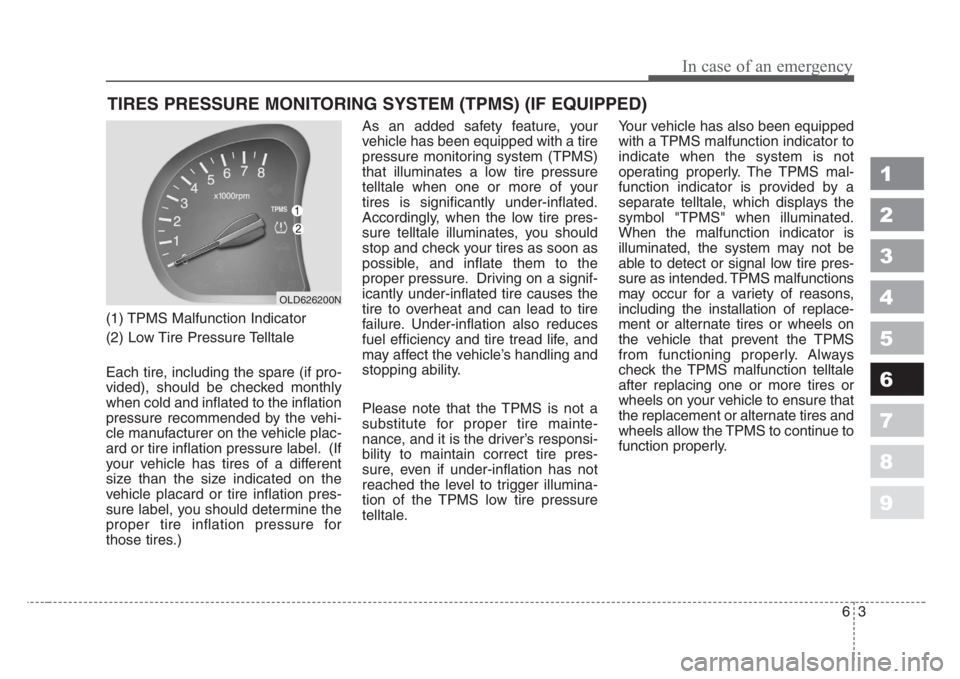
(1) TPMS Malfunction Indicator
(2) Low Tire Pressure Telltale
Each tire, including the spare (if pro-
vided), should be checked monthly
when cold and inflated to the inflation
pressure recommended by the vehi-
cle manufacturer on the vehicle plac-
ard or tire inflation pressure label. (If
your vehicle has tires of a different
size than the size indicated on the
vehicle placard or tire inflation pres-
sure label, you should determine the
proper tire inflation pressure for
those tires.)As an added safety feature, your
vehicle has been equipped with a tire
pressure monitoring system (TPMS)
that illuminates a low tire pressure
telltale when one or more of your
tires is significantly under-inflated.
Accordingly, when the low tire pres-
sure telltale illuminates, you should
stop and check your tires as soon as
possible, and inflate them to the
proper pressure. Driving on a signif-
icantly under-inflated tire causes the
tire to overheat and can lead to tire
failure. Under-inflation also reduces
fuel efficiency and tire tread life, and
may affect the vehicle’s handling and
stopping ability.
Please note that the TPMS is not a
substitute for proper tire mainte-
nance, and it is the driver’s responsi-
bility to maintain correct tire pres-
sure, even if under-inflation has not
reached the level to trigger illumina-
tion of the TPMS low tire pressure
telltale.Your vehicle has also been equipped
with a TPMS malfunction indicator to
indicate when the system is not
operating properly. The TPMS mal-
function indicator is provided by a
separate telltale, which displays the
symbol "TPMS" when illuminated.
When the malfunction indicator is
illuminated, the system may not be
able to detect or signal low tire pres-
sure as intended. TPMS malfunctions
may occur for a variety of reasons,
including the installation of replace-
ment or alternate tires or wheels on
the vehicle that prevent the TPMS
from functioning properly. Always
check the TPMS malfunction telltale
after replacing one or more tires or
wheels on your vehicle to ensure that
the replacement or alternate tires and
wheels allow the TPMS to continue to
function properly.
1
2
3
4
5
6
7
8
9
OLD626200N
Page 220 of 298

In case of an emergency
4 6
Low tire pressure
telltale
When the tire pressure monitoring
system warning telltale is illuminat-
ed, one or more of your tires is sig-
nificantly under-inflated. Immediately
reduce your speed, avoid hard cor-
nering and anticipate increased stop-
ping distances. You should stop and
check your tires as soon as possible.
Inflate the tires to the proper pres-
sure as indicated on the vehicle’s
placard or tire inflation pressure label
located on the driver’s side center pil-
lar outer panel. If you cannot reach a
service station or if the tire cannot
hold the newly added air, replace the
low pressure tire with the temporary
spare tire. Then the TPMS malfunc-
tion indicator may turn on and the
Low Tire Pressure telltale may turn
off after restarting and about 20 min-
utes of continuous driving before you
have the low-pressure tire repaired
and replaced on the vehicle.1
2
3
4
5
6
7
8
9
WARNING - Low pressure
damage
Significantly low tire pressure
makes the vehicle unstable and
can contribute to loss of vehicle
control and increased braking
distances.
Continued driving on low pres-
sure tires can cause the tires to
overheat and fail.CAUTION- Changing tem-
peratures
In winter or cold weather, the
low tire pressure telltale may be
illuminated if the tire pressure
was adjusted to the recom-
mended tire inflation pressure
in warm weather. It does not
mean your TPMS is malfunction-
ing because the decreased tem-
perature leads to a proportional
lowering of tire pressure.
When you drive your vehicle
from a warm area to a cold area
or from a cold area to a warm
area, or the outside temperature
is greatly higher or lower, you
should check the tire inflation
pressure and adjust the tires to
the recommended tire inflation
pressure.
Page 221 of 298

65
In case of an emergency
TPMS (Tire pressure
monitoring system)
malfunction telltale
The TPMS malfunction indicator turns
on and stays on when there is a prob-
lem with the Tire Pressure Monitoring
System. If the system is able to cor-
rectly detect an under-inflation warning
at the same time as system failure then
it will illuminate both the TPMS mal-
function and the low tire pressure tell-
tale e. g. if Front Left sensor fails, the
TPMS malfunction indicator turns on,
but if Front Right, Rear Left, or Rear
Right tire is under-inflated, the low tire
pressure telltale may turn on at the
same time as the TPMS malfunction
indicator.
Have the system checked by an
authorized Kia dealer as soon as pos-
sible to determine the cause of the
problem.
✽
NOTICE
• The TPMS malfunction indicator
may be illuminated if the vehicle is
moving around electric power sup-
ply cable or radio transmitter such
as near police stations, government
and public offices, broadcasting sta-
tions, military installations, air-
ports, or transmitting tower, etc.
which can interfere with normal
operation of the Tire Pressure
Monitoring System (TPMS).
• The TPMS malfunction indicator
may be illuminated if some elec-
tronic devices, such as notebook
computers, are used in the vehicle.
This can interfere with normal
operation of the Tire Pressure
Monitoring System (TPMS).
(Continued)(Continued)
• If there is a failed tire sensor, it is
possible for the TPMS to tem-
porarily learn a replacement sen-
sor if closely driven to another
vehicle that is also equipped with
TPMS. In rare cases, this may
temporarily delay the TPMS mal-
function indicator from turning
on.
1
2
3
4
5
6
7
8
9
TPMS
Page 222 of 298

In case of an emergency
6 6
Changing a tire with TPMS
If you have a flat tire, the Low Tire
Pressure telltale will turn on. Have
the flat tire repaired by an authorized
Kia dealer as soon as possible or
replace the flat tire with the tempo-
rary spare tire.
✽
NOTICE
NEVER use a puncture-repairing
agent to repair and/or inflate a low
pressure tire. If used, you will have
to replace the tire pressure sensor.
Each wheel is equipped with a tire
pressure sensor mounted inside the
tire behind the valve stem. You must
use TPMS specific wheels. It is rec-
ommended that you always have
your tires serviced by an authorized
Kia dealer as soon as possible.After you replace the low pressure
tire with the temporary spare tire, the
TPMS malfunction indicator may illu-
minate after restarting and about 20
minutes of continuous driving.
Once the low pressure tire is re-inflat-
ed to the recommended pressure
and installed on the vehicle, the
TPMS malfunction indicator and the
low tire pressure telltale will be soon
extinguished. If the low pressure and
TPMS malfunction indicators are not
extinguished after about 20 minutes
of continuous driving, please visit an
authorized Kia dealer.
You may not be able to identify a low
tire by simply looking at it. Always use
a good quality tire pressure gauge to
measure the tire's inflation pressure.
Please note that a tire that is hot
(from being driven) will have a higher
pressure measurement than a tire
that is cold (from sitting stationary for
at least 3 hours and driven less than
1.6 km (1 mile) during that 3 hour
period). Allow the tire to cool before
measuring the inflation pressure.Always be sure the tire is cold before
inflating to the recommended pres-
sure.
A cold tire means the vehicle has
been sitting for 3 hours and driven for
less than 1.6 km (1 mile) in that 3
hour period.
1
2
3
4
5
6
7
8
9
CAUTION
• Do not use any tire sealant if
your vehicle is equipped with
a Tire Pressure Monitoring
System. The liquid sealant can
damage the tire pressure sen-
sors.
• In order for the system to cor-
rectly monitor tires for under-
inflation, there should be a
total of exactly 4 sensors fit-
ted to each of the four driven
wheel positions. There should
be no other sensors in the
vehicle since this could cause
the system to monitor the
wrong sensors
Page 240 of 298

In case of an emergency
24 6
1
2
3
4
5
6
7
8
9
IF YOU HAVE A FLAT TIRE
The spare tire, jack, jack handle,
wheel lug nut wrench are stored in
the trunk compartment. Move the
carpeting out of the way to reach this
equipment.Removing the spare tire
Turn the tire hold-down wing bolt
counterclockwise.
Store the tire in the reverse order of
removal.
To prevent the spare tire and tools
from “rattling” while the vehicle is in
motion, store them properly.
Important - use of compact
spare tire
Your vehicle is equipped with a com-
pact spare tire. This compact spare
tire takes up less space than a regu-
lar-size tire. This tire is smaller than a
conventional tire and is designed for
temporary use only.
1LDN40091LDA4010
CAUTION - Compact
spare
• You should drive carefully
when the compact spare is in
use. The compact spare
should be replaced by the
proper conventional tire and
rim at the first opportunity.
• The operation of this vehicle
is not recommended with
more than one compact spare
tire in use at the same time.
Page 241 of 298
625
In case of an emergency
1
2
3
4
5
6
7
8
9
The compact spare should be inflat-
ed to 420 kPa (60 psi).
✽
NOTICE
Check the inflation pressure after
installing the spare tire. Adjust it to
the specified pressure, as necessary.
When using a compact spare tire,
observe the following precautions:
• Under no circumstances should
you exceed 80 km/h (50 mph); a
higher speed could damage the
tire.
• Ensure that you drive slowly
enough for the road conditions to
avoid all hazards. Any road hazard,
such as a pothole or debris, could
seriously damage the compact
spare.
• Any continuous road use of this tire
could result in tire failure, loss of
vehicle control, and possible per-
sonal injury.
• Do not exceed the vehicle’s maxi-
mum load rating or the load-carry-
ing capacity shown on the sidewall
of the compact spare tire.
• Avoid driving over obstacles. The
compact spare tire diameter is
smaller than the diameter of a con-
ventional tire and reduces the
ground clearance approximately
25 mm (1 inch), which could result
in damage to the vehicle.• Do not take this vehicle through an
automatic car wash.
• This tire should not be installed on
the front axle if the vehicle must be
driven in snow or on ice.
• Do not use the compact spare tire
on any other vehicle because this
tire has been designed especially
for your vehicle.
• The compact spare tire’s tread life
is shorter than a regular tire.
Inspect your compact spare tire
regularly and replace worn com-
pact spare tires with the same size
and design, mounted on the same
wheel.CAUTION - Compact
spare
This spare tire should be used
only for VERY short distances.
Compact spares should NEVER
be used for long drives or
extended distances.
Page 245 of 298

629
In case of an emergency
1
2
3
4
5
6
7
8
9
11. Once the wheel lug nuts have
been tightened, lower the vehicle
fully to the ground and continue to
tighten the lug nuts until they are
fully secured. Tighten the wheel
lug nuts firmly in a “X” pattern.
If you are unsure of the tightness
of the wheel lug nuts, have them
checked at the nearest service
station. The specified tightening
torque is 9~11 kg•m (65-79 lb•ft,
88-107 N•m). Improperly tight-
ened wheel lug nuts could cause
brake pedal vibration while brak-
ing.To prevent the jack, jack handle,
wheel lug nut wrench and spare tire
from rattling while the vehicle is in
motion, store them properly.
CAUTION
Your vehicle has metric threads
on the wheel bolts and nuts.
Make certain during wheel
removal that the same nuts
removed are reinstalled - or, if
replaced, that nuts with metric
threads and the same chamfer
configuration are used.
Installation of a non-metric
thread nut on a metric bolt or
vice-versa will not secure the
wheel to the hub properly and
will damage the bolt so that it
must be replaced.
Note that most lug nuts do not
have metric threads. Be sure to
use extreme care in checking
for thread style before installing
aftermarket lug nuts or wheels.
If in doubt, consult an
Authorized Kia Dealer.
WARNING- Wheel bolts
If the bolts are damaged or if
non-metric nut is used on a met-
ric bolts or vice versa, they may
lose their ability to retain the
wheel. This could lead to the
loss of the wheel resulting in
severe injury or death.
WARNING
Check the inflation pressures as
soon as possible after installing
the spare tire. Adjust it to the
specified pressure, if necessary.
Refer to Section 8, Specifications.
OLD046018