window KIA SPECTRA5 2008 Owners Manual
[x] Cancel search | Manufacturer: KIA, Model Year: 2008, Model line: SPECTRA5, Model: KIA SPECTRA5 2008Pages: 298, PDF Size: 5.38 MB
Page 8 of 298
Your vehicle at a glance
2 2
1
2
3
4
5
6
7
8
9
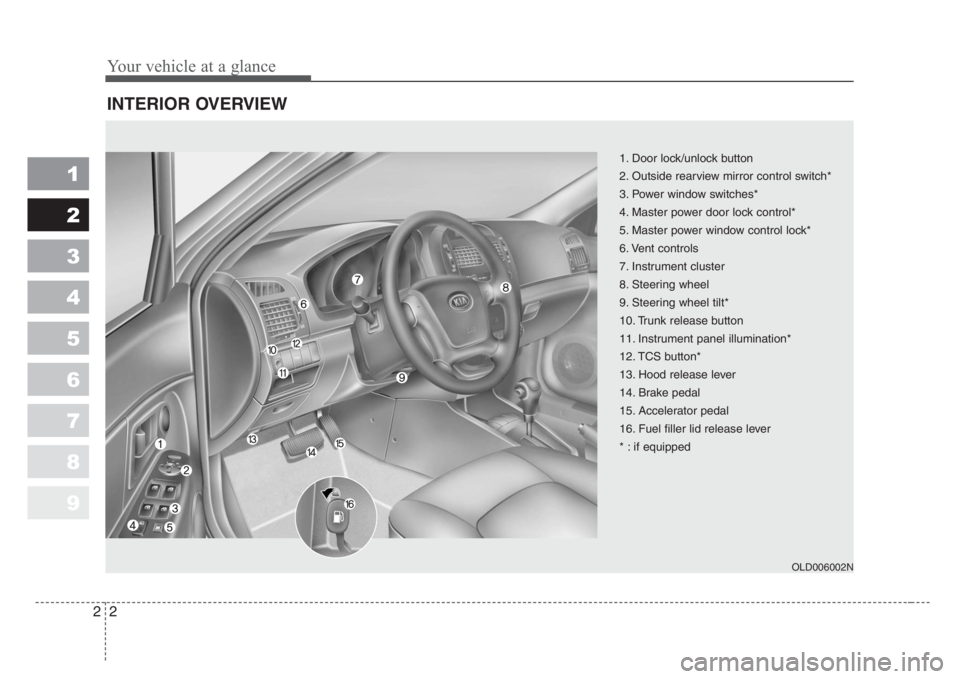
INTERIOR OVERVIEW
1. Door lock/unlock button
2. Outside rearview mirror control switch*
3. Power window switches*
4. Master power door lock control*
5. Master power window control lock*
6. Vent controls
7. Instrument cluster
8. Steering wheel
9. Steering wheel tilt*
10. Trunk release button
11. Instrument panel illumination*
12. TCS button*
13. Hood release lever
14. Brake pedal
15. Accelerator pedal
16. Fuel filler lid release lever
* : if equipped
OLD006002N
Page 11 of 298
1
2
3
4
5
6
7
8
9Keys / 3-2
Remote keyless entry / 3-3
Immobilizer system / 3-6
Door locks / 3-8
Windows / 3-13
Seat / 3-16
Safety belts / 3-27
Air bag - Advanced supplemental restraint
system / 3-50
Trunk / 3-76
Hood / 3-78
Fuel filler lid / 3-80
Mirrors / 3-83
Interior lights / 3-87
Storage compartment / 3-88
Interior features / 3-90
Sunroof / 3-94
Luggage net / 3-97
Antenna / 3-98
Audio system / 3-99
Knowing your vehicle
Page 12 of 298
Knowing your vehicle
2 3
1
2
3
4
5
6
7
8
9
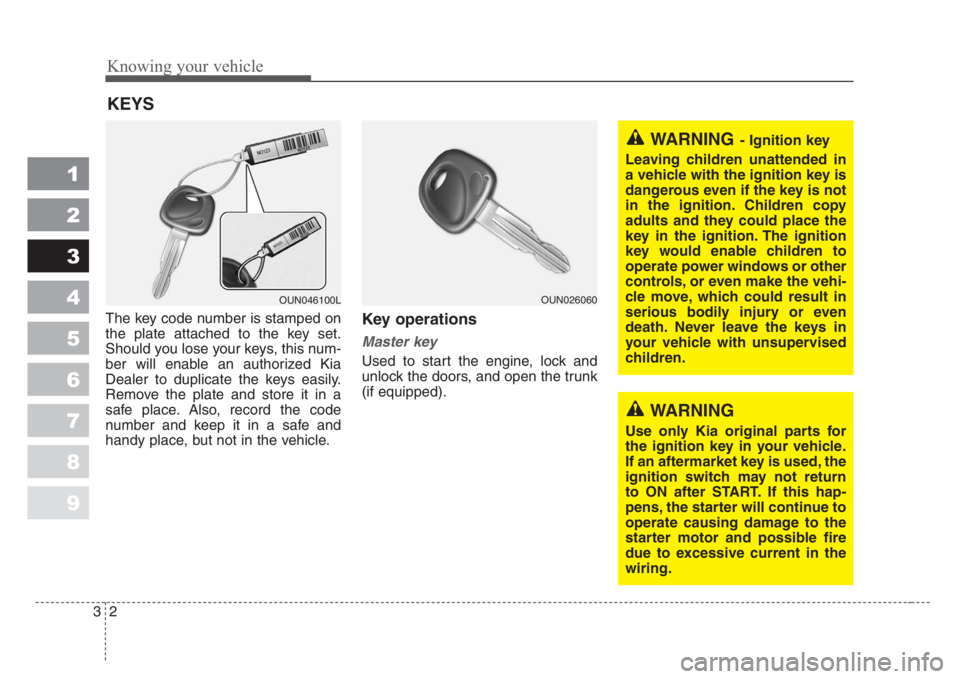
The key code number is stamped on
the plate attached to the key set.
Should you lose your keys, this num-
ber will enable an authorized Kia
Dealer to duplicate the keys easily.
Remove the plate and store it in a
safe place. Also, record the code
number and keep it in a safe and
handy place, but not in the vehicle.Key operations
Master key
Used to start the engine, lock and
unlock the doors, and open the trunk
(if equipped).
KEYS
OUN046100LOUN026060
WARNING- Ignition key
Leaving children unattended in
a vehicle with the ignition key is
dangerous even if the key is not
in the ignition. Children copy
adults and they could place the
key in the ignition. The ignition
key would enable children to
operate power windows or other
controls, or even make the vehi-
cle move, which could result in
serious bodily injury or even
death. Never leave the keys in
your vehicle with unsupervised
children.
WARNING
Use only Kia original parts for
the ignition key in your vehicle.
If an aftermarket key is used, the
ignition switch may not return
to ON after START. If this hap-
pens, the starter will continue to
operate causing damage to the
starter motor and possible fire
due to excessive current in the
wiring.
Page 19 of 298
39
1
2
3
4
5
6
7
8
9
Knowing your vehicle
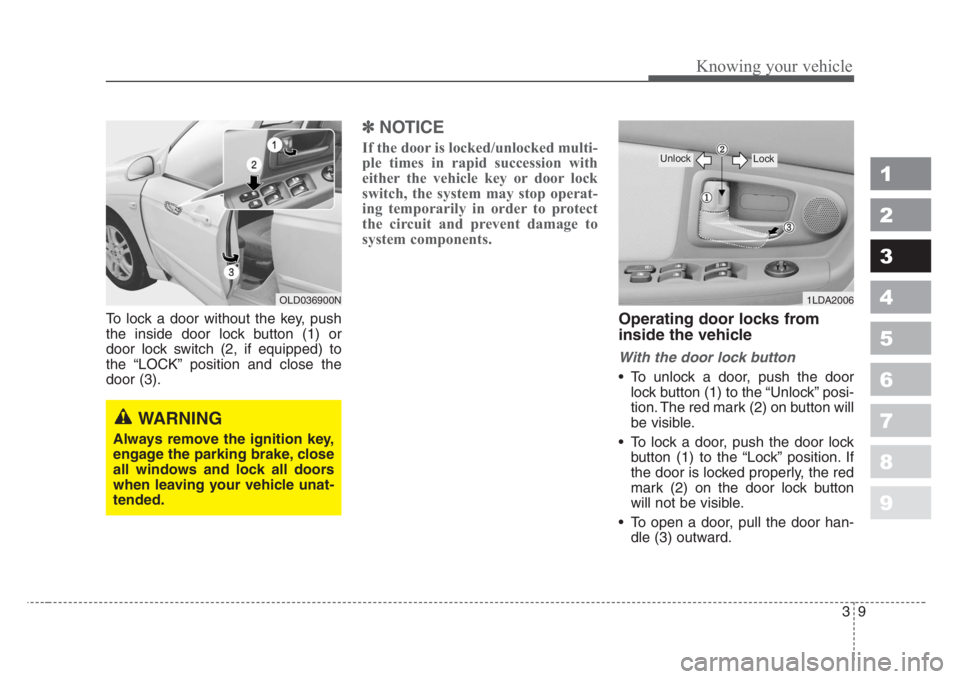
To lock a door without the key, push
the inside door lock button (1) or
door lock switch (2, if equipped) to
the “LOCK” position and close the
door (3).
✽
NOTICE
If the door is locked/unlocked multi-
ple times in rapid succession with
either the vehicle key or door lock
switch, the system may stop operat-
ing temporarily in order to protect
the circuit and prevent damage to
system components.
Operating door locks from
inside the vehicle
With the door lock button
• To unlock a door, push the door
lock button (1) to the “Unlock” posi-
tion. The red mark (2) on button will
be visible.
• To lock a door, push the door lock
button (1) to the “Lock” position. If
the door is locked properly, the red
mark (2) on the door lock button
will not be visible.
• To open a door, pull the door han-
dle (3) outward.
1LDA2006
Lock Unlock
OLD036900N
WARNING
Always remove the ignition key,
engage the parking brake, close
all windows and lock all doors
when leaving your vehicle unat-
tended.
Page 21 of 298
311
1
2
3
4
5
6
7
8
9
Knowing your vehicle
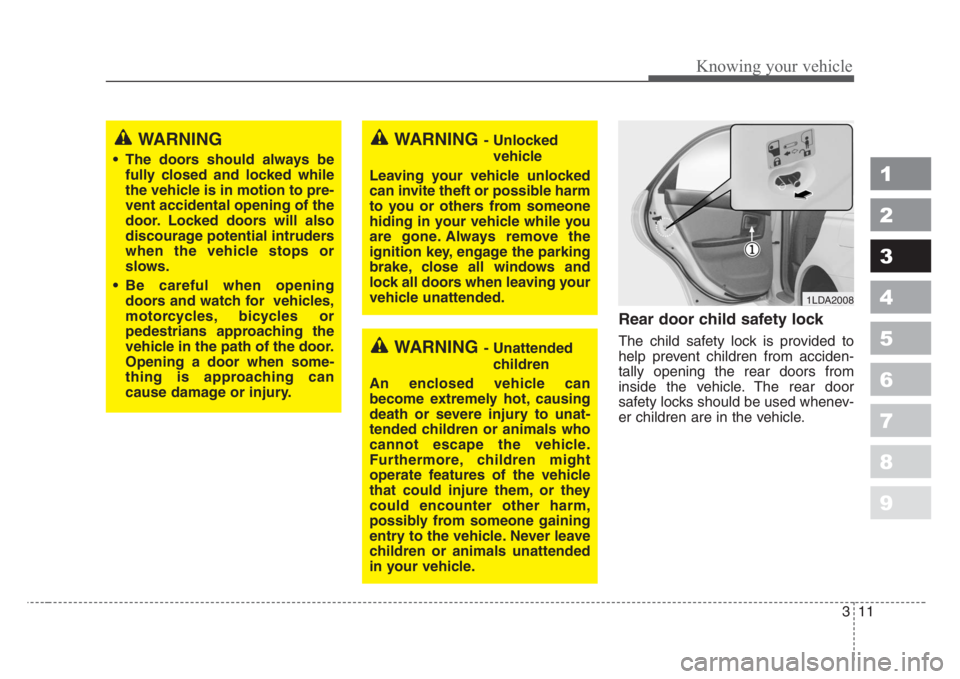
Rear door child safety lock
The child safety lock is provided to
help prevent children from acciden-
tally opening the rear doors from
inside the vehicle. The rear door
safety locks should be used whenev-
er children are in the vehicle.
1LDA2008
WARNING- Unlocked
vehicle
Leaving your vehicle unlocked
can invite theft or possible harm
to you or others from someone
hiding in your vehicle while you
are gone. Always remove the
ignition key, engage the parking
brake, close all windows and
lock all doors when leaving your
vehicle unattended.
WARNING- Unattended
children
An enclosed vehicle can
become extremely hot, causing
death or severe injury to unat-
tended children or animals who
cannot escape the vehicle.
Furthermore, children might
operate features of the vehicle
that could injure them, or they
could encounter other harm,
possibly from someone gaining
entry to the vehicle. Never leave
children or animals unattended
in your vehicle.
WARNING
• The doors should always be
fully closed and locked while
the vehicle is in motion to pre-
vent accidental opening of the
door. Locked doors will also
discourage potential intruders
when the vehicle stops or
slows.
• Be careful when opening
doors and watch for vehicles,
motorcycles, bicycles or
pedestrians approaching the
vehicle in the path of the door.
Opening a door when some-
thing is approaching can
cause damage or injury.
Page 23 of 298
313
1
2
3
4
5
6
7
8
9
Knowing your vehicle
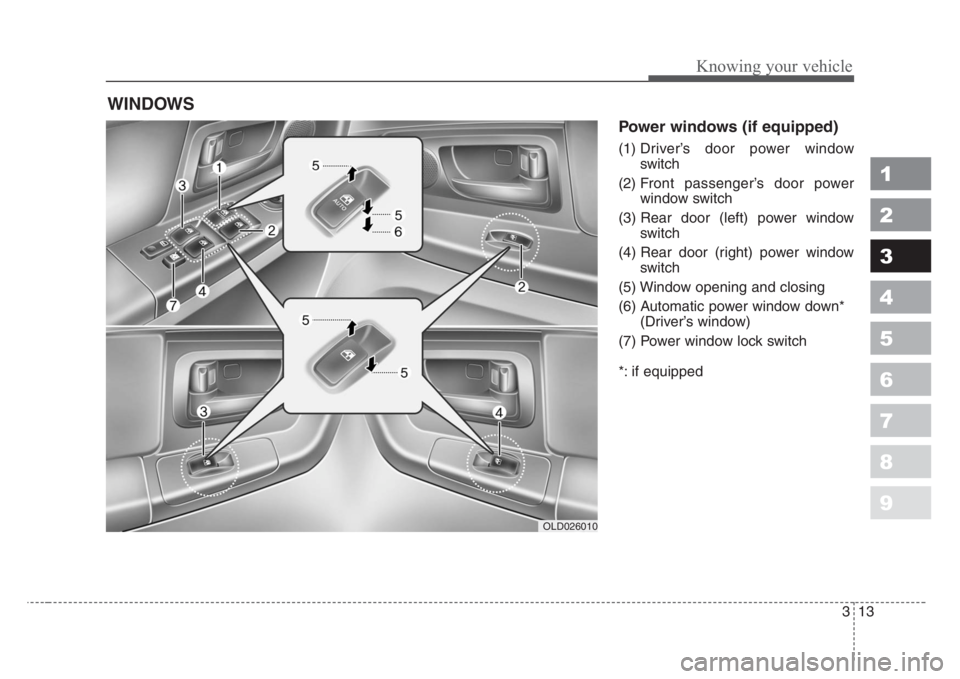
Power windows (if equipped)
(1) Driver’s door power window
switch
(2) Front passenger’s door power
window switch
(3) Rear door (left) power window
switch
(4) Rear door (right) power window
switch
(5) Window opening and closing
(6) Automatic power window down*
(Driver’s window)
(7) Power window lock switch
*: if equipped
WINDOWS
OLD026010
Page 24 of 298
Knowing your vehicle
14 3
1
2
3
4
5
6
7
8
9
The ignition switch must be in the ON
position for power windows to oper-
ate. Each door has a power window
switch that controls the door’s win-
dow. However, the driver has a power
window lock switch which can block
the operation of passenger windows.
The power windows can be operated
for approximately 30 seconds after
the ignition key is removed or turned
to the ACC or LOCK position.
However, if the front doors are
opened, the power windows cannot
be operated even within the 30 sec-
onds after the ignition key removal.
While driving, if you notice buffeting
and pulsation (wind shock) with
either side window open, you should
open the opposite window slightly to
reduce the condition.
Window opening and closing
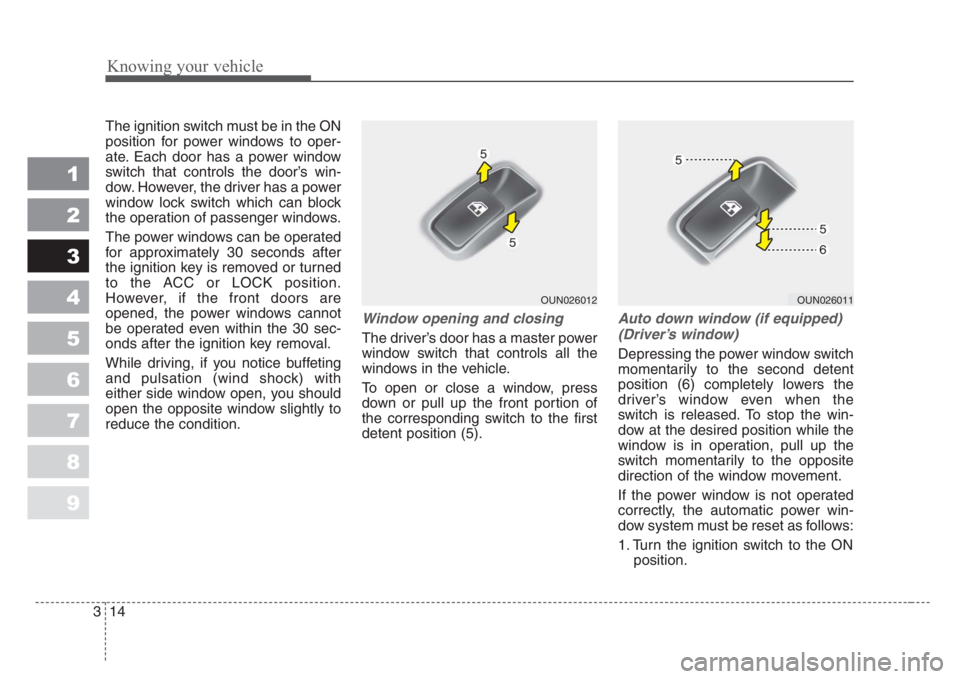
The driver’s door has a master power
window switch that controls all the
windows in the vehicle.
To open or close a window, press
down or pull up the front portion of
the corresponding switch to the first
detent position (5).
Auto down window (if equipped)
(Driver’s window)
Depressing the power window switch
momentarily to the second detent
position (6) completely lowers the
driver’s window even when the
switch is released. To stop the win-
dow at the desired position while the
window is in operation, pull up the
switch momentarily to the opposite
direction of the window movement.
If the power window is not operated
correctly, the automatic power win-
dow system must be reset as follows:
1. Turn the ignition switch to the ON
position.
OUN026011OUN026012
Page 25 of 298
315
1
2
3
4
5
6
7
8
9
Knowing your vehicle
2. Close driver’s window and contin-
ue pulling up on driver’s power
window switch for at least 1 sec-
ond after the window is complete-
ly closed.
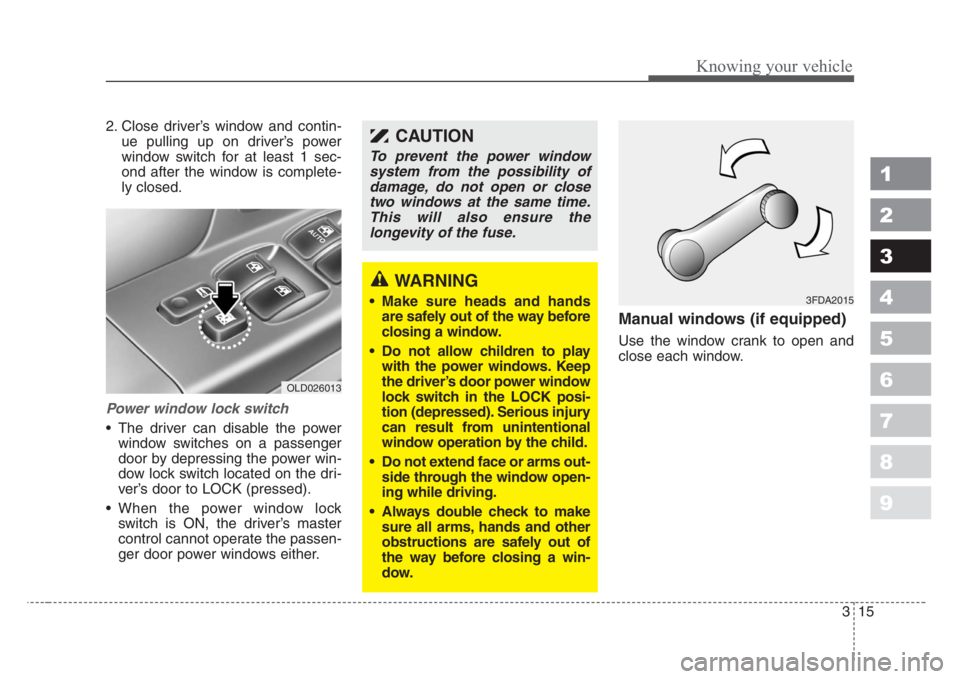
Power window lock switch
• The driver can disable the power
window switches on a passenger
door by depressing the power win-
dow lock switch located on the dri-
ver’s door to LOCK (pressed).
• When the power window lock
switch is ON, the driver’s master
control cannot operate the passen-
ger door power windows either.
Manual windows (if equipped)
Use the window crank to open and
close each window.
3FDA2015
OLD026013
CAUTION
To prevent the power window
system from the possibility of
damage, do not open or close
two windows at the same time.
This will also ensure the
longevity of the fuse.
WARNING
• Make sure heads and hands
are safely out of the way before
closing a window.
• Do not allow children to play
with the power windows. Keep
the driver’s door power window
lock switch in the LOCK posi-
tion (depressed). Serious injury
can result from unintentional
window operation by the child.
• Do not extend face or arms out-
side through the window open-
ing while driving.
•Always double check to make
sure all arms, hands and other
obstructions are safely out of
the way before closing a win-
dow.
Page 74 of 298

Knowing your vehicle
64 3
1
2
3
4
5
6
7
8
9
WARNING - Side and cur-
tain air bags
• In order for side and curtain
air bags to provide the best
protection, both front seat
occupants and both outboard
rear occupants should sit in
an upright position with the
safety belts properly fastened.
Importantly, children should
sit in a proper child restraint
system in the rear seat.
• When children are seated in
the rear outboard seats, they
must be seated in the proper
child restraint system. Make
sure to put the child restraint
system as far away from the
door side as possible, and
secure the child restraint sys-
tem in a locked position.
(Continued)(Continued)
• If a small child is seated on
the rear outboard seat cush-
ion, it is probable that they will
below the deployment level of
the side curtain airbag and
thus not protected by that
airbag.
• Do not allow the passengers
to lean their heads or bodies
onto doors, put their arms on
the doors,stretch their arms
out of the window, or place
objects between the doors
and passengers when they are
seated on seats equipped with
side air bags.
• Never try to open or repair any
components of the side cur-
tain air bag system. This
should only be done by an
authorized Kia dealer.
Failure to follow the above men-
tioned instructions can result in
severe injury or death to the
vehicle occupants in an acci-
dent.
Page 81 of 298

371
1
2
3
4
5
6
7
8
9
Knowing your vehicle
• In order to help provide protection
in a severe collision, the air bags
must inflate rapidly. The speed of
air bag inflation is a consequence
of the extremely short time in which
a collision occurs and the need to
get the air bag between the occu-
pant and the vehicle structures
before the occupant impacts those
structures. This speed of inflation
reduces the risk of serious or life-
threatening injuries in a severe col-
lision and is thus a necessary part
of air bag design.
However, air bag inflation can also
cause injuries which normally can
include facial abrasions, bruises
and broken bones, and sometimes
more serious injuries because the
inflation speed also causes the air
bags to expand with a great deal of
force.
• There are even circumstances
under which contact with the
steering wheel air bag can cause
fatal injuries,especially if the
occupant is positioned exces-
sively close to the steering
wheel.Noise and smoke
When the air bags inflate, they make
a loud noise and they leave smoke
and powder in the air inside of the
vehicle. This is normal and is a result
of the ignition of the air bag inflator.
After the air bag inflates, you may
feel substantial discomfort in breath-
ing due to the contact of your chest
to both the safety belt and the air
bag, as well as from breathing the
smoke and powder.We strongly
urge you to open your doors
and/or windows as soon as possi-
ble after impact in order to reduce
discomfort and prevent prolonged
exposure to the smoke and pow-
der.
Though smoke and powder are non-
toxic, it may cause irritation to the
skin (eyes, nose and throat etc).
Wash and rinse with the cold water
immediately and consult the doctor if
the symptom persists.WARNING
• To avoid severe personal
injury or death caused by
deploying air bags in a colli-
sion, the driver should sit as
far back from the steering
wheel air bag as possible (at
least 250 mm (10 inches)
away). The front passenger
should always move their seat
as far back as possible and sit
back in their seat.
• Air bag inflates instantly in an
event of collision, passengers
may be injured by the air bag
expansion force if they are not
in proper position.
• Air bag inflation may cause
injuries which normally
include facial or bodily abra-
sions, injuries by the broken
glasses or burns by the explo-
sives.