ignition KIA SPECTRA5 2009 User Guide
[x] Cancel search | Manufacturer: KIA, Model Year: 2009, Model line: SPECTRA5, Model: KIA SPECTRA5 2009Pages: 291, PDF Size: 2.63 MB
Page 24 of 291
Knowing your vehicle14
3
1
2
3
4
5
6
7
8
9
The power windows can be operated
for approximately 30 seconds after
the ignition key is removed or turned
to the ACC or LOCK position.
However, if the front doors are
opened, the power windows cannot
be operated even within the 30 sec-
onds after the ignition key removal.✽ ✽
NOTICEWhile driving with the rear windows
down or with the sunroof (if
equipped) in an open(or partially
open position), your vehicle may
demonstrate a wind buffeting or
pulsation noise. This noise is a nor-
mal occurrence and can be reduced
or eliminated by taking the follow-
ing actions. If the noise occurs with
one or both of the rear windows
down, partially lower both front
windows approximately one inch. If
you experience the noise with the
snroof open, slightly reduce the size
of the sunroof opening.
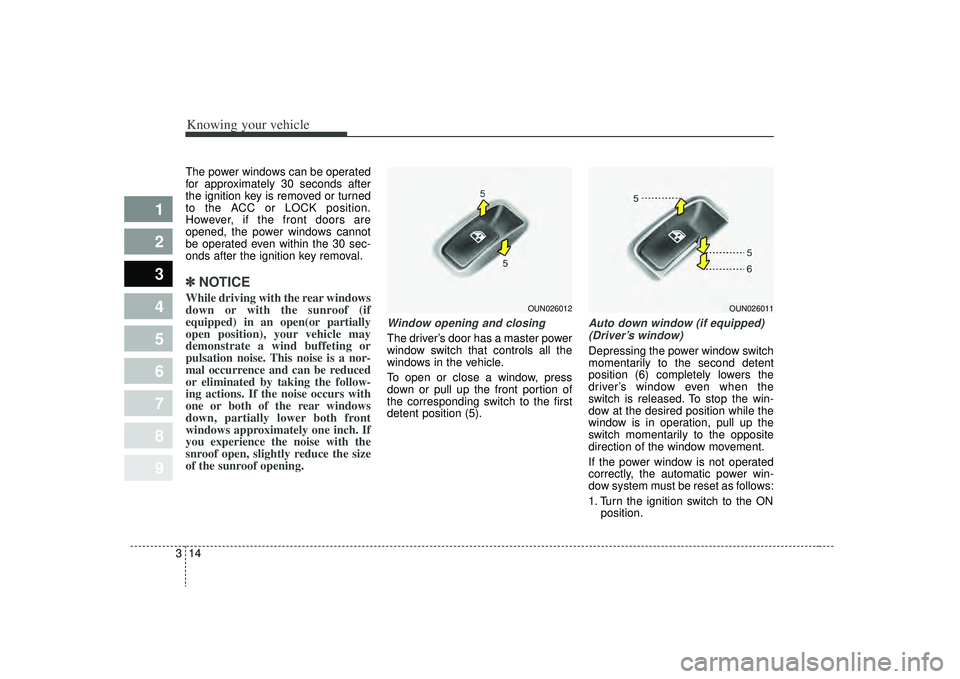
Window opening and closingThe driver’s door has a master power
window switch that controls all the
windows in the vehicle.
To open or close a window, press
down or pull up the front portion of
the corresponding switch to the first
detent position (5).
Auto down window (if equipped)
(Driver’s window)Depressing the power window switch
momentarily to the second detent
position (6) completely lowers the
driver’s window even when the
switch is released. To stop the win-
dow at the desired position while the
window is in operation, pull up the
switch momentarily to the opposite
direction of the window movement.
If the power window is not operated
correctly, the automatic power win-
dow system must be reset as follows:
1. Turn the ignition switch to the ON position.
OUN026011
OUN026012
Page 38 of 291
Knowing your vehicle28
3
1
2
3
4
5
6
7
8
9
✽ ✽
NOTICE• Both the driver's and front pas-
senger's pre-tensioner seat belts
will be activated in certain frontal
collisions. The pre-tensioner seat
belts can be activated, where the
frontal collision is severe enough,
together with the air bags.
• When the pre-tensioner seat belts are activated, a loud noise may be
heard and fine dust, which may
appear to be smoke, may be visible
in the passenger compartment.
These are normal operating condi-
tions and are not hazardous.
• Although it is harmless, the fine dust may cause skin irritation and
should not be breathed for pro-
longed periods. Wash all exposed
skin areas thoroughly after an
accident in which the pre-tension-
er seat belts were activated.
WARNING
To obtain maximum benefit from
a pre-tensioner seat belt:
The seat belt must be worn
correctly.
The seat belt must be adjusted to the correct position.
CAUTION
Because the sensor that acti- vates the SRS air bag is con-nected with pre-tensioner seatbelt, the SRS air bag warninglight on the instrument panelwill blink or illuminate forapproximately 6 seconds afterthe ignition key has beenturned to the “ON” position,then the light should go off.
If the pre-tensioner seat belt is not working properly, thiswarning light will illuminateeven if there is no malfunctionof SRS air bag system. If theSRS air bag warning lightdoes not illuminate when theignition key is turned to “ON”,or if it remains illuminatedafter blinking or illuminatingfor approximately 6 seconds,or if it illuminates while thevehicle is being driven, pleasehave an authorized Kia dealerinspect the pre-tensioner seatbelt or SRS air bag system assoon as possible.
Page 42 of 291
Knowing your vehicle32
3
1
2
3
4
5
6
7
8
9
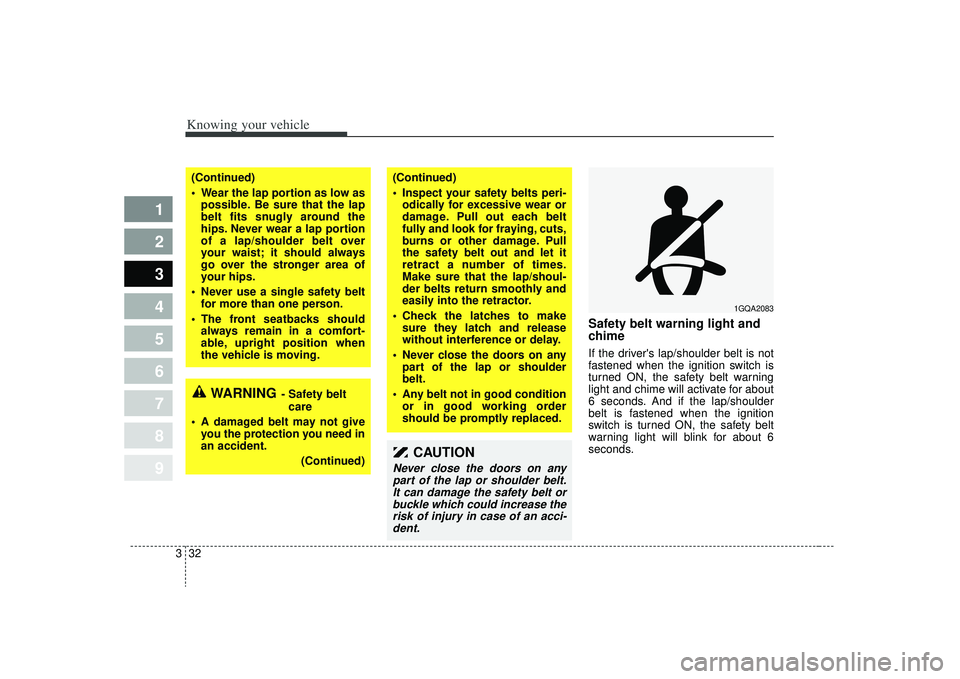
Safety belt warning light and
chimeIf the driver's lap/shoulder belt is not
fastened when the ignition switch is
turned ON, the safety belt warning
light and chime will activate for about
6 seconds. And if the lap/shoulder
belt is fastened when the ignition
switch is turned ON, the safety belt
warning light will blink for about 6
seconds.
(Continued)
Inspect your safety belts peri-
odically for excessive wear or
damage. Pull out each belt
fully and look for fraying, cuts,
burns or other damage. Pull
the safety belt out and let it
retract a number of times.
Make sure that the lap/shoul-
der belts return smoothly and
easily into the retractor.
Check the latches to make sure they latch and release
without interference or delay.
Never close the doors on any part of the lap or shoulder
belt.
Any belt not in good condition or in good working order
should be promptly replaced.
WARNING
- Safety belt
care
A damaged belt may not give you the protection you need in
an accident.
(Continued)
CAUTION
Never close the doors on anypart of the lap or shoulder belt.It can damage the safety belt orbuckle which could increase therisk of injury in case of an acci-dent.
(Continued)
Wear the lap portion as low as possible. Be sure that the lap
belt fits snugly around the
hips. Never wear a lap portion
of a lap/shoulder belt over
your waist; it should always
go over the stronger area of
your hips.
Never use a single safety belt for more than one person.
The front seatbacks should always remain in a comfort-
able, upright position when
the vehicle is moving.
1GQA2083
Page 43 of 291
333
1
2
3
4
5
6
7
8
9
Knowing your vehicle
If the lap/shoulder belt is unfastened
while the lap/shoulder belt is fas-
tened with the ignition switch ON, the
safety belt warning light will blink for
about 6 seconds and if the vehicle
speed exceeds 10 km/h (6 mph) the
safety belt warning light and chime
will activate until it is fastened.
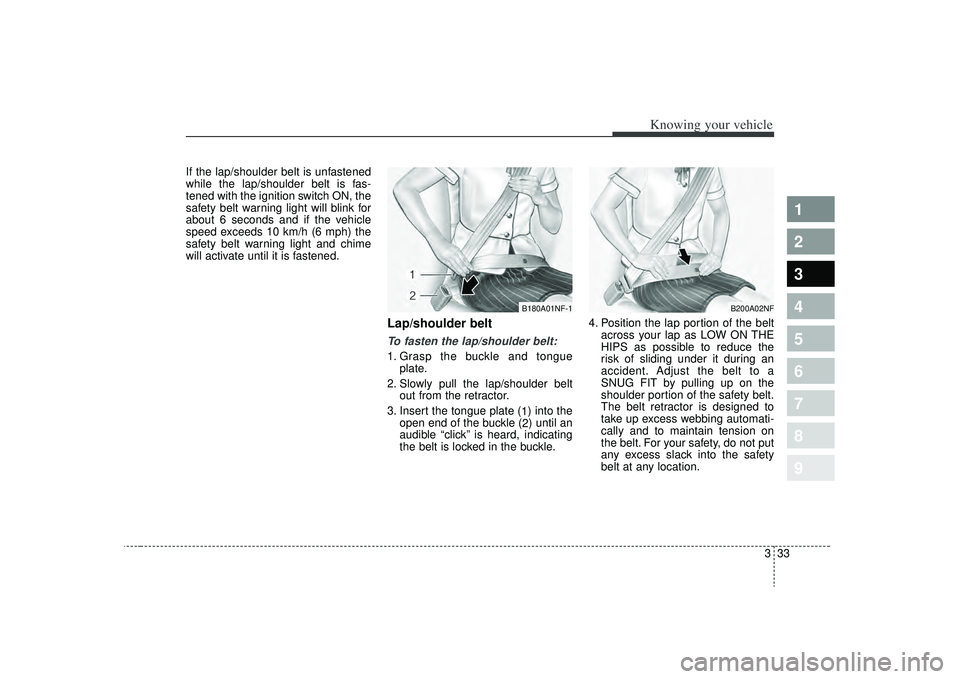
Lap/shoulder beltTo fasten the lap/shoulder belt:1. Grasp the buckle and tongueplate.
2. Slowly pull the lap/shoulder belt out from the retractor.
3. Insert the tongue plate ( 1) into the
open end of the buckle ( 2) until an
audible “click” is heard, indicating
the belt is locked in the buckle. 4. Position the lap portion of the belt
across your lap as LOW ON THE
HIPS as possible to reduce the
risk of sliding under it during an
accident. Adjust the belt to a
SNUG FIT by pulling up on the
shoulder portion of the safety belt.
The belt retractor is designed to
take up excess webbing automati-
cally and to maintain tension on
the belt. For your safety, do not put
any excess slack into the safety
belt at any location.
B180A01NF-1
B200A02NF
Page 62 of 291
Knowing your vehicle52
3
1
2
3
4
5
6
7
8
9
WARNING
- Air bags &
safety belts
Even in vehicles with air bags, you and your passengers
must always wear the safety
belts provided in order to min-
imize the risk and severity of
injury in the event of a colli-
sion or rollover.
Always wear your safety belt. It can help keep you away
from the air bags during heavy
braking just before a collision.
It may also reduce the risk of
occupant ejection.
If occupants are not wearing safety belts or correctly seat-
ed, they cannot be protected,
and thus face serious injury or
death.
(Continued)
(Continued)
Driver’s and front passenger’sair bag are designed to inflate
only in certain frontal colli-
sions, and side and curtain air
bags (if equipped) are
designed to inflate in certain
side impacts. Frontal air bag
will generally not provide pro-
tection in side impacts (vehi-
cles not equipped with side
and curtain air bags) or rear
impacts, rollovers, less severe
frontal collisions. They will not
provide protection from later
impacts in a multi-impact col-
lision.
(Continued)
(Continued)
If your vehicle has been sub-jected to flood conditions (e.g.
soaked carpeting/standing
water on the floor of the vehi-
cle, etc.) or if your vehicle has
become flood damaged in any
way, do not attempt to start
the vehicle or put the key in
the ignition before discon-
necting the battery.
Disregarding this precaution
may cause air bag deploy-
ment, which could result in
serious personal injury or
death. If your vehicle is sub-
jected to flooded conditions,
before starting the vehicle,
have the vehicle towed to an
authorized Kia dealer for
inspection and necessary
repairs.
Page 63 of 291
353
1
2
3
4
5
6
7
8
9
Knowing your vehicle
Air bag system components The main components of your SRS
are:
To indicate that your vehicle isequipped with air bags, the corre-
sponding air bag covers are
marked with “SRS AIR BAG”.
- Driver’s air bag
- Passenger’s air bag
- Side air bag
- Curtain air bag
A diagnostic system that continual- ly monitors the system operation.
An indicator light to warn you of a possible problem with the system.
Emergency power backup in case your car’s electrical system is dis-
connected in a crash.
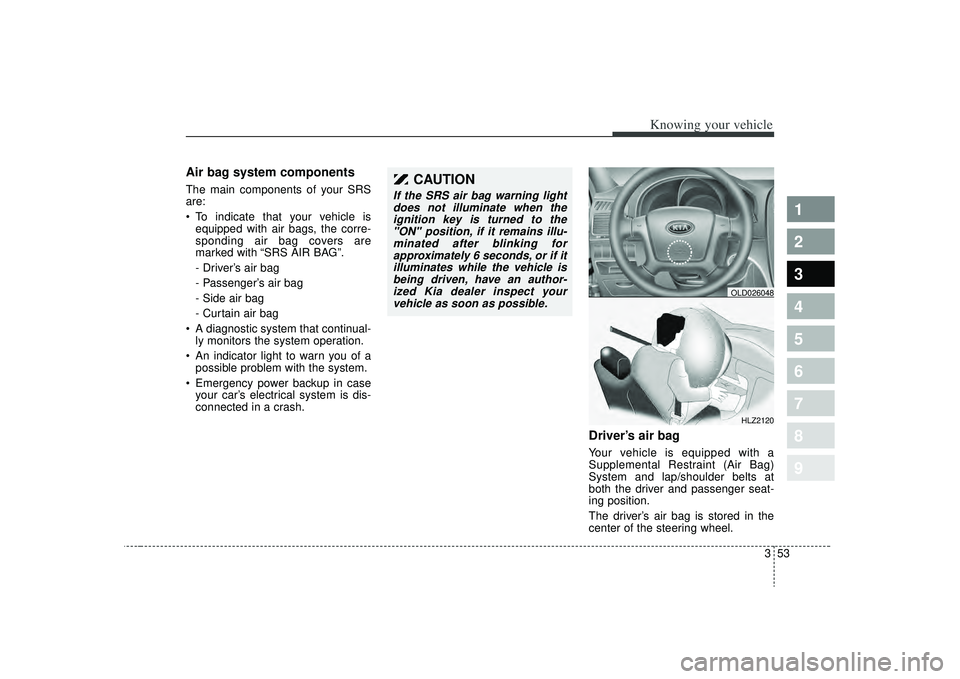
Driver’s air bagYour vehicle is equipped with a
Supplemental Restraint (Air Bag)
System and lap/shoulder belts at
both the driver and passenger seat-
ing position.
The driver’s air bag is stored in the
center of the steering wheel.
CAUTION
If the SRS air bag warning lightdoes not illuminate when theignition key is turned to the"ON" position, if it remains illu-minated after blinking forapproximately 6 seconds, or if itilluminates while the vehicle isbeing driven, have an author-ized Kia dealer inspect yourvehicle as soon as possible.
HLZ2120OLD026048
Page 73 of 291
363
1
2
3
4
5
6
7
8
9
Knowing your vehicle
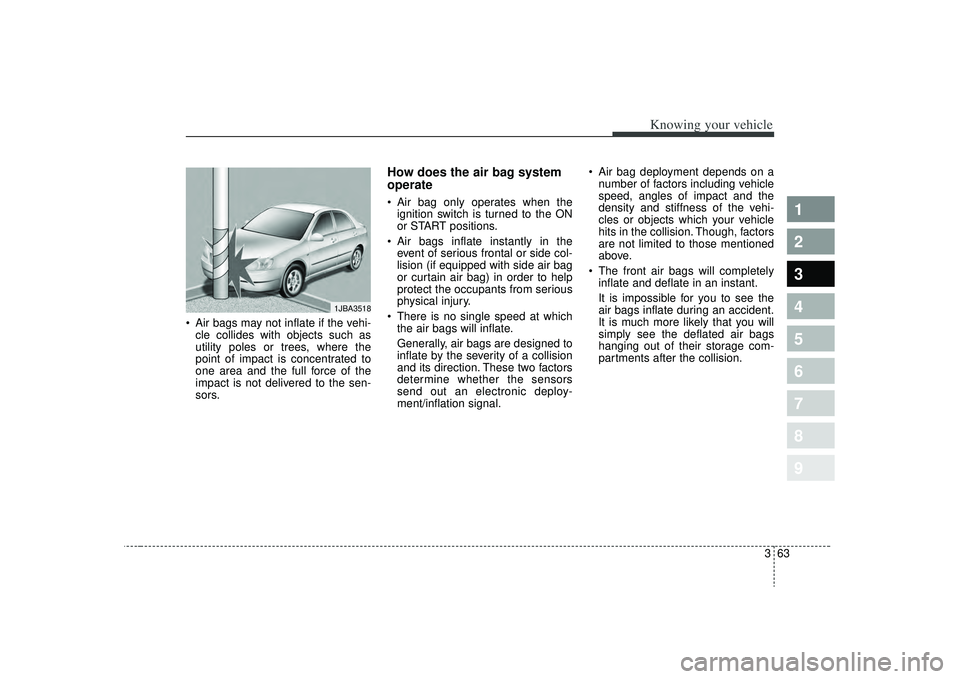
Air bags may not inflate if the vehi-cle collides with objects such as
utility poles or trees, where the
point of impact is concentrated to
one area and the full force of the
impact is not delivered to the sen-
sors.
How does the air bag system
operate Air bag only operates when theignition switch is turned to the ON
or START positions.
Air bags inflate instantly in the event of serious frontal or side col-
lision (if equipped with side air bag
or curtain air bag) in order to help
protect the occupants from serious
physical injury.
There is no single speed at which the air bags will inflate.
Generally, air bags are designed to
inflate by the severity of a collision
and its direction. These two factors
determine whether the sensors
send out an electronic deploy-
ment/inflation signal. Air bag deployment depends on a
number of factors including vehicle
speed, angles of impact and the
density and stiffness of the vehi-
cles or objects which your vehicle
hits in the collision. Though, factors
are not limited to those mentioned
above.
The front air bags will completely inflate and deflate in an instant.
It is impossible for you to see the
air bags inflate during an accident.
It is much more likely that you will
simply see the deflated air bags
hanging out of their storage com-
partments after the collision.
1JBA3518
Page 74 of 291
Knowing your vehicle64
3
1
2
3
4
5
6
7
8
9
In order to help provide protection
in a severe collision, the air bags
must inflate rapidly. The speed of
air bag inflation is a consequence
of the extremely short time in which
a collision occurs and the need to
get the air bag between the occu-
pant and the vehicle structures
before the occupant impacts those
structures. This speed of inflation
reduces the risk of serious or life-
threatening injuries in a severe col-
lision and is thus a necessary part
of air bag design.
However, air bag inflation can also
cause injuries which normally can
include facial abrasions, bruises
and broken bones, and sometimes
more serious injuries because the
inflation speed also causes the air
bags to expand with a great deal of
force.
There are even circumstances under which contact with the
steering wheel air bag can cause
fatal injuries, especially if the
occupant is positioned exces-
sively close to the steering
wheel.
Noise and smokeWhen the air bags inflate, they make
a loud noise and they leave smoke
and powder in the air inside of the
vehicle. This is normal and is a result
of the ignition of the air bag inflator.
After the air bag inflates, you may
feel substantial discomfort in breath-
ing due to the contact of your chest
to both the safety belt and the air
bag, as well as from breathing the
smoke and powder. We strongly
urge you to open your doors
and/or windows as soon as possi-
ble after impact in order to reduce
discomfort and prevent prolonged
exposure to the smoke and pow-
der.
Though smoke and powder are non-
toxic, it may cause irritation to the
skin (eyes, nose and throat etc).
Wash and rinse with the cold water
immediately and consult the doctor if
the symptom persists.
WARNING
To avoid severe personal injury or death caused by
deploying air bags in a colli-
sion, the driver should sit as
far back from the steering
wheel air bag as possible (at
least 250 mm (10 inches)
away). The front passenger
should always move their seat
as far back as possible and sit
back in their seat.
Air bag inflates instantly in an event of collision, passengers
may be injured by the air bag
expansion force if they are not
in proper position.
Air bag inflation may cause injuries which normally
include facial or bodily abra-
sions, injuries by the broken
glasses or burns by the explo-
sives.
Page 76 of 291

Knowing your vehicle66
3
1
2
3
4
5
6
7
8
9
Air bag warning lightThe purpose of air bag warning light
in your instrument panel is to alert
you of a potential problem with your
air bag - Supplemental Restraint
System (SRS). When the ignition switch is turned
ON, the indicator light should blink or
illuminate for approximately 6 sec-
onds, then go off.
Have the system checked if:
The light does not turn on briefly
when you turn the ignition ON.
The light stays on after the engine starts.
The light comes on while the vehi- cle is in motion.
Air bag (Supplemental
Restraint System) service Your Supplemental Restraint System
is virtually maintenance-free. There
are no parts which you can service.
You must have the system serviced
under the following circumstances:
If an air bag ever inflates, the airbag must be replaced. Do not try to
remove or discard the air bag by
yourself. This must be done by an
authorized Kia dealer.
If the air bag warning indicator light alerts you to a problem, have the
air bag system checked as soon as
possible. Otherwise, your air bag
system may be ineffective.
A-BAG-W
Page 89 of 291
379
1
2
3
4
5
6
7
8
9
Knowing your vehicle
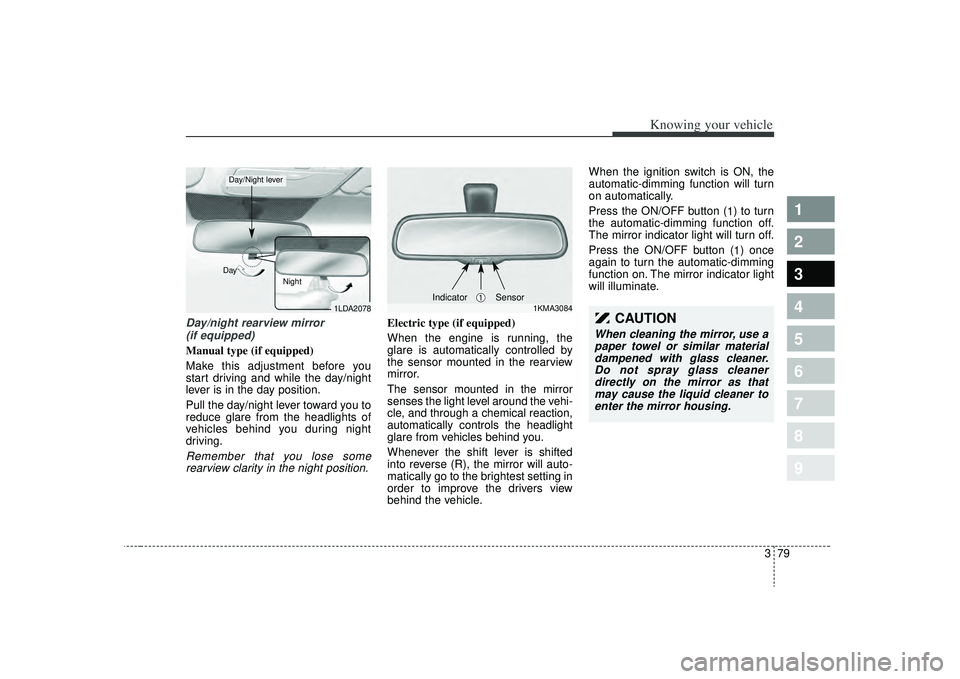
Day/night rearview mirror (if equipped)Manual type (if equipped)
Make this adjustment before you
start driving and while the day/night
lever is in the day position.
Pull the day/night lever toward you to
reduce glare from the headlights of
vehicles behind you during night
driving.Remember that you lose somerearview clarity in the night position.
Electric type (if equipped)
When the engine is running, the
glare is automatically controlled by
the sensor mounted in the rearview
mirror.
The sensor mounted in the mirror
senses the light level around the vehi-
cle, and through a chemical reaction,
automatically controls the headlight
glare from vehicles behind you.
Whenever the shift lever is shifted
into reverse (R), the mirror will auto-
matically go to the brightest setting in
order to improve the drivers view
behind the vehicle. When the ignition switch is ON, the
automatic-dimming function will turn
on automatically.
Press the ON/OFF button (
1) to turn
the automatic-dimming function off.
The mirror indicator light will turn off.
Press the ON/OFF button ( 1) once
again to turn the automatic-dimming
function on. The mirror indicator light
will illuminate.
1LDA2078
Day
Night
Day/Night lever
1KMA3084
➀
Sensor
Indicator
CAUTION
When cleaning the mirror, use apaper towel or similar materialdampened with glass cleaner.Do not spray glass cleanerdirectly on the mirror as thatmay cause the liquid cleaner toenter the mirror housing.