cooling KIA Sportage 2005 JE_ / 2.G User Guide
[x] Cancel search | Manufacturer: KIA, Model Year: 2005, Model line: Sportage, Model: KIA Sportage 2005 JE_ / 2.GPages: 354, PDF Size: 2.78 MB
Page 271 of 354
63
In case of an emergency
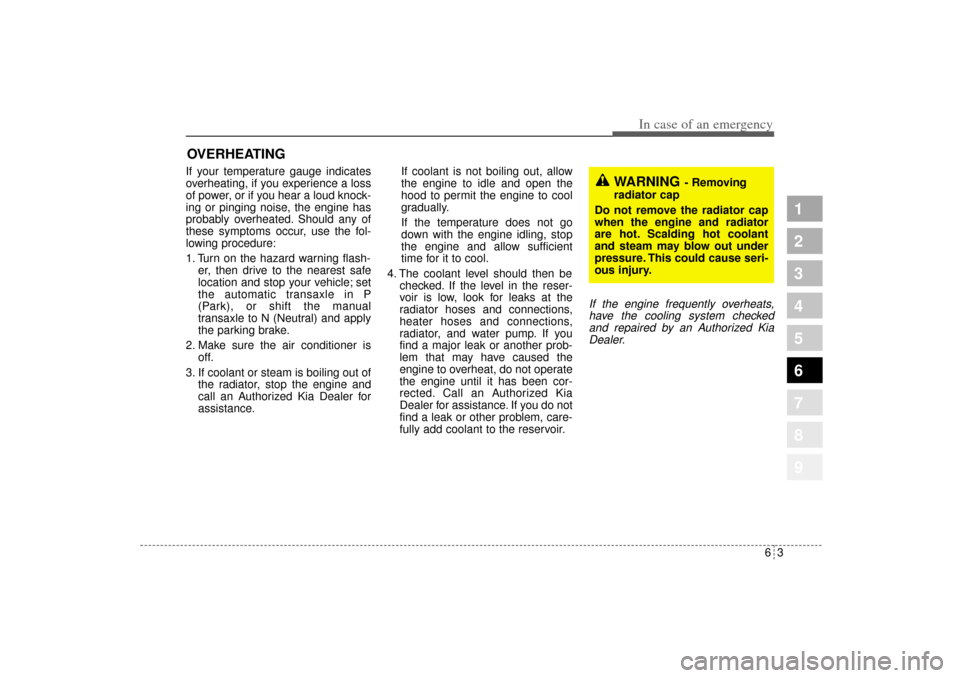
OVERHEATING If your temperature gauge indicates
overheating, if you experience a loss
of power, or if you hear a loud knock-
ing or pinging noise, the engine has
probably overheated. Should any of
these symptoms occur, use the fol-
lowing procedure:
1. Turn on the hazard warning flash-
er, then drive to the nearest safe
location and stop your vehicle; set
the automatic transaxle in P
(Park), or shift the manual
transaxle to N (Neutral) and apply
the parking brake.
2. Make sure the air conditioner is
off.
3. If coolant or steam is boiling out of
the radiator, stop the engine and
call an Authorized Kia Dealer for
assistance.If coolant is not boiling out, allow
the engine to idle and open the
hood to permit the engine to cool
gradually.
If the temperature does not go
down with the engine idling, stop
the engine and allow sufficient
time for it to cool.
4. The coolant level should then be
checked. If the level in the reser-
voir is low, look for leaks at the
radiator hoses and connections,
heater hoses and connections,
radiator, and water pump. If you
find a major leak or another prob-
lem that may have caused the
engine to overheat, do not operate
the engine until it has been cor-
rected. Call an Authorized Kia
Dealer for assistance. If you do not
find a leak or other problem, care-
fully add coolant to the reservoir.
If the engine frequently overheats,
have the cooling system checked
and repaired by an Authorized Kia
Dealer.
1
2
3
4
5
6
7
8
9
WARNING
- Removing
radiator cap
Do not remove the radiator cap
when the engine and radiator
are hot. Scalding hot coolant
and steam may blow out under
pressure. This could cause seri-
ous injury.
KM CAN (ENG) 6.qxd 9/13/2004 4:47 PM Page 3
Page 294 of 354
1
2
3
4
5
6
7
8
9
Maintenance services / 7-3
Maintenance schedule / 7-4
Owner maintenance / 7-8
Engine compartment / 7-11
Engine oil and oil filter / 7-13
Engine cooling system / 7-15
Brakes and clutch / 7-18
Parking brake / 7-19
Drive belts / 7-20
Power steering / 7-21
Steering wheel / 7-22
Automatic transaxle / 7-23
Manual transaxle / 7-25
Rear differential (4WD) / 7-25
Transfer case (4WD) / 7-25
Lubricants and fluids / 7-26
Air cleaner / 7-27
Air conditioner air filter / 7-28
Wiper blades / 7-29
Maintenance
KM CAN (ENG) 7.qxd 9/13/2004 4:47 PM Page 1
Page 297 of 354
Maintenance4 7
1
2
3
4
5
6
7
8
9
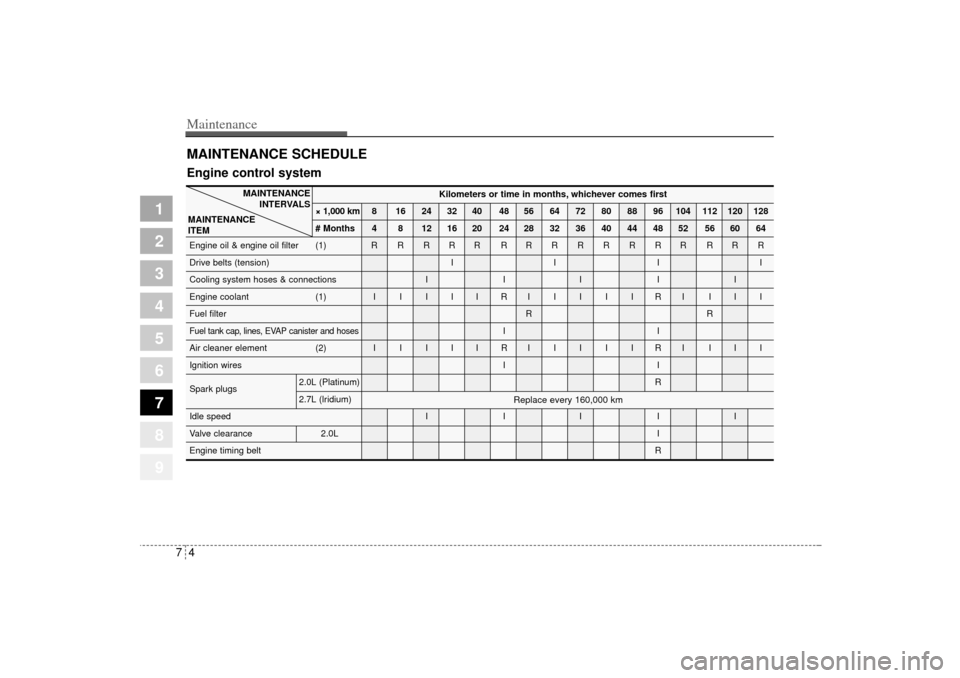
MAINTENANCE SCHEDULE
MAINTENANCE
INTERVALS
MAINTENANCE
ITEM
Engine control system
Kilometers or time in months, whichever comes first
× 1,000 km 8 16 24 32 40 48 56 64 72 80 88 96 104 112 120 128
# Months 4 8 12 16 20 24 28 32 36 40 44 48 52 56 60 64
Engine oil & engine oil filter (1) R R R R R RRRRRRRR RRR
Drive belts (tension) I I I I
Cooling system hoses & connections I I I I I
Engine coolant (1) I I I I I RIIIIIRI III
Fuel filterRR
Fuel tank cap, lines, EVAP canister and hoses
II
Air cleaner element (2) I I I I I RIIIIIRI III
Ignition wires I I
Spark plugs2.0L (Platinum)R
2.7L (lridium)
Idle speed I I I I I
Valve clearance 2.0LI
Engine timing beltRReplace every 160,000 km
KM CAN (ENG) 7.qxd 9/13/2004 4:47 PM Page 4
Page 308 of 354
715
Maintenance
1
2
3
4
5
6
7
8
9
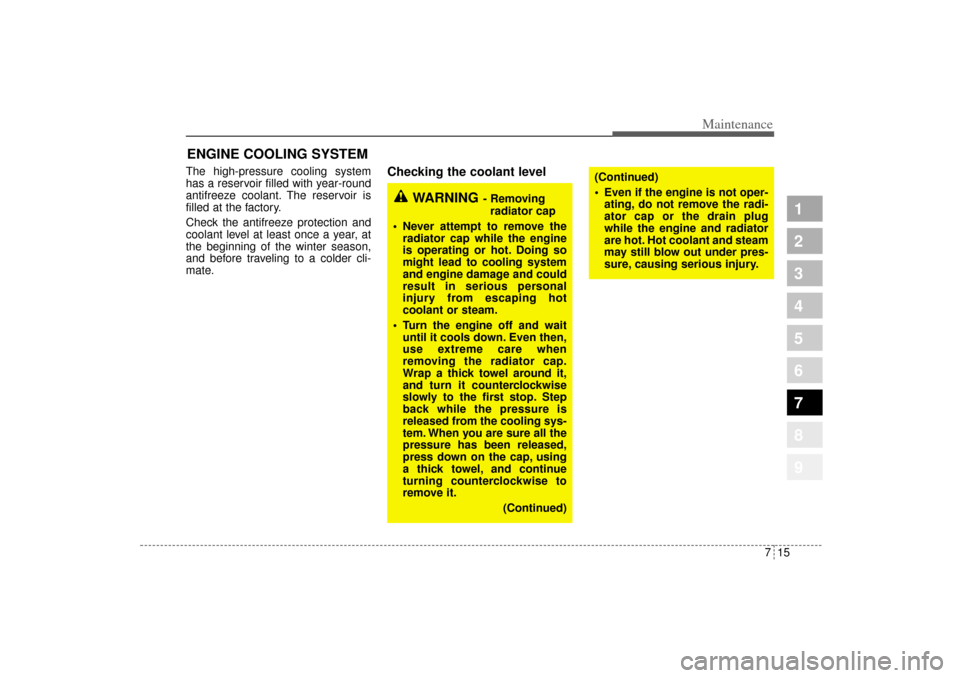
ENGINE COOLING SYSTEMThe high-pressure cooling system
has a reservoir filled with year-round
antifreeze coolant. The reservoir is
filled at the factory.
Check the antifreeze protection and
coolant level at least once a year, at
the beginning of the winter season,
and before traveling to a colder cli-
mate.
Checking the coolant level
WARNING
- Removing
radiator cap
Never attempt to remove the
radiator cap while the engine
is operating or hot. Doing so
might lead to cooling system
and engine damage and could
result in serious personal
injury from escaping hot
coolant or steam.
Turn the engine off and wait
until it cools down. Even then,
use extreme care when
removing the radiator cap.
Wrap a thick towel around it,
and turn it counterclockwise
slowly to the first stop. Step
back while the pressure is
released from the cooling sys-
tem. When you are sure all the
pressure has been released,
press down on the cap, using
a thick towel, and continue
turning counterclockwise to
remove it.
(Continued)
(Continued)
Even if the engine is not oper-
ating, do not remove the radi-
ator cap or the drain plug
while the engine and radiator
are hot. Hot coolant and steam
may still blow out under pres-
sure, causing serious injury.
KM CAN (ENG) 7.qxd 9/13/2004 4:47 PM Page 15
Page 309 of 354
Maintenance16 7
1
2
3
4
5
6
7
8
9
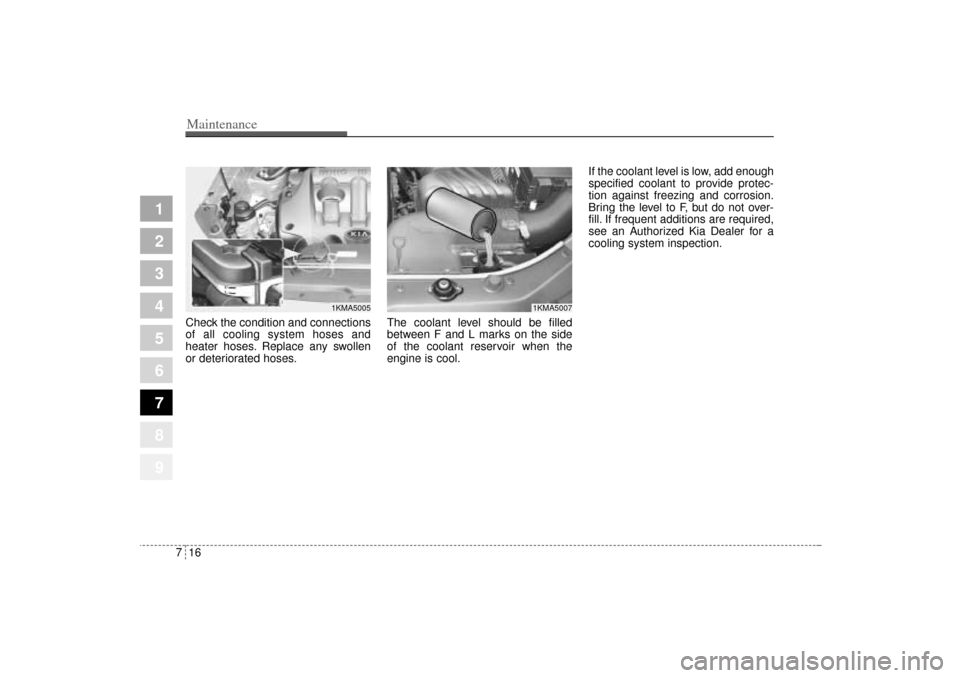
Check the condition and connections
of all cooling system hoses and
heater hoses. Replace any swollen
or deteriorated hoses.The coolant level should be filled
between F and L marks on the side
of the coolant reservoir when the
engine is cool.If the coolant level is low, add enough
specified coolant to provide protec-
tion against freezing and corrosion.
Bring the level to F, but do not over-
fill. If frequent additions are required,
see an Authorized Kia Dealer for a
cooling system inspection.
1KMA5005
1KMA5007
KM CAN (ENG) 7.qxd 9/13/2004 4:47 PM Page 16