sensor KIA Sportage 2005 JE_ / 2.G Owner's Manual
[x] Cancel search | Manufacturer: KIA, Model Year: 2005, Model line: Sportage, Model: KIA Sportage 2005 JE_ / 2.GPages: 354, PDF Size: 2.78 MB
Page 42 of 354
331
Knowing your vehicle
1
2
3
4
5
6
7
8
9
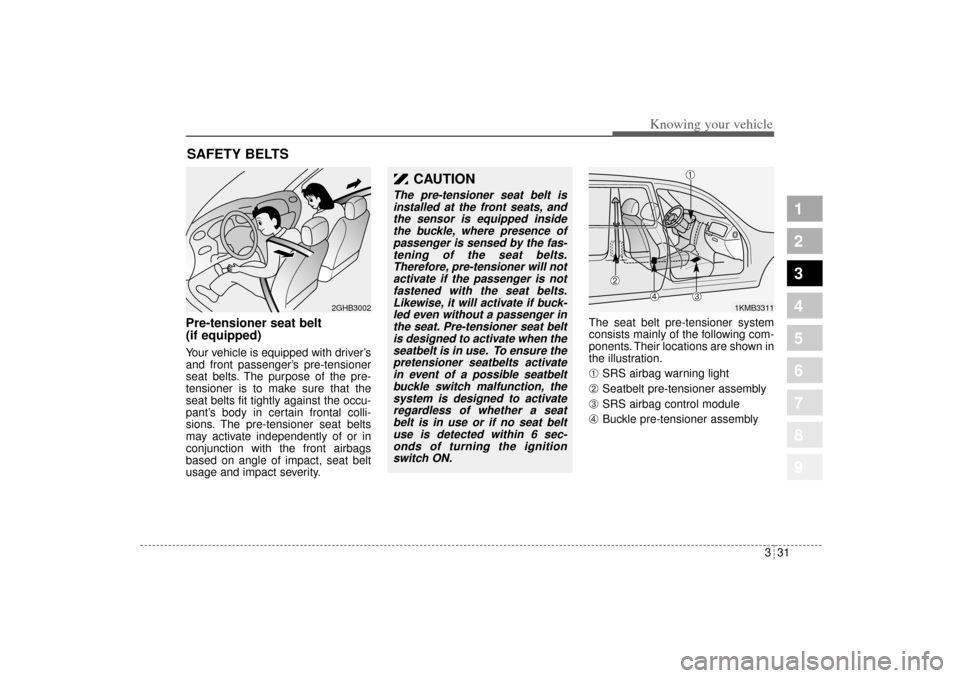
Pre-tensioner seat belt
(if equipped)Your vehicle is equipped with driver’s
and front passenger’s pre-tensioner
seat belts. The purpose of the pre-
tensioner is to make sure that the
seat belts fit tightly against the occu-
pant’s body in certain frontal colli-
sions. The pre-tensioner seat belts
may activate independently of or in
conjunction with the front airbags
based on angle of impact, seat belt
usage and impact severity.The seat belt pre-tensioner system
consists mainly of the following com-
ponents. Their locations are shown in
the illustration.
➀
SRS airbag warning light
➁
Seatbelt pre-tensioner assembly
➂
SRS airbag control module
➃
Buckle pre-tensioner assembly
SAFETY BELTS
2GHB3002
CAUTION
The pre-tensioner seat belt is
installed at the front seats, and
the sensor is equipped inside
the buckle, where presence of
passenger is sensed by the fas-
tening of the seat belts.
Therefore, pre-tensioner will not
activate if the passenger is not
fastened with the seat belts.
Likewise, it will activate if buck-
led even without a passenger in
the seat. Pre-tensioner seat belt
is designed to activate when the
seatbelt is in use. To ensure the
pretensioner seatbelts activate
in event of a possible seatbelt
buckle switch malfunction, the
system is designed to activate
regardless of whether a seat
belt is in use or if no seat belt
use is detected within 6 sec-
onds of turning the ignition
switch ON.
1KMB3311
➀
➁
➂
➃
KM CAN (ENG) 3 (~57).qxd 9/13/2004 4:49 PM Page 31
Page 43 of 354
Knowing your vehicle32 3
1
2
3
4
5
6
7
8
9
Load limiterWhen the pre-tentioner activates, if
the system senses excessive seat
belt tension on the driver or passen-
ger’s seat belt, the load limiter inside
the pre-tensioner will release some
of the pressure on the affected seat
belt.
WARNING
To obtain maximum benefit from
a pre-tensioner seat belt:
The seat belt must be worn
correctly.
The seat belt must be adjusted
to the correct position.
CAUTION
When the pre-tensioner seat
belts are activated, a loud noise
may be heard and fine dust,
which may appear to be smoke,
may be visible in the passenger
compartment and are not toxic.
Although, it is harmless, the fine
dust may cause skin irritation
and should not be breathed for
prolonged periods. Wash your
hands and face thoroughly after
an accident in which the airbags
and/or pre-tensioner seat belts
were activated.
CAUTION
Because the sensor that acti-
vates the SRS airbag is con-
nected with pre-tensioner seat
belt, the SRS airbag warning
light on the instrument panel
will illuminate for approxi-
mately 6 seconds after the
ignition key has been turned
to the “ON” position, then the
light should go off.
If the pre-tensioner seat belt is
not working properly, this
warning light will illuminate
even if there is no malfunction
of SRS airbag system. If the
SRS airbag warning light does
not illuminate when the igni-
tion key is turned to “ON” , or
if it remains illuminated after
illuminating for approximately
6 seconds, or if it illuminates
while the vehicle is being driv-
en, please have an authorized
Kia dealer inspect the pre-ten-
sioner seat belt or SRS airbag
system as soon as possible.
KM CAN (ENG) 3 (~57).qxd 9/13/2004 4:49 PM Page 32
Page 68 of 354
357
Knowing your vehicle
1
2
3
4
5
6
7
8
9
AIRBAG - ADVANCED SUPPLEMENTAL RESTRAINT SYSTEM
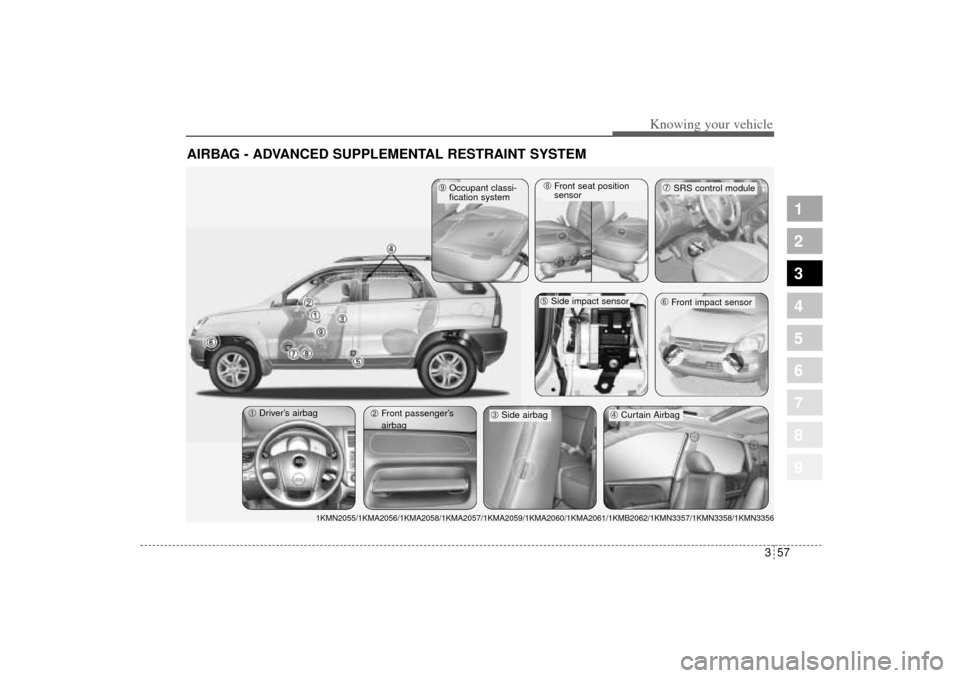
➀Driver’s airbag
➁Front passenger’s
airbag
➃Curtain Airbag
➅Front impact sensor➆SRS control module
1KMN2055/1KMA2056/1KMA2058/1KMA2057/1KMA2059/1KMA2060/1KMA2061/1KMB2062/1KMN3357/1KMN3358/1KMN3356
➂Side airbag
➄Side impact sensor
➈Occupant classi-
fication system
➇Front seat position
sensor
KM CAN (ENG) 3 (~57).qxd 9/13/2004 4:50 PM Page 57
Page 69 of 354
Knowing your vehicle58 3
1
2
3
4
5
6
7
8
9
➀
Driver’s airbag
(see page 3- 61)
➁
Front passenger’s airbag
(see page 3- 62)
➂
Side airbag
(if equipped, see page 3- 69)
➃
Curtain Airbag
(if equipped, see page 3- 69)
➄Front impact sensor
(see page 3- 71)
➅
Side impact sensor
(if equipped, see page 3- 71)
➆
SRS Control Module
(see page 3- 71)
➇
Front seat position sensor
➈
Occupant classification system
(see page 3- 62)
Airbag inflation condition
(see page 3- 72)
Airbag non-inflation condition
(see page 3- 74)
Airbag warning light
(see page 3- 79)
Airbag service
(see page 3- 79)
Airbag warning label
(see page 3- 81)
What your airbag system doesDriver’s airbag and front passenger’s
airbag are designed to supplement
the protection offered by the safety
belt in certain frontal collisions.
Likewise, side airbag and curtain
airbags are designed to supplement
the protection offered by the safety
belt in side collisions. Safety belts
are designed to reduce the injury of
the driver or passengers in case of
impact or collision. No safety belt or
airbag system can completely elimi-
nate injuries that may cause in colli-
sions or impacts. To help reduce
impact on driver or passengers in
any collision, safety belts must be
correctly worn.
What your airbag system does
not doThe air bag system is designed to
supplement the protection offered by
the safety belt system.IT IS NOT A
SUBSTITUTE FOR THE SAFETY
BELT.
KM CAN (ENG) 3 (~112).qxd 9/13/2004 4:50 PM Page 58
Page 71 of 354
Knowing your vehicle60 3
1
2
3
4
5
6
7
8
9
Airbag system components The main components of your SRS
are:
To indicate that your vehicle is
equipped with airbags, the corre-
sponding airbag covers are
marked with “SRS AIRBAG”.
- Driver’s airbag (see page 3- 61)
- Passenger’s airbag(see page 3- 62)
- Side airbag
(if equipped, see page 3- 69)
- Curtain airbag
(if equipped, see page 3- 69)
A diagnostic system that continual-
ly monitors the system operation.
Airbag warning light to warn you of
a possible problem with the sys-
tem.
Emergency power backup in case
your car’s electrical system is dis-
connected in a crash.The SRS uses a collection of sen-
sors to gather information about the
driver’s and front passenger’s seat
position, the driver’s and front pas-
senger’s safety belt usage and
impact severity.
The driver’s and front passenger’s
seat position sensors, which are
installed on the seat track, determine
if the seats are fore or aft of a refer-
ence position. Similarly, the safety
belt usage sensors determine if the
driver and front passenger’s safety
belts are fastened. These sensors
provide the ability to control the SRS
deployment based on how close the
driver’s seat is to the steering wheel,
how close the passenger’s seat is to
the instrument panel, whether or not
the safety belts are fastened, and the
severity of the impact.
(Continued)
If your vehicle has been sub-
jected to flood conditions (e.g.
soaked carpeting/standing
water on the floor of the vehi-
cle, etc.) or if your vehicle has
become flood damaged in any
way, do not attempt to start
the vehicle or put the key in
the ignition before discon-
necting the battery.
Disregarding this precaution
may cause airbag deployment,
which could result in serious
personal injury or death. If
your vehicle is subjected to
flooded conditions, before
starting the vehicle, have the
vehicle towed to an authorized
Kia dealer for inspection and
necessary repairs.
KM CAN (ENG) 3 (~112).qxd 9/13/2004 4:50 PM Page 60
Page 72 of 354
361
1
2
3
4
5
6
7
8
9
Knowing your vehicle
The advanced SRS offers the ability
to control the airbag inflation with two
levels. A first stage level is provided
for moderate-severity impacts. A sec-
ond stage level is provided for more
severe impacts.
According to the impact severity,
seating position and safety belt
usage, the SRSCM (SRS Control
Module) controls the airbag inflation.
Failure to properly wear safety
belts can increase the risk or
severity of injury in an accident.
Additionally, your SRS is equipped
with an occupant classification sys-
tem in the front passenger’s seat.
The occupant classification system
detects the presence of a passenger
in the front passenger’s seat and will
turn off the front passenger’s airbag
under certain conditions. For more
detail, see “Occupant Classification
System” later in this section.
CAUTION
If the seat position sensor is not
working properly, the SRS
airbag warning light ( ) on the
instrument panel will illuminate
even if there is no malfunction
of the SRS airbag system,
because the SRS airbag warn-
ing light is connected with the
seat position sensor. If the SRS
airbag warning light does not
illuminate when the ignition key
is turned to the "ON" position, if
it remains illuminated after illu-
minating for approximately 6
seconds, or if it illuminates
while the vehicle is being driv-
en, have an authorized Kia deal-
er inspect the seat position sen-
sor and the advanced SRS
airbag system as soon as possi-
ble.
AIR
BAG
WARNING
Modification to the seat struc-
ture can adversely affect the
seat position sensor and
cause the airbag to deploy at a
different level than should be
provided.
Failure to properly wear safety
belts can increase the risk or
severity of injury by causing
the airbags to deploy at a dif-
ferent level than should be
provided.
Do not place any objects
underneath the front seats
which could damage the seat
position sensor or interfere
with the occupant classifica-
tion system.
Do not place any objects that
may cause magnetic fields
near the front seat. These may
cause a malfunction of the
seat position sensor.
(Continued)
KM CAN (ENG) 3 (~112).qxd 9/13/2004 4:50 PM Page 61
Page 83 of 354
Knowing your vehicle72 3
1
2
3
4
5
6
7
8
9
Why didn’t my airbag go off in
a collision? (Inflation and non-inflation condi-
tions of the airbag)There are many types of accidents
in which the airbag would not be
expected to provide additional
protection.
These include rear impacts, sec-
ond or third collisions in multiple
impact accidents, as well as low
speed impacts. In other words,
just because your vehicle is dam-
aged and even if it is totally unus-
able, don’t be surprised that the
airbags did not inflate.
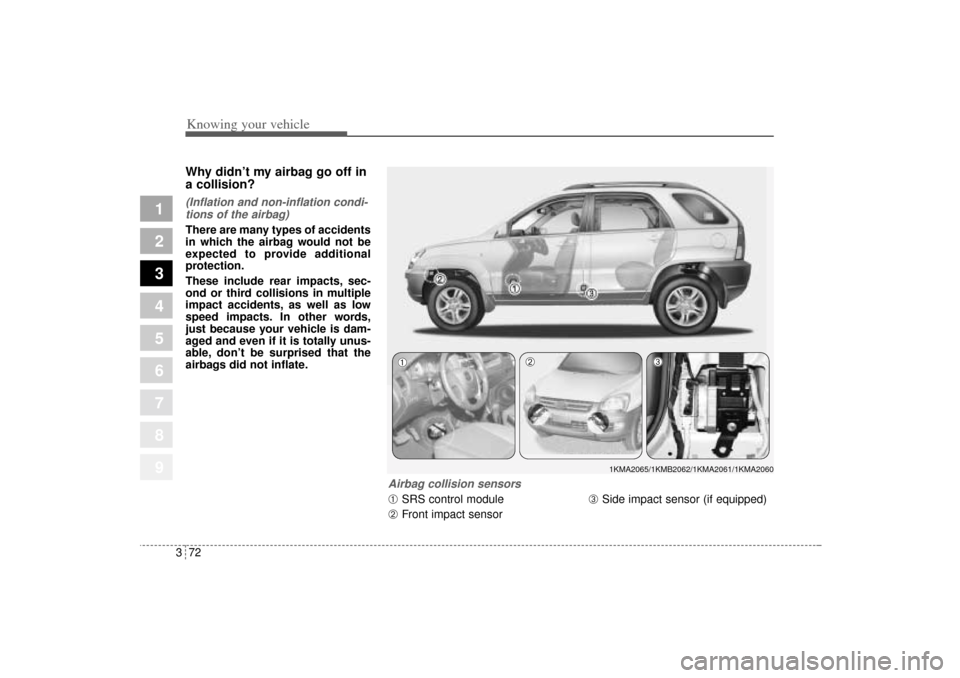
Airbag collision sensors➀
SRS control module
➁
Front impact sensor
➂
Side impact sensor (if equipped)1KMA2065/1KMB2062/1KMA2061/1KMA2060
➀
➁
➂
KM CAN (ENG) 3 (~112).qxd 9/13/2004 4:50 PM Page 72
Page 84 of 354
373
1
2
3
4
5
6
7
8
9
Knowing your vehicle
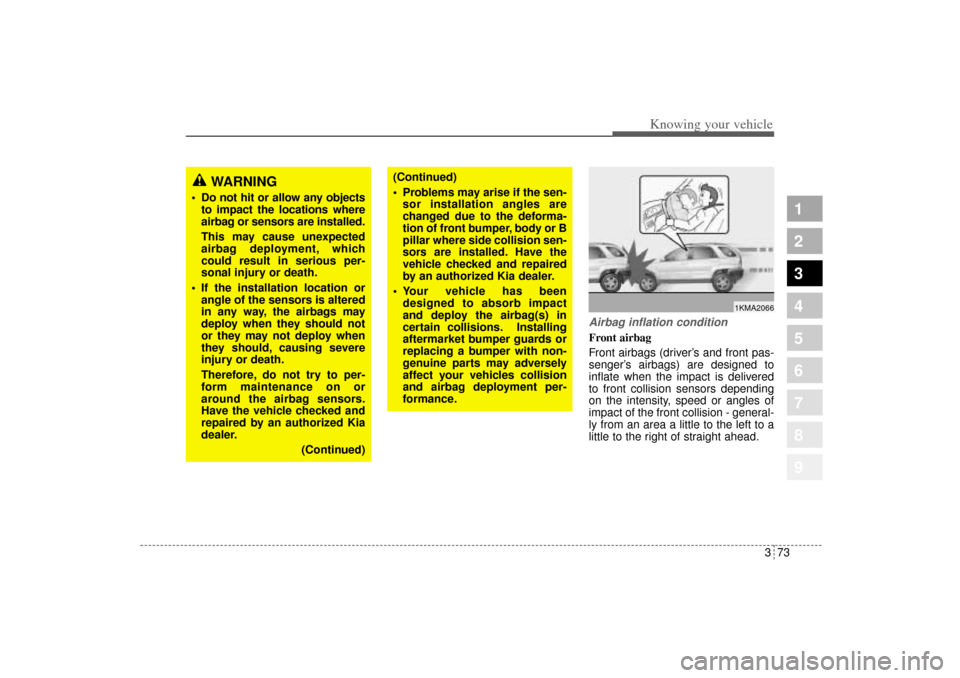
Airbag inflation conditionFront airbag
Front airbags (driver’s and front pas-
senger’s airbags) are designed to
inflate when the impact is delivered
to front collision sensors depending
on the intensity, speed or angles of
impact of the front collision - general-
ly from an area a little to the left to a
little to the right of straight ahead.
WARNING
Do not hit or allow any objects
to impact the locations where
airbag or sensors are installed.
This may cause unexpected
airbag deployment, which
could result in serious per-
sonal injury or death.
If the installation location or
angle of the sensors is altered
in any way, the airbags may
deploy when they should not
or they may not deploy when
they should, causing severe
injury or death.
Therefore, do not try to per-
form maintenance on or
around the airbag sensors.
Have the vehicle checked and
repaired by an authorized Kia
dealer.
(Continued)
(Continued)
Problems may arise if the sen-
sor installation angles are
changed due to the deforma-
tion of front bumper, body or B
pillar where side collision sen-
sors are installed. Have the
vehicle checked and repaired
by an authorized Kia dealer.
Your vehicle has been
designed to absorb impact
and deploy the airbag(s) in
certain collisions. Installing
aftermarket bumper guards or
replacing a bumper with non-
genuine parts may adversely
affect your vehicles collision
and airbag deployment per-
formance.
1KMA2066
KM CAN (ENG) 3 (~112).qxd 9/13/2004 4:50 PM Page 73
Page 85 of 354
Knowing your vehicle74 3
1
2
3
4
5
6
7
8
9
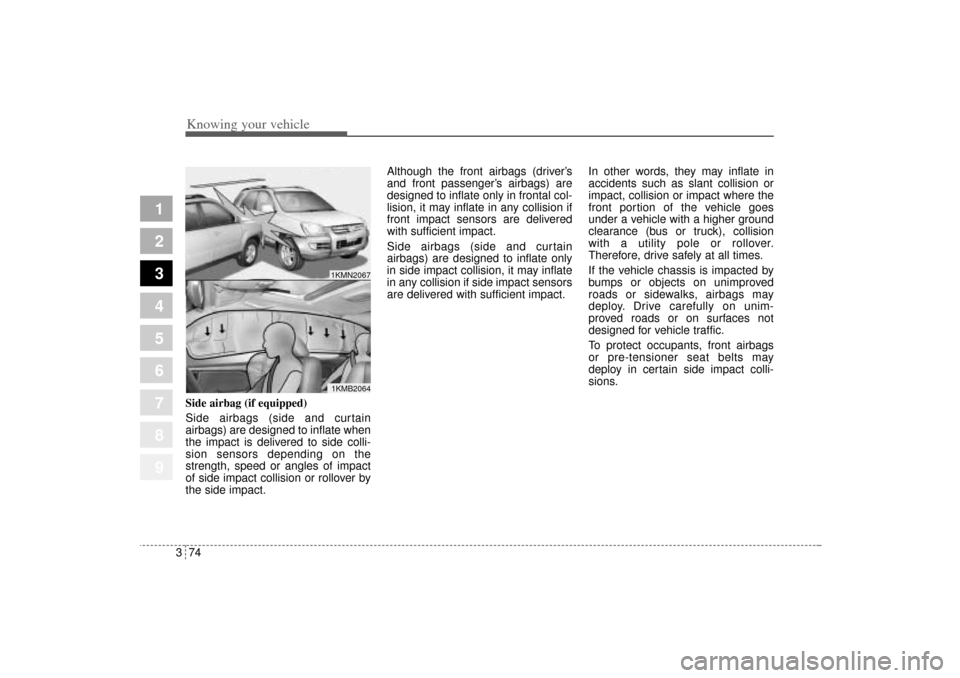
Side airbag (if equipped)
Side airbags (side and curtain
airbags) are designed to inflate when
the impact is delivered to side colli-
sion sensors depending on the
strength, speed or angles of impact
of side impact collision or rollover by
the side impact.Although the front airbags (driver’s
and front passenger’s airbags) are
designed to inflate only in frontal col-
lision, it may inflate in any collision if
front impact sensors are delivered
with sufficient impact.
Side airbags (side and curtain
airbags) are designed to inflate only
in side impact collision, it may inflate
in any collision if side impact sensors
are delivered with sufficient impact.In other words, they may inflate in
accidents such as slant collision or
impact, collision or impact where the
front portion of the vehicle goes
under a vehicle with a higher ground
clearance (bus or truck), collision
with a utility pole or rollover.
Therefore, drive safely at all times.
If the vehicle chassis is impacted by
bumps or objects on unimproved
roads or sidewalks, airbags may
deploy. Drive carefully on unim-
proved roads or on surfaces not
designed for vehicle traffic.
To protect occupants, front airbags
or pre-tensioner seat belts may
deploy in certain side impact colli-
sions.
1KMN20671KMB2064
KM CAN (ENG) 3 (~112).qxd 9/13/2004 4:50 PM Page 74
Page 88 of 354
377
1
2
3
4
5
6
7
8
9
Knowing your vehicle
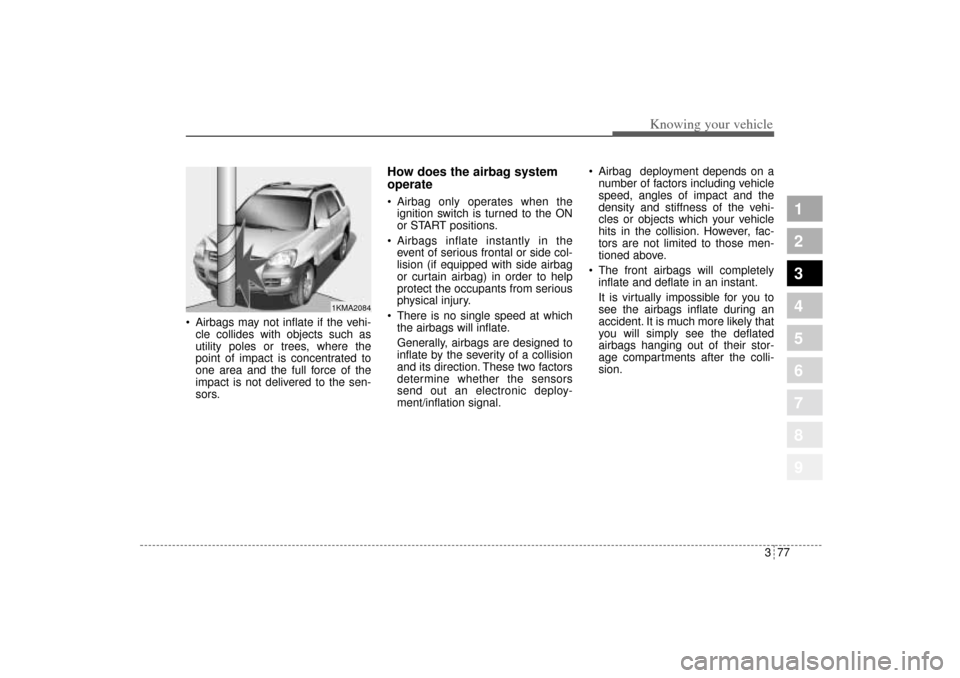
Airbags may not inflate if the vehi-
cle collides with objects such as
utility poles or trees, where the
point of impact is concentrated to
one area and the full force of the
impact is not delivered to the sen-
sors.
How does the airbag system
operate Airbag only operates when the
ignition switch is turned to the ON
or START positions.
Airbags inflate instantly in the
event of serious frontal or side col-
lision (if equipped with side airbag
or curtain airbag) in order to help
protect the occupants from serious
physical injury.
There is no single speed at which
the airbags will inflate.
Generally, airbags are designed to
inflate by the severity of a collision
and its direction. These two factors
determine whether the sensors
send out an electronic deploy-
ment/inflation signal. Airbag deployment depends on a
number of factors including vehicle
speed, angles of impact and the
density and stiffness of the vehi-
cles or objects which your vehicle
hits in the collision. However, fac-
tors are not limited to those men-
tioned above.
The front airbags will completely
inflate and deflate in an instant.
It is virtually impossible for you to
see the airbags inflate during an
accident. It is much more likely that
you will simply see the deflated
airbags hanging out of their stor-
age compartments after the colli-
sion.
1KMA2084
KM CAN (ENG) 3 (~112).qxd 9/13/2004 4:50 PM Page 77