warning light KIA Sportage 2005 JE_ / 2.G Owner's Manual
[x] Cancel search | Manufacturer: KIA, Model Year: 2005, Model line: Sportage, Model: KIA Sportage 2005 JE_ / 2.GPages: 354, PDF Size: 2.78 MB
Page 15 of 354
Knowing your vehicle4 3
1
2
3
4
5
6
7
8
9
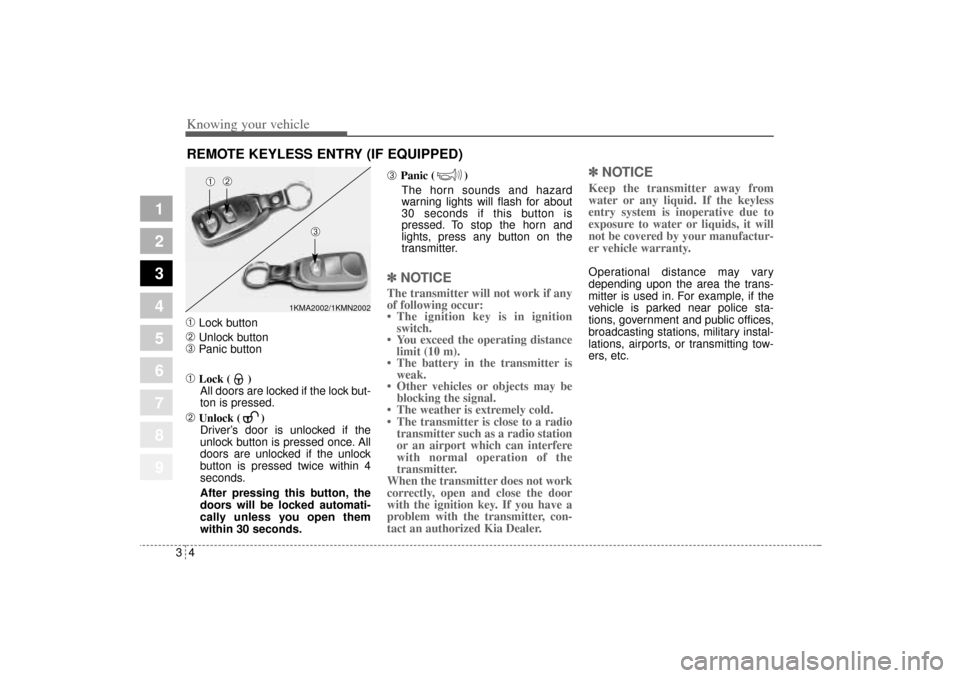
➀
Lock button
➁
Unlock button
➂
Panic button
➀
Lock ( )
All doors are locked if the lock but-
ton is pressed.
➁
Unlock ( )
Driver’s door is unlocked if the
unlock button is pressed once. All
doors are unlocked if the unlock
button is pressed twice within 4
seconds.
After pressing this button, the
doors will be locked automati-
cally unless you open them
within 30 seconds.
➂
Panic ( )
The horn sounds and hazard
warning lights will flash for about
30 seconds if this button is
pressed. To stop the horn and
lights, press any button on the
transmitter.
✽ ✽
NOTICEThe transmitter will not work if any
of following occur:
• The ignition key is in ignition
switch.
• You exceed the operating distance
limit (10 m).
• The battery in the transmitter is
weak.
• Other vehicles or objects may be
blocking the signal.
• The weather is extremely cold.
• The transmitter is close to a radio
transmitter such as a radio station
or an airport which can interfere
with normal operation of the
transmitter.
When the transmitter does not work
correctly, open and close the door
with the ignition key. If you have a
problem with the transmitter, con-
tact an authorized Kia Dealer.
✽ ✽
NOTICEKeep the transmitter away from
water or any liquid. If the keyless
entry system is inoperative due to
exposure to water or liquids, it will
not be covered by your manufactur-
er vehicle warranty. Operational distance may vary
depending upon the area the trans-
mitter is used in. For example, if the
vehicle is parked near police sta-
tions, government and public offices,
broadcasting stations, military instal-
lations, airports, or transmitting tow-
ers, etc.
REMOTE KEYLESS ENTRY (IF EQUIPPED)
1KMA2002/1KMN2002
➀
➁
➂
KM CAN (ENG) 3 (~57).qxd 9/13/2004 4:49 PM Page 4
Page 17 of 354
Knowing your vehicle6 3
1
2
3
4
5
6
7
8
9
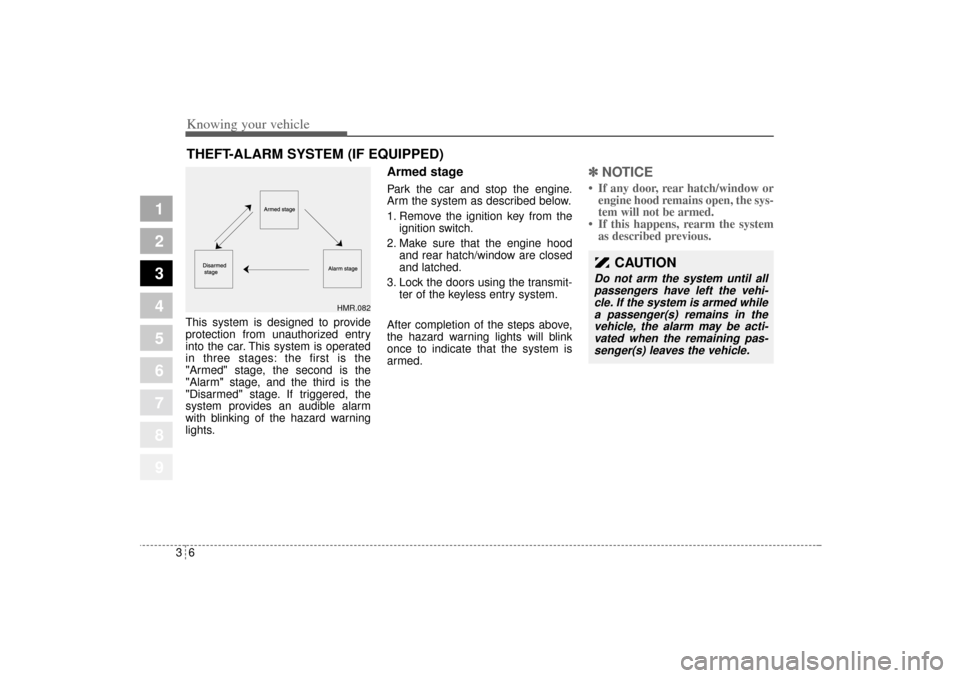
This system is designed to provide
protection from unauthorized entry
into the car. This system is operated
in three stages: the first is the
"Armed" stage, the second is the
"Alarm" stage, and the third is the
"Disarmed" stage. If triggered, the
system provides an audible alarm
with blinking of the hazard warning
lights.
Armed stagePark the car and stop the engine.
Arm the system as described below.
1. Remove the ignition key from the
ignition switch.
2. Make sure that the engine hood
and rear hatch/window are closed
and latched.
3. Lock the doors using the transmit-
ter of the keyless entry system.
After completion of the steps above,
the hazard warning lights will blink
once to indicate that the system is
armed.
✽ ✽
NOTICE• If any door, rear hatch/window or
engine hood remains open, the sys-
tem will not be armed.
• If this happens, rearm the system
as described previous.
THEFT-ALARM SYSTEM (IF EQUIPPED)
HMR.082
CAUTION
Do not arm the system until all
passengers have left the vehi-
cle. If the system is armed while
a passenger(s) remains in the
vehicle, the alarm may be acti-
vated when the remaining pas-
senger(s) leaves the vehicle.
KM CAN (ENG) 3 (~57).qxd 9/13/2004 4:49 PM Page 6
Page 18 of 354
37
Knowing your vehicle
1
2
3
4
5
6
7
8
9
Alarm stageThe alarm will be activated if any of
the following occurs while the system
is armed.
A front or rear door is opened with-
out using the ignition key or trans-
mitter.
The rear hatch/window is opened
without using the ignition key or
transmitter.
The engine hood is opened.
The siren will sound and the hazard
warning lights will blink continuously
for 27 seconds, and repeat the alarm
3 times unless the system is dis-
armed. To turn off the system, unlock
the doors with the ignition key or
transmitter.✽ ✽
NOTICEAvoid trying to start the engine
while the alarm is activated. The
vehicle starting motor is disabled
during the alarm stage.
Disarmed stageThe system will be disarmed when
the doors are unlocked by depress-
ing the unlock button on the transmit-
ter or unlocked with the ignition key.
After depressing unlock button, the
hazard warning lights will blink twice
to indicate that the system is dis-
armed.
After depressing unlock button, if any
door is not opened within 30 sec-
onds, the system will be rearmed.
If the system is not disarmed with the
ignition key or transmitter, insert the
key in the ignition switch, turn the key
to the ON position and wait for 30
seconds. Then the system will be dis-
armed.
KM CAN (ENG) 3 (~57).qxd 9/13/2004 4:49 PM Page 7
Page 42 of 354
331
Knowing your vehicle
1
2
3
4
5
6
7
8
9
Pre-tensioner seat belt
(if equipped)Your vehicle is equipped with driver’s
and front passenger’s pre-tensioner
seat belts. The purpose of the pre-
tensioner is to make sure that the
seat belts fit tightly against the occu-
pant’s body in certain frontal colli-
sions. The pre-tensioner seat belts
may activate independently of or in
conjunction with the front airbags
based on angle of impact, seat belt
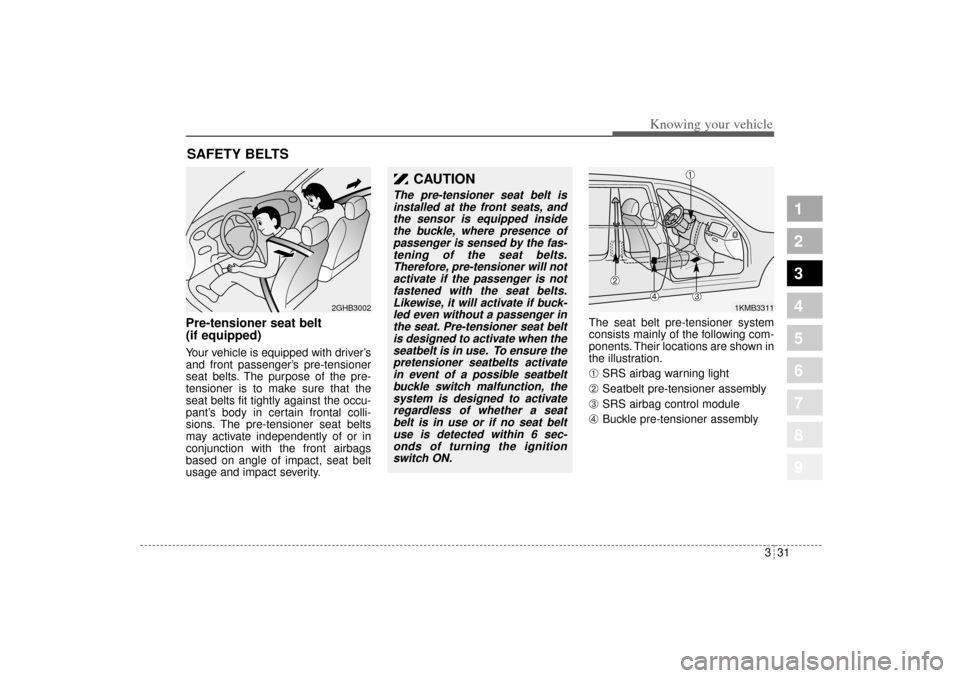
usage and impact severity.The seat belt pre-tensioner system
consists mainly of the following com-
ponents. Their locations are shown in
the illustration.
➀
SRS airbag warning light
➁
Seatbelt pre-tensioner assembly
➂
SRS airbag control module
➃
Buckle pre-tensioner assembly
SAFETY BELTS
2GHB3002
CAUTION
The pre-tensioner seat belt is
installed at the front seats, and
the sensor is equipped inside
the buckle, where presence of
passenger is sensed by the fas-
tening of the seat belts.
Therefore, pre-tensioner will not
activate if the passenger is not
fastened with the seat belts.
Likewise, it will activate if buck-
led even without a passenger in
the seat. Pre-tensioner seat belt
is designed to activate when the
seatbelt is in use. To ensure the
pretensioner seatbelts activate
in event of a possible seatbelt
buckle switch malfunction, the
system is designed to activate
regardless of whether a seat
belt is in use or if no seat belt
use is detected within 6 sec-
onds of turning the ignition
switch ON.
1KMB3311
➀
➁
➂
➃
KM CAN (ENG) 3 (~57).qxd 9/13/2004 4:49 PM Page 31
Page 43 of 354
Knowing your vehicle32 3
1
2
3
4
5
6
7
8
9
Load limiterWhen the pre-tentioner activates, if
the system senses excessive seat
belt tension on the driver or passen-
ger’s seat belt, the load limiter inside
the pre-tensioner will release some
of the pressure on the affected seat
belt.
WARNING
To obtain maximum benefit from
a pre-tensioner seat belt:
The seat belt must be worn
correctly.
The seat belt must be adjusted
to the correct position.
CAUTION
When the pre-tensioner seat
belts are activated, a loud noise
may be heard and fine dust,
which may appear to be smoke,
may be visible in the passenger
compartment and are not toxic.
Although, it is harmless, the fine
dust may cause skin irritation
and should not be breathed for
prolonged periods. Wash your
hands and face thoroughly after
an accident in which the airbags
and/or pre-tensioner seat belts
were activated.
CAUTION
Because the sensor that acti-
vates the SRS airbag is con-
nected with pre-tensioner seat
belt, the SRS airbag warning
light on the instrument panel
will illuminate for approxi-
mately 6 seconds after the
ignition key has been turned
to the “ON” position, then the
light should go off.
If the pre-tensioner seat belt is
not working properly, this
warning light will illuminate
even if there is no malfunction
of SRS airbag system. If the
SRS airbag warning light does
not illuminate when the igni-
tion key is turned to “ON” , or
if it remains illuminated after
illuminating for approximately
6 seconds, or if it illuminates
while the vehicle is being driv-
en, please have an authorized
Kia dealer inspect the pre-ten-
sioner seat belt or SRS airbag
system as soon as possible.
KM CAN (ENG) 3 (~57).qxd 9/13/2004 4:49 PM Page 32
Page 46 of 354
335
Knowing your vehicle
1
2
3
4
5
6
7
8
9
The rear safety belts use a special
auto-lock feature designed to allow a
child restraint to be used in these
positions without an added locking
clip. They normally lock only under
extreme or emergency conditions
(emergency lock mode). However
they can be adjusted so that they
remain in fixed and locked when a
child restraint system is placed in
these positions. (Use this auto-lock
mode only to secure a child restraint,
never for passengers restrained by
the safety belts.) Page 3-49 gives
instructions on placing the safety belt
in the auto lock mode.
The drivers safety belt can only oper-
ate in the emergency lock mode.Safety belts provide the best restraint
when:
The seatback is upright.
The occupant is sitting upright (not
slouched).
The lap belt is snug across the hips.
The shoulder belt is snug across
the chest.
The knees are straight forward.
To help you remember to fasten your
safety belt, a warning light will blink.
See “Safety belt warning light and
chime” on page 3-36.
WARNING
- After a colli-
sion
Lap/shoulder belt assemblies
may be stretched or damaged
when subjected to the stress
and forces of a collision.
The entire restraint system
should be inspected following
any collision. All belts, retrac-
tors, anchors and hardware
damaged by a collision should
be replaced before the vehicle
is operated again.
WARNING -
Cargo area
Passengers should never be
allowed to ride in the cargo area
of a vehicle. No safety belts are
provided for the cargo area.
Persons riding in the vehicle
without a fastened safety belt
are much more likely to suffer
serious bodily injury or death
during an accident.
KM CAN (ENG) 3 (~57).qxd 9/13/2004 4:49 PM Page 35
Page 48 of 354
337
Knowing your vehicle
1
2
3
4
5
6
7
8
9
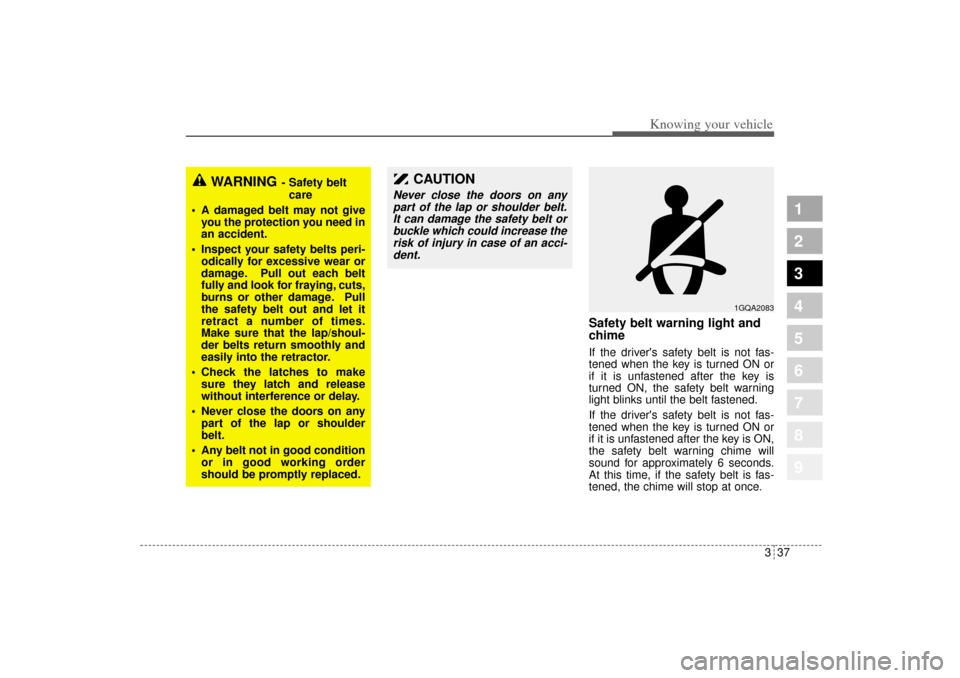
Safety belt warning light and
chimeIf the driver's safety belt is not fas-
tened when the key is turned ON or
if it is unfastened after the key is
turned ON, the safety belt warning
light blinks until the belt fastened.
If the driver's safety belt is not fas-
tened when the key is turned ON or
if it is unfastened after the key is ON,
the safety belt warning chime will
sound for approximately 6 seconds.
At this time, if the safety belt is fas-
tened, the chime will stop at once.
1GQA2083
CAUTION
Never close the doors on any
part of the lap or shoulder belt.
It can damage the safety belt or
buckle which could increase the
risk of injury in case of an acci-
dent.
WARNING
- Safety belt
care
A damaged belt may not give
you the protection you need in
an accident.
Inspect your safety belts peri-
odically for excessive wear or
damage. Pull out each belt
fully and look for fraying, cuts,
burns or other damage. Pull
the safety belt out and let it
retract a number of times.
Make sure that the lap/shoul-
der belts return smoothly and
easily into the retractor.
Check the latches to make
sure they latch and release
without interference or delay.
Never close the doors on any
part of the lap or shoulder
belt.
Any belt not in good condition
or in good working order
should be promptly replaced.
KM CAN (ENG) 3 (~57).qxd 9/13/2004 4:49 PM Page 37
Page 57 of 354
Knowing your vehicle46 3
1
2
3
4
5
6
7
8
9
Restraint of larger children As children grow, they may need to
use new child-restraint systems,
including larger child seats or boost-
er seats, which are appropriate for
their increased size.
A child who has outgrown available
child-restraint systems should use
the belts provided in the vehicle.
When seated in the rear outboard
seats, the child should be restrained
by the lap/shoulder belt.
If the shoulder belt portion slightly
touches the child’s neck or face, try
placing the child closer to the center
of the vehicle. If the shoulder belt still
touches their face or neck they may
need to be returned to a child
restraint system. In addition, after-
market devices are available from
independent manufacturers which
help pull the shoulder belt down and
away from the child’s face or neck.
Larger children should use one of
the seat belts provided.
WARNING
- Infants and
young children
Infants and young children are
at much greater risk of serious
injury or death in an accident
or sudden stop if they are unre-
strained or restrained improp-
erly. Follow all instructions in
this section of your Kia manual
and the instructions that came
on and with an improved child
safety restraint system. The
child restraint must be correct-
ly installed in the vehicle, and
the child must be correctly
installed in the child restraint.
All children under 12 are
safest in the back seat.
Never install a child or infant
seat in the front passenger
position. The baby will be
injured or killed by the airbag
if it deploys in an accident.
Never allow a child to stand or
kneel on the seat of a moving
vehicle. Insist the child sit down
in an approved restraint system.
WARNING
- Children on
laps
Never hold a child on your lap or
in your arms in a moving vehi-
cle.
Even a very strong person can-
not hold onto a child in the
event of even a minor collision.
CAUTION
- Hot metal
parts
Safety belts and seats can
become hot in a vehicle that has
been closed during warm/hot
weather; they could burn a
child. Check seat covers and
buckles before you place a child
anywhere near them.
KM CAN (ENG) 3 (~57).qxd 9/13/2004 4:49 PM Page 46
Page 69 of 354
Knowing your vehicle58 3
1
2
3
4
5
6
7
8
9
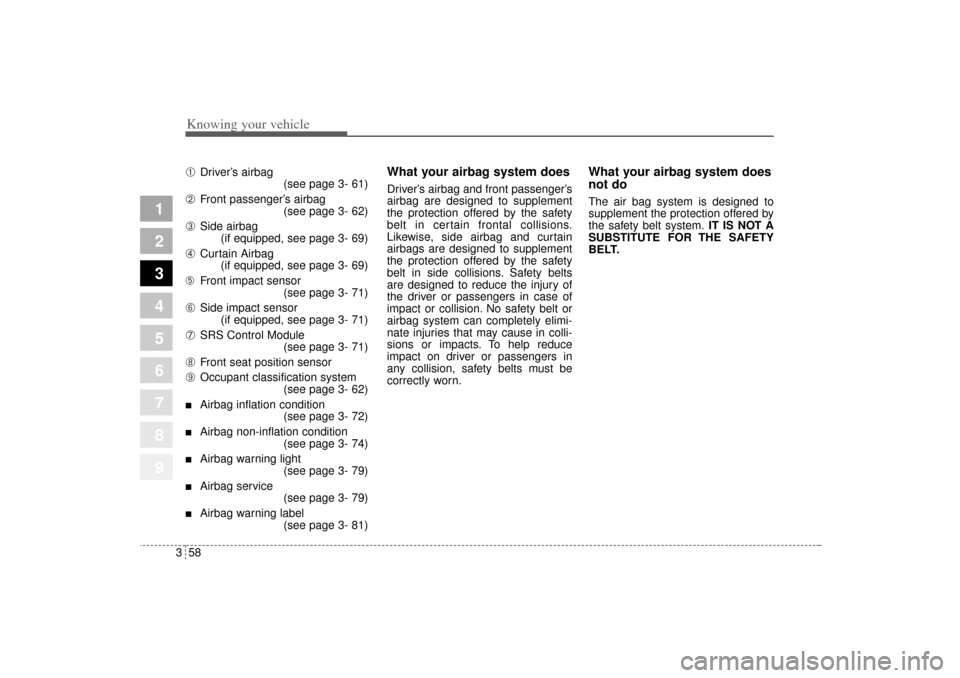
➀
Driver’s airbag
(see page 3- 61)
➁
Front passenger’s airbag
(see page 3- 62)
➂
Side airbag
(if equipped, see page 3- 69)
➃
Curtain Airbag
(if equipped, see page 3- 69)
➄Front impact sensor
(see page 3- 71)
➅
Side impact sensor
(if equipped, see page 3- 71)
➆
SRS Control Module
(see page 3- 71)
➇
Front seat position sensor
➈
Occupant classification system
(see page 3- 62)
Airbag inflation condition
(see page 3- 72)
Airbag non-inflation condition
(see page 3- 74)
Airbag warning light
(see page 3- 79)
Airbag service
(see page 3- 79)
Airbag warning label
(see page 3- 81)
What your airbag system doesDriver’s airbag and front passenger’s
airbag are designed to supplement
the protection offered by the safety
belt in certain frontal collisions.
Likewise, side airbag and curtain
airbags are designed to supplement
the protection offered by the safety
belt in side collisions. Safety belts
are designed to reduce the injury of
the driver or passengers in case of
impact or collision. No safety belt or
airbag system can completely elimi-
nate injuries that may cause in colli-
sions or impacts. To help reduce
impact on driver or passengers in
any collision, safety belts must be
correctly worn.
What your airbag system does
not doThe air bag system is designed to
supplement the protection offered by
the safety belt system.IT IS NOT A
SUBSTITUTE FOR THE SAFETY
BELT.
KM CAN (ENG) 3 (~112).qxd 9/13/2004 4:50 PM Page 58
Page 71 of 354
Knowing your vehicle60 3
1
2
3
4
5
6
7
8
9
Airbag system components The main components of your SRS
are:
To indicate that your vehicle is
equipped with airbags, the corre-
sponding airbag covers are
marked with “SRS AIRBAG”.
- Driver’s airbag (see page 3- 61)
- Passenger’s airbag(see page 3- 62)
- Side airbag
(if equipped, see page 3- 69)
- Curtain airbag
(if equipped, see page 3- 69)
A diagnostic system that continual-
ly monitors the system operation.
Airbag warning light to warn you of
a possible problem with the sys-
tem.
Emergency power backup in case
your car’s electrical system is dis-
connected in a crash.The SRS uses a collection of sen-
sors to gather information about the
driver’s and front passenger’s seat
position, the driver’s and front pas-
senger’s safety belt usage and
impact severity.
The driver’s and front passenger’s
seat position sensors, which are
installed on the seat track, determine
if the seats are fore or aft of a refer-
ence position. Similarly, the safety
belt usage sensors determine if the
driver and front passenger’s safety
belts are fastened. These sensors
provide the ability to control the SRS
deployment based on how close the
driver’s seat is to the steering wheel,
how close the passenger’s seat is to
the instrument panel, whether or not
the safety belts are fastened, and the
severity of the impact.
(Continued)
If your vehicle has been sub-
jected to flood conditions (e.g.
soaked carpeting/standing
water on the floor of the vehi-
cle, etc.) or if your vehicle has
become flood damaged in any
way, do not attempt to start
the vehicle or put the key in
the ignition before discon-
necting the battery.
Disregarding this precaution
may cause airbag deployment,
which could result in serious
personal injury or death. If
your vehicle is subjected to
flooded conditions, before
starting the vehicle, have the
vehicle towed to an authorized
Kia dealer for inspection and
necessary repairs.
KM CAN (ENG) 3 (~112).qxd 9/13/2004 4:50 PM Page 60