ECU KIA Sportage 2006 JE_ / 2.G Owner's Guide
[x] Cancel search | Manufacturer: KIA, Model Year: 2006, Model line: Sportage, Model: KIA Sportage 2006 JE_ / 2.GPages: 354, PDF Size: 3.62 MB
Page 113 of 354
347
Knowing your vehicle
1
2
3
4
5
6
7
8
9
Installing a child restraint system
For safety reasons, we recommend
that the child restraint system be
used in the rear seats.
Never place a rear-facing child
restraint in the front passenger
seat, because of the danger that
an inflating passenger side air bag
could impact the rear-facing child
restraint and kill the child.
Since all passenger safety belts
move freely under normal conditions
and only lock under extreme or
emergency conditions (emergency
lock mode), you must manually
change these safety belts to the auto
lock mode to secure a child restraint.
(Continued)
Never allow a child to stand upor kneel while the vehicle is
moving.
Never use an infant carrier or child seat that "hooks" over a
seatback. It will not provide
adequate protection in an
accident.
Never allow a child to be held while they are in a moving
vehicle, as this could result in
serious injury to the child in
the event of an accident or a
sudden stop. Holding a child
in a moving vehicle does not
provide the child with any pro-
tection during an accident,
even if the person holding the
child is wearing a seat belt.
WARNING
- Child seat
installation
Before installing the child restraint system, read the
instructions supplied by the
child restraint system manu-
facturer.
If the safety belt does not operate as described in this
section, have the system
checked immediately by your
authorized Kia dealer.
Failure to observe this manu- al's instructions regarding
child restraint system and the
instructions provided with the
child restraint system could
increase the chance and/or
severity of injury in an acci-
dent.
KM CAN (ENG) 3 (~54)new.qxd 7/29/05 9:33 AM Page 47
Page 114 of 354
Knowing your vehicle48
3
1
2
3
4
5
6
7
8
9
Placing a passenger safety
belt into the auto lock modeThe use of the auto lock mode will
ensure that the normal movement of
the child in the vehicle does not
cause the safety belt to be pulled out
and loosen the firmness of its hold
on the child restraint system. To
secure a child restraint system, use
the following procedure.
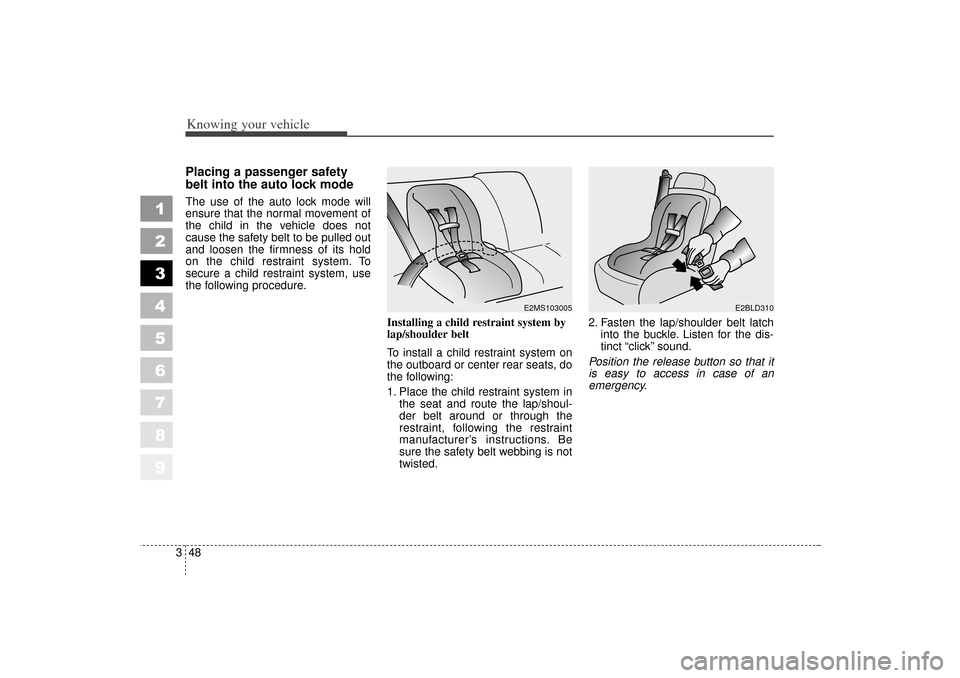
Installing a child restraint system by
lap/shoulder belt
To install a child restraint system on
the outboard or center rear seats, do
the following:
1. Place the child restraint system inthe seat and route the lap/shoul-
der belt around or through the
restraint, following the restraint
manufacturer’s instructions. Be
sure the safety belt webbing is not
twisted. 2. Fasten the lap/shoulder belt latch
into the buckle. Listen for the dis-
tinct “click” sound.
Position the release button so that it
is easy to access in case of an
emergency.
E2MS103005
E2BLD310
KM CAN (ENG) 3 (~54)new.qxd 7/29/05 9:33 AM Page 48
Page 116 of 354
Knowing your vehicle50
3
1
2
3
4
5
6
7
8
9
7. Double check that the retractor is
in the “Auto Lock” mode by
attempting to pull more of the safe-
ty belt out of the retractor. If you
cannot, the retractor is in the “Auto
Lock” mode.
To remove the child restraint, press
the release button on the buckle and
then pull the lap/shoulder belt out of
the restraint and allow the safety belt
to retract fully.
When the safety belt is allowed to
retract to its fully stowed position,
the retractor will automatically
switch from the “Auto Lock” mode
to the emergency lock mode for
normal adult usage.Securing a child restraint seat
with “Tether Anchor” system
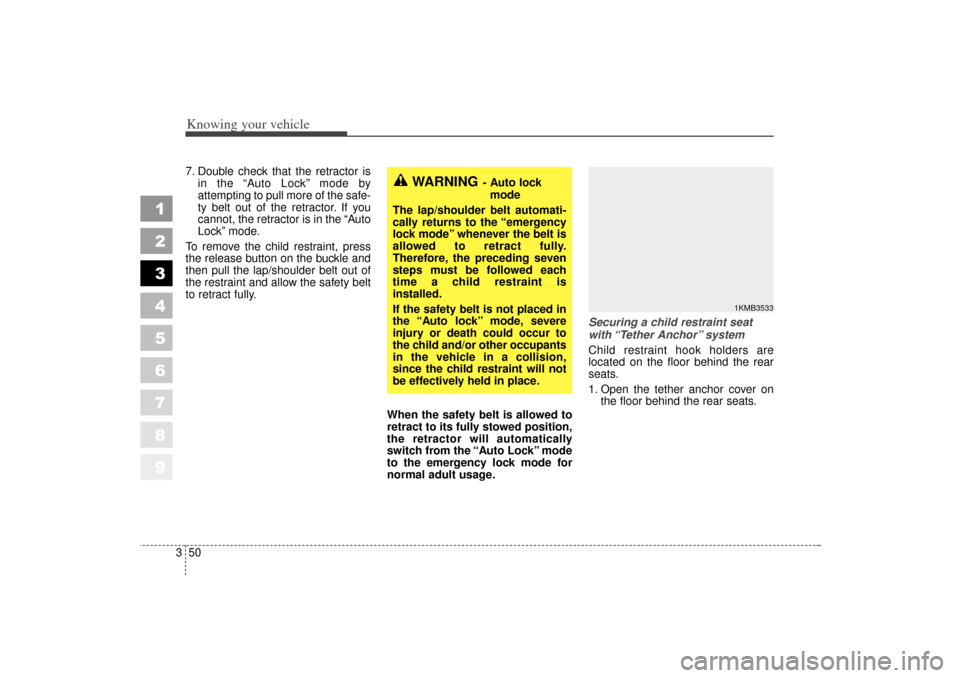
Child restraint hook holders are
located on the floor behind the rear
seats.
1. Open the tether anchor cover on
the floor behind the rear seats.
WARNING
- Auto lock
mode
The lap/shoulder belt automati-
cally returns to the “emergency
lock mode” whenever the belt is
allowed to retract fully.
Therefore, the preceding seven
steps must be followed each
time a child restraint is
installed.
If the safety belt is not placed in
the “Auto lock” mode, severe
injury or death could occur to
the child and/or other occupants
in the vehicle in a collision,
since the child restraint will not
be effectively held in place.
1KMB3533
KM CAN (ENG) 3 (~54)new.qxd 7/29/05 9:33 AM Page 50
Page 117 of 354
351
Knowing your vehicle
1
2
3
4
5
6
7
8
9
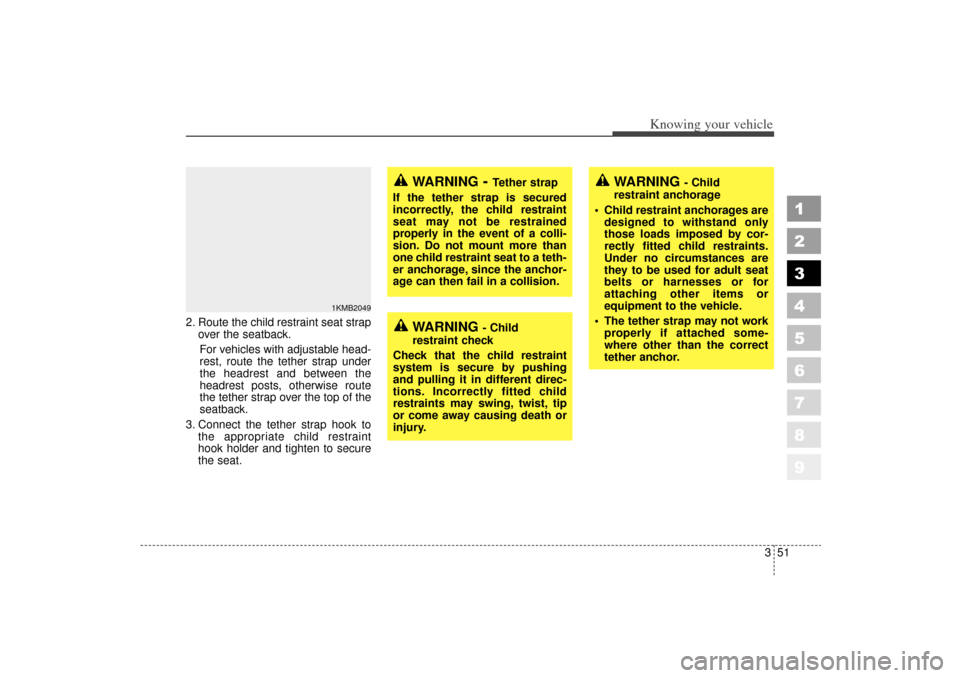
2. Route the child restraint seat strapover the seatback.
For vehicles with adjustable head-
rest, route the tether strap under
the headrest and between the
headrest posts, otherwise route
the tether strap over the top of the
seatback.
3. Connect the tether strap hook to the appropriate child restraint
hook holder and tighten to secure
the seat.
1KMB2049
WARNING
- Tether strap
If the tether strap is secured
incorrectly, the child restraint
seat may not be restrained
properly in the event of a colli-
sion. Do not mount more than
one child restraint seat to a teth-
er anchorage, since the anchor-
age can then fail in a collision.
WARNING
- Child
restraint check
Check that the child restraint
system is secure by pushing
and pulling it in different direc-
tions. Incorrectly fitted child
restraints may swing, twist, tip
or come away causing death or
injury.
WARNING
- Child
restraint anchorage
Child restraint anchorages are designed to withstand only
those loads imposed by cor-
rectly fitted child restraints.
Under no circumstances are
they to be used for adult seat
belts or harnesses or for
attaching other items or
equipment to the vehicle.
The tether strap may not work properly if attached some-
where other than the correct
tether anchor.
KM CAN (ENG) 3 (~54)new.qxd 7/29/05 9:33 AM Page 51
Page 119 of 354
353
Knowing your vehicle
1
2
3
4
5
6
7
8
9
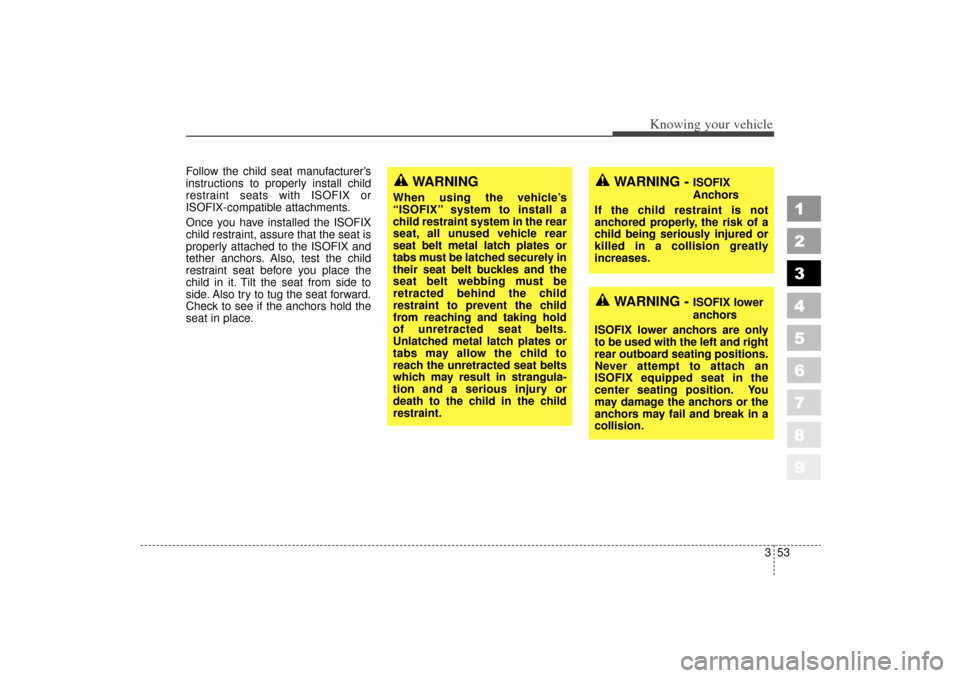
Follow the child seat manufacturer’s
instructions to properly install child
restraint seats with ISOFIX or
ISOFIX-compatible attachments.
Once you have installed the ISOFIX
child restraint, assure that the seat is
properly attached to the ISOFIX and
tether anchors. Also, test the child
restraint seat before you place the
child in it. Tilt the seat from side to
side. Also try to tug the seat forward.
Check to see if the anchors hold the
seat in place.
WARNING -
ISOFIX
Anchors
If the child restraint is not
anchored properly, the risk of a
child being seriously injured or
killed in a collision greatly
increases.
WARNING -
ISOFIX lower
anchors
ISOFIX lower anchors are only
to be used with the left and right
rear outboard seating positions.
Never attempt to attach an
ISOFIX equipped seat in the
center seating position. You
may damage the anchors or the
anchors may fail and break in a
collision.
WARNING
When using the vehicle’s
“ISOFIX” system to install a
child restraint system in the rear
seat, all unused vehicle rear
seat belt metal latch plates or
tabs must be latched securely in
their seat belt buckles and the
seat belt webbing must be
retracted behind the child
restraint to prevent the child
from reaching and taking hold
of unretracted seat belts.
Unlatched metal latch plates or
tabs may allow the child to
reach the unretracted seat belts
which may result in strangula-
tion and a serious injury or
death to the child in the child
restraint.
KM CAN (ENG) 3 (~54)new.qxd 7/29/05 9:33 AM Page 53
Page 130 of 354
Driving your vehicle10
4
1
2
3
4
5
6
7
8
9
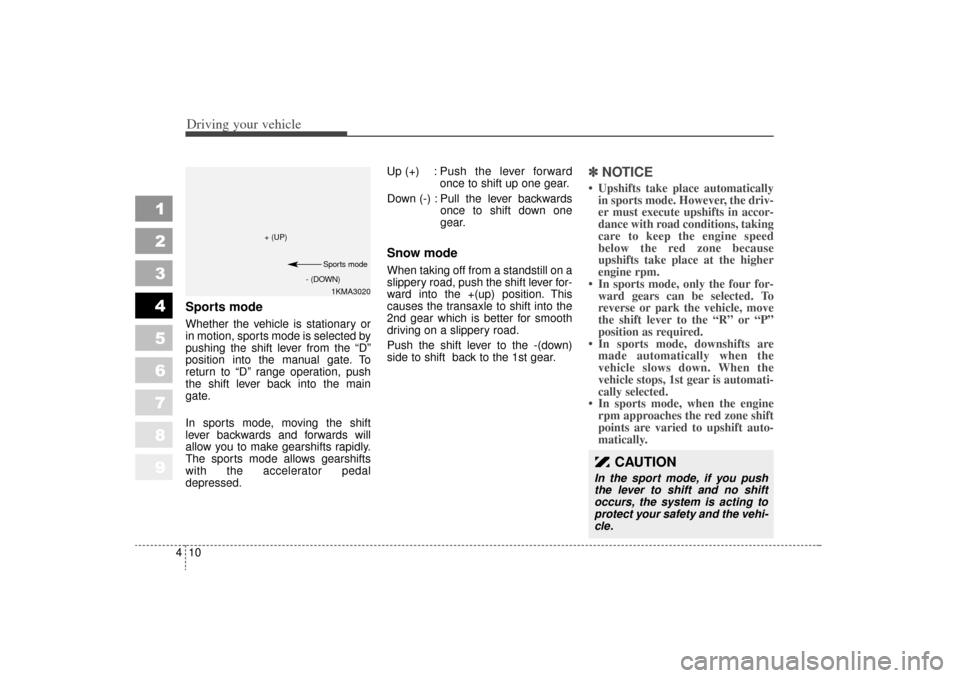
Sports modeWhether the vehicle is stationary or
in motion, sports mode is selected by
pushing the shift lever from the “D”
position into the manual gate. To
return to “D” range operation, push
the shift lever back into the main
gate.
In sports mode, moving the shift
lever backwards and forwards will
allow you to make gearshifts rapidly.
The sports mode allows gearshifts
with the accelerator pedal
depressed. Up (+) : Push the lever forward
once to shift up one gear.
Down (-) : Pull the lever backwards once to shift down one
gear.
Snow modeWhen taking off from a standstill on a
slippery road, push the shift lever for-
ward into the +(up) position. This
causes the transaxle to shift into the
2nd gear which is better for smooth
driving on a slippery road.
Push the shift lever to the -(down)
side to shift back to the 1st gear.
✽ ✽
NOTICE Upshifts take place automatically
in sports mode. However, the driv-
er must execute upshifts in accor-
dance with road conditions, taking
care to keep the engine speed
below the red zone because
upshifts take place at the higher
engine rpm.
In sports mode, only the four for- ward gears can be selected. To
reverse or park the vehicle, move
the shift lever to the “R” or “P”
position as required.
In sports mode, downshifts are made automatically when the
vehicle slows down. When the
vehicle stops, 1st gear is automati-
cally selected.
In sports mode, when the engine rpm approaches the red zone shift
points are varied to upshift auto-
matically.
1KMA3020
+ (UP)
- (DOWN)Sports mode
CAUTION
In the sport mode, if you push
the lever to shift and no shift
occurs, the system is acting to
protect your safety and the vehi-
cle.
KM CAN (ENG) 4 new.qxd 7/29/05 9:35 AM Page 10
Page 140 of 354
Driving your vehicle20
4
1
2
3
4
5
6
7
8
9
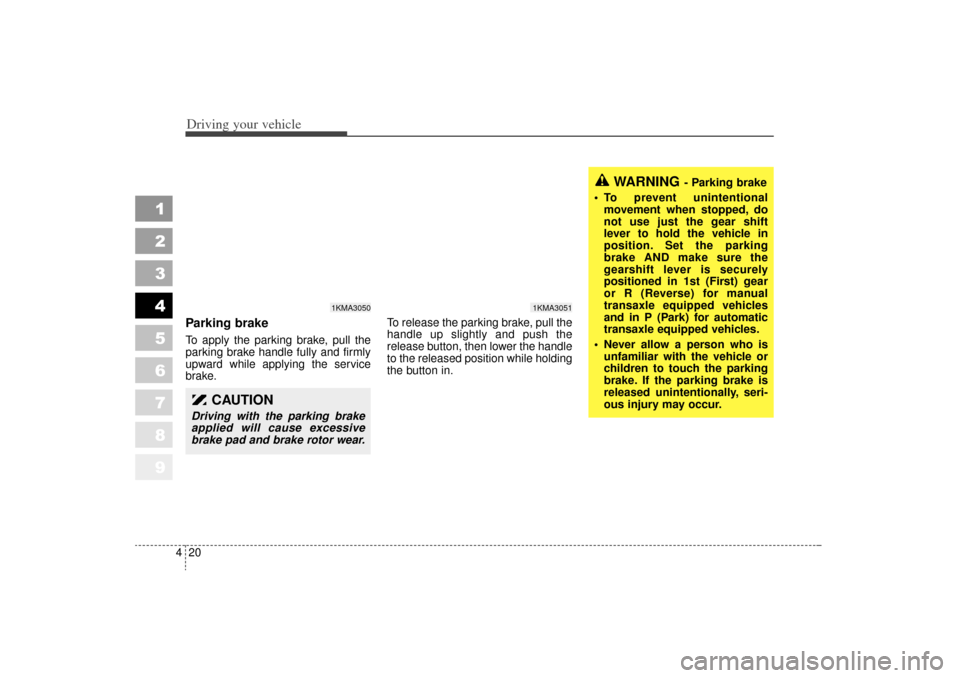
Parking brake To apply the parking brake, pull the
parking brake handle fully and firmly
upward while applying the service
brake. To release the parking brake, pull the
handle up slightly and push the
release button, then lower the handle
to the released position while holding
the button in.
CAUTION
Driving with the parking brake
applied will cause excessive
brake pad and brake rotor wear.
1KMA3050
1KMA3051
WARNING
- Parking brake
To prevent unintentional movement when stopped, do
not use just the gear shift
lever to hold the vehicle in
position. Set the parking
brake AND make sure the
gearshift lever is securely
positioned in 1st (First) gear
or R (Reverse) for manual
transaxle equipped vehicles
and in P (Park) for automatic
transaxle equipped vehicles.
Never allow a person who is unfamiliar with the vehicle or
children to touch the parking
brake. If the parking brake is
released unintentionally, seri-
ous injury may occur.
KM CAN (ENG) 4 new.qxd 7/29/05 9:35 AM Page 20
Page 169 of 354
449
Driving your vehicle
1
2
3
4
5
6
7
8
9
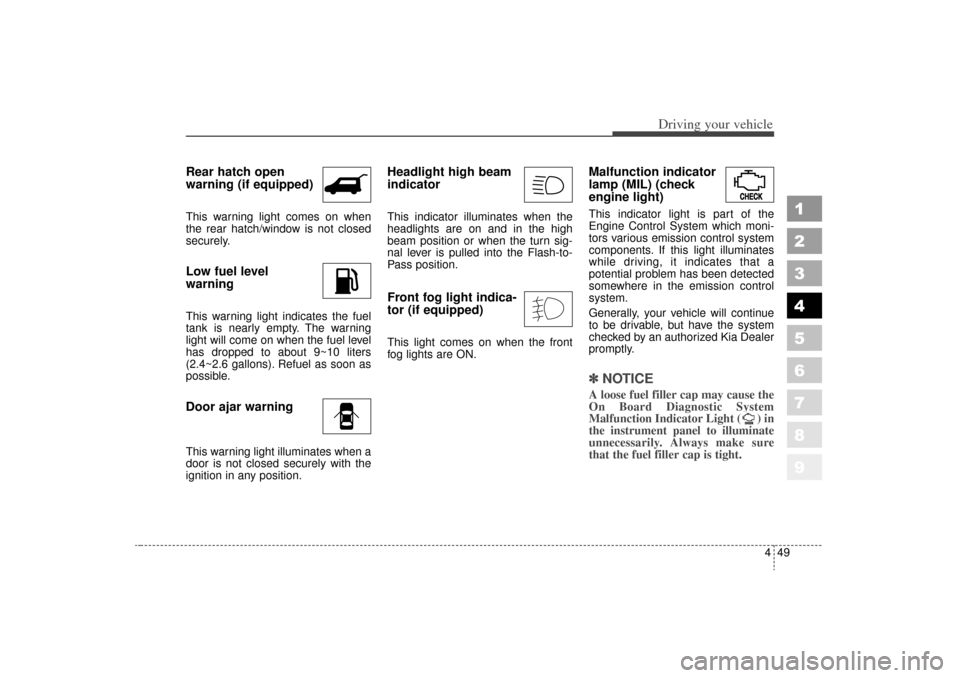
Rear hatch open
warning (if equipped)This warning light comes on when
the rear hatch/window is not closed
securely.Low fuel level
warningThis warning light indicates the fuel
tank is nearly empty. The warning
light will come on when the fuel level
has dropped to about 9~10 liters
(2.4~2.6 gallons). Refuel as soon as
possible.Door ajar warningThis warning light illuminates when a
door is not closed securely with the
ignition in any position.
Headlight high beam
indicator This indicator illuminates when the
headlights are on and in the high
beam position or when the turn sig-
nal lever is pulled into the Flash-to-
Pass position.Front fog light indica-
tor (if equipped) This light comes on when the front
fog lights are ON.
Malfunction indicator
lamp (MIL) (check
engine light)This indicator light is part of the
Engine Control System which moni-
tors various emission control system
components. If this light illuminates
while driving, it indicates that a
potential problem has been detected
somewhere in the emission control
system.
Generally, your vehicle will continue
to be drivable, but have the system
checked by an authorized Kia Dealer
promptly.✽ ✽
NOTICEA loose fuel filler cap may cause the
On Board Diagnostic System
Malfunction Indicator Light ( ) in
the instrument panel to illuminate
unnecessarily. Always make sure
that the fuel filler cap is tight.
KM CAN (ENG) 4 new.qxd 7/29/05 9:35 AM Page 49
Page 228 of 354
Driving tips16
5
1
2
3
4
5
6
7
8
9
Off-road driving with your
four-wheel drive vehicleOff-road driving can be great fun. But
it has definite hazards. The greatest
of these is the terrain itself.
“Off-roading” means you’ve left the
paved road system behind. Traffic
lanes are not marked. Curves are not
banked.
There are no carefully engineered
road signs to warn you of dangerous
conditions or to advise you of a safe
speed. You have to assess the envi-
ronment yourself. Surfaces can be
slippery, rough, uphill or downhill.
Off-road driving involves learning
new skills. That’s why it’s important
that you read and understand this
section. You’ll find useful driving
information and suggestions. These
will help make your off-road driving
safer and more enjoyable. Before you go off-roading
There are some things to do before
you leave the paved roads. Be sure
to have all necessary maintenance
and service work done beforehand.
Be sure to read all the information
about your four-wheel drive vehicle
in this manual. Is there enough fuel?
Is the spare tire fully inflated? Are the
fluid levels at the proper levels? What
are the local laws that apply to off-
roading where you’ll be driving? If
you don’t know, you should check
with law enforcement people in the
area. Will you be on someone’s pri-
vate land? If so, be sure to get the
necessary permission.
Loading your vehicle for off-road
driving
There are some important items to
remember about how to properly
load your vehicle.
The heaviest things should be in
the cargo area and forward of your
rear axle. Place heavier items as
far forward as you can.
Be sure the load is properly secured, so driving over off-road
terrain doesn’t shift your load or
throw items toward the driver or
passengers.
KM CAN (ENG) 5 new.qxd 7/29/05 9:38 AM Page 16
Page 229 of 354
517
Driving tips
1
2
3
4
5
6
7
8
9
Traveling to remote areas
It makes sense to plan your trip,
especially when going to a remote
area. Know the terrain and plan your
route. You are much less likely to
encounter unwanted surprises. Get
accurate maps of trails.
It’s also a good idea to travel with at
least one other vehicle. If something
happens to one of them, the other
can quickly help.
WARNING -
Cargo
Cargo piled close to the height of (or higher than) the seat
backs can be thrown forward
during a sudden stop or on
downhill slopes. You or your
passengers could be severely
injured. Keep cargo below the
top of the seat backs and, if
possible, do not pile separate
items.
Unsecured cargo in the cargo area can be tossed about
when driving on the highways
or over rough terrain. You or
your passengers can be
struck by flying objects and
severely injured. Secure the
cargo properly.
(Continued)
(Continued)
Cargo should not be carriedon the roof without a proper
roof rack installed. The roof
rack will hold a maximum of
45 kg (100 lbs.). Heavy loads
in a roof rack raise the vehi-
cle’s center of gravity, making
it more likely to roll over. You
can be seriously or fatally
injured if the vehicle rolls
over. Do not load cargo on the
roof while driving off-road, if
at all possible. Put heavy
loads inside the cargo area,
not on the roof or in a roof
rack. Keep cargo in the cargo
area as far forward and low as
possible.
KM CAN (ENG) 5 new.qxd 7/29/05 9:38 AM Page 17