airbag KIA Sportage 2006 JE_ / 2.G Owner's Guide
[x] Cancel search | Manufacturer: KIA, Model Year: 2006, Model line: Sportage, Model: KIA Sportage 2006 JE_ / 2.GPages: 354, PDF Size: 3.62 MB
Page 31 of 354
Knowing your vehicle74
3
1
2
3
4
5
6
7
8
9
How does the airbag system
operate Airbags only operate when the
ignition switch is turned to the ON
or START positions.
Airbags inflate instantly in the event of serious frontal or side col-
lision in order to help protect the
occupants from physical injury.
The airbag Electronic Control Unit
(ECU) is a small computer which
calculates the immediate impact
information and sends out a
deployment signal based on the
ECU's calculation of the likely
severity of the developing collision.
There is no single vehicle speed at which the airbags will inflate. Airbag deployment depends on a
number of factors including vehicle
speed, angles of impact and the
density and stiffness of the vehi-
cles or objects which your vehicle
hits in the collision. However, fac-
tors are not limited to those men-
tioned above.
The front airbags will completely inflate and deflate in an instant.
It is impossible for you to see the
airbags inflate during an accident.
It is much more likely that you will
simply see the deflated airbags
hanging out of their storage com-
partments after the collision. In order to help provide protection
in a severe collision, the airbags
must inflate rapidly. The speed of
airbag inflation has been deter-
mined by the Canadian Motor
Vehicle Safety Standard (CMVSS)
to reduce the likelihood of serious
or life-threatening injuries and is
thus a mandatory part of the airbag
design.
However, airbag inflation can also
cause injuries which normally can
include facial abrasions, bruises
and broken bones, and sometimes
more serious injuries because that
inflation speed also causes the
airbags to expand with a great deal
force.
There are even circumstances under which contact with the
steering wheel airbag can cause
fatal injuries, especially if the
occupant is positioned exces-
sively close to the steering
wheel.
KM CAN (ENG) 3 (55~)new.qxd 7/29/05 9:37 AM Page 74
Page 32 of 354
375
1
2
3
4
5
6
7
8
9
Knowing your vehicle
Noise and smokeWhen the airbags inflate, they make
a loud noise and they leave smoke
and powder in the air inside of the
vehicle. This is normal. After the
airbag inflates, you may feel sub-
stantial discomfort in breathing due
to the contact of your chest to both
the safety belt and the airbag, as well
as from breathing the smoke and
powder.We strongly urge you to
open your doors and/or windows
as soon as possible after impact
in order to reduce discomfort and
prevent prolonged exposure to
the smoke and powder.
Though the smoke and powder are
non-toxic, they may cause irritation
(eyes, nose and throat etc). Wash
and rinse with cold water immediate-
ly and consult the doctor if the symp-
tom persists.
WARNING -
Seated posi-
tioning
Driver should sit as far back from the steering wheel airbag
as possible to reduce the risk
of injury or death in a collision
(at least 250 mm (10 inches)
away). The front passenger
should always move their seat
as far back as possible and sit
back in their seat.
Airbags inflate instantly in an event of collision and passen-
gers may be injured by the
airbag expansion force if they
are too close to the dash-
board.
Airbag inflation may cause injuries which normally
include facial or bodily abra-
sions, injuries from broken
eyeglasses or burns from the
airbag gases.
WARNING
- Hot airbag
parts
When the airbags deploy, the
airbag related parts in steering
wheel and/or instrument panel
and/or in both sides of the roof
rails above the front and rear
doors are very hot. To prevent
injury, do not touch the airbag
storage area’s internal compo-
nents immediately after an
airbag has inflated.
KM CAN (ENG) 3 (55~)new.qxd 7/29/05 9:37 AM Page 75
Page 33 of 354
Knowing your vehicle76
3
1
2
3
4
5
6
7
8
9
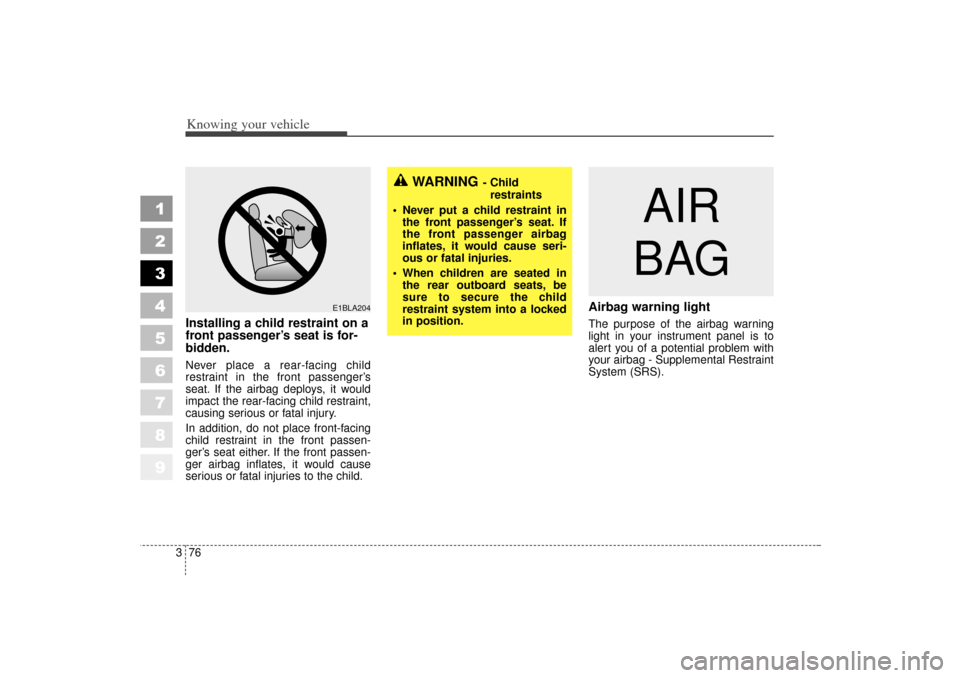
Installing a child restraint on a
front passenger’s seat is for-
bidden.Never place a rear-facing child
restraint in the front passenger’s
seat. If the airbag deploys, it would
impact the rear-facing child restraint,
causing serious or fatal injury.
In addition, do not place front-facing
child restraint in the front passen-
ger’s seat either. If the front passen-
ger airbag inflates, it would cause
serious or fatal injuries to the child.
Airbag warning lightThe purpose of the airbag warning
light in your instrument panel is to
alert you of a potential problem with
your airbag - Supplemental Restraint
System (SRS).
WARNING
- Child
restraints
Never put a child restraint in the front passenger’s seat. If
the front passenger airbag
inflates, it would cause seri-
ous or fatal injuries.
When children are seated in the rear outboard seats, be
sure to secure the child
restraint system into a locked
in position.
AIR
BAG
E1BLA204
KM CAN (ENG) 3 (55~)new.qxd 7/29/05 9:37 AM Page 76
Page 34 of 354
377
1
2
3
4
5
6
7
8
9
Knowing your vehicle
When the ignition switch is turned
ON, the indicator light should illumi-
nate for approximately 6 seconds,
then go off.
Have the system checked if:
The light does not turn on brieflywhen you turn the ignition ON.
The light stays on after the engine starts.
The light comes on while the vehi- cle is in motion.
Airbag (Supplemental
Restraint System) service Your Supplemental Restraint System
is virtually maintenance-free. There
are no parts which you can service.
You must have the system serviced
under the following circumstances:
If an airbag ever inflates, the airbagmust be replaced. Do not try to
remove or discard the airbag by
yourself. This must be done by an
authorized Kia dealer.
If the airbag warning indicator light alerts you to a problem, have the
airbag system checked as soon as
possible. Otherwise, your airbag
system may be ineffective.
WARNING
- No modifica-
tions
Do not modify any part of the
airbag system modification
could make the airbag system
ineffective.
KM CAN (ENG) 3 (55~)new.qxd 7/29/05 9:37 AM Page 77
Page 35 of 354
Knowing your vehicle78
3
1
2
3
4
5
6
7
8
9
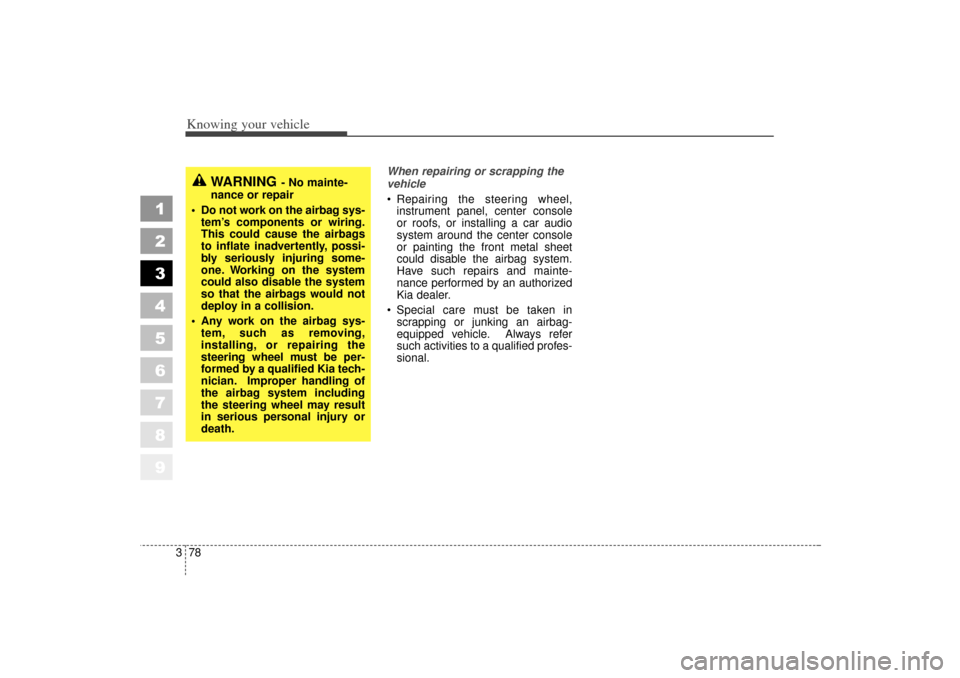
When repairing or scrapping the
vehicle
Repairing the steering wheel,
instrument panel, center console
or roofs, or installing a car audio
system around the center console
or painting the front metal sheet
could disable the airbag system.
Have such repairs and mainte-
nance performed by an authorized
Kia dealer.
Special care must be taken in scrapping or junking an airbag-
equipped vehicle. Always refer
such activities to a qualified profes-
sional.
WARNING
- No mainte-
nance or repair
Do not work on the airbag sys- tem’s components or wiring.
This could cause the airbags
to inflate inadvertently, possi-
bly seriously injuring some-
one. Working on the system
could also disable the system
so that the airbags would not
deploy in a collision.
Any work on the airbag sys- tem, such as removing,
installing, or repairing the
steering wheel must be per-
formed by a qualified Kia tech-
nician. Improper handling of
the airbag system including
the steering wheel may result
in serious personal injury or
death.
KM CAN (ENG) 3 (55~)new.qxd 7/29/05 9:37 AM Page 78
Page 36 of 354
379
1
2
3
4
5
6
7
8
9
Knowing your vehicle
Airbag warning labelAirbag warning labels which are now required by the Canadian Motor Vehicle Safety Standard (CMVSS) are attached
to alert driver and passengers of potential risk of airbag system.
Note that these government warnings focus on the risk to children, Kia also wants you to be aware of the risks which
adults are exposed to. Those have been described in previous pages.
1KMA2085/6KMC3001/1KMB1039/1KMB1035
➀
➂
(if equipped)
➁
(if equipped)
KM CAN (ENG) 3 (55~)new.qxd 7/29/05 9:37 AM Page 79
Page 67 of 354
101
2
3
4
5
6
7
8
9
Keys / 3-2
Remote keyless entry / 3-3
Theft-alarm system / 3-5
Immobilizer system / 3-7
Door locks / 3-9
Window / 3-16
Seat / 3-19
Safety belts / 3-30
Airbags-supplemental restraint system / 3-54
Hood / 3-80
Fuel filler lid / 3-82
Mirrors / 3-85
Interior lights / 3-89
Storage compartment / 3-91
Interior features / 3-94
Sunroof / 3-100
Luggage net / 3-104
Tonneau cover / 3-105
Luggage center box / 3-107
Roof rack / 3-108
Antenna / 3-109
Knowing your vehicle
10
KM CAN (ENG) 3 (~54)new.qxd 7/29/05 9:33 AM Page 1
Page 86 of 354
Knowing your vehicle20
3
1
2
3
4
5
6
7
8
9
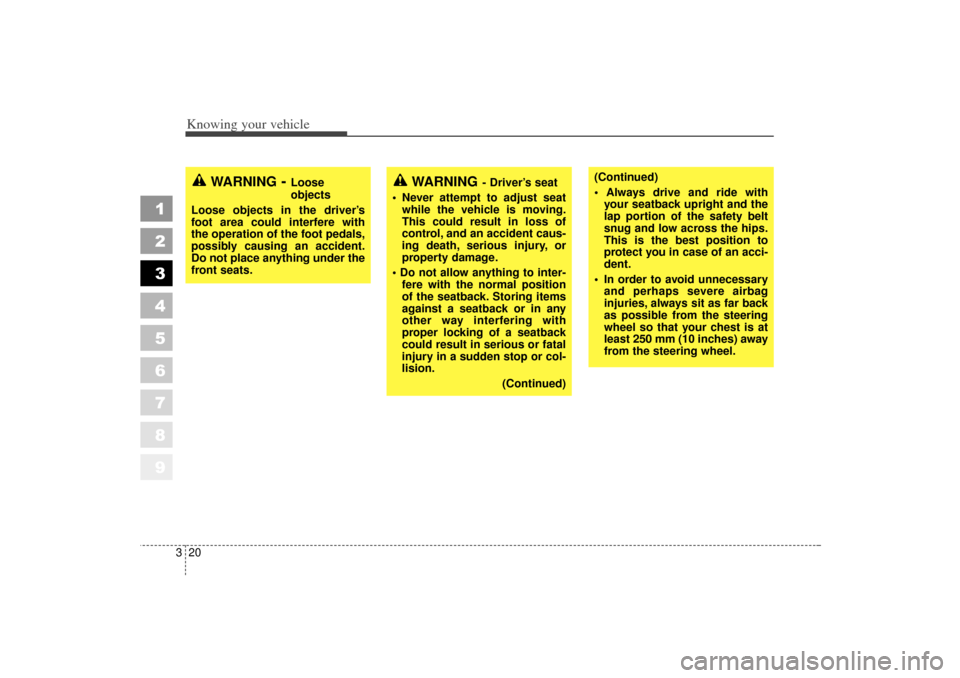
(Continued)
Always drive and ride with
your seatback upright and the
lap portion of the safety belt
snug and low across the hips.
This is the best position to
protect you in case of an acci-
dent.
In order to avoid unnecessary and perhaps severe airbag
injuries, always sit as far back
as possible from the steering
wheel so that your chest is at
least 250 mm (10 inches) away
from the steering wheel.
WARNING
- Loose
objects
Loose objects in the driver’s
foot area could interfere with
the operation of the foot pedals,
possibly causing an accident.
Do not place anything under the
front seats.
WARNING
- Driver’s seat
Never attempt to adjust seat while the vehicle is moving.
This could result in loss of
control, and an accident caus-
ing death, serious injury, or
property damage.
Do not allow anything to inter- fere with the normal position
of the seatback. Storing items
against a seatback or in any
other way interfering with
proper locking of a seatback
could result in serious or fatal
injury in a sudden stop or col-
lision.
(Continued)
KM CAN (ENG) 3 (~54)new.qxd 7/29/05 9:33 AM Page 20
Page 96 of 354
Knowing your vehicle30
3
1
2
3
4
5
6
7
8
9
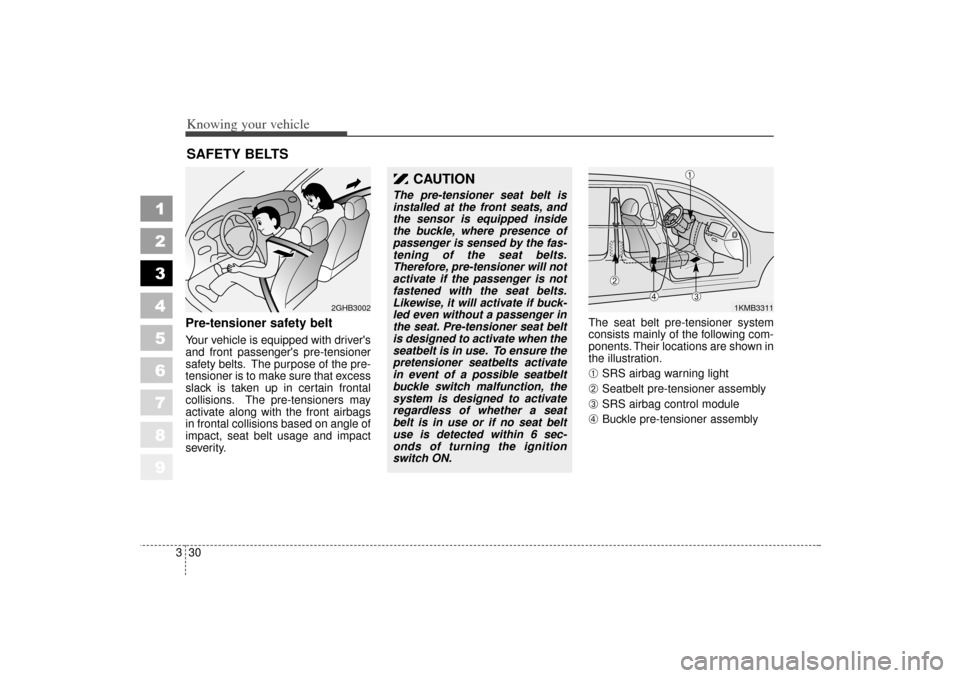
Pre-tensioner safety belt Your vehicle is equipped with driver's
and front passenger's pre-tensioner
safety belts. The purpose of the pre-
tensioner is to make sure that excess
slack is taken up in certain frontal
collisions. The pre-tensioners may
activate along with the front airbags
in frontal collisions based on angle of
impact, seat belt usage and impact
severity. The seat belt pre-tensioner system
consists mainly of the following com-
ponents. Their locations are shown in
the illustration.
➀
SRS airbag warning light
➁
Seatbelt pre-tensioner assembly
➂
SRS airbag control module
➃
Buckle pre-tensioner assembly
SAFETY BELTS
2GHB3002
1KMB3311
➀
➁
➂
➃
CAUTION
The pre-tensioner seat belt is
installed at the front seats, and
the sensor is equipped inside
the buckle, where presence of
passenger is sensed by the fas-
tening of the seat belts.
Therefore, pre-tensioner will not
activate if the passenger is not
fastened with the seat belts.
Likewise, it will activate if buck-
led even without a passenger in
the seat. Pre-tensioner seat belt
is designed to activate when the
seatbelt is in use. To ensure the
pretensioner seatbelts activate
in event of a possible seatbelt
buckle switch malfunction, the
system is designed to activate
regardless of whether a seat
belt is in use or if no seat belt
use is detected within 6 sec-
onds of turning the ignition
switch ON.
KM CAN (ENG) 3 (~54)new.qxd 7/29/05 9:33 AM Page 30
Page 97 of 354
331
Knowing your vehicle
1
2
3
4
5
6
7
8
9
Load limiter
When the pre-tentioner activates, if
the system senses excessive seat
belt tension on the driver or passen-
ger’s seat belt, the load limiter inside
the pre-tensioner will release some
of the pressure on the affected seat
belt.
CAUTION -
Airbag/Pre-
tensioner dust
When the airbags and pre-ten-
sioners are activated, a loud
noise may be heard and fine
dust, which may appear to be
smoke, may be visible in the
passenger compartment. This
dust is not toxic. The dust may
cause skin irritation and should
not be breathed for prolonged
periods. Ventilate the vehicle
after impact and wash your
hands and face thoroughly after
an accident.
WARNING
- Airbag/pre-
tensioner warning light
If the SRS airbag warning light
does not illuminate when the
ignition key is turned to “ON” ,
or if it remains illuminated after
approximately 6 seconds, or if it
illuminates while the vehicle is
being driven, please have an
authorized Kia dealer inspect
the pre-tensioner and airbag
system as soon as possible.
WARNING
- Safety belt adjustment
To obtain maximum benefit from
a pre-tensioner seat belt:
The safety belt must be worn correctly.
The safety belt must be adjusted to the correct posi-
tion.
KM CAN (ENG) 3 (~54)new.qxd 7/29/05 9:33 AM Page 31