oil level KIA Sportage 2006 JE_ / 2.G Owner's Manual
[x] Cancel search | Manufacturer: KIA, Model Year: 2006, Model line: Sportage, Model: KIA Sportage 2006 JE_ / 2.GPages: 354, PDF Size: 3.62 MB
Page 167 of 354
447
Driving your vehicle
1
2
3
4
5
6
7
8
9
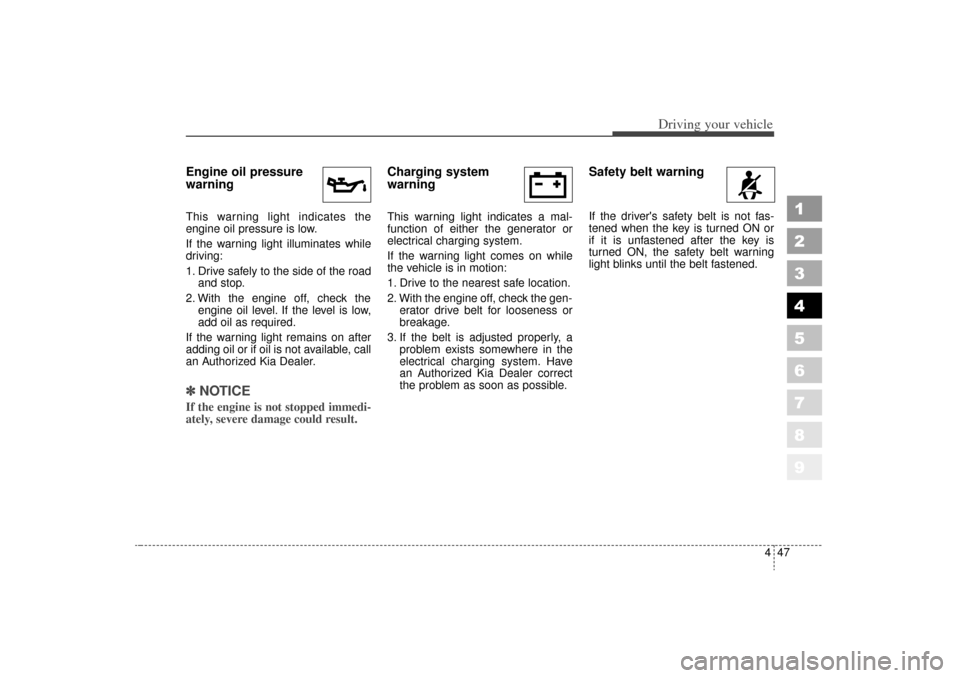
Engine oil pressure
warning This warning light indicates the
engine oil pressure is low.
If the warning light illuminates while
driving:
1. Drive safely to the side of the roadand stop.
2. With the engine off, check the engine oil level. If the level is low,
add oil as required.
If the warning light remains on after
adding oil or if oil is not available, call
an Authorized Kia Dealer.✽ ✽
NOTICEIf the engine is not stopped immedi-
ately, severe damage could result.
Charging system
warning This warning light indicates a mal-
function of either the generator or
electrical charging system.
If the warning light comes on while
the vehicle is in motion:
1. Drive to the nearest safe location.
2. With the engine off, check the gen-
erator drive belt for looseness or
breakage.
3. If the belt is adjusted properly, a problem exists somewhere in the
electrical charging system. Have
an Authorized Kia Dealer correct
the problem as soon as possible.
Safety belt warning If the driver's safety belt is not fas-
tened when the key is turned ON or
if it is unfastened after the key is
turned ON, the safety belt warning
light blinks until the belt fastened.
KM CAN (ENG) 4 new.qxd 7/29/05 9:35 AM Page 47
Page 217 of 354
55
Driving tips
BEFORE DRIVING Before entering vehicle: Be sure that all windows, outsidemirror(s), and outside lights are
clean.
Check the condition of the tires.
Check under the vehicle for any sign of leaks.
Be sure there are no obstacles behind you if you intend to back up.Necessary inspections Fluid levels, such as engine oil,
engine coolant, brake fluid, and
washer fluid should be checked on a
regular basis, with the exact interval
depending on the fluid. Further
details are provided in Section 7,
Maintenance.
Before starting Close and lock all doors.
Position the seat so that all con-trols are easily reached.
Adjust the inside and outside rearview mirrors.
Be sure that all lights work.
Check all gauges.
Check the operation of warning lights when the ignition switch is
turned to the ON position.
Release the parking brake and make sure the brake warning light
goes out.
For safe operation, be sure you are
familiar with your vehicle and its
equipment.
1
2
3
4
5
6
7
8
9
WARNING
- Driving under
the influence of alcohol or
drugs
Drinking and driving is danger-
ous. Drunk driving is the num-
ber one contributor to the high-
way death toll each year. Even a
small amount of alcohol will
affect your reflexes, perceptions
and judgement. Driving while
under the influence of drugs is
as dangerous or more danger-
ous than driving drunk.
You are much more likely to
have a serious accident if you
drink or take drugs and drive.
If you are drinking or taking
drugs, don’t drive. Do not ride
with a driver who has been
drinking or taking drugs.
Choose a designated driver or
call a cab.
KM CAN (ENG) 5 new.qxd 7/29/05 9:38 AM Page 5
Page 267 of 354
63
In case of an emergency
OVERHEATING If your temperature gauge indicates
overheating, if you experience a loss
of power, or if you hear a loud knock-
ing or pinging noise, the engine has
probably overheated. Should any of
these symptoms occur, use the fol-
lowing procedure:
1. Turn on the hazard warning flash-er, then drive to the nearest safe
location and stop your vehicle; set
the automatic transaxle in P
(Park), or shift the manual
transaxle to N (Neutral) and apply
the parking brake.
2. Make sure the air conditioner is off.
3. If coolant or steam is boiling out of the radiator, stop the engine and
call an Authorized Kia Dealer for
assistance. If coolant is not boiling out, allow
the engine to idle and open the
hood to permit the engine to cool
gradually.
If the temperature does not go
down with the engine idling, stop
the engine and allow sufficient
time for it to cool.
4. The coolant level should then be checked. If the level in the reser-
voir is low, look for leaks at the
radiator hoses and connections,
heater hoses and connections,
radiator, and water pump. If you
find a major leak or another prob-
lem that may have caused the
engine to overheat, do not operate
the engine until it has been cor-
rected. Call an Authorized Kia
Dealer for assistance. If you do not
find a leak or other problem, care-
fully add coolant to the reservoir. If the engine frequently overheats,
have the cooling system checked
and repaired by an Authorized Kia
Dealer.
1
2
3
4
5
6
7
8
9
WARNING
- Removing
radiator cap
Do not remove the radiator cap
when the engine and radiator
are hot. Scalding hot coolant
and steam may blow out under
pressure. This could cause seri-
ous injury.
KM CAN (ENG) 6 new.qxd 7/29/05 9:40 AM Page 3
Page 296 of 354
77
Maintenance
1
2
3
4
5
6
7
8
9
Chart symbols:I- Inspect these items and their related parts. If necessary, correct, clean, refill, adjust of replace.
R- Replace or change
L- Lubricate.(1) Refer to the lubricant and coolant specifications in the Owner’s Manual
(2) More frequent maintenance is required if driving under dusty conditions.
(3) More frequent maintenance is required if the vehicle is operated under any of the following conditions: a. Short-distance driving
b. Driving on dusty roads.
c. Extensive idling or slow-speed driving in stop-and-go traffic.
(4) If necessary, rotate and balance the wheels.
* Note: Check the engine oil and coolant levels every week.
KM CAN (ENG) 7.qxd 7/29/05 9:41 AM Page 7
Page 297 of 354
Maintenance87
1
2
3
4
5
6
7
8
9
OWNER MAINTENANCE Owner maintenance schedule The following lists are vehicle checks
and inspections that should be per-
formed by the owner or an
Authorized Kia Dealer at the fre-
quencies indicated to help ensure
safe, dependable operation of your
vehicle.
Any adverse conditions should be
brought to the attention of your deal-
er as soon as possible.
These Owner Maintenance Checks
are generally not covered by war-
ranties and you may be charged for
labor, parts and lubricants used.When you stop for fuel:
Check the engine oil level.
Check coolant level in coolant
reservoir.
Check the windshield washer fluid level.
Look for low or under-inflated tires. While operating your vehicle:
Note any changes in the sound of
the exhaust or any smell of
exhaust fumes in the vehicle.
Check for vibrations in the steering wheel. Notice any increased steer-
ing effort or looseness in the steer-
ing wheel, or change in its straight-
ahead position.
Notice if your vehicle constantly turns slightly or “pulls” to one side
when traveling on smooth, level
road.
When stopping, listen and check for strange sounds, pulling to one
side, increased brake pedal travel
or “hard-to-push” brake pedal.
If any slipping or changes in the operation of your transaxle occurs,
check the transaxle fluid level.
Check automatic transaxle P (Park) function.
Check parking brake.
Check for fluid leaks under your vehicle (water dripping from the air
conditioning system during or after
use is normal).
WARNING
Be careful when checking your
engine coolant level when the
engine is hot. Scalding hot
coolant and steam may blow out
under pressure. This could cause
burns or other serious injury.
KM CAN (ENG) 7.qxd 7/29/05 9:41 AM Page 8
Page 302 of 354
713
Maintenance
1
2
3
4
5
6
7
8
9
ENGINE OIL AND OIL FILTER
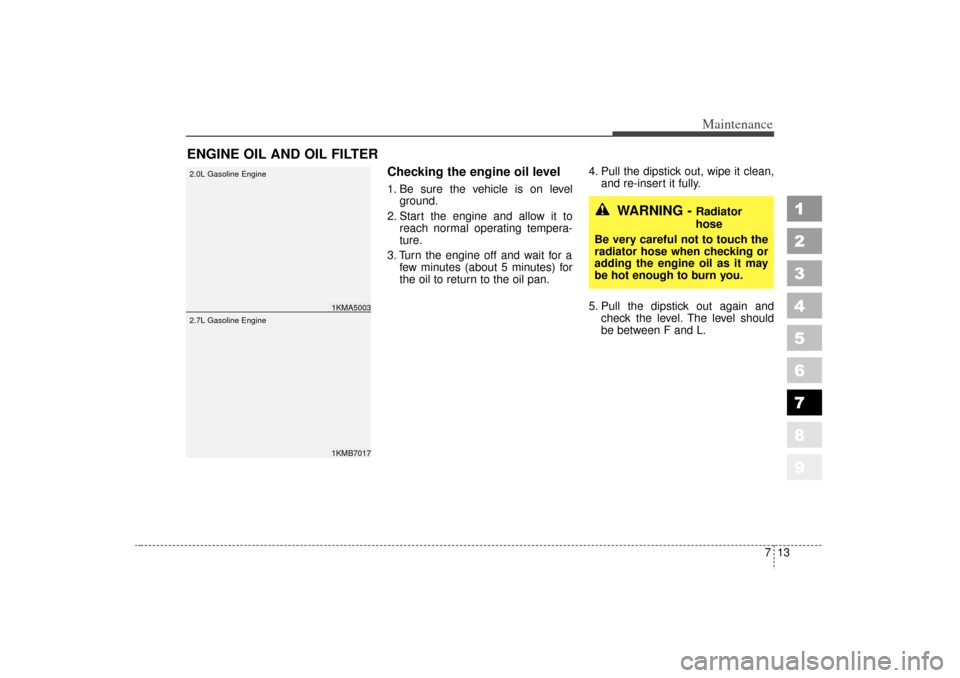
Checking the engine oil level 1. Be sure the vehicle is on levelground.
2. Start the engine and allow it to reach normal operating tempera-
ture.
3. Turn the engine off and wait for a few minutes (about 5 minutes) for
the oil to return to the oil pan. 4. Pull the dipstick out, wipe it clean,
and re-insert it fully.
5. Pull the dipstick out again and check the level. The level should
be between F and L.
1KMB70171KMA5003
2.0L Gasoline Engine2.7L Gasoline Engine
WARNING -
Radiator
hose
Be very careful not to touch the
radiator hose when checking or
adding the engine oil as it may
be hot enough to burn you.
KM CAN (ENG) 7.qxd 7/29/05 9:41 AM Page 13
Page 303 of 354
Maintenance14
7
1
2
3
4
5
6
7
8
9
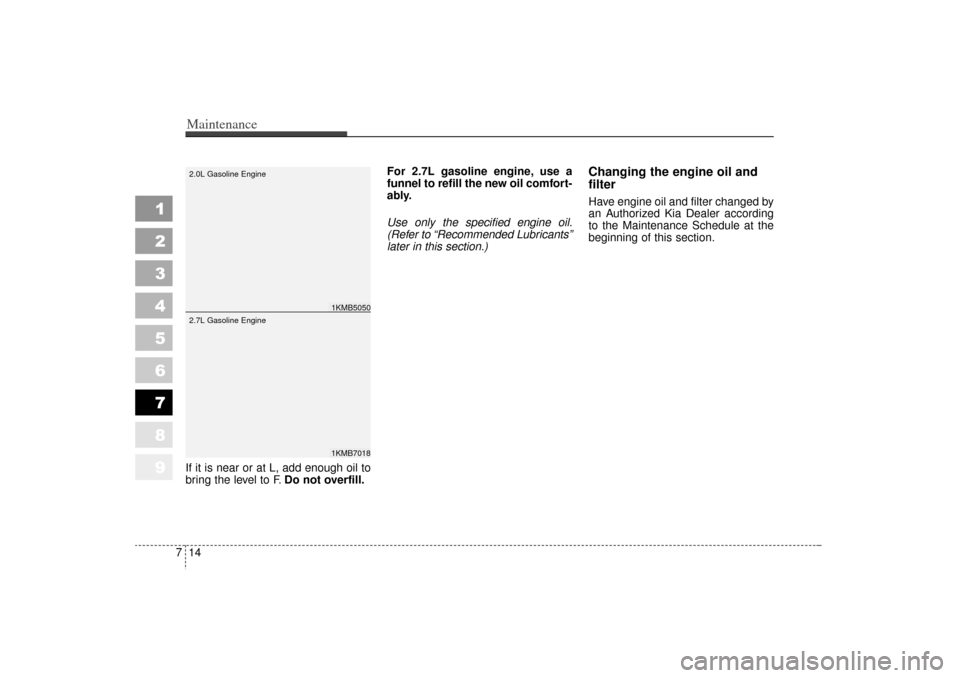
If it is near or at L, add enough oil to
bring the level to F. Do not overfill. For 2.7L gasoline engine, use a
funnel to refill the new oil comfort-
ably.
Use only the specified engine oil.
(Refer to “Recommended Lubricants”
later in this section.)
Changing the engine oil and
filterHave engine oil and filter changed by
an Authorized Kia Dealer according
to the Maintenance Schedule at the
beginning of this section.
1KMB70181KMB5050
2.0L Gasoline Engine2.7L Gasoline Engine
KM CAN (ENG) 7.qxd 7/29/05 9:41 AM Page 14
Page 310 of 354
721
Maintenance
1
2
3
4
5
6
7
8
9
POWER STEERING Checking the power steering
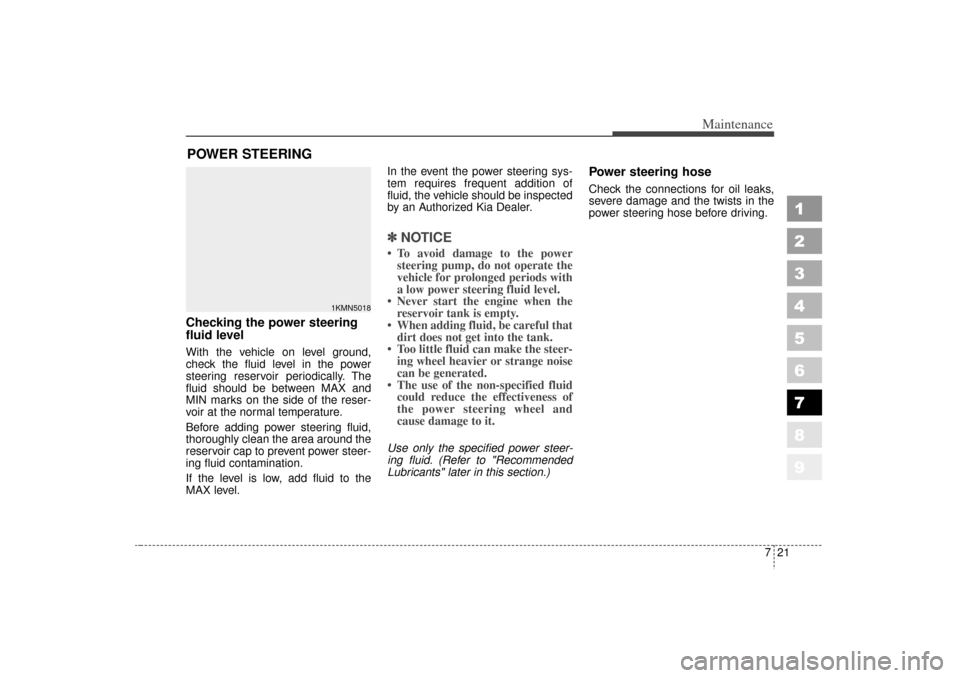
fluid level With the vehicle on level ground,
check the fluid level in the power
steering reservoir periodically. The
fluid should be between MAX and
MIN marks on the side of the reser-
voir at the normal temperature.
Before adding power steering fluid,
thoroughly clean the area around the
reservoir cap to prevent power steer-
ing fluid contamination.
If the level is low, add fluid to the
MAX level.In the event the power steering sys-
tem requires frequent addition of
fluid, the vehicle should be inspected
by an Authorized Kia Dealer.
✽ ✽
NOTICE• To avoid damage to the power
steering pump, do not operate the
vehicle for prolonged periods with
a low power steering fluid level.
Never start the engine when the reservoir tank is empty.
When adding fluid, be careful that dirt does not get into the tank.
Too little fluid can make the steer- ing wheel heavier or strange noise
can be generated.
The use of the non-specified fluid could reduce the effectiveness of
the power steering wheel and
cause damage to it.Use only the specified power steer-
ing fluid. (Refer to "Recommended
Lubricants" later in this section.)
Power steering hoseCheck the connections for oil leaks,
severe damage and the twists in the
power steering hose before driving.
1KMN5018
KM CAN (ENG) 7.qxd 7/29/05 9:41 AM Page 21
Page 313 of 354
Maintenance24
7
1
2
3
4
5
6
7
8
9
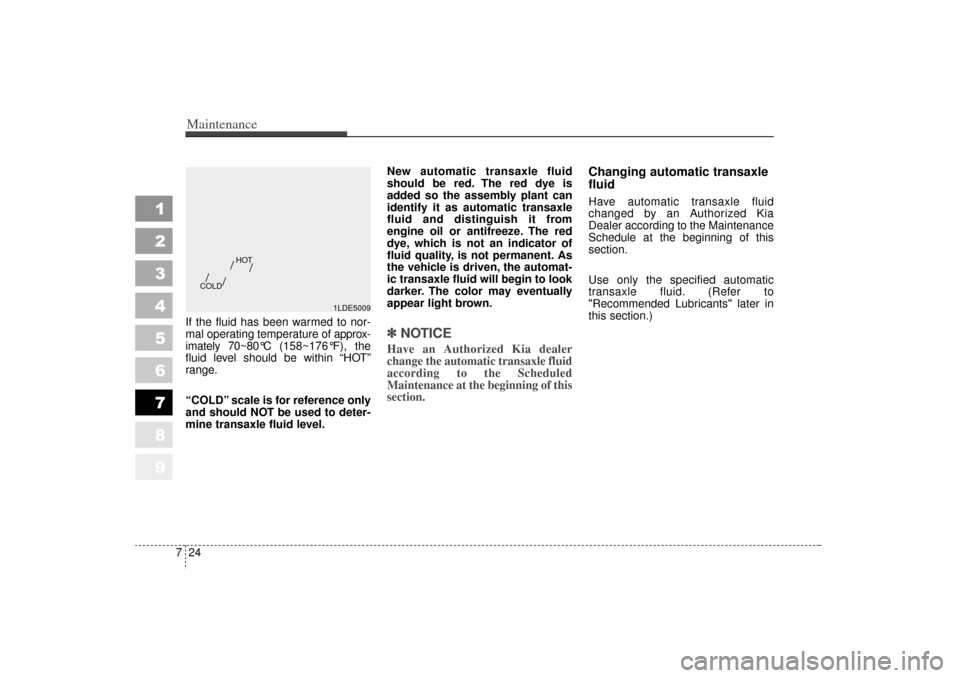
If the fluid has been warmed to nor-
mal operating temperature of approx-
imately 70~80°C (158~176°F), the
fluid level should be within “HOT”
range.
“COLD” scale is for reference only
and should NOT be used to deter-
mine transaxle fluid level. New automatic transaxle fluid
should be red. The red dye is
added so the assembly plant can
identify it as automatic transaxle
fluid and distinguish it from
engine oil or antifreeze. The red
dye, which is not an indicator of
fluid quality, is not permanent. As
the vehicle is driven, the automat-
ic transaxle fluid will begin to look
darker. The color may eventually
appear light brown.
✽ ✽
NOTICEHave an Authorized Kia dealer
change the automatic transaxle fluid
according to the Scheduled
Maintenance at the beginning of this
section.
Changing automatic transaxle
fluidHave automatic transaxle fluid
changed by an Authorized Kia
Dealer according to the Maintenance
Schedule at the beginning of this
section.
Use only the specified automatic
transaxle fluid. (Refer to
"Recommended Lubricants" later in
this section.)
1LDE5009
COLD HOT
KM CAN (ENG) 7.qxd 7/29/05 9:41 AM Page 24
Page 315 of 354
Maintenance26
7
1
2
3
4
5
6
7
8
9
LUBRICANTS AND FLUIDS Checking the washer fluid
level The reservoir is translucent so that
you can check the level with a quick
visual inspection.
Check the fluid level in the washer
fluid reservoir and add fluid if neces-
sary. Plain water may be used if
washer fluid is not available.
However, use washer solvent with
antifreeze characteristics in cold cli-
mates to prevent freezing.
Body lubrication All moving points of the body, such
as door hinges, hood hinges, and
locks, should be lubricated each time
the engine oil is changed. Use a non-
freezing lubricant on locks during
cold weather.
Make sure the engine hood second-
ary latch keeps the hood from open-
ing when the primary latch is
released.
1KMA5021
WARNING -
Coolant
Do not use radiator coolant or antifreeze in the washer fluid
reservoir.
Radiator coolant can severely obscure visibility when
sprayed on the windshield
and may cause loss of vehicle
control or damage to paint
and body trim.
Windshield Washer fluid agents contain some amounts
of alcohol and can be flamma-
ble under certain circum-
stances. Do not allow sparks
or flame to contact the washer
fluid or the washer fluid reser-
voir. Damage to the vehicle or
it's occupants could occur.
Windshield washer fluid is poisonous to humans and ani-
mals. Do not drink and avoid
contacting windshield washer
fluid. Serious injury or death
could occur.
KM CAN (ENG) 7.qxd 7/29/05 9:41 AM Page 26