ECU KIA Sportage 2009 JE_ / 2.G Owner's Manual
[x] Cancel search | Manufacturer: KIA, Model Year: 2009, Model line: Sportage, Model: KIA Sportage 2009 JE_ / 2.GPages: 371, PDF Size: 3.5 MB
Page 15 of 371
Knowing your vehicle63
1
2
3
4
5
6
7
8
9
Alarm stageThe alarm will be activated if any of
the following occurs while the system
is armed.
A front or rear door is opened with-out using the ignition key or trans-
mitter.
The rear hatch/window is opened without using the ignition key or
transmitter.
The engine hood is opened.
The siren will sound and the hazard
warning lights will blink continuously
for 27 seconds, and repeat the alarm
3 times unless the system is dis-
armed. To turn off the system, unlock
the doors with the ignition key or
transmitter.✽ ✽ NOTICEAvoid trying to start the engine
while the alarm is activated. The
vehicle starting motor is disabled
during the alarm stage.
Disarmed stageThe system will be disarmed when
the doors are unlocked by depress-
ing the unlock button on the transmit-
ter or unlocked with the ignition key.
After depressing unlock button, the
hazard warning lights will blink twice
to indicate that the system is dis-
armed.
After depressing unlock button, if any
door is not opened within 30 sec-
onds, the system will be rearmed.
If the system is not disarmed with the
ignition key or transmitter, insert the
key in the ignition switch, turn the key
to the ON position and wait for 30
seconds. Then the system will be dis-
armed. Your vehicle is equipped with an elec-
tronic engine immobilizer system to
reduce the risk of unauthorized vehi-
cle use.
Your immobilizer system is comprised
of a small transponder in the ignition
key, and antenna coil in the key cylin-
der and Immobilizer Control Unit (or
Smartra Unit).
With this system, whenever you insert
your ignition key into the ignition
switch and turn it to ON, the antenna
coil in the ignition switch receives a
signal from the transponder in the
ignition key and then sends the signal
to the ECU (Engine Control Unit).
The ECU checks the signal whether
the ignition key is valid.
If the key is determined to be valid,
the engine will start.
If the key is determined to be invalid,
the engine will not start.
IMMOBILIZER SYSTEM
(IF EQUIPPED)
Page 18 of 371
39
Knowing your vehicle
1
2
3
4
5
6
7
8
9
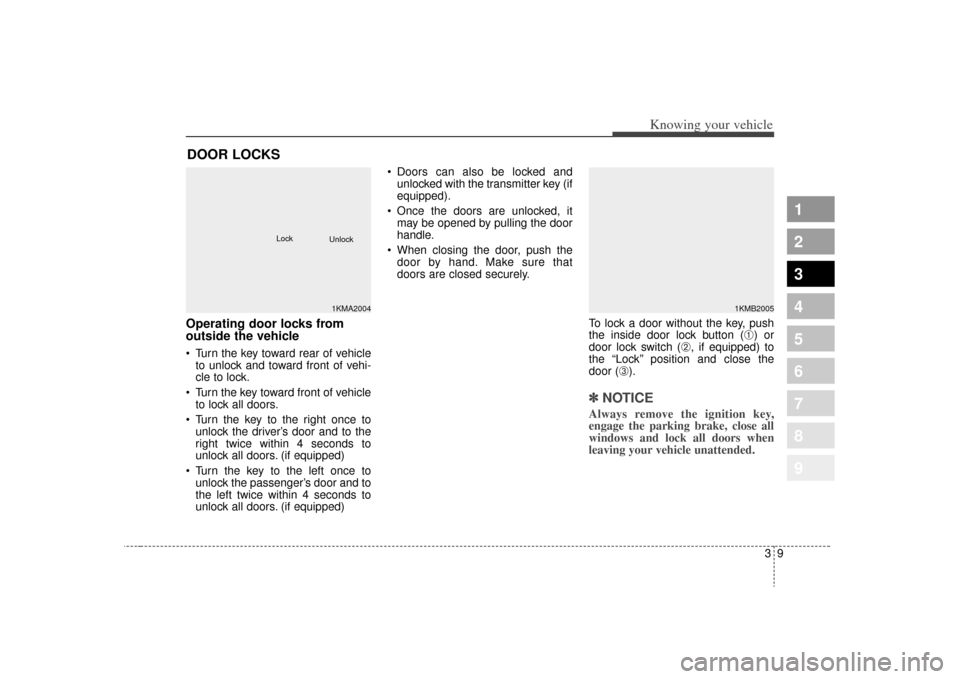
Operating door locks from
outside the vehicle Turn the key toward rear of vehicleto unlock and toward front of vehi-
cle to lock.
Turn the key toward front of vehicle to lock all doors.
Turn the key to the right once to unlock the driver’s door and to the
right twice within 4 seconds to
unlock all doors. (if equipped)
Turn the key to the left once to unlock the passenger’s door and to
the left twice within 4 seconds to
unlock all doors. (if equipped) Doors can also be locked and
unlocked with the transmitter key (if
equipped).
Once the doors are unlocked, it may be opened by pulling the door
handle.
When closing the door, push the door by hand. Make sure that
doors are closed securely.
To lock a door without the key, push
the inside door lock button (
➀) or
door lock switch (
➁, if equipped) to
the “Lock” position and close the
door (
➂).
✽ ✽ NOTICEAlways remove the ignition key,
engage the parking brake, close all
windows and lock all doors when
leaving your vehicle unattended.
DOOR LOCKS
1KMA2004
Lock
Unlock
1KMB2005
Page 23 of 371
Knowing your vehicle14
3
1
2
3
4
5
6
7
8
9
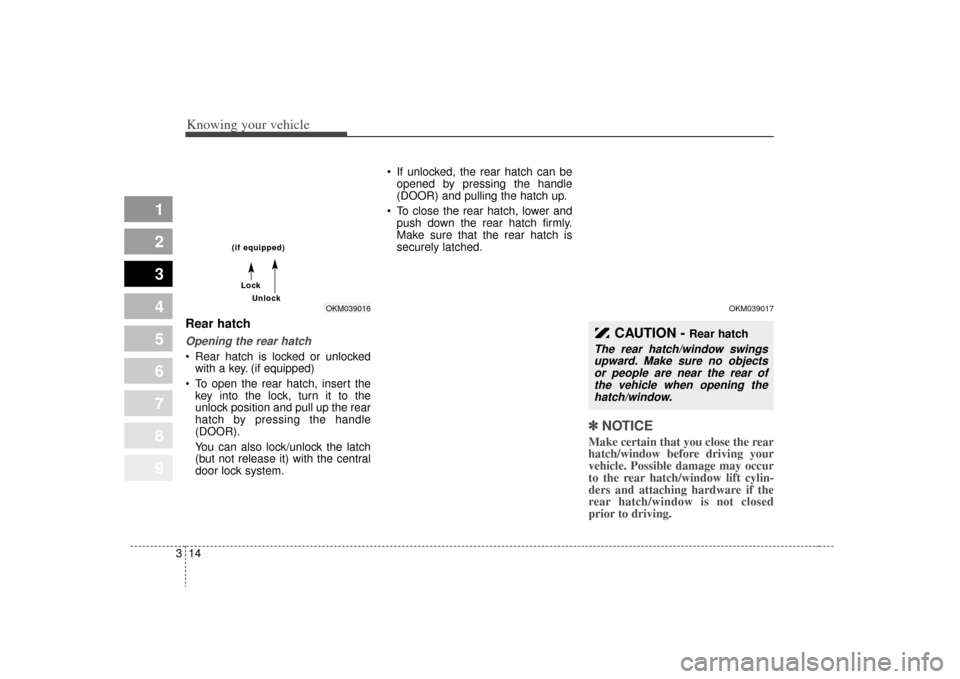
Rear hatchOpening the rear hatch Rear hatch is locked or unlocked
with a key. (if equipped)
To open the rear hatch, insert the key into the lock, turn it to the
unlock position and pull up the rear
hatch by pressing the handle
(DOOR).
You can also lock/unlock the latch
(but not release it) with the central
door lock system. If unlocked, the rear hatch can be
opened by pressing the handle
(DOOR) and pulling the hatch up.
To close the rear hatch, lower and push down the rear hatch firmly.
Make sure that the rear hatch is
securely latched.
✽ ✽ NOTICEMake certain that you close the rear
hatch/window before driving your
vehicle. Possible damage may occur
to the rear hatch/window lift cylin-
ders and attaching hardware if the
rear hatch/window is not closed
prior to driving.
CAUTION -
Rear hatch
The rear hatch/window swings
upward. Make sure no objectsor people are near the rear ofthe vehicle when opening thehatch/window.
OKM039017
OKM039016
Loc
Loc
k
k
Unloc
Unloc
k
k
(if equipped)
(if equipped)
Page 24 of 371
315
Knowing your vehicle
1
2
3
4
5
6
7
8
9
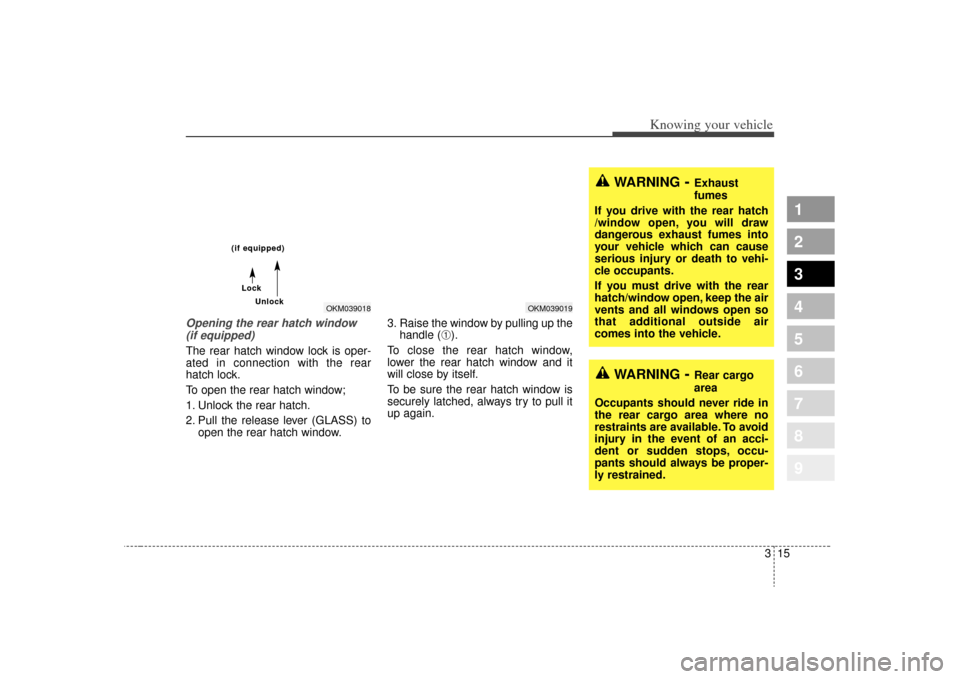
Opening the rear hatch window(if equipped)The rear hatch window lock is oper-
ated in connection with the rear
hatch lock.
To open the rear hatch window;
1. Unlock the rear hatch.
2. Pull the release lever (GLASS) to open the rear hatch window. 3. Raise the window by pulling up the
handle (
➀).
To close the rear hatch window,
lower the rear hatch window and it
will close by itself.
To be sure the rear hatch window is
securely latched, always try to pull it
up again.
WARNING
- Exhaust
fumes
If you drive with the rear hatch
/window open, you will draw
dangerous exhaust fumes into
your vehicle which can cause
serious injury or death to vehi-
cle occupants.
If you must drive with the rear
hatch/window open, keep the air
vents and all windows open so
that additional outside air
comes into the vehicle.
WARNING
- Rear cargo
area
Occupants should never ride in
the rear cargo area where no
restraints are available. To avoid
injury in the event of an acci-
dent or sudden stops, occu-
pants should always be proper-
ly restrained.
OKM039019
OKM039018
Loc
Loc
k
k
Unloc
Unloc
k
k
(if equipped)
(if equipped)
Page 30 of 371
321
Knowing your vehicle
1
2
3
4
5
6
7
8
9
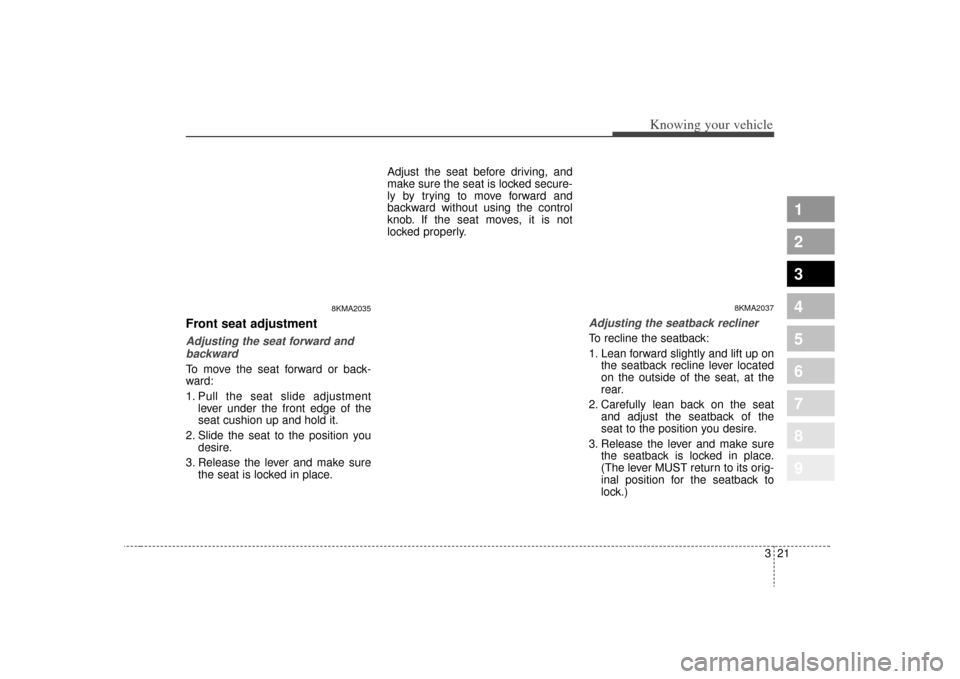
Front seat adjustmentAdjusting the seat forward andbackwardTo move the seat forward or back-
ward:
1. Pull the seat slide adjustment lever under the front edge of the
seat cushion up and hold it.
2. Slide the seat to the position you desire.
3. Release the lever and make sure the seat is locked in place. Adjust the seat before driving, and
make sure the seat is locked secure-
ly by trying to move forward and
backward without using the control
knob. If the seat moves, it is not
locked properly.
Adjusting the seatback reclinerTo recline the seatback:
1. Lean forward slightly and lift up on
the seatback recline lever located
on the outside of the seat, at the
rear.
2. Carefully lean back on the seat and adjust the seatback of the
seat to the position you desire.
3. Release the lever and make sure the seatback is locked in place.
(The lever MUST return to its orig-
inal position for the seatback to
lock.)
8KMA2035
8KMA2037
Page 38 of 371
329
Knowing your vehicle
1
2
3
4
5
6
7
8
9
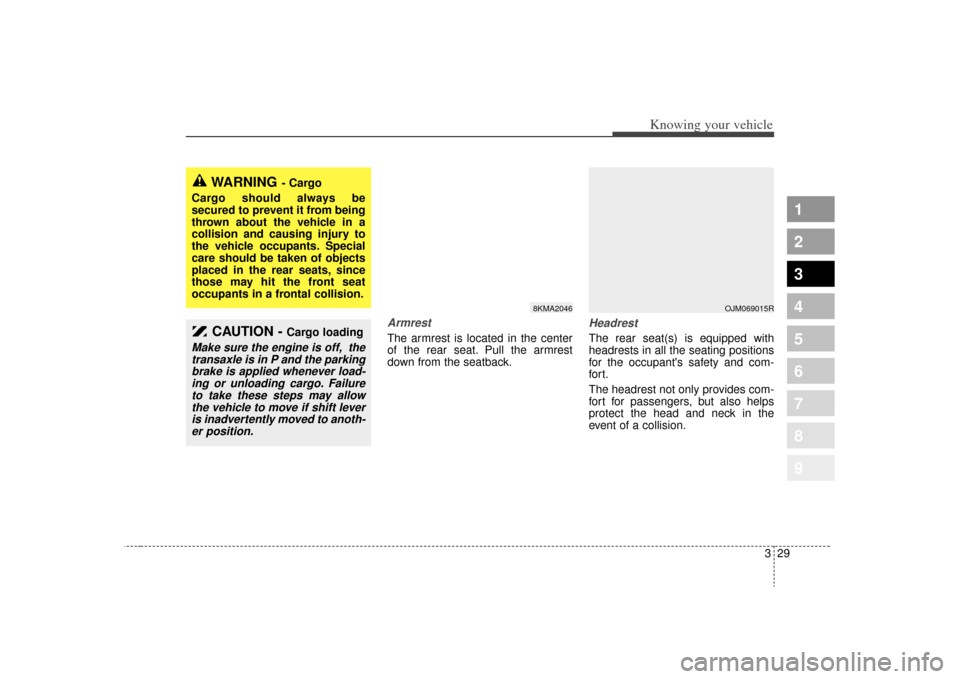
ArmrestThe armrest is located in the center
of the rear seat. Pull the armrest
down from the seatback.
HeadrestThe rear seat(s) is equipped with
headrests in all the seating positions
for the occupant's safety and com-
for t.
The headrest not only provides com-
fort for passengers, but also helps
protect the head and neck in the
event of a collision.
WARNING
- Cargo
Cargo should always be
secured to prevent it from being
thrown about the vehicle in a
collision and causing injury to
the vehicle occupants. Special
care should be taken of objects
placed in the rear seats, since
those may hit the front seat
occupants in a frontal collision.
CAUTION -
Cargo loading
Make sure the engine is off, the transaxle is in P and the parkingbrake is applied whenever load-ing or unloading cargo. Failureto take these steps may allowthe vehicle to move if shift leveris inadvertently moved to anoth-er position.
8KMA2046
OJM069015R
Page 44 of 371
335
Knowing your vehicle
1
2
3
4
5
6
7
8
9
The rear safety belts use a special
auto-lock feature designed to allow a
child restraint to be used in these
positions without an added locking
clip. They normally lock only under
extreme or emergency conditions
(emergency lock mode). However
they can be adjusted so that they
remain fixed and locked when a child
restraint system is placed in these
positions. (Use this auto-lock mode
only to secure a child restraint, never
for passengers restrained by the
safety belts.) Page 3-48 gives
instructions on placing the safety belt
in the auto lock mode.
The drivers safety belt can only oper-
ate in the emergency lock mode.Safety belts provide the best restraint
when:
The seatback is upright.
The occupant is sitting upright (not
slouched).
The lap belt is snug across the hips.
The shoulder belt is snug across the chest.
The knees are straight forward.
To help you remember to fasten your
safety belt, a warning light will blink.
WARNING
- After a colli- sion
Lap/shoulder belt assemblies may be stretched or damaged
when subjected to the stress
and forces of a collision.
The entire restraint system should be inspected following
any collision. All belts, retrac-
tors, anchors and hardware
damaged by a collision should
be replaced before the vehicle
is operated again.
WARNING -
Cargo area
Passengers should never be
allowed to ride in the cargo area
of a vehicle. No safety belts are
provided for the cargo area.
Persons riding in the vehicle
without a fastened safety belt
are much more likely to suffer
serious bodily injury or death
during an accident.
WARNING
- Twisted belts
A twisted or jammed safety belt
cannot restrain you properly. If
you cannot untwist or unjam the
safety belt, have an authorized
Kia dealer service it immediate-
ly. Never drive or ride with a
twisted or jammed safety belt.
Page 49 of 371
Knowing your vehicle40
3
1
2
3
4
5
6
7
8
9
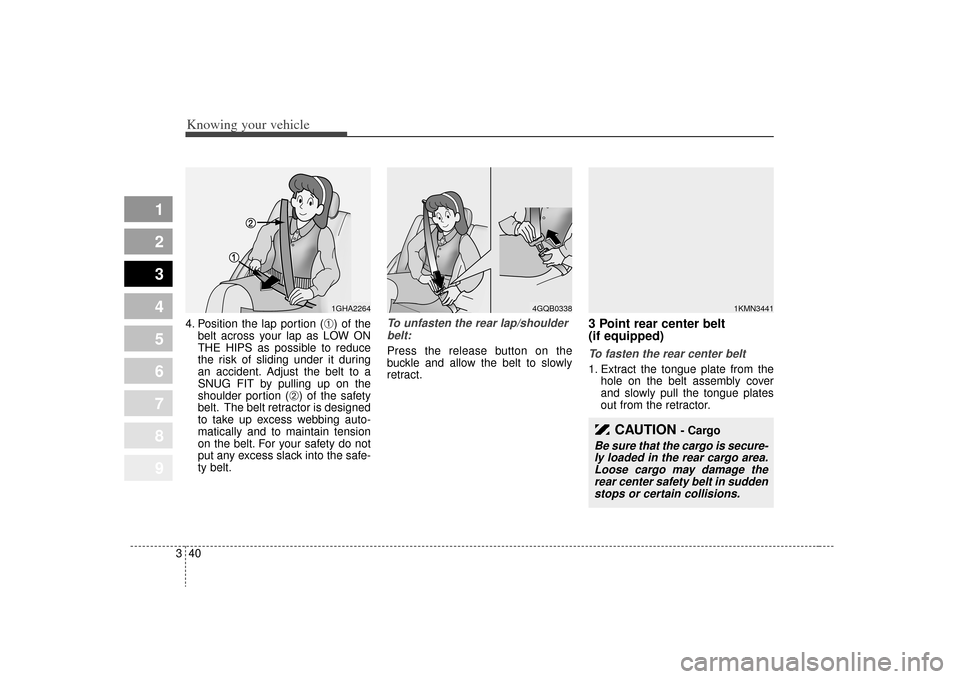
4. Position the lap portion (
➀) of the
belt across your lap as LOW ON
THE HIPS as possible to reduce
the risk of sliding under it during
an accident. Adjust the belt to a
SNUG FIT by pulling up on the
shoulder portion (
➁) of the safety
belt. The belt retractor is designed
to take up excess webbing auto-
matically and to maintain tension
on the belt. For your safety do not
put any excess slack into the safe-
ty belt.
To unfasten the rear lap/shoulder
belt:Press the release button on the
buckle and allow the belt to slowly
retract.
3 Point rear center belt
(if equipped) To fasten the rear center belt1. Extract the tongue plate from the hole on the belt assembly cover
and slowly pull the tongue plates
out from the retractor.
1GHA2264
4GQB0338
1KMN3441
CAUTION
- Cargo
Be sure that the cargo is secure-ly loaded in the rear cargo area.Loose cargo may damage therear center safety belt in suddenstops or certain collisions.
Page 55 of 371
Knowing your vehicle46
3
1
2
3
4
5
6
7
8
9
Child restraint system For small children and babies, the
use of a child seat or infant seat is
strongly recommended and is
required by law in almost all states.
This child seat or infant seat should
be of appropriate size for the child
and should be installed in accor-
dance with the manufacturer's
instructions.
Children riding in the car should sit
on the rear seat and must always be
properly restrained to minimize the
risk of injury in an accident, sudden
stop or sudden maneuver. According
to accident statistics, children are
safer when properly restrained in the
rear seats than in the front seat.
Child restraint systems are designed
to be secured in vehicle seats by lap
belts or the lap belt portion of a
lap/shoulder belt or by a LATCH sys-
tem (if equipped). Children could be injured or killed in
a crash if their restraints are not
properly secured. For small children
and babies, a child seat or infant seat
must be used. Before buying a par-
ticular child restraint system, make
sure it fits your car and seat belts,
and fits your child. Follow all the
instructions provided by the child
seat manufacturer when installing
the child restraint system.
WARNING
- Shoulder
belts on small children
Never allow a shoulder belt to be in contact with a child’s
neck or face while the vehicle
is in motion.
If safety belts are not properly worn and adjusted, there is a
risk of death or serious injury
to such a child.
Page 57 of 371
Knowing your vehicle48
3
1
2
3
4
5
6
7
8
9
Installing a child restraint system For safety reasons, we recommend
that the child restraint system be
used in the rear seats.
Never place a rear-facing child
restraint in the front passenger
seat, because of the danger that
an inflating passenger side air bag
could impact the rear-facing child
restraint and kill the child.
Since all passenger safety belts
move freely under normal conditions
and only lock under extreme or
emergency conditions (emergency
lock mode), you must manually
change these safety belts to the auto
lock mode to secure a child restraint.
(Continued)
Never allow a child to stand up
or kneel while the vehicle is
moving.
Never use an infant carrier or child seat that "hooks" over a
seatback. It will not provide
adequate protection in an
accident.
Never allow a child to be held while they are in a moving
vehicle, as this could result in
serious injury to the child in
the event of an accident or a
sudden stop. Holding a child
in a moving vehicle does not
provide the child with any pro-
tection during an accident,
even if the person holding the
child is wearing a seat belt.
WARNING
- Child seat
installation
Before installing the child restraint system, read the
instructions supplied by the
child restraint system manu-
facturer.
If the safety belt does not operate as described in this
section, have the system
checked immediately by your
authorized Kia dealer.
Failure to observe this manu- al's instructions regarding
child restraint system and the
instructions provided with the
child restraint system could
increase the chance and/or
severity of injury in an acci-
dent.