change time KIA Sportage 2010 SL / 3.G User Guide
[x] Cancel search | Manufacturer: KIA, Model Year: 2010, Model line: Sportage, Model: KIA Sportage 2010 SL / 3.GPages: 371, PDF Size: 5.23 MB
Page 253 of 371
521
Driving tips
1
2
3
4
5
6
7
8
9
Approaching a hill
When you approach a hill, you need
to decide if it’s one of those hills
that’s just too steep to climb,
descend, or cross. Steepness can be
difficult to judge. On a very small hill,
for example, there may be a smooth,
constant incline with only a small
change in elevation where you can
easily see all the way to the top. On
a large hill, the incline may get steep-
er as you near the top, but you may
not see this because the crest of the
hill is hidden by bushes, grass, or
shrubs.Here are some other things to con-
sider as you approach a hill:
Is there a constant incline, or does
the hill get sharply steeper in
places?
Is there good traction on the hill- side, or will the surface cause tire
slipping?
Is there a straight path up or down the hill so you won’t have to make
turning maneuvers?
Are there obstructions on the hill that can block your path (boulders,
trees, logs or ruts)?
What’s beyond the hill? Is there a cliff, an embankment, a drop-off, or
a fence? Get out of the vehicle and
walk the hill if you are unsure. It’s
the smart way to find out. Is the hill simply too rough? Steep
hills often have ruts, gullies,
troughs, and exposed rocks
because they are more susceptible
to the effects of erosion.
How have weather conditions affected the terrain? Is there likely
to be mud, snow or ice on the hill?
What time of day is it? Are temper- atures dropping so that wet sur-
faces will start to freeze?
Page 257 of 371
525
Driving tips
1
2
3
4
5
6
7
8
9
Driving downhill
Going downhill can be considerably
more dangerous than driving uphill.
When off-roading takes you downhill,
you’ll want to consider many of the
same things you thought about
before you went uphill. As a brief
reminder, those include:
How steep is the downhill? Will I beable to maintain vehicle control?
What’s the surface like? Smooth? Rough? Slippery? Hard-packed
dirt? Gravel?
Are there hidden surface obsta- cles? Ruts? Logs? Boulders?
What’s at the bottom of the hill? Is there a hidden creek bank or even
a river bottom with large rocks?
Have changes in the weather con- ditions and their effect on the ter-
rain since you went uphill made
your task more difficult? Once you have decided that you can
go down a hill safely, try to keep your
vehicle headed straight down, and
use a low gear. This way, engine
braking can help your brakes so they
won’t have to do all the work.
Descend slowly, keeping your vehi-
cle under control at all times.WARNING- Leaving vehi-
cle
If you are going to leave your
vehicle, set the parking brake
and shift a manual transaxle to
1(First), or an automatic
transaxle to P (Park).
Page 265 of 371
533
Driving tips
1
2
3
4
5
6
7
8
9
TRAILER TOWING
✽ ✽ NOTICE
Pulling a trailer improperly can
damage your vehicle and result in
costly repairs not covered by your
warranty. To pull a trailer correctly,
follow the advice in this section.
Your Sportage equipped with a 2.7
liter engine can tow a trailer.
However, we do not recommend
trailer towing for the Sportage
equipped with the 2.0 liter engine. To
identify what the vehicle trailering
capacity is for your vehicle, you
should read the information in
“Weight of the Trailer” that appears
later in this section.
Remember that trailering is different
than just driving your vehicle by itself.
Trailering means changes in han-
dling, durability, and fuel economy.
Successful, safe trailering requires
correct equipment, and it has to be
used properly. This section contains many time-
tested, important trailering tips and
safety rules. Many of these are
important for your safety and that of
your passengers. Please read this
section carefully before you pull a
trailer.
Load-pulling components such as
the engine, transaxle, wheel assem-
blies, and tires are forced to work
harder against the load of the added
weight. The engine is required to
operate at relatively higher speeds
and under greater loads. This addi-
tional burden generates extra heat.
The trailer also adds considerably to
wind resistance, increasing the
pulling requirements.
WARNING- Towing a
trailer
If you don't use the correct
equipment and drive properly,
you can lose control when you
pull a trailer. For example, if the
trailer is too heavy, the brakes
may not work well - or even at
all. You and your passengers
could be seriously or fatally
injured. Pull a trailer only if you
have followed all the steps in
this section.Item 2.7L Engine
Maximum trailer Without trailer brakes 454 (1000)
weight kg (lbs.) With trailer brakes 907 (2000)
Maximum permissible static vertical
load on the coupling device kg (lbs.) 91 (200)
Page 269 of 371
537
Driving tips
1
2
3
4
5
6
7
8
9
Following distance
Stay at least twice as far behind the
vehicle ahead as you would when
driving your vehicle without a trailer.
This can help you avoid situations
that require heavy braking and sud-
den turns.
Passing
You’ll need more passing distance
up ahead when you’re towing a trail-
er. And, because you’re a good deal
longer, you’ll need to go much farther
beyond the passed vehicle before
you can return to your lane.
Backing up
Hold the bottom of the steering
wheel with one hand. Then, to move
the trailer to the left, just move your
hand to the left. To move the trailer to
the right, move your hand to the
right. Always back up slowly and, if
possible, have someone guide you.
Making turns
When you’re turning with a trailer,
make wider turns than normal. Do
this so your trailer won’t strike soft
shoulders, curbs, road signs, trees,
or other objects. Avoid jerky or sud-
den maneuvers. Signal well in
advance.
Turn signals when towing a trailer
When you tow a trailer, your vehicle
has to have a different turn signal
flasher and extra wiring. The green
arrows on your instrument panel will
flash whenever you signal a turn or
lane change. Properly connected,
the trailer lights will also flash to alert
other drivers you’re about to turn,
change lanes, or stop.
When towing a trailer, the green
arrows on your instrument panel will
flash for turns even if the bulbs on
the trailer are burned out. Thus, you
may think drivers behind you are
seeing your signals when, in fact,
they are not. It’s important to check
occasionally to be sure the trailer
bulbs are still working. You must also
check the lights every time you dis-
connect and then reconnect the
wires.
Page 337 of 371
Maintenance
28
7
1
2
3
4
5
6
7
8
9
LUBRICANTS AND FLUIDS
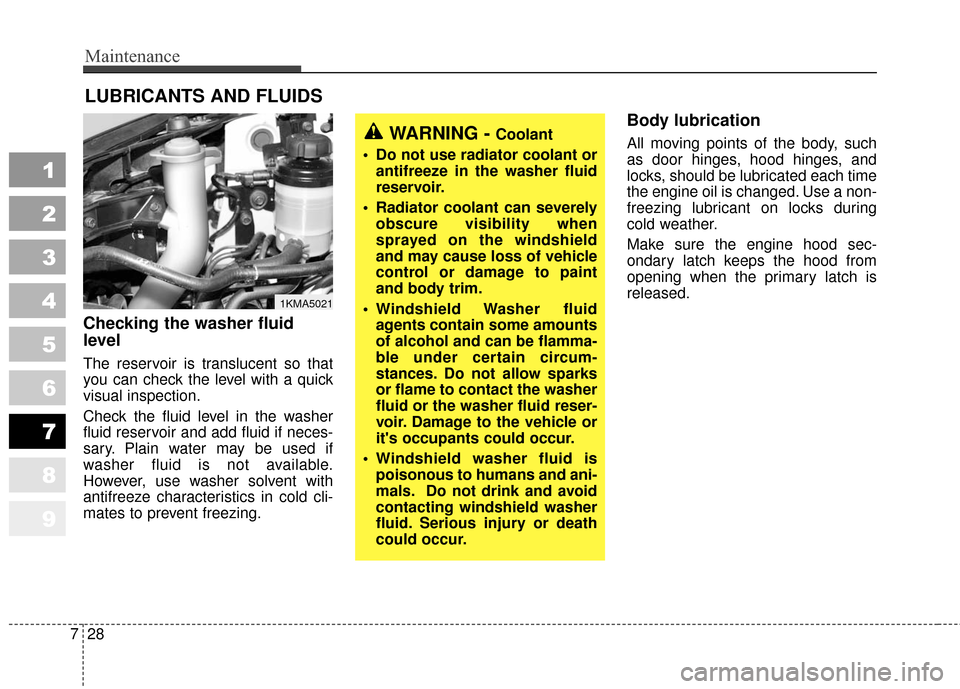
Checking the washer fluid
level
The reservoir is translucent so that
you can check the level with a quick
visual inspection.
Check the fluid level in the washer
fluid reservoir and add fluid if neces-
sary. Plain water may be used if
washer fluid is not available.
However, use washer solvent with
antifreeze characteristics in cold cli-
mates to prevent freezing.
Body lubrication
All moving points of the body, such
as door hinges, hood hinges, and
locks, should be lubricated each time
the engine oil is changed. Use a non-
freezing lubricant on locks during
cold weather.
Make sure the engine hood sec-
ondary latch keeps the hood from
opening when the primary latch is
released.
1KMA5021
WARNING - Coolant
Do not use radiator coolant or antifreeze in the washer fluid
reservoir.
Radiator coolant can severely obscure visibility when
sprayed on the windshield
and may cause loss of vehicle
control or damage to paint
and body trim.
Windshield Washer fluid agents contain some amounts
of alcohol and can be flamma-
ble under certain circum-
stances. Do not allow sparks
or flame to contact the washer
fluid or the washer fluid reser-
voir. Damage to the vehicle or
it's occupants could occur.
Windshield washer fluid is poisonous to humans and ani-
mals. Do not drink and avoid
contacting windshield washer
fluid. Serious injury or death
could occur.
Page 366 of 371
Specifications
48
1
2
3
4
5
6
7
8
9
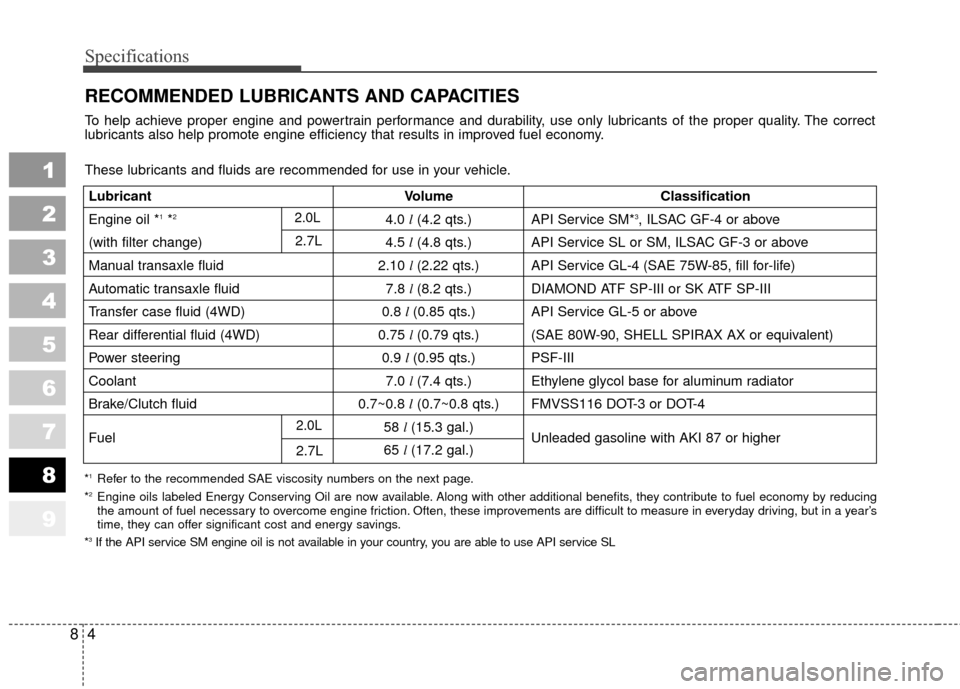
RECOMMENDED LUBRICANTS AND CAPACITIES
*1Refer to the recommended SAE viscosity numbers on the next page.
*2Engine oils labeled Energy Conserving Oil are now available. Along with other additional benefits, they contribute to fuel econo my by reducing
the amount of fuel necessary to overcome engine friction. Often, these improvements are difficult to measure in everyday driving, but in a year’s
time, they can offer significant cost and energy savings.
*
3If the API service SM engine oil is not available in your country, you are able to use API service SL
Lubricant Volume Classification
Engine oil *
1*24.0 l(4.2 qts.) API Service SM*3, ILSAC GF-4 or above
(with filter change) 4.5 l(4.8 qts.) API Service SL or SM, ILSAC GF-3 or above
Manual transaxle fluid 2.10 l (2.22 qts.) API Service GL-4 (SAE 75W-85, fill for-life)
Automatic transaxle fluid 7.8 l (8.2 qts.) DIAMOND ATF SP-III or SK ATF SP-III
Transfer case fluid (4WD) 0.8 l (0.85 qts.) API Service GL-5 or above
Rear differential fluid (4WD) 0.75 l (0.79 qts.) (SAE 80W-90, SHELL SPIRAX AX or equivalent)
Power steering 0.9 l (0.95 qts.) PSF-III
Coolant 7.0 l (7.4 qts.) Ethylene glycol base for aluminum radiator
Brake/Clutch fluid 0.7~0.8 l(0.7~0.8 qts.) FMVSS116 DOT-3 or DOT-4
Fuel 58
l (15.3 gal.)
Unleaded gasoline with AKI 87 or higher
65 l (17.2 gal.)2.0L
2.7L
2.0L
2.7L
To help achieve proper engine and powertrain performance and durability, use only lubricants of the proper quality. The correct
lubricants also help promote engine efficiency that results in improved fuel economy.
These lubricants and fluids are recommended for use in your vehicle.