airbag KIA Sportage 2010 SL / 3.G Owner's Guide
[x] Cancel search | Manufacturer: KIA, Model Year: 2010, Model line: Sportage, Model: KIA Sportage 2010 SL / 3.GPages: 371, PDF Size: 5.23 MB
Page 77 of 371
Knowing your vehicle
68
3
1
2
3
4
5
6
7
8
9
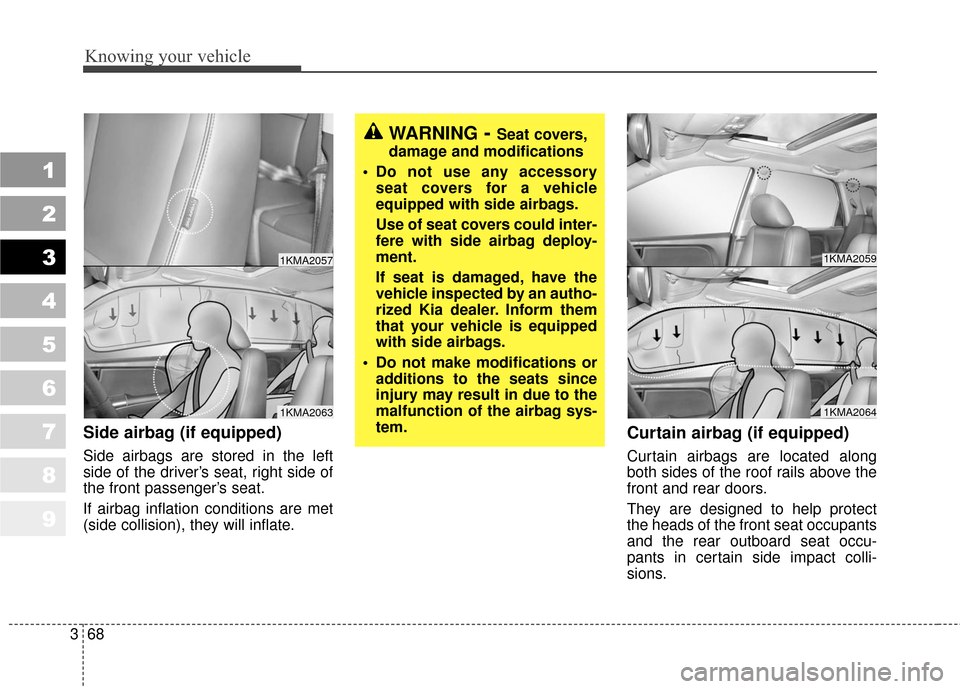
Side airbag (if equipped)
Side airbags are stored in the left
side of the driver’s seat, right side of
the front passenger’s seat.
If airbag inflation conditions are met
(side collision), they will inflate.
Curtain airbag (if equipped)
Curtain airbags are located along
both sides of the roof rails above the
front and rear doors.
They are designed to help protect
the heads of the front seat occupants
and the rear outboard seat occu-
pants in certain side impact colli-
sions.
WARNING- Seat covers,
damage and modifications
Do not use any accessory seat covers for a vehicle
equipped with side airbags.
Use of seat covers could inter-
fere with side airbag deploy-
ment.
If seat is damaged, have the
vehicle inspected by an autho-
rized Kia dealer. Inform them
that your vehicle is equipped
with side airbags.
Do not make modifications or additions to the seats since
injury may result in due to the
malfunction of the airbag sys-
tem.
1KMA2063
1KMA20571KMA2059
1KMA2064
Page 78 of 371
369
1
2
3
4
5
6
7
8
9
Knowing your vehicle
The curtain airbag deploymentoccurs only on the side of the vehi-
cle affected by the impact.
The side airbags (side and curtain airbags) are not designed to
deploy during collisions from the
front or rear of the vehicle or in
most rollover situations.
The curtain airbags are designed to deploy only during certain side-
impact collisions, depending on the
crash severity, angle, speed and
impact. The curtain airbags are not
designed to deploy in all side
impact situations.WARNING
In order for side airbags (sideand curtain airbags) to pro-
vide their best protection,
occupants should sit in an
upright position with the seat
belts properly fastened.
Children must be seated in the proper child restraint system.
Make sure to secure the child
restraint system in a locked
position.
(Continued)
(Continued)
Advise occupants not to leantheir heads or bodies onto
doors, and not to place
objects between the doors
and them since this may
defeat operation of the side
airbags.
Never try to open or repair any components of the side cur-
tain airbag system. This
should only be done by an
authorized Kia dealer.
Failure to follow the above men-
tioned instructions can result in
injury or death to the vehicle
occupants in an accident.
Page 79 of 371
Knowing your vehicle
70
3
1
2
3
4
5
6
7
8
9
Why didn’t my airbag go off in
a collision?
(Inflation and non-inflation condi-
tions of the airbag)
There are many types of accidents
in which one or more of the
airbags would not be expected to
provide additional protection.
These include rear impacts, sec-
ond or third collisions in multiple
impact accidents, as well as low
speed impacts. Just because your
vehicle is damaged and even if it
is totally unusable, don’t be sur-
prised that the airbags did not
inflate.
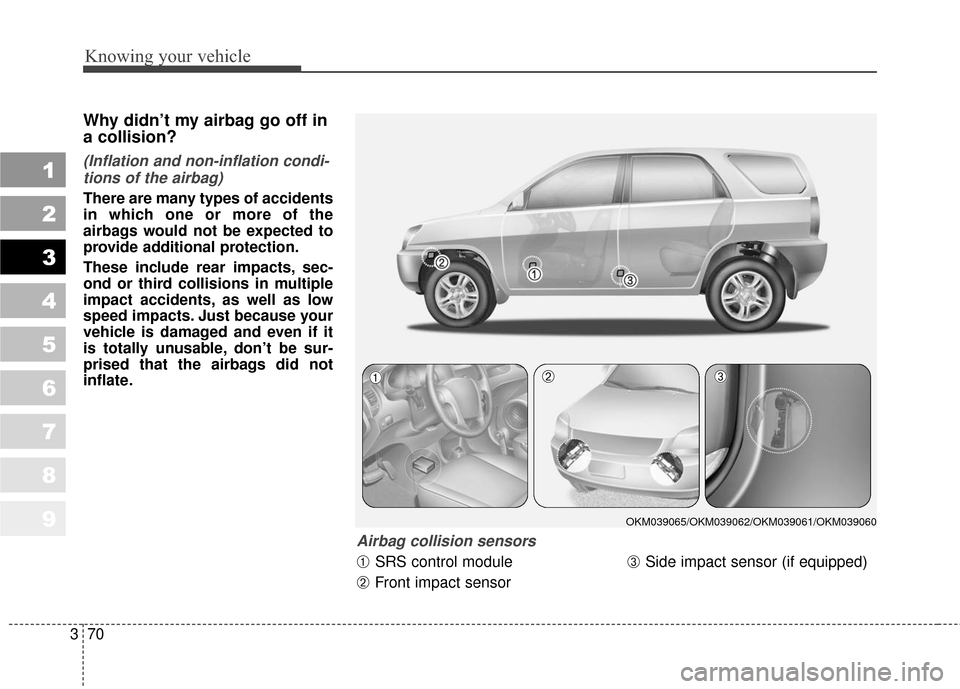
Airbag collision sensors
➀ SRS control module
➁ Front impact sensor
➂ Side impact sensor (if equipped)
OKM039065/OKM039062/OKM039061/OKM039060
➀➁➂
Page 80 of 371
371
1
2
3
4
5
6
7
8
9
Knowing your vehicle
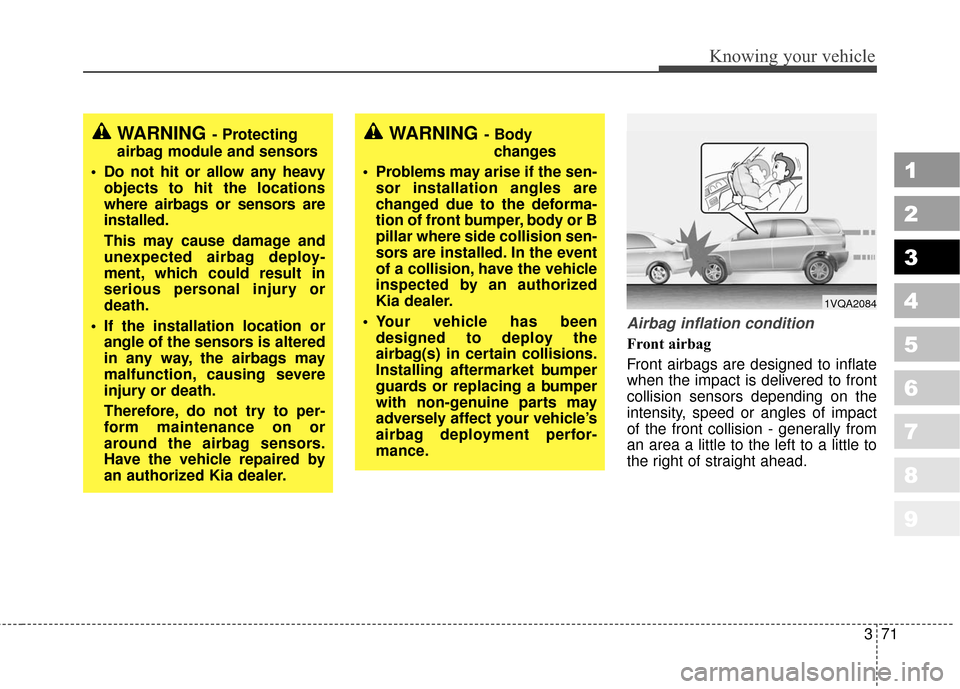
Airbag inflation condition
Front airbag
Front airbags are designed to inflate
when the impact is delivered to front
collision sensors depending on the
intensity, speed or angles of impact
of the front collision - generally from
an area a little to the left to a little to
the right of straight ahead.
WARNING- Protecting
airbag module and sensors
Do not hit or allow any heavy objects to hit the locations
where airbags or sensors are
installed.
This may cause damage and
unexpected airbag deploy-
ment, which could result in
serious personal injury or
death.
If the installation location or angle of the sensors is altered
in any way, the airbags may
malfunction, causing severe
injury or death.
Therefore, do not try to per-
form maintenance on or
around the airbag sensors.
Have the vehicle repaired by
an authorized Kia dealer.WARNING- Body
changes
Problems may arise if the sen- sor installation angles are
changed due to the deforma-
tion of front bumper, body or B
pillar where side collision sen-
sors are installed. In the event
of a collision, have the vehicle
inspected by an authorized
Kia dealer.
Your vehicle has been designed to deploy the
airbag(s) in certain collisions.
Installing aftermarket bumper
guards or replacing a bumper
with non-genuine parts may
adversely affect your vehicle’s
airbag deployment perfor-
mance.
1VQA2084
Page 81 of 371
Knowing your vehicle
72
3
1
2
3
4
5
6
7
8
9
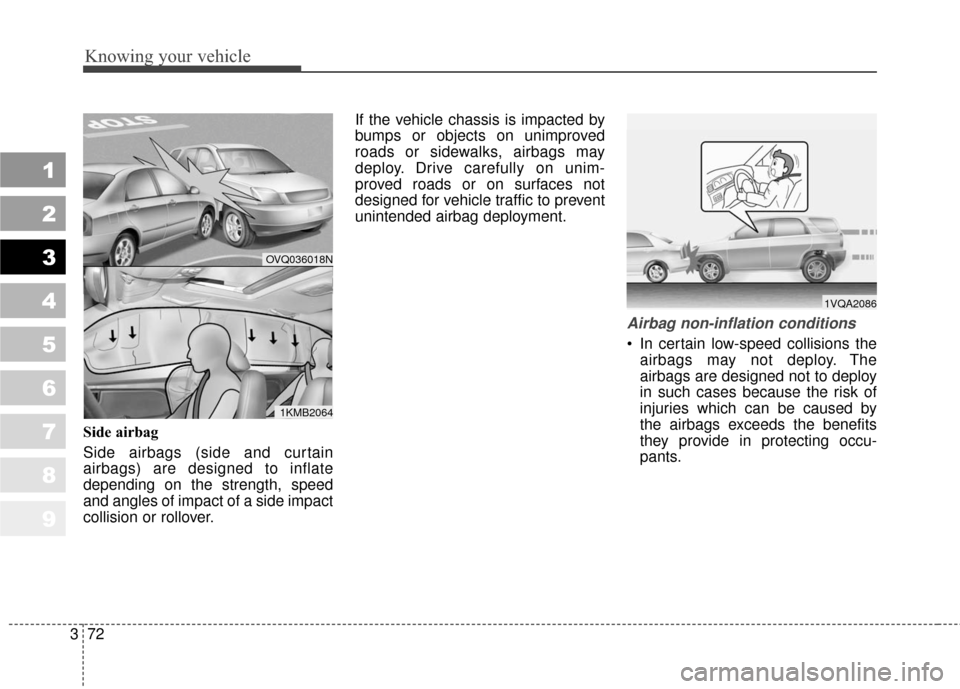
Side airbag
Side airbags (side and curtain
airbags) are designed to inflate
depending on the strength, speed
and angles of impact of a side impact
collision or rollover. If the vehicle chassis is impacted by
bumps or objects on unimproved
roads or sidewalks, airbags may
deploy. Drive carefully on unim-
proved roads or on surfaces not
designed for vehicle traffic to prevent
unintended airbag deployment.
Airbag non-inflation conditions
In certain low-speed collisions the
airbags may not deploy. The
airbags are designed not to deploy
in such cases because the risk of
injuries which can be caused by
the airbags exceeds the benefits
they provide in protecting occu-
pants.
OVQ036018N
1KMB2064
1VQA2086
Page 82 of 371
373
1
2
3
4
5
6
7
8
9
Knowing your vehicle
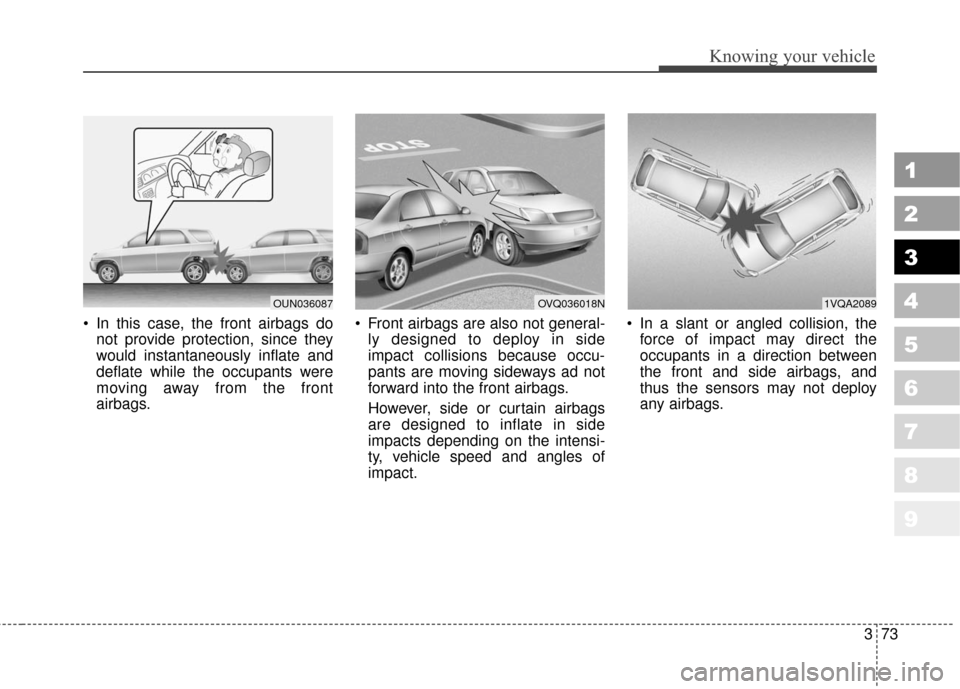
In this case, the front airbags donot provide protection, since they
would instantaneously inflate and
deflate while the occupants were
moving away from the front
airbags. Front airbags are also not general-
ly designed to deploy in side
impact collisions because occu-
pants are moving sideways ad not
forward into the front airbags.
However, side or curtain airbags
are designed to inflate in side
impacts depending on the intensi-
ty, vehicle speed and angles of
impact. In a slant or angled collision, the
force of impact may direct the
occupants in a direction between
the front and side airbags, and
thus the sensors may not deploy
any airbags.
OVQ036018N1VQA2089OUN036087
Page 83 of 371
Knowing your vehicle
74
3
1
2
3
4
5
6
7
8
9
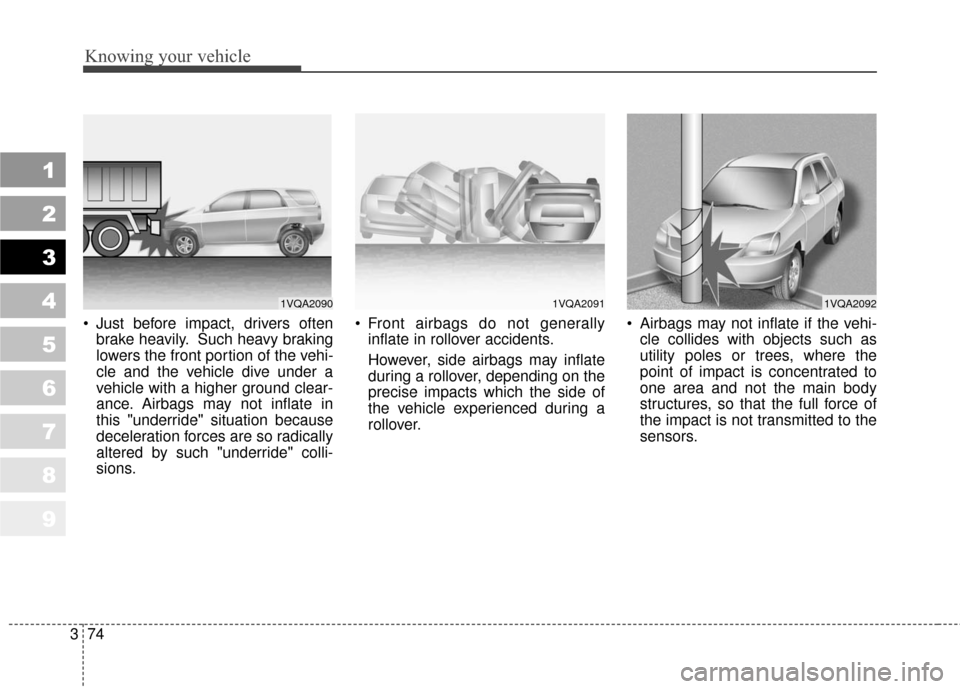
Just before impact, drivers often
brake heavily. Such heavy braking
lowers the front portion of the vehi-
cle and the vehicle dive under a
vehicle with a higher ground clear-
ance. Airbags may not inflate in
this "underride" situation because
deceleration forces are so radically
altered by such "underride" colli-
sions. Front airbags do not generally
inflate in rollover accidents.
However, side airbags may inflate
during a rollover, depending on the
precise impacts which the side of
the vehicle experienced during a
rollover. Airbags may not inflate if the vehi-
cle collides with objects such as
utility poles or trees, where the
point of impact is concentrated to
one area and not the main body
structures, so that the full force of
the impact is not transmitted to the
sensors.
1VQA20901VQA20911VQA2092
Page 84 of 371
375
1
2
3
4
5
6
7
8
9
Knowing your vehicle
How does the airbag system
operate
Airbags only operate when theignition switch is turned to the ON
or START positions.
Airbags inflate instantly in the event of serious frontal or side col-
lision in order to help protect the
occupants from physical injury.
The airbag Electronic Control Unit
(ECU) is a small computer which
calculates the immediate impact
information and sends out a
deployment signal based on the
ECU's calculation of the likely
severity of the developing collision.
There is no single vehicle speed at which the airbags will inflate. Airbag deployment depends on a
number of factors including vehicle
speed, angles of impact and the
density and stiffness of the vehi-
cles or objects which your vehicle
hits in the collision. However, fac-
tors are not limited to those men-
tioned above.
The front airbags will completely inflate and deflate in an instant.
It is impossible for you to see the
airbags inflate during an accident.
It is much more likely that you will
simply see the deflated airbags
hanging out of their storage com-
partments after the collision. In order to help provide protection
in a severe collision, the airbags
must inflate rapidly. The speed of
airbag inflation has been deter-
mined by the Canadian Motor
Vehicle Safety Standard (CMVSS)
to reduce the likelihood of serious
or life-threatening injuries and is
thus a mandatory part of the airbag
design.
However, airbag inflation can also
cause injuries which normally can
include facial abrasions, bruises
and broken bones, and sometimes
more serious injuries because that
inflation speed also causes the
airbags to expand with a great deal
force.
There are even circumstances under which contact with the
steering wheel airbag can cause
fatal injuries, especially if the
occupant is positioned exces-
sively close to the steering
wheel.
Page 85 of 371
Knowing your vehicle
76
3
1
2
3
4
5
6
7
8
9
Noise and smoke
When the airbags inflate, they make
a loud noise and they leave smoke
and powder in the air inside of the
vehicle. This is normal. After the
airbag inflates, you may feel sub-
stantial discomfort in breathing due
to the contact of your chest to both
the safety belt and the airbag, as well
as from breathing the smoke and
powder. We strongly urge you to
open your doors and/or windows
as soon as possible after impact
in order to reduce discomfort and
prevent prolonged exposure to
the smoke and powder.
Though the smoke and powder are
non-toxic, they may cause irritation
(eyes, nose and throat etc). Wash
and rinse with cold water immediate-
ly and consult the doctor if the symp-
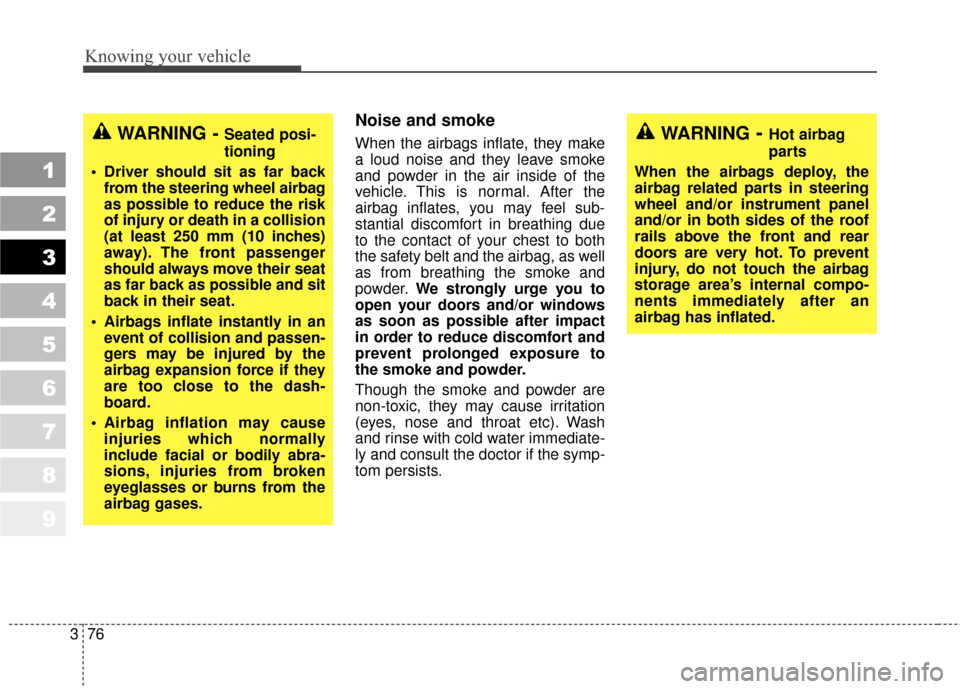
tom persists.WARNING - Seated posi-
tioning
Driver should sit as far back from the steering wheel airbag
as possible to reduce the risk
of injury or death in a collision
(at least 250 mm (10 inches)
away). The front passenger
should always move their seat
as far back as possible and sit
back in their seat.
Airbags inflate instantly in an event of collision and passen-
gers may be injured by the
airbag expansion force if they
are too close to the dash-
board.
Airbag inflation may cause injuries which normally
include facial or bodily abra-
sions, injuries from broken
eyeglasses or burns from the
airbag gases.WARNING- Hot airbag
parts
When the airbags deploy, the
airbag related parts in steering
wheel and/or instrument panel
and/or in both sides of the roof
rails above the front and rear
doors are very hot. To prevent
injury, do not touch the airbag
storage area’s internal compo-
nents immediately after an
airbag has inflated.
Page 86 of 371
377
1
2
3
4
5
6
7
8
9
Knowing your vehicle
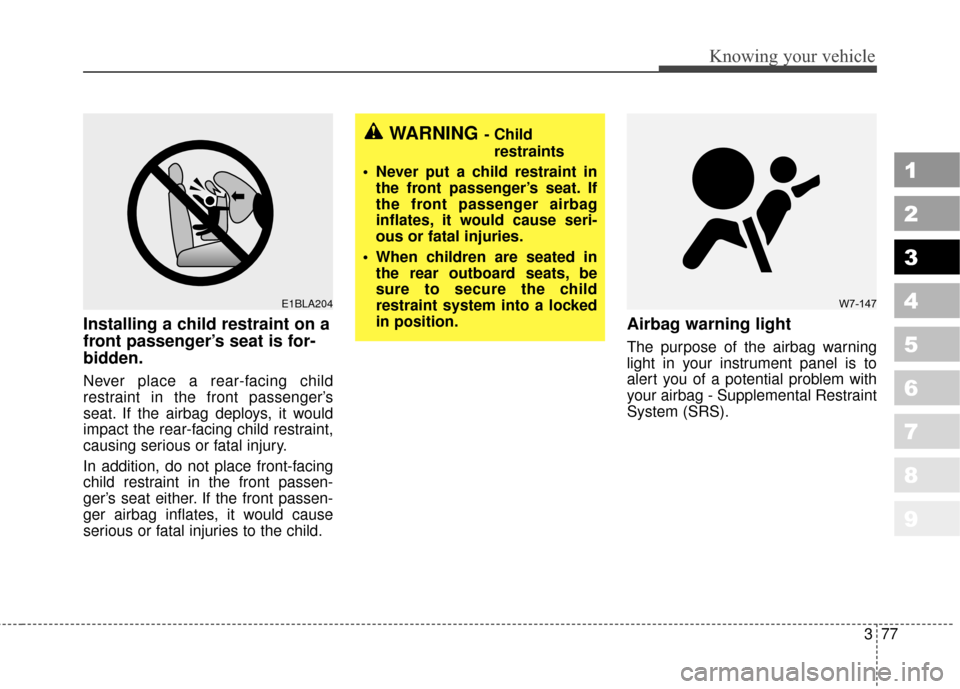
Installing a child restraint on a
front passenger’s seat is for-
bidden.
Never place a rear-facing child
restraint in the front passenger’s
seat. If the airbag deploys, it would
impact the rear-facing child restraint,
causing serious or fatal injury.
In addition, do not place front-facing
child restraint in the front passen-
ger’s seat either. If the front passen-
ger airbag inflates, it would cause
serious or fatal injuries to the child.
Airbag warning light
The purpose of the airbag warning
light in your instrument panel is to
alert you of a potential problem with
your airbag - Supplemental Restraint
System (SRS).
WARNING- Childrestraints
Never put a child restraint in the front passenger’s seat. If
the front passenger airbag
inflates, it would cause seri-
ous or fatal injuries.
When children are seated in the rear outboard seats, be
sure to secure the child
restraint system into a locked
in position.
E1BLA204W7-147