warning KIA Sportage 2010 SL / 3.G Owner's Guide
[x] Cancel search | Manufacturer: KIA, Model Year: 2010, Model line: Sportage, Model: KIA Sportage 2010 SL / 3.GPages: 371, PDF Size: 5.23 MB
Page 38 of 371

329
Knowing your vehicle
1
2
3
4
5
6
7
8
9
Armrest
The armrest is located in the center
of the rear seat. Pull the armrest
down from the seatback.
Headrest
The rear seat(s) is equipped with
headrests in all the seating positions
for the occupant's safety and com-
for t.
The headrest not only provides com-
fort for passengers, but also helps
protect the head and neck in the
event of a collision.
WARNING- Cargo
Cargo should always be
secured to prevent it from being
thrown about the vehicle in a
collision and causing injury to
the vehicle occupants. Special
care should be taken of objects
placed in the rear seats, since
those may hit the front seat
occupants in a frontal collision.
CAUTION - Cargo loading
Make sure the engine is off, the transaxle is in P and the parkingbrake is applied whenever load-ing or unloading cargo. Failureto take these steps may allowthe vehicle to move if shift leveris inadvertently moved to anoth-er position.
8KMA2046OJM069015R
Page 39 of 371
Knowing your vehicle
30
3
1
2
3
4
5
6
7
8
9
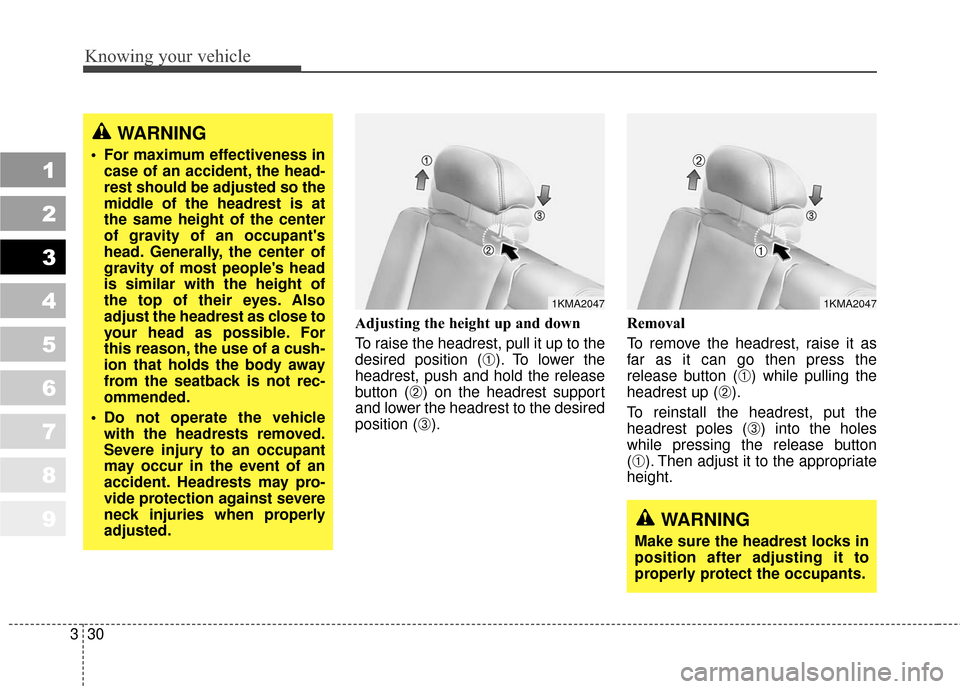
Adjusting the height up and down
To raise the headrest, pull it up to the
desired position (
➀). To lower the
headrest, push and hold the release
button (
➁) on the headrest support
and lower the headrest to the desired
position (
➂). Removal
To remove the headrest, raise it as
far as it can go then press the
release button (
➀) while pulling the
headrest up (
➁).
To reinstall the headrest, put the
headrest poles (
➂) into the holes
while pressing the release button
(
➀). Then adjust it to the appropriate
height.
WARNING
For maximum effectiveness in case of an accident, the head-
rest should be adjusted so the
middle of the headrest is at
the same height of the center
of gravity of an occupant's
head. Generally, the center of
gravity of most people's head
is similar with the height of
the top of their eyes. Also
adjust the headrest as close to
your head as possible. For
this reason, the use of a cush-
ion that holds the body away
from the seatback is not rec-
ommended.
Do not operate the vehicle with the headrests removed.
Severe injury to an occupant
may occur in the event of an
accident. Headrests may pro-
vide protection against severe
neck injuries when properly
adjusted.
1KMA20471KMA2047
WARNING
Make sure the headrest locks in
position after adjusting it to
properly protect the occupants.
➀
➁
Page 40 of 371
331
Knowing your vehicle
1
2
3
4
5
6
7
8
9
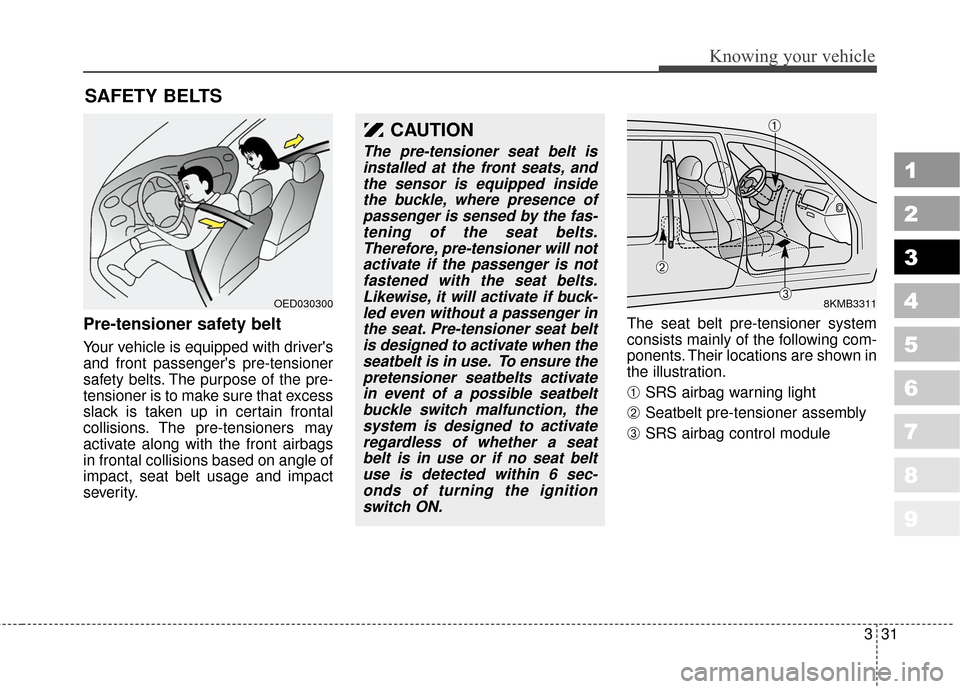
Pre-tensioner safety belt
Your vehicle is equipped with driver's
and front passenger's pre-tensioner
safety belts. The purpose of the pre-
tensioner is to make sure that excess
slack is taken up in certain frontal
collisions. The pre-tensioners may
activate along with the front airbags
in frontal collisions based on angle of
impact, seat belt usage and impact
severity.The seat belt pre-tensioner system
consists mainly of the following com-
ponents. Their locations are shown in
the illustration.
➀ SRS airbag warning light
➁ Seatbelt pre-tensioner assembly
➂ SRS airbag control module
SAFETY BELTS
OED030300
CAUTION
The pre-tensioner seat belt is
installed at the front seats, andthe sensor is equipped insidethe buckle, where presence ofpassenger is sensed by the fas-tening of the seat belts.Therefore, pre-tensioner will notactivate if the passenger is notfastened with the seat belts.Likewise, it will activate if buck-led even without a passenger inthe seat. Pre-tensioner seat beltis designed to activate when theseatbelt is in use. To ensure thepretensioner seatbelts activatein event of a possible seatbeltbuckle switch malfunction, thesystem is designed to activateregardless of whether a seatbelt is in use or if no seat beltuse is detected within 6 sec-onds of turning the ignitionswitch ON.
8KMB3311
➀
➁
➂
Page 41 of 371
Knowing your vehicle
32
3
1
2
3
4
5
6
7
8
9
Load limiter
When the pre-tentioner activates, if
the system senses excessive seat
belt tension on the driver or passen-
ger’s seat belt, the load limiter inside
the pre-tensioner will release some
of the pressure on the affected seat
belt.
CAUTION - Airbag/Pre-
tensioner dust
When the airbags and pre-ten- sioners are activated, a loudnoise may be heard and finedust, which may appear to besmoke, may be visible in thepassenger compartment. Thisdust is not toxic. The dust maycause skin irritation and shouldnot be breathed for prolongedperiods. Ventilate the vehicleafter impact and wash yourhands and face thoroughly afteran accident.
WARNING- Airbag/pre-
tensioner warning light
If the SRS airbag warning light
does not illuminate when the
ignition key is turned to “ON”, or
if it remains illuminated after
approximately 6 seconds, or if it
illuminates while the vehicle is
being driven, please have an
authorized Kia dealer inspect
the pre-tensioner and airbag
system as soon as possible.WARNING- Safety belt adjustment
To obtain maximum benefit from
a pre-tensioner seat belt:
The safety belt must be worn correctly.
The safety belt must be adjusted to the correct posi-
tion.
Page 42 of 371
333
Knowing your vehicle
1
2
3
4
5
6
7
8
9
WARNING- Replacing
used pre-tensioners
Pre-tensioners are designed to operate once. After activa-
tion, pre-tensioner seat belts
must be replaced. All seat
belts, of any type, should
always be replaced after they
have been worn during a colli-
sion.
Do not attempt to replace the pre-tensioners yourself. This
must be done by an autho-
rized Kia dealer.CAUTION - Hot parts
The pre-tensioner assemblymechanism become hot duringactivation. Do not touch the pre-tensioner seat belt assembly forseveral minutes after they havebeen activated.
WARNING- Damaging
the pre-tensioners
Do not hit or strike the pre- tensioner assemblies, espe-
cially with a tool or heavy
object.
Do not attempt to service or repair the pre-tensioners.
WARNING
If the vehicle or pre-tensioner
seat belt must be discarded, con-
tact an authorized Kia dealer.
Page 43 of 371

Knowing your vehicle
34
3
1
2
3
4
5
6
7
8
9
Safety belt restraint system We strongly recommend that the dri-
ver and all passengers be properly
restrained at all times by using the
safety belts provided with the vehi-
cle. Proper use of the safety belts
decreases the risk of severe injury or
death in accidents or sudden stops.
In most states, and in Canada, the
law requires their use.
All seats have lap/shoulder belts.
Inertial locks in the safety belt retrac-
tors allow all of the lap/shoulder safe-
ty belts to remain unlocked during
normal vehicle operation. This allows
the occupants some freedom of
movement and increased comfort
while using the safety belts. If a force
is applied to the vehicle, such as a
strong stop, a sharp turn, or a colli-
sion, the safety belt retractors will
automatically lock the safety belts. Since the inertial locks do not require
a collision in order to lock up, you
may become aware of the safety
belts locking while braking or going
around sharp corners.
Always use the rear seat position(s)
to install your child restraint(s).
WARNING- Safety belts
To minimize the risk of serious
or fatal injury in an accident, the
driver and all passengers
should use the appropriate
safety restraints for their age
and size. The presence of
airbags does not change the
need to be properly restrained
by a safety belt or size-appropri-
ate child restraint. In fact,
airbags are designed to work
the best when passengers are
correctly restrained in the vehi-
cle.
Be sure you are familiar with the information in this section,
including the information on
infant and child restraints.
Read the safety warnings on the sun visors of your vehicle
also.
WARNING- Child
restraint in front seat
Never install a child restraint
system in the front passenger
position, as an inflating airbag
could cause serious or fatal
injury to a child in that position.
Page 44 of 371

335
Knowing your vehicle
1
2
3
4
5
6
7
8
9
The rear safety belts use a special
auto-lock feature designed to allow a
child restraint to be used in these
positions without an added locking
clip. They normally lock only under
extreme or emergency conditions
(emergency lock mode). However
they can be adjusted so that they
remain fixed and locked when a child
restraint system is placed in these
positions. (Use this auto-lock mode
only to secure a child restraint, never
for passengers restrained by the
safety belts.) Page 3-48 gives
instructions on placing the safety belt
in the auto lock mode.
The drivers safety belt can only oper-
ate in the emergency lock mode.Safety belts provide the best restraint
when:
The seatback is upright.
The occupant is sitting upright (not
slouched).
The lap belt is snug across the hips.
The shoulder belt is snug across the chest.
The knees are straight forward.
To help you remember to fasten your
safety belt, a warning light will blink.
WARNING- After a colli- sion
Lap/shoulder belt assemblies may be stretched or damaged
when subjected to the stress
and forces of a collision.
The entire restraint system should be inspected following
any collision. All belts, retrac-
tors, anchors and hardware
damaged by a collision should
be replaced before the vehicle
is operated again.
WARNING - Cargo area
Passengers should never be
allowed to ride in the cargo area
of a vehicle. No safety belts are
provided for the cargo area.
Persons riding in the vehicle
without a fastened safety belt
are much more likely to suffer
serious bodily injury or death
during an accident.
WARNING- Twisted belts
A twisted or jammed safety belt
cannot restrain you properly. If
you cannot untwist or unjam the
safety belt, have an authorized
Kia dealer service it immediate-
ly. Never drive or ride with a
twisted or jammed safety belt.
Page 45 of 371

Knowing your vehicle
36
3
1
2
3
4
5
6
7
8
9
CAUTION
Never close the doors on any
part of the lap or shoulder belt.It can damage the safety belt orbuckle which could increase therisk of injury in case of an acci-dent.
WARNING- Belt use
Safety belts must be used cor-
rectly to work properly in an
accident. Each seating position
in your vehicle has a specific
safety belt assembly that
includes a buckle and tongue
designed to be used together.
Failure to heed these warnings
and follow these instructions
will increase the risk and sever-
ity of injuries and the likelihood
of death in an accident.
Use the shoulder portion of the safety belt on the outside
shoulder only. Never wear the
shoulder portion under the
arm.
Never swing the safety belt around your neck to fit over
the inside shoulder.
Never wear the shoulder por- tion of the safety belt across
the neck or face.
(Continued)(Continued)
Wear the lap portion as low aspossible. Be sure that the lap
belt fits snugly around the
hips. Never wear a lap portion
of a lap/shoulder belt over
your waist; it should always
go over the stronger area of
your hips.
Never use a single safety belt for more than one person.
The front seatbacks should always remain in a comfort-
able, upright position when
the vehicle is moving.(Continued)
Pull the safety belt out and let
it retract a number of times.
Make sure that the lap/shoul-
der belts return smoothly and
easily into the retractor.
Check the latches to make sure they latch and release
without interference or delay.
Never close the doors on any part of the lap or shoulder
belt.
Any belt not in good condition or in good working order
should be promptly replaced.
WARNING- Safety belt
care
A damaged belt may not give you the protection you need in
an accident.
Inspect your safety belts peri- odically for excessive wear or
damage. Pull out each belt
fully and look for fraying, cuts,
burns or other damage.
(Continued)
Page 46 of 371

337
Knowing your vehicle
1
2
3
4
5
6
7
8
9
Safety belt warning light and
chime
If the driver's safety belt is not fas-
tened when the key is turned ON or
if it is unfastened after the key is
turned ON, the safety belt warning
light blinks until the belt fastened.
If the driver's safety belt is not fas-
tened when the key is turned ON or
if it is unfastened after the key is ON,
the safety belt warning chime will
sound for approximately 6 seconds.
At this time, if the safety belt is fas-
tened, the chime will stop at once.
Lap/shoulder belt
To fasten the front lap/shoulderbelt:
1. Grasp the buckle and tongue plate.
2. Slowly pull the lap/shoulder belt out from the retractor. 3. Insert the tongue plate (
➀) into the
open end of the buckle (
➁) until an
audible “click” is heard, indicating
the belt is locked in the buckle.
1GQA20831GHA22621GHA2263
Page 48 of 371
339
Knowing your vehicle
1
2
3
4
5
6
7
8
9
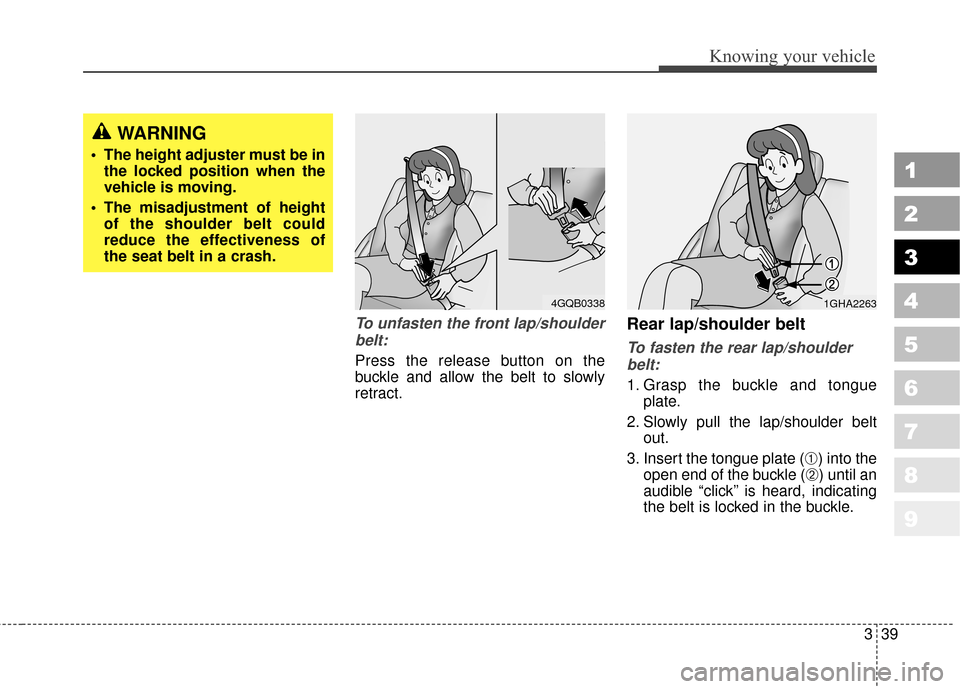
To unfasten the front lap/shoulderbelt:
Press the release button on the
buckle and allow the belt to slowly
retract.
Rear lap/shoulder belt
To fasten the rear lap/shoulderbelt:
1. Grasp the buckle and tongue plate.
2. Slowly pull the lap/shoulder belt out.
3. Insert the tongue plate (
➀) into the
open end of the buckle (
➁) until an
audible “click’’ is heard, indicating
the belt is locked in the buckle.
4GQB03381GHA2263
WARNING
The height adjuster must be in the locked position when the
vehicle is moving.
The misadjustment of height of the shoulder belt could
reduce the effectiveness of
the seat belt in a crash.