engine KIA Sportage 2012 SL / 3.G User Guide
[x] Cancel search | Manufacturer: KIA, Model Year: 2012, Model line: Sportage, Model: KIA Sportage 2012 SL / 3.GPages: 387, PDF Size: 8.44 MB
Page 19 of 387
2
Interior overview / 2-2
Instrument panel overview / 2-3
Engine compartment / 2-4
Your vehicle at a glance
Page 21 of 387
23
Your vehicle at a glance
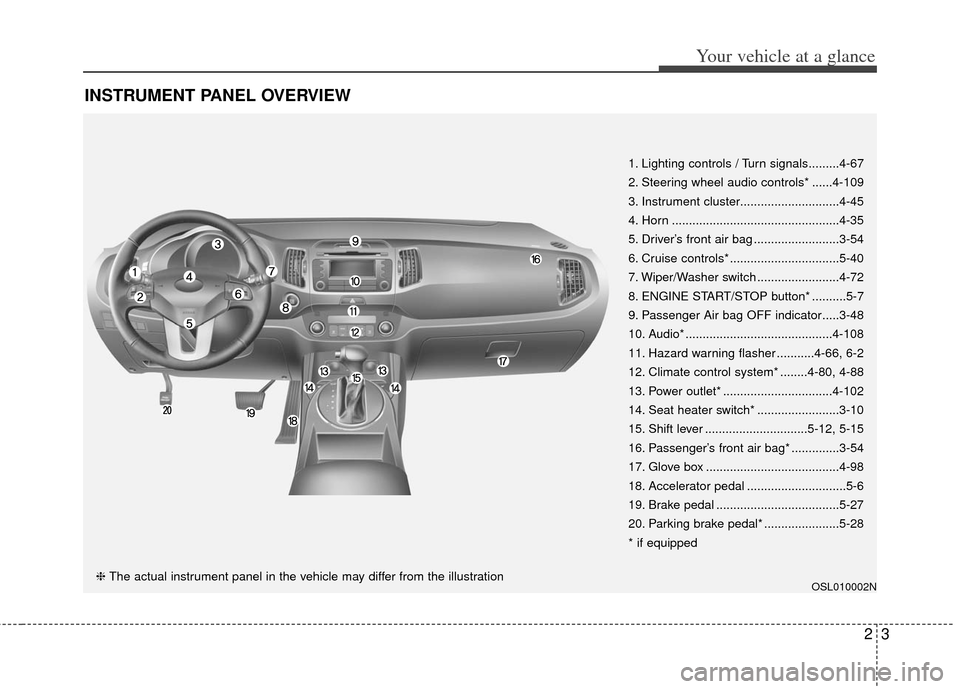
INSTRUMENT PANEL OVERVIEW
OSL010002N
1. Lighting controls / Turn signals.........4-67
2. Steering wheel audio controls* ......4-109
3. Instrument cluster.............................4-45
4. Horn .................................................4-35
5. Driver’s front air bag .........................3-54
6. Cruise controls* ................................5-40
7. Wiper/Washer switch ........................4-72
8. ENGINE START/STOP button* ..........5-7
9. Passenger Air bag OFF indicator.....3-48
10. Audio* ...........................................4-108
11. Hazard warning flasher ...........4-66, 6-2
12. Climate control system* ........4-80, 4-88
13. Power outlet* ................................4-102
14. Seat heater switch* ........................3-10
15. Shift lever ..............................5-12, 5-15
16. Passenger’s front air bag* ..............3-54
17. Glove box .......................................4-98
18. Accelerator pedal .............................5-6
19. Brake pedal ....................................5-27
20. Parking brake pedal* ......................5-28
* if equipped
❈ The actual instrument panel in the vehicle may differ from the illustration
Page 22 of 387
Your vehicle at a glance
42
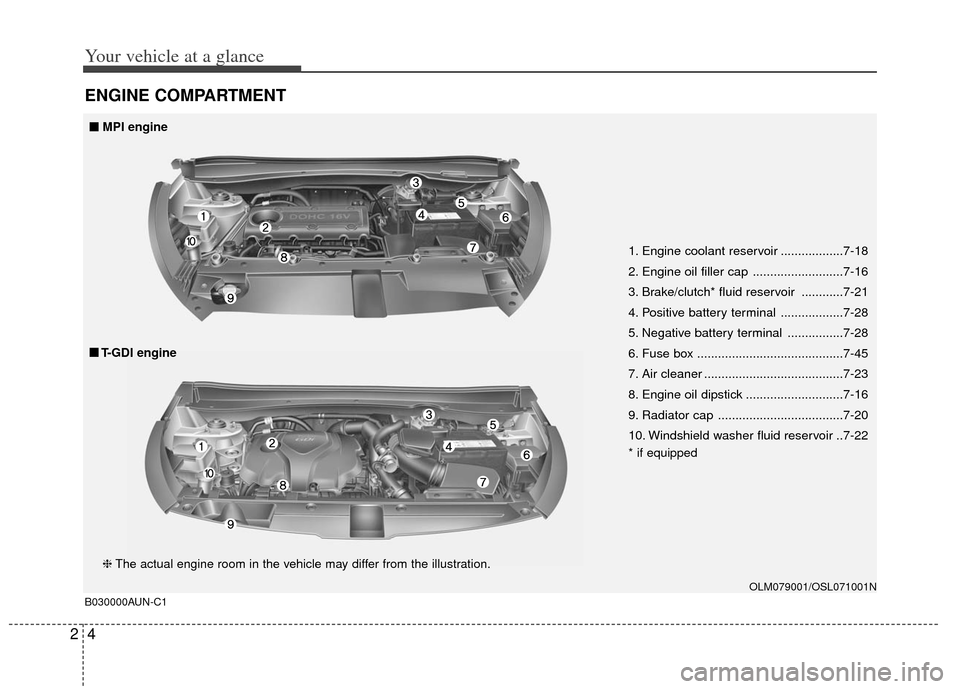
ENGINE COMPARTMENT
B030000AUN-C1
1. Engine coolant reservoir ..................7-18
2. Engine oil filler cap ..........................7-16
3. Brake/clutch* fluid reservoir ............7-21
4. Positive battery terminal ..................7-28
5. Negative battery terminal ................7-28
6. Fuse box ..........................................7-45
7. Air cleaner ........................................7-23
8. Engine oil dipstick ............................7-16
9. Radiator cap ....................................7-20
10. Windshield washer fluid reservoir ..7-22
* if equipped
OLM079001/OSL071001N
❈The actual engine room in the vehicle may differ from the illustration.
■
■
MPI engine
■
■ T-GDI engine
Page 28 of 387
Safety features of your vehicle
63
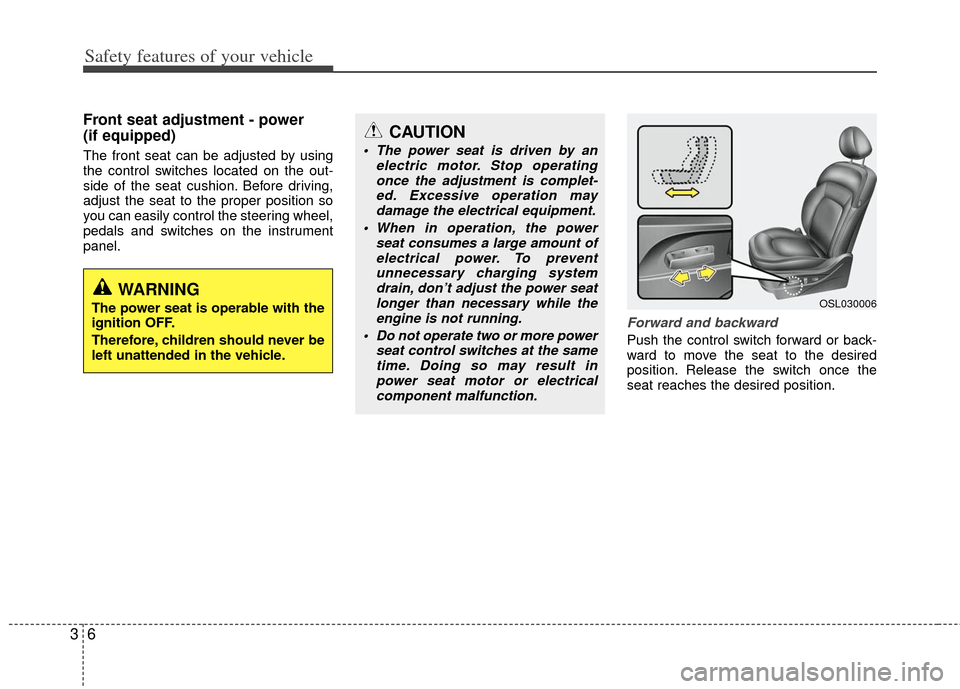
Front seat adjustment - power
(if equipped)
The front seat can be adjusted by using
the control switches located on the out-
side of the seat cushion. Before driving,
adjust the seat to the proper position so
you can easily control the steering wheel,
pedals and switches on the instrument
panel.
Forward and backward
Push the control switch forward or back-
ward to move the seat to the desired
position. Release the switch once the
seat reaches the desired position.
CAUTION
The power seat is driven by anelectric motor. Stop operatingonce the adjustment is complet-ed. Excessive operation maydamage the electrical equipment.
When in operation, the power seat consumes a large amount ofelectrical power. To preventunnecessary charging systemdrain, don’t adjust the power seatlonger than necessary while theengine is not running.
Do not operate two or more power seat control switches at the sametime. Doing so may result inpower seat motor or electricalcomponent malfunction.
OSL030006WARNING
The power seat is operable with the
ignition OFF.
Therefore, children should never be
left unattended in the vehicle.
Page 36 of 387
Safety features of your vehicle
14
3
CAUTION- Rear seat belts
When returning the rear seatbacks
to the upright position, remember to return the rear shoulder belts totheir proper position. Routing the seat belt webbing through the rearseat belt guides will help keep thebelts from being trapped behind orunder the seats.
CAUTION - Damaging rear
seat belt buckles
When you fold the rear seatback,
insert the buckle in the pocketbetween the rear seatback andcushion. Doing so can prevent thebuckle from being damaged by the rear seatback.
WARNING - Cargo loading
Make sure the engine is off, the
automatic transaxle is in P (Park) or
the manual transaxle is in 1st, and
the parking brake is securely
applied whenever loading or
unloading cargo. Failure to take
these steps may allow the vehicle
to move if the shift lever is inadver-
tently moved to another position.
WARNING- Cargo
Cargo should always be secured to
prevent it from being thrown about
the vehicle in a collision and caus-
ing injury to the vehicle occupants.
Do not place objects on the rear
seats, since they cannot be proper-
ly secured and may hit the front
seat occupants in a collision.
WARNING - Uprighting
seat
When you return the seatback to its
upright position, hold the seatback
and return it slowly and be sure
there are no other occupants
around the seat. If the seatback is
returned without being held and
controlled, the back of the seat
could move forward or backward
resulting in accidental injury to a
person struck by the seatback.
Page 70 of 387
Safety features of your vehicle
48
3
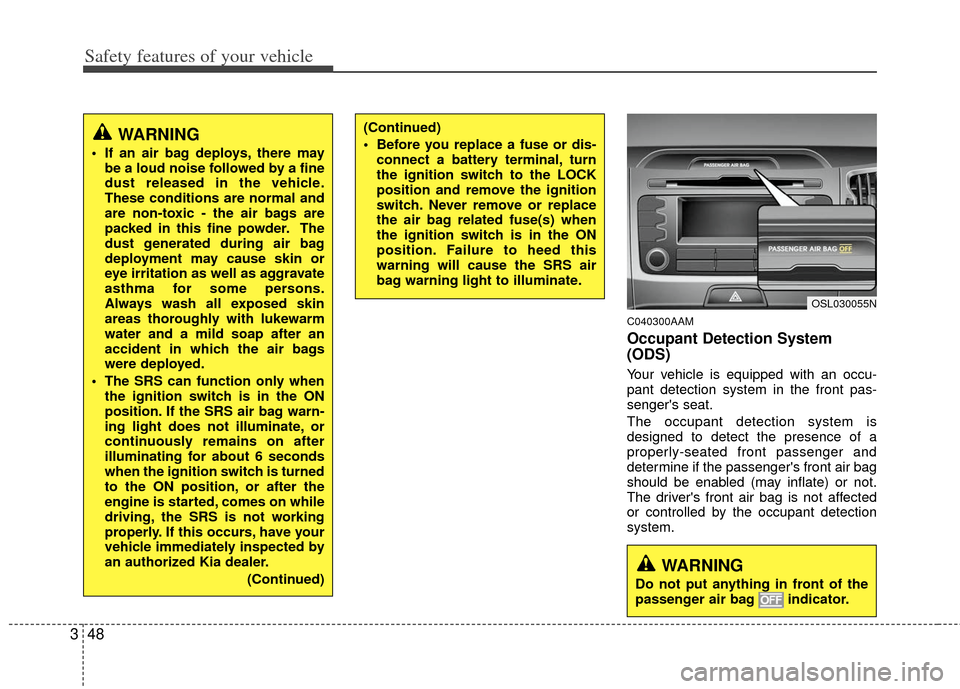
C040300AAM
Occupant Detection System
(ODS)
Your vehicle is equipped with an occu-
pant detection system in the front pas-
senger's seat.
The occupant detection system is
designed to detect the presence of a
properly-seated front passenger and
determine if the passenger's front air bag
should be enabled (may inflate) or not.
The driver's front air bag is not affected
or controlled by the occupant detection
system.
WARNING
If an air bag deploys, there may
be a loud noise followed by a fine
dust released in the vehicle.
These conditions are normal and
are non-toxic - the air bags are
packed in this fine powder. The
dust generated during air bag
deployment may cause skin or
eye irritation as well as aggravate
asthma for some persons.
Always wash all exposed skin
areas thoroughly with lukewarm
water and a mild soap after an
accident in which the air bags
were deployed.
The SRS can function only when the ignition switch is in the ON
position. If the SRS air bag warn-
ing light does not illuminate, or
continuously remains on after
illuminating for about 6 seconds
when the ignition switch is turned
to the ON position, or after the
engine is started, comes on while
driving, the SRS is not working
properly. If this occurs, have your
vehicle immediately inspected by
an authorized Kia dealer.
(Continued)
(Continued)
Before you replace a fuse or dis-connect a battery terminal, turn
the ignition switch to the LOCK
position and remove the ignition
switch. Never remove or replace
the air bag related fuse(s) when
the ignition switch is in the ON
position. Failure to heed this
warning will cause the SRS air
bag warning light to illuminate.
WARNING
Do not put anything in front of the
passenger air bag indicator.
OSL030055N
Page 74 of 387
Safety features of your vehicle
52
3
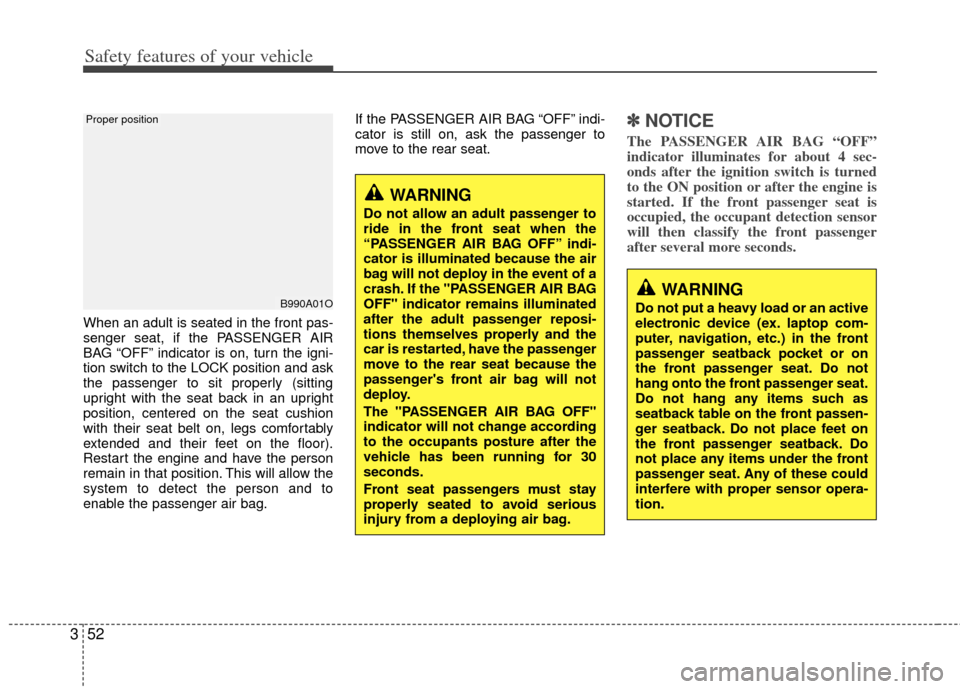
When an adult is seated in the front pas-
senger seat, if the PASSENGER AIR
BAG “OFF” indicator is on, turn the igni-
tion switch to the LOCK position and ask
the passenger to sit properly (sitting
upright with the seat back in an upright
position, centered on the seat cushion
with their seat belt on, legs comfortably
extended and their feet on the floor).
Restart the engine and have the person
remain in that position. This will allow the
system to detect the person and to
enable the passenger air bag. If the PASSENGER AIR BAG “OFF” indi-
cator is still on, ask the passenger to
move to the rear seat.
✽ ✽
NOTICE
The PASSENGER AIR BAG “OFF”
indicator illuminates for about 4 sec-
onds after the ignition switch is turned
to the ON position or after the engine is
started. If the front passenger seat is
occupied, the occupant detection sensor
will then classify the front passenger
after several more seconds.
B990A01OWARNING
Do not put a heavy load or an active
electronic device (ex. laptop com-
puter, navigation, etc.) in the front
passenger seatback pocket or on
the front passenger seat. Do not
hang onto the front passenger seat.
Do not hang any items such as
seatback table on the front passen-
ger seatback. Do not place feet on
the front passenger seatback. Do
not place any items under the front
passenger seat. Any of these could
interfere with proper sensor opera-
tion.
Proper position
WARNING
Do not allow an adult passenger to
ride in the front seat when the
“PASSENGER AIR BAG OFF” indi-
cator is illuminated because the air
bag will not deploy in the event of a
crash. If the "PASSENGER AIR BAG
OFF" indicator remains illuminated
after the adult passenger reposi-
tions themselves properly and the
car is restarted, have the passenger
move to the rear seat because the
passenger's front air bag will not
deploy.
The "PASSENGER AIR BAG OFF"
indicator will not change according
to the occupants posture after the
vehicle has been running for 30
seconds.
Front seat passengers must stay
properly seated to avoid serious
injury from a deploying air bag.
Page 80 of 387
Safety features of your vehicle
58
3
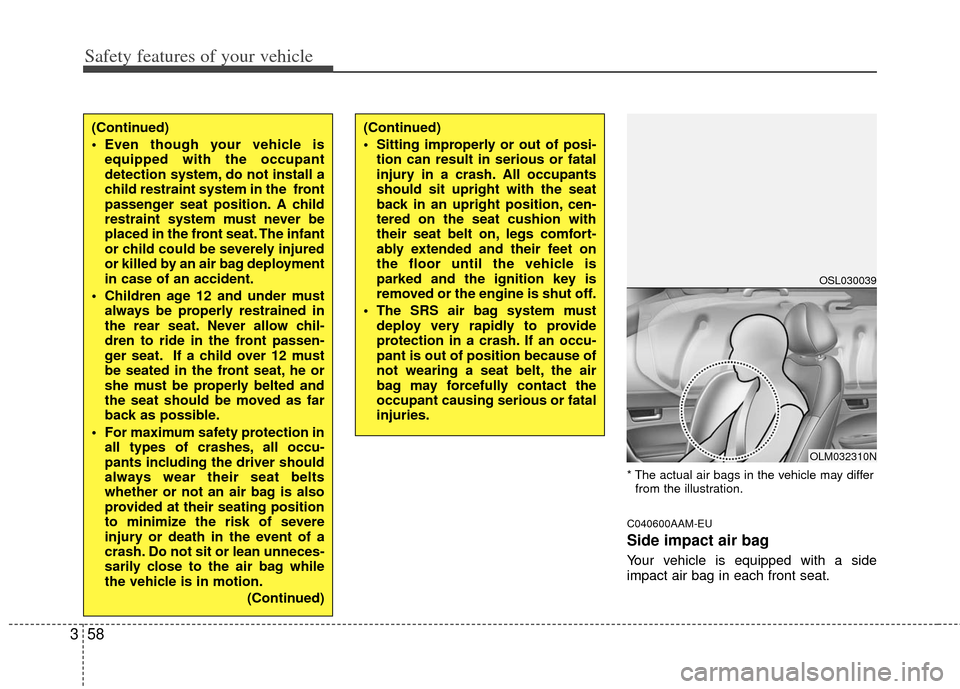
* The actual air bags in the vehicle may differ
from the illustration.
C040600AAM-EU
Side impact air bag
Your vehicle is equipped with a side
impact air bag in each front seat.
(Continued)
Sitting improperly or out of posi- tion can result in serious or fatal
injury in a crash. All occupants
should sit upright with the seat
back in an upright position, cen-
tered on the seat cushion with
their seat belt on, legs comfort-
ably extended and their feet on
the floor until the vehicle is
parked and the ignition key is
removed or the engine is shut off.
The SRS air bag system must deploy very rapidly to provide
protection in a crash. If an occu-
pant is out of position because of
not wearing a seat belt, the air
bag may forcefully contact the
occupant causing serious or fatal
injuries.(Continued)
Even though your vehicle isequipped with the occupant
detection system, do not install a
child restraint system in the front
passenger seat position. A child
restraint system must never be
placed in the front seat. The infant
or child could be severely injured
or killed by an air bag deployment
in case of an accident.
Children age 12 and under must always be properly restrained in
the rear seat. Never allow chil-
dren to ride in the front passen-
ger seat. If a child over 12 must
be seated in the front seat, he or
she must be properly belted and
the seat should be moved as far
back as possible.
For maximum safety protection in all types of crashes, all occu-
pants including the driver should
always wear their seat belts
whether or not an air bag is also
provided at their seating position
to minimize the risk of severe
injury or death in the event of a
crash. Do not sit or lean unneces-
sarily close to the air bag while
the vehicle is in motion.
(Continued)
OSL030039
OLM032310N
Page 88 of 387
Safety features of your vehicle
66
3
C041100AUN
SRS Care
The SRS is virtually maintenance-free
and so there are no parts you can safely
service by yourself. If the SRS air bag
warning light does not illuminate, or con-
tinuously remains on, have your vehicle
immediately inspected by an authorized
Kia dealer.
Any work on the SRS system, such as
removing, installing, repairing, or any
work on the steering wheel, the front
passenger’s panel, front seats and roof
rails must be performed by an authorized
Kia dealer. Improper handling of the SRS
system may result in serious personal
injury.
WARNING
Modification to SRS components
or wiring, including the addition
of any kind of badges to the pad
covers or modifications to the
body structure, can adversely
affect SRS performance and lead
to possible injury.
For cleaning the air bag pad cov- ers, use only a soft, dry cloth or
one which has been moistened
with plain water. Solvents or
cleaners could adversely affect
the air bag covers and proper
deployment of the system.
No objects should be placed over
or near the air bag modules on the
steering wheel, instrument panel,
and the front passenger's panel
above the glove box, because any
such object could cause harm if the
vehicle is in a crash severe enough
to cause the air bags to inflate.
(Continued)
(Continued)
If the air bags inflate, they must be replaced by an authorized Kia
dealer.
Do not tamper with or disconnect SRS wiring, or other components
of the SRS system. Doing so
could result in injury, due to acci-
dental inflation of the air bags or
by rendering the SRS inopera-
tive.
If components of the air bag sys- tem must be discarded, or if the
vehicle must be scrapped, certain
safety precautions must be
observed. An authorized Kia
dealer knows these precautions
and can give you the necessary
information. Failure to follow
these precautions and proce-
dures could increase the risk of
personal injury.
If your car was flooded and has soaked carpeting or water on
flooring, you shouldn't try to start
the engine; have the car towed to
an authorized Kia dealer.
Page 92 of 387
Features of your vehicle
24
D010100AUN
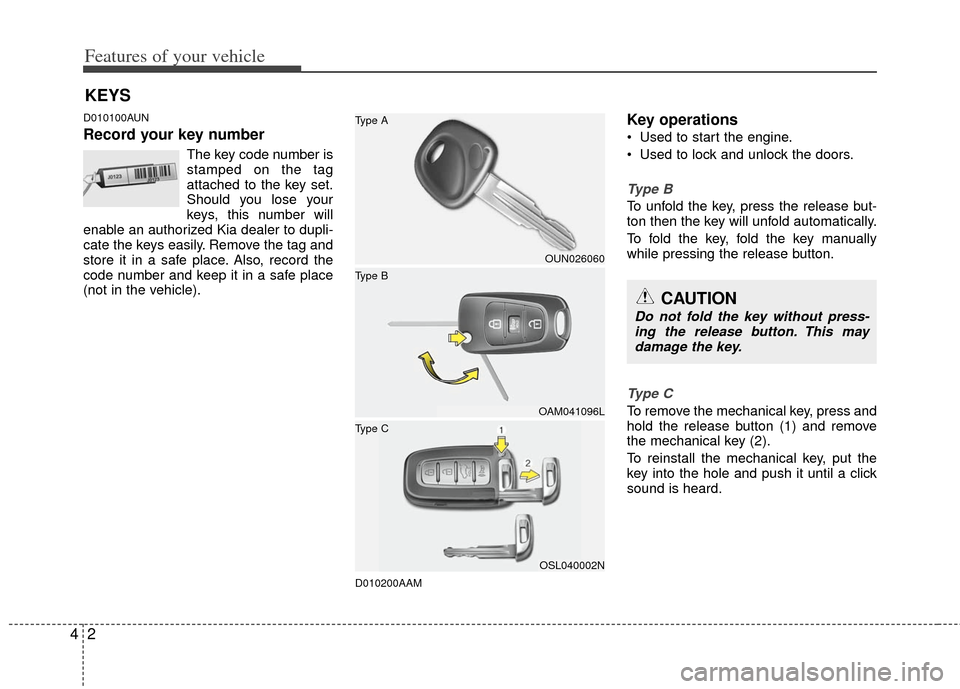
Record your key number
The key code number is
stamped on the tag
attached to the key set.
Should you lose your
keys, this number will
enable an authorized Kia dealer to dupli-
cate the keys easily. Remove the tag and
store it in a safe place. Also, record the
code number and keep it in a safe place
(not in the vehicle).
D010200AAM
Key operations
• Used to start the engine.
Used to lock and unlock the doors.
Type B
To unfold the key, press the release but-
ton then the key will unfold automatically.
To fold the key, fold the key manually
while pressing the release button.
Type C
To remove the mechanical key, press and
hold the release button (1) and remove
the mechanical key (2).
To reinstall the mechanical key, put the
key into the hole and push it until a click
sound is heard.
KEYS
OUN026060
OAM041096L
OSL040002N
Type B Type A
Type C
CAUTION
Do not fold the key without press- ing the release button. This maydamage the key.