steering wheel KIA Sportage 2013 SL / 3.G Owner's Manual
[x] Cancel search | Manufacturer: KIA, Model Year: 2013, Model line: Sportage, Model: KIA Sportage 2013 SL / 3.GPages: 387, PDF Size: 8.44 MB
Page 5 of 387

Index
2I
Air bags ··················\
··················\
··················\
··················\
···3-42Air bag warning label................................................3-68
Air bag warning light ................................................3-45
Curtain air bag ..........................................................3-60
Driver's and passenger's front air bag ......................3-54
Side impact air bag....................................................3-58
Air cleaner··················\
··················\
··················\
·················7-23\
Alarm system ··················\
··················\
··················\
············4-13
All wheel drive (AWD), see four wheel drive (4WD) ··················\
··················\
··················\
···········5-21
Antenna ··················\
··················\
··················\
··················\
·4-108
Anti-lock brake system (ABS)··················\
··················\
····5-30
Appearance care··················\
··················\
··················\
········7-53 Exterior care ··················\
··················\
··················\
········7-53
Interior care ··················\
··················\
··················\
·········7-58
Armrest ··················\
··················\
··················\
··················\
···3-16
Audio system ··················\
··················\
··················\
··········4-108 Antenna ··················\
··················\
··················\
·············4-108
Aux, USB and iPod ··················\
··················\
·············4-110
Steering wheel audio control ··················\
················4-109
Automatic climate control system ··················\
················4-88 Air conditioning ··················\
··················\
··················\
··4-94
Automatic heating and air conditioning··················\
··4-89
Manual heating and air conditioning ··················\
······4-90 Automatic transaxle ··················\
··················\
··················\
··5-15
Ignition key interlock system ··················\
··················\
5-19
Shift lock system ··················\
··················\
··················\
·5-18
Sports mode··················\
··················\
··················\
·········5-17
Battery ··················\
··················\
··················\
··················\
·····7-28
Battery saver function ··················\
··················\
·················4-67\
Before driving ··················\
··················\
··················\
·············5-3
Bottle holders, see cup holders ··················\
··················\
·4-101
Brake fluid ··················\
··················\
··················\
················7-21
Brake system ··················\
··················\
··················\
·············5-27 Anti-lock brake system (ABS) ··················\
················5-30
Downhill brake control (DBC)··············\
··················\
··5-36
Electronic stability control (ESC) ··················\
···········5-32
Parking brake··················\
··················\
··················\
·······5-28
Power brakes ··················\
··················\
··················\
·······5-27
Bulb wattage ··················\
··················\
··················\
···············8-2
Button start/stop, see engine start/stop button ··················\
5-7
Capacities (Lubricants) ··················\
··················\
·················8-4
Care Exterior care ··················\
··················\
··················\
········7-53
Interior care ··················\
··················\
··················\
·········7-58
Tire care··················\
··················\
··················\
···············7-31
A
B
C
Page 7 of 387

Index
4I
Economical operation ··················\
··················\
················5-44
Electric power steering ··················\
··················\
··············4-34
Electrochromic mirror (ECM) ··················\
··················\
···4-37
Electronic stability control (ESC) ··················\
···············5-32
Emergency starting ··················\
··················\
··················\
····6-4Jump starting ··················\
··················\
··················\
········6-4
Push starting ··················\
··················\
··················\
·········6-5
Emergency tailgate safety release ··················\
················4-21
Emergency towing ··················\
··················\
··················\
···6-17
Emergency while driving ··················\
··················\
·············6-2
Emission control system ··················\
··················\
············7-59 Crankcase emission control system ··················\
·······7-59
Evaporative emission control system ··················\
·····7-59
Exhaust emission control system ··················\
···········7-60
Engine compartment ··················\
··················\
············2-4, 7-2
Engine coolant ··················\
··················\
··················\
·········7-18
Engine number ··················\
··················\
··················\
···········8-7
Engine oil ··················\
··················\
··················\
·················7-16\
Engine overheats ··················\
··················\
··················\
········6-6
Engine start/stop button ··················\
··················\
···············5-7
Engine temperature gauge ··················\
··················\
·········4-47
Engine will not start ··················\
··················\
··················\
···6-3
Evaporative emission control system ··················\
··········7-59
Exhaust emission control system ··················\
·················7-60\
Explanation of scheduled maintenance items ········\
········7-10
Exterior care ··················\
··················\
··················\
·············7-53 Exterior features ··················\
··················\
··················\
·····4-107
Roof rack ··················\
··················\
··················\
··········4-107
Flat tire ··················\
··················\
··················\
··················\
······6-7 Changing tires ··················\
··················\
··················\
······6-8
Compact spare tire ··················\
··················\
···············6-13
Jack and tools ··················\
··················\
··················\
·······6-7
Removing and storing the spare tire ··················\
········6-8
Floor mat anchor(s) ··················\
··················\
·················4-10\
4
Fluid Washer fluid ··················\
··················\
··················\
·······7-22
Brake fluid ··················\
··················\
··················\
··········7-21
Folding the rear seat ··················\
··················\
··················\
3-12
Four wheel drive (4WD) ··················\
··················\
············5-21
Front seat adjustment - manual ···········\
··················\
···········3-5
Front seat adjustment - power ··················\
··················\
·····3-6
Fuel filler lid ··················\
··················\
··················\
············4-28
Fuel gauge ··················\
··················\
··················\
················4-48
Fuel requirements ··················\
··················\
··················\
······1-3
Fuses ·················\
··················\
··················\
··················\
·······7-45 Fuse/relay panel description ··················\
··················\
7-48
Main fuse··················\
··················\
··················\
·············7-47
Memory fuse ··················\
··················\
··················\
·······7-46
E
F
Page 11 of 387

Index
8I
Spare tireCompact spare tire ··················\
··················\
···············6-13
Compact spare tire replacement ··················\
·············7-35
Removing and storing the spare tire ··················\
········6-8
Special driving conditions ··················\
··················\
·········5-46 Driving at night ··················\
··················\
··················\
··5-48
Driving in flooded areas ··················\
··················\
·······5-49
Driving in the rain ··················\
··················\
················5-49
Hazardous driving conditions ··················\
················5-46
Highway driving ··················\
··················\
··················\
·5-50
Rocking the vehicle ··················\
··················\
··············5-47
Smooth cornering ··················\
··················\
·················5-48\
Speedometer ···············\
··················\
··················\
················4-46
Sports mode ··················\
··················\
··················\
·············5-17
Starting difficulties, see engine will not start ··················\
6-3
Starting the engine ··················\
··················\
················5-6, 5-9
Steering wheel ··················\
··················\
··················\
·········4-34 Horn ·················\
··················\
··················\
··················\
···4-35
Power steering ··················\
··················\
··················\
····4-34
Tilt steering ··················\
··················\
··················\
········4-35
Steering wheel audio control ··················\
··················\
···4-109
Storage compartment ··················\
··················\
·················4-98\
Center console storage ··················\
··················\
·········4-98
Glove box ··················\
··················\
··················\
···········4-98
Sunglass holder ··················\
··················\
··················\
··4-99
Sunroof, see panoramic sunroof ··················\
··················\
4-30
Sunvisor ·················\
··················\
··················\
··················\
4-101 Tachometer ················\
··················\
··················\
·················4-46\
Tailgate ················\
··················\
··················\
··················\
·····4-20
Emergency tailgate safety release ··················\
··········4-21
Tether anchor system ··················\
··················\
·················3-38\
Theft-alarm system ··················\
··················\
··················\
··4-13
Tie-down hook ··················\
··················\
··················\
·········6-19
Tilt steering ··················\
··················\
··················\
··············4-35
Tire specification and pressure label ··················\
·············8-8
Tires and wheels ··················\
··················\
·················7-30\
, 8-3 Checking tire inflation pressure ··················\
·············7-31
Compact spare tire replacement ··················\
·············7-35
Recommended cold tire inflation pressures ·············7-30
Tire care ··················\
··················\
··················\
·············7-30
Tire maintenance ··················\
··················\
··················\
7-35
Tire replacement ··················\
··················\
··················\
·7-34
Tire rotation ··················\
··················\
··················\
········7-32
Tire sidewall labeling ··················\
··················\
···········7-36
Tire traction ··················\
··················\
··················\
········7-35
Wheel alignment and tire balance ··················\
··········7-33
Wheel replacement ··················\
··················\
···············7-35
Towing ·················\
··················\
··················\
··················\
····6-15 Emergency towing ··················\
··················\
················6-17
Removable towing hook ················\
··················\
·········6-16
Tie-down hook (for flatbed towing) ··················\
·······6-19T
Page 20 of 387
Your vehicle at a glance
22
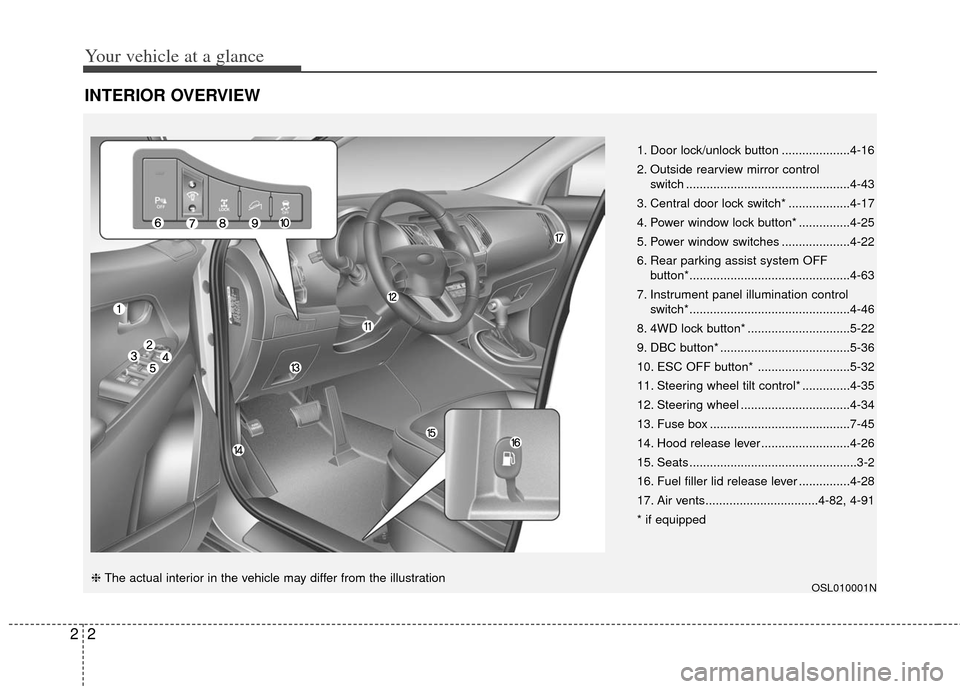
INTERIOR OVERVIEW
OSL010001N
1. Door lock/unlock button ....................4-16
2. Outside rearview mirror control switch ................................................4-43
3. Central door lock switch* ..................4-17
4. Power window lock button* ...............4-25
5. Power window switches ....................4-22
6. Rear parking assist system OFF button*...............................................4-63
7. Instrument panel illumination control switch*...............................................4-46
8. 4WD lock button* ..............................5-22
9. DBC button* ......................................5-36
10. ESC OFF button* ...........................5-32
11. Steering wheel tilt control* ..............4-35
12. Steering wheel ................................4-34
13. Fuse box .........................................7-45
14. Hood release lever ..........................4-26
15. Seats .................................................3-2
16. Fuel filler lid release lever ...............4-28
17. Air vents.................................4-82, 4-91
* if equipped
❈ The actual interior in the vehicle may differ from the illustration
Page 21 of 387
23
Your vehicle at a glance
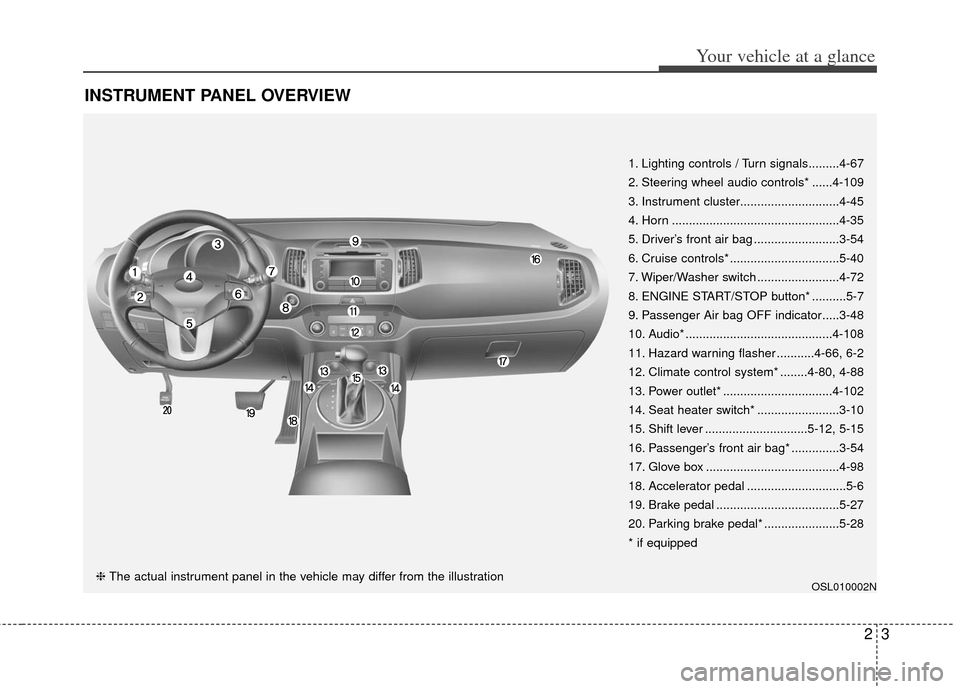
INSTRUMENT PANEL OVERVIEW
OSL010002N
1. Lighting controls / Turn signals.........4-67
2. Steering wheel audio controls* ......4-109
3. Instrument cluster.............................4-45
4. Horn .................................................4-35
5. Driver’s front air bag .........................3-54
6. Cruise controls* ................................5-40
7. Wiper/Washer switch ........................4-72
8. ENGINE START/STOP button* ..........5-7
9. Passenger Air bag OFF indicator.....3-48
10. Audio* ...........................................4-108
11. Hazard warning flasher ...........4-66, 6-2
12. Climate control system* ........4-80, 4-88
13. Power outlet* ................................4-102
14. Seat heater switch* ........................3-10
15. Shift lever ..............................5-12, 5-15
16. Passenger’s front air bag* ..............3-54
17. Glove box .......................................4-98
18. Accelerator pedal .............................5-6
19. Brake pedal ....................................5-27
20. Parking brake pedal* ......................5-28
* if equipped
❈ The actual instrument panel in the vehicle may differ from the illustration
Page 25 of 387
33
Safety features of your vehicle
WARNING- Driver’s seat
Never attempt to adjust the seatwhile the vehicle is moving. This
could result in loss of control,
and an accident causing death,
serious injury, or property dam-
age.
Do not allow anything to interfere with the normal position of the
seatback. Storing items against a
seatback or in any other way
interfering with proper locking of
a seatback could result in serious
or fatal injury in a sudden stop or
collision.
seatback upright and the lap por-
tion of the seat belt snug and low
across the hips. This is the best
position to protect you in case of
an accident.
In order to avoid unnecessary and perhaps severe air bag
injuries, always sit as far back as
possible from the steering wheel
while maintaining comfortable
control of the vehicle. We recom-
mend that your chest be at least
25 cm (10 inches) away from the
steering wheel.
WARNING - Uprighting
seat
When you return the seatback to its
upright position, hold the seatback
and return it slowly and be sure
there are no other passengers
around the seat. If the seatback is
returned without being held and
controlled, the back of the seat
could spring forward resulting in
accidental injury to a person struck
by the seatback.
WARNING- Loose objects
Loose objects in the driver’s foot
area could interfere with the opera-
tion of the foot pedals, possibly
causing an accident. Do not place
anything under the front seats.
WARNING
Do not use a sitting cushion that
reduces friction between the seat
and passenger. The passenger’s
hips may slide under the lap por-
tion of the seat belt during an acci-
dent or a sudden stop. Serious or
fatal internal injuries could result
because the seat belt cannot oper-
ate normally.
(Continued)
If a seat is reclined during an acci-
dent, the occupant’s hips may slide
under the lap portion of the seat
belt applying great force to the
unprotected abdomen. Serious or
fatal internal injuries could result.
The driver must advise the passen-
ger to keep the seatback in an
upright position whenever the vehi-
cle is in motion. In addition, exces-
sive reclining can significantly
reduce the ability of the restraint
system to restrain occupants in
certain accidents, specifically
rollover accidents.
WARNING- Driver respon-
sibility for passengers
Riding in a vehicle with the seat-
back reclined could lead to serious
or fatal injury in an accident.
(Continued)
Page 28 of 387
Safety features of your vehicle
63
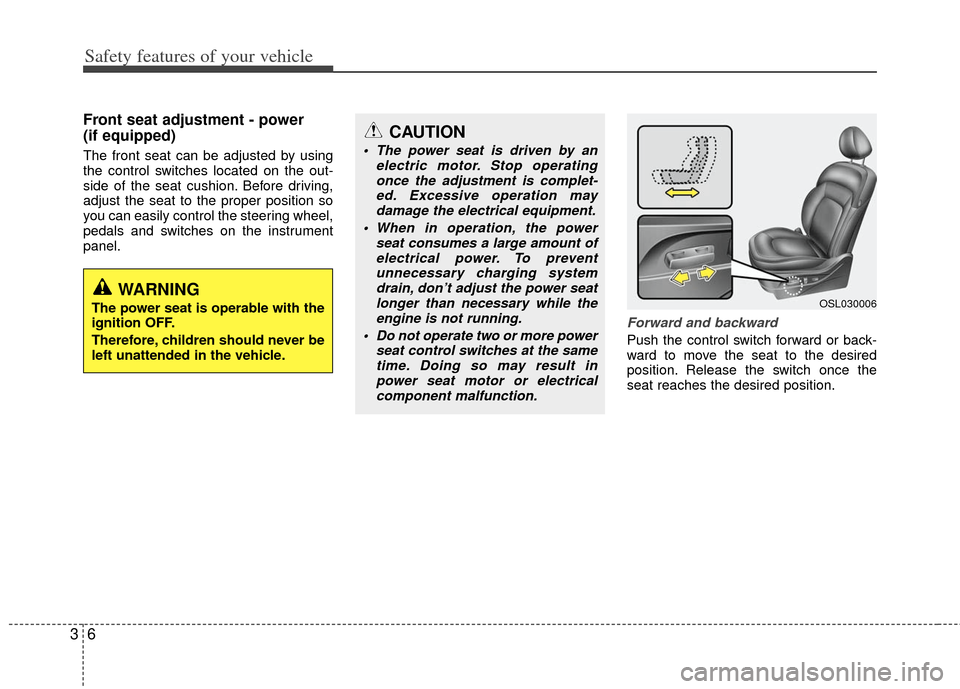
Front seat adjustment - power
(if equipped)
The front seat can be adjusted by using
the control switches located on the out-
side of the seat cushion. Before driving,
adjust the seat to the proper position so
you can easily control the steering wheel,
pedals and switches on the instrument
panel.
Forward and backward
Push the control switch forward or back-
ward to move the seat to the desired
position. Release the switch once the
seat reaches the desired position.
CAUTION
The power seat is driven by anelectric motor. Stop operatingonce the adjustment is complet-ed. Excessive operation maydamage the electrical equipment.
When in operation, the power seat consumes a large amount ofelectrical power. To preventunnecessary charging systemdrain, don’t adjust the power seatlonger than necessary while theengine is not running.
Do not operate two or more power seat control switches at the sametime. Doing so may result inpower seat motor or electricalcomponent malfunction.
OSL030006WARNING
The power seat is operable with the
ignition OFF.
Therefore, children should never be
left unattended in the vehicle.
Page 65 of 387
343
Safety features of your vehicle
C040900AHM-EU
How does the air bag system
operate
Air bags are activated (able to inflate ifnecessary) only when the ignition
switch is turned to the ON or START
position.
Air bags inflate instantly in the event of a serious frontal collision or side colli-
sion in order to help protect the occu-
pants from serious physical injury.
Also, the side and/or curtain air bags
inflate instantly in the event of a
rollover in order to help protect the
occupants from serious physical injury.
There is no single speed at which the air bags will inflate.
Generally, air bags are designed to
inflate based upon the severity of a col-
lision and its direction. These two fac-
tors determine whether the sensors
produce an electronic deployment/
inflation signal.
Air bag deployment depends on a number of factors including vehicle
speed, angles of impact and the densi-
ty and stiffness of the vehicles or
objects which your vehicle hits in the
collision. The determining factors are
not limited to those mentioned above. The front air bags will completely
inflate and deflate in an instant.
It is virtually impossible for you to see
the air bags inflate during an accident.
It is much more likely that you will sim-
ply see the deflated air bags hanging
out of their storage compartments after
the collision.
In order to help provide protection in a severe collision, the air bags must
inflate rapidly. The speed of the air bag
inflation is a consequence of extremely
short time in which a collision occurs
and the need to inflate the air bag
between the occupant and the vehicle
structures before the occupant impacts
those structures. This speed of inflation
reduces the risk of serious or life-
threatening injuries in a severe collision
and is thus a necessary part of the air
bag design.
However, air bag inflation can also
cause injuries which can include facial
abrasions, bruises and broken bones
because the inflation speed also caus-
es the air bags to expand with a great
deal of force. There are even circumstances
under which contact with the steer-
ing wheel or passenger air bag can
cause fatal injuries, especially if the
occupant is positioned excessively
close to the steering wheel or pas-
senger air bag.
WARNING
To avoid severe personal injuryor death caused by deploying air
bags in a collision, the driver
should sit as far back from the
steering wheel air bag as possi-
ble (at least 250 mm (10 inches)
away). The front passengers
should always move their seats
as far back as possible and sit
back in their seat.
Air bags inflate instantly in the event of a collision, and passen-
gers may be injured by the air bag
expansion force if they are not in
a proper position.
Air bag inflation may cause injuries including facial or bodily
abrasions, injuries from broken
glasses or burns.
Page 66 of 387
Safety features of your vehicle
44
3
C040902AUN
Noise and smoke
When the air bags inflate, they make a
loud noise and they leave smoke and
powder in the air inside of the vehicle.
This is normal and is a result of the igni-
tion of the air bag inflator. After the air
bag inflates, you may feel substantial dis-
comfort in breathing due to the contact of
your chest with both the seat belt and the
air bag, as well as from breathing the
smoke and powder. Open your doors
and/or windows as soon as possible
after impact in order to reduce dis-
comfort and prevent prolonged expo-
sure to the smoke and powder.
Though smoke and powder are non-
toxic, it may cause irritation to the skin
(eyes, nose and throat, etc). If this is the
case, wash and rinse with cold water
immediately and consult a doctor if the
symptom persists.
C040903AEN
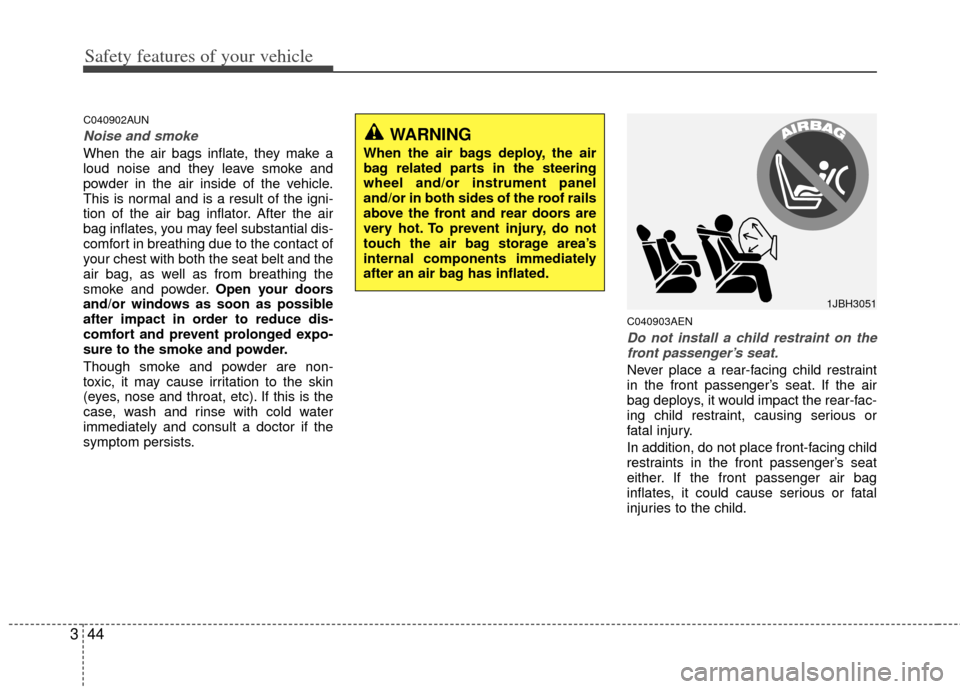
Do not install a child restraint on the front passenger’s seat.
Never place a rear-facing child restraint
in the front passenger’s seat. If the air
bag deploys, it would impact the rear-fac-
ing child restraint, causing serious or
fatal injury.
In addition, do not place front-facing child
restraints in the front passenger’s seat
either. If the front passenger air bag
inflates, it could cause serious or fatal
injuries to the child.
1JBH3051
WARNING
When the air bags deploy, the air
bag related parts in the steering
wheel and/or instrument panel
and/or in both sides of the roof rails
above the front and rear doors are
very hot. To prevent injury, do not
touch the air bag storage area’s
internal components immediately
after an air bag has inflated.
Page 68 of 387
Safety features of your vehicle
46
3
C040100AHM-EU
SRS components and functions
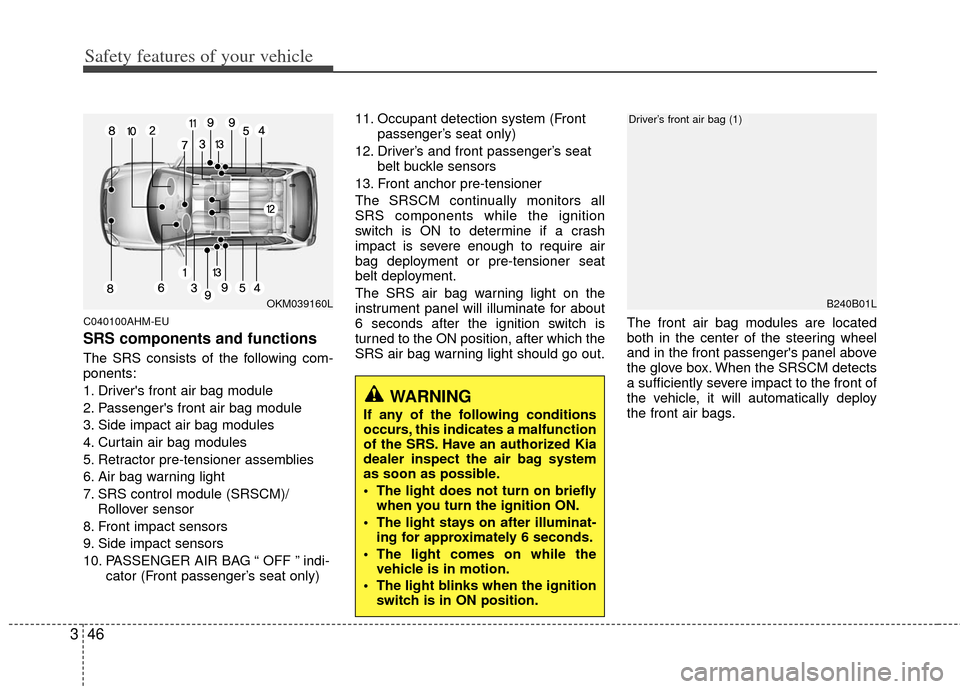
The SRS consists of the following com-
ponents:
1. Driver's front air bag module
2. Passenger's front air bag module
3. Side impact air bag modules
4. Curtain air bag modules
5. Retractor pre-tensioner assemblies
6. Air bag warning light
7. SRS control module (SRSCM)/
Rollover sensor
8. Front impact sensors
9. Side impact sensors
10. PASSENGER AIR BAG “ OFF ” indi- cator (Front passenger’s seat only) 11. Occupant detection system (Front
passenger’s seat only)
12. Driver’s and front passenger’s seat belt buckle sensors
13. Front anchor pre-tensioner
The SRSCM continually monitors all
SRS components while the ignition
switch is ON to determine if a crash
impact is severe enough to require air
bag deployment or pre-tensioner seat
belt deployment.
The SRS air bag warning light on the
instrument panel will illuminate for about
6 seconds after the ignition switch is
turned to the ON position, after which the
SRS air bag warning light should go out. The front air bag modules are located
both in the center of the steering wheel
and in the front passenger's panel above
the glove box. When the SRSCM detects
a sufficiently severe impact to the front of
the vehicle, it will automatically deploy
the front air bags.
B240B01L
Driver’s front air bag (1)
WARNING
If any of the following conditions
occurs, this indicates a malfunction
of the SRS. Have an authorized Kia
dealer inspect the air bag system
as soon as possible.
The light does not turn on briefly
when you turn the ignition ON.
The light stays on after illuminat- ing for approximately 6 seconds.
The light comes on while the vehicle is in motion.
The light blinks when the ignition switch is in ON position.
OKM039160L