belt KIA Sportage 2014 SL / 3.G Owner's Manual
[x] Cancel search | Manufacturer: KIA, Model Year: 2014, Model line: Sportage, Model: KIA Sportage 2014 SL / 3.GPages: 457, PDF Size: 11.61 MB
Page 16 of 457

Safety features of your vehicle
Seats. . . . . . . . . . . . . . . . . . . . . . . . . . . . . . . . . . . . \
. . 3-2
• Front seat. . . . . . . . . . . . . . . . . . . . . . . . . . . . . . . . . . \
. . 3-6
. . . . . . . . . . . . . . . . . . . . . . . . . . . . . . . . . . . . \
3-14
Seat belts . . . . . . . . . . . . . . . . . . . . . . . . . . . . . . . . . . 3-23\
. . . . . . . . . . . . . . . . . . . . . . . . . 3-32
. . . . . . . . . . . . . . . . . . . . . . . . . . 3-35
. . . . . . . . . . . . . . . . . . . . . . . . . . . . . 3-37
Child restraint system . . . . . . . . . . . . . . . . . . . . . . . 3-39
. . . . . . . . . . . . . . . . . . . 3-41- Automatic locking mode . . . . . . . . . . . . . . . . . . . . . . 3-42
- Tether Anchor system . . . . . . . . . . . . . . . . . . . . . . . . 3-44
- Lower anchor system . . . . . . . . . . . . . . . . . . . . . . . . . 3-45
Air bag - advanced supplemental restraint system . . 3-48
. . . . . . . . . . . . . 3-49
. . . . . . . . . . . . . . . . . . . . . . . . . . 3-51
. . . . . . . . . . . . 3-61
. . . . . . . . . . . . . . . . . . . . . . . . . . . 3-66
. . . . . . . . . . . . . . . . . . . . . . . . . . . . . . . 3-68
. . . . . . . . . . . . . . . . . . . . . . . . . . . . . . . . . . . . \
3-75
3
Page 18 of 457
33
Safety features of your vehicle
WARNING - Uprightingseat
When you return the seatback
to its upright position, hold the
seatback and return it slowly
and be sure there are no other
passengers around the seat. If
the seatback is returned with-
out being held and controlled,
the back of the seat could
spring forward resulting in acci-
dental injury to a person struck
by the seatback.
WARNING- Loose objects
Loose objects in the driver’s
foot area could interfere with
the operation of the foot pedals,
possibly causing an accident.
Do not place anything under the
front seats.
WARNING
Do not use a sitting cushion
that reduces friction between
the seat and passenger. The
passenger’s hips may slide
under the lap portion of the seat
belt during an accident or a
sudden stop. Serious or fatal
internal injuries could result
because the seat belt cannot
operate normally.
WARNING- Driver
responsibility for passen-
gers
Riding in a vehicle with the
seatback reclined could lead to
serious or fatal injury in an acci-
dent.
If a seat is reclined during an
accident, the occupant’s hips
may slide under the lap portion
of the seat belt applying great
force to the unprotected
abdomen. Serious or fatal inter-
nal injuries could result. The
driver must advise the passen-
ger to keep the seatback in an
upright position whenever the
vehicle is in motion. In addition,
excessive reclining can signifi-
cantly reduce the ability of the
restraint system to restrain
occupants in certain accidents,
specifically rollover accidents.
Page 19 of 457
Safety features of your vehicle
43
WARNING - Driver’sseat
Never attempt to adjust the
seat while the vehicle is mov-
ing. This could result in loss
of control, and an accident
causing death, serious injury,
or property damage.
Do not allow anything to inter- fere with the normal position
of the seatback. Storing items
against a seatback or in any
other way interfering with
proper locking of a seatback
could result in serious or fatal
injury in a sudden stop or col-
lision.
your seatback upright and the
lap portion of the seat belt
snug and low across the hips.
This is the best position to
protect you in case of an acci-
dent.
(Continued)
(Continued)
In order to avoid unnecessaryand perhaps severe air bag
injuries, always sit as far back
as possible from the steering
wheel while maintaining com-
fortable control of the vehicle.
We recommend that your
chest be at least 25 cm (10
inches) away from the steer-
ing wheel.WARNING - Rear seat-backs
The rear seatback must be
securely latched. If not, pas-
sengers and objects could be
thrown forward resulting in
serious injury or death in the
event of a sudden stop or col-
lision.
Luggage and other cargo should be laid flat in the cargo
area. If objects are large,
heavy, or must be piled, they
must be secured. Under no
circumstances should cargo
be piled higher than the seat-
backs. Failure to follow these
warnings could result in seri-
ous injury or death in the
event of a sudden stop, colli-
sion or rollover.
(Continued)
Page 20 of 457
35
Safety features of your vehicle
(Continued)
No passenger should ride inthe cargo area or sit or lie on
folded seatbacks while the
vehicle is moving. All passen-
gers must be properly seated
in seats and restrained prop-
erly while riding.
When resetting the seatback to the upright position, make
sure it is securely latched by
pushing it forward and back-
wards.
To avoid the possibility of burns, do not remove the car-
pet in the cargo area.
Emission control devices
beneath this floor generate
high temperatures.WARNING
After adjusting the seat, always
check that it is securely locked
into place by attempting to
move the seat forward or back-
ward without using the lock
release lever. Sudden or unex-
pected movement of the dri-
ver's seat could cause you to
lose control of the vehicle
resulting in an accident.
WARNING
Do not adjust the seat whilewearing seat belts. Moving the
seat cushion forward may
cause strong pressure on the
abdomen.
Use extreme caution so that hands or other objects are not
caught in the seat mecha-
nisms while the seat is mov-
ing.
Do not put a cigarette lighter on the floor or seat. When you
operate the seat, gas may
gush out of the lighter and
cause fire.
Page 31 of 457
Safety features of your vehicle
16
3
Rear seat adjustment
Seatback angle
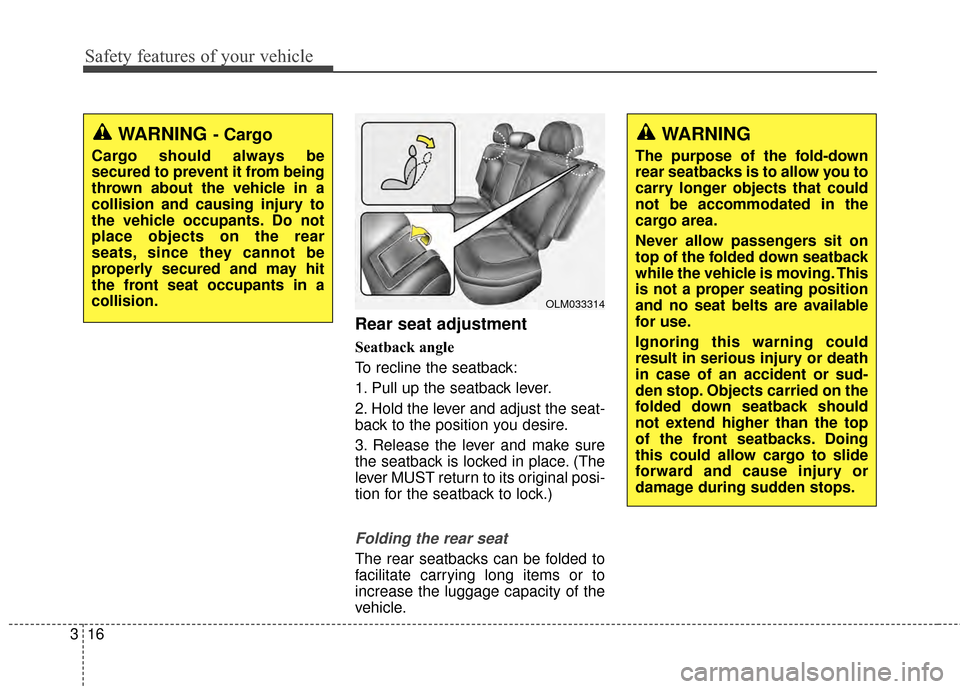
To recline the seatback:
1. Pull up the seatback lever.
2. Hold the lever and adjust the seat-
back to the position you desire.
3. Release the lever and make sure
the seatback is locked in place. (The
lever MUST return to its original posi-
tion for the seatback to lock.)
Folding the rear seat
The rear seatbacks can be folded to
facilitate carrying long items or to
increase the luggage capacity of the
vehicle.
WARNING
The purpose of the fold-down
rear seatbacks is to allow you to
carry longer objects that could
not be accommodated in the
cargo area.
Never allow passengers sit on
top of the folded down seatback
while the vehicle is moving. This
is not a proper seating position
and no seat belts are available
for use.
Ignoring this warning could
result in serious injury or death
in case of an accident or sud-
den stop. Objects carried on the
folded down seatback should
not extend higher than the top
of the front seatbacks. Doing
this could allow cargo to slide
forward and cause injury or
damage during sudden stops.
WARNING- Cargo
Cargo should always be
secured to prevent it from being
thrown about the vehicle in a
collision and causing injury to
the vehicle occupants. Do not
place objects on the rear
seats, since they cannot be
properly secured and may hit
the front seat occupants in a
collision.
OLM033314
Page 32 of 457
317
Safety features of your vehicle
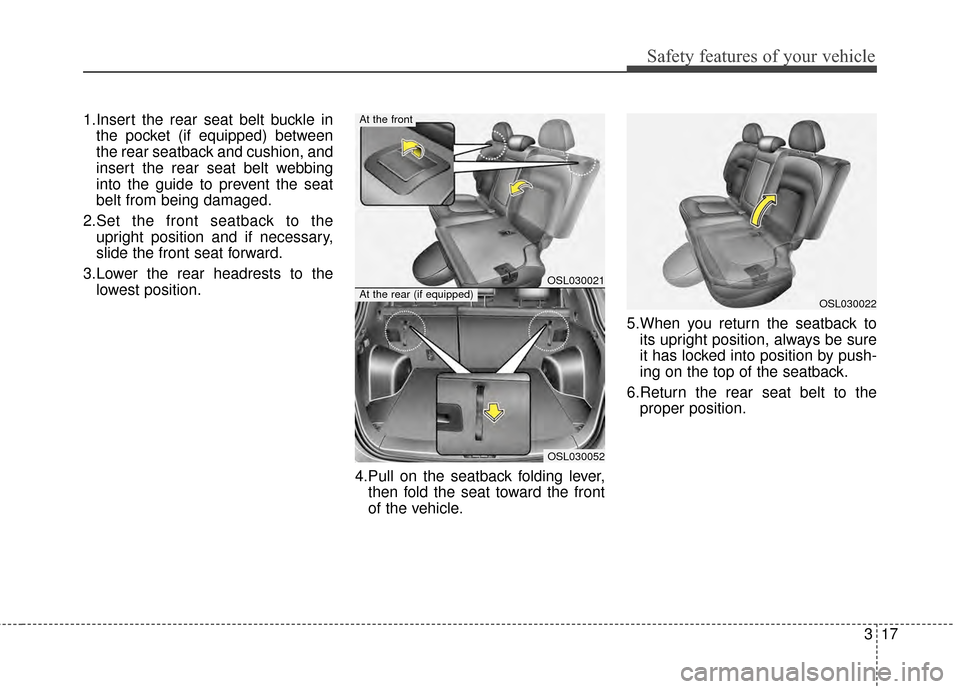
1.Insert the rear seat belt buckle inthe pocket (if equipped) between
the rear seatback and cushion, and
insert the rear seat belt webbing
into the guide to prevent the seat
belt from being damaged.
2.Set the front seatback to the upright position and if necessary,
slide the front seat forward.
3.Lower the rear headrests to the lowest position.
4.Pull on the seatback folding lever,then fold the seat toward the front
of the vehicle. 5.When you return the seatback to
its upright position, always be sure
it has locked into position by push-
ing on the top of the seatback.
6.Return the rear seat belt to the proper position.
OSL030022
OSL030021
OSL030052
At the front
At the rear (if equipped)
Page 33 of 457
Safety features of your vehicle
18
3
CAUTION- Rear seat
belts
When returning the rear seat-
backs to the upright position,remember to return the rearshoulder belts to their properposition. Routing the seat beltwebbing through the rear seatbelt guides will help keep thebelts from being trapped behindor under the seats.
CAUTION - Damaging
rear seat belt buckles
When you fold the rear seat-
back, insert the buckle in thepocket between the rear seat-back and cushion. Doing so canprevent the buckle from beingdamaged by the rear seatback.
WARNING- Uprighting seat
When you return the seatback
to its upright position, hold the
seatback and return it slowly
and be sure there are no other
occupants around the seat. If
the seatback is returned with-
out being held and controlled,
the back of the seat could move
forward or backward resulting
in accidental injury to a person
struck by the seatback.
WARNING
When you return the rear seat-
back to its upright position after
being folded down:
Be careful not to damage the
seat belt webbing or buckle. Do
not allow the seat belt webbing
or buckle to get caught or
pinched in the rear seat. Ensure
that the seatback is completely
locked into its upright position
by pushing on the top of the
seatback. Otherwise, in an acci-
dent or sudden stop, the seat
could fold down and allow
cargo to enter the passenger
compartment, which could
result in serious injury or death.
Page 38 of 457
323
Safety features of your vehicle
SEAT BELTS
C020100AHM
Seat belt restraint system
WARNING
For maximum restraint sys-tem protection, the seat belts
must always be used whenev-
er the vehicle is moving.
Seat belts are most effective when seatbacks are in the
upright position.
Children age 12 and under must always be properly
restrained in the rear seat.
Never allow children to ride in
the front passenger seat. If a
child over 12 must be seated
in the front seat, he/she must
be properly belted and the
seat should be moved as far
back as possible.
(Continued)
(Continued)
Never wear the shoulder beltunder your arm or behind
your back. An improperly
positioned shoulder belt can
cause serious injuries in a
crash. The shoulder belt
should be positioned midway
over your shoulder across
your collarbone.
Avoid wearing twisted seat belts. A twisted belt can't do
its job well. In a collision, it
could even cut into you. Be
sure the belt webbing is
straight and not twisted.
Be careful not to damage the belt webbing or hardware. If
the belt webbing or hardware
is damaged, replace it.WARNING
Seat belts are designed to bear
upon the bony structure of the
body, and should be worn low
across the front of the pelvis or
the pelvis, chest and shoulders,
as applicable; wearing the lap
section of the belt across the
abdominal area must be avoid-
ed.
Seat belts should be adjusted
as firmly as possible, consis-
tent with comfort, to provide the
protection for which they have
been designed.
A slack belt will greatly reduce
the protection afforded to the
wearer. Care should be taken to
avoid contamination of the web-
bing with polishes, oils and
chemicals, and particularly bat-
tery acid. Cleaning may safely
be carried out using mild soap
and water. The belt should be
replaced if webbing becomes
frayed, contaminated or dam-
aged.
(Continued)
Page 39 of 457
Safety features of your vehicle
24
3
WARNING
No modifications or additions
should be made by the user
which will either prevent the
seat belt adjusting devices
from operating to remove
slack, or prevent the seat belt
assembly from being adjusted
to remove slack.
When you fasten the seat belt, be careful not to latch the seat
belt in buckles of other seat.
It's very dangerous and you
may not be protected by the
seat belt properly.
Do not unfasten the seat belt and do not fasten and unfas-
ten the seat belt repeatedly
while driving. This could
result in loss of control, and
an accident causing death,
serious injury, or property
damage.
(Continued)
(Continued)
When fastening the seat belt,make sure that the seat belt
does not pass over objects
that are hard or can break eas-
ily.
Make sure there is nothing in the buckle. The seat belt may
not be fastened securely.(Continued)
It is essential to replace the
entire assembly after it has
been worn in a severe impact
even if damage to the assembly
is not obvious. Belts should not
be worn with straps twisted.
Each belt assembly must only
be used by one occupant; it is
dangerous to put a belt around
a child being carried on the
occupant's lap.
Page 40 of 457
325
Safety features of your vehicle
C020101AAM-EU
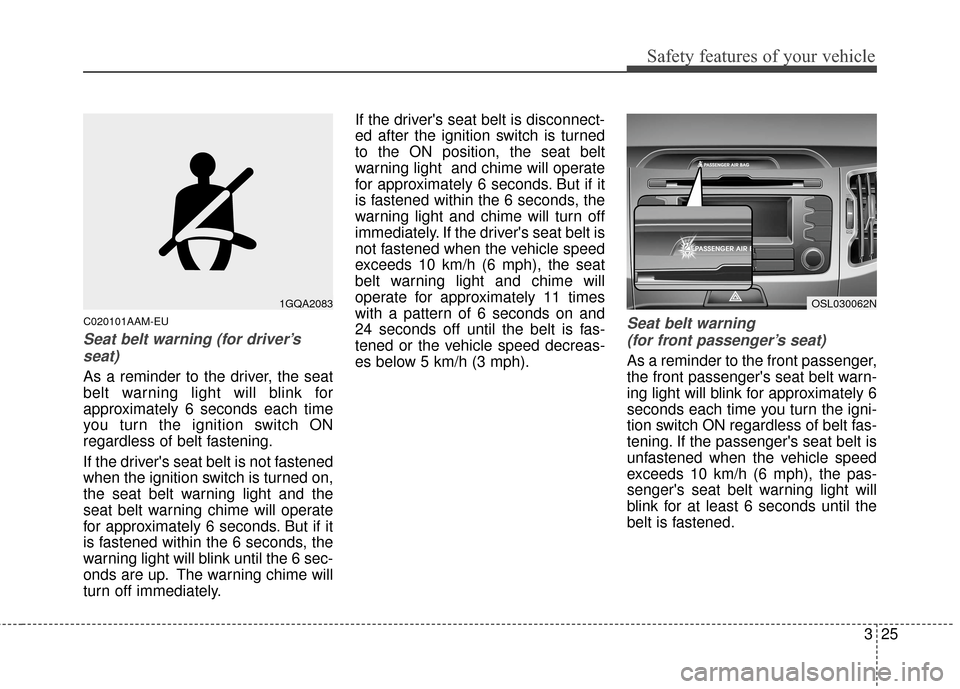
Seat belt warning (for driver’sseat)
As a reminder to the driver, the seat
belt warning light will blink for
approximately 6 seconds each time
you turn the ignition switch ON
regardless of belt fastening.
If the driver's seat belt is not fastened
when the ignition switch is turned on,
the seat belt warning light and the
seat belt warning chime will operate
for approximately 6 seconds. But if it
is fastened within the 6 seconds, the
warning light will blink until the 6 sec-
onds are up. The warning chime will
turn off immediately. If the driver's seat belt is disconnect-
ed after the ignition switch is turned
to the ON position, the seat belt
warning light and chime will operate
for approximately 6 seconds. But if it
is fastened within the 6 seconds, the
warning light and chime will turn off
immediately. If the driver's seat belt is
not fastened when the vehicle speed
exceeds 10 km/h (6 mph), the seat
belt warning light and chime will
operate for approximately 11 times
with a pattern of 6 seconds on and
24 seconds off until the belt is fas-
tened or the vehicle speed decreas-
es below 5 km/h (3 mph).
Seat belt warning
(for front passenger’s seat)
As a reminder to the front passenger,
the front passenger's seat belt warn-
ing light will blink for approximately 6
seconds each time you turn the igni-
tion switch ON regardless of belt fas-
tening. If the passenger's seat belt is
unfastened when the vehicle speed
exceeds 10 km/h (6 mph), the pas-
senger's seat belt warning light will
blink for at least 6 seconds until the
belt is fastened.
OSL030062N1GQA2083