heating system KIA Sportage 2017 QL / 4.G User Guide
[x] Cancel search | Manufacturer: KIA, Model Year: 2017, Model line: Sportage, Model: KIA Sportage 2017 QL / 4.GPages: 595, PDF Size: 16.22 MB
Page 239 of 595
Features of your vehicle
154
4
Air conditioning (if equipped)
All Kia Air Conditioning Systems are
filled with R-1234yf refrigerant.
1.Start the engine. Press the air con-
ditioning button.
2.Set the mode to the position.
3.Set the air intake control to the out- side air or recirculated air position.
4.Adjust the fan speed control and temperature control to maintain
maximum comfort.
When maximum cooling is desired, set the temperature control to the
extreme left position, set the mode
control to the MAX A/C position,
then set the fan speed control to
the highest speed. Air conditioning system operation tips
If the vehicle has been parked in
direct sunlight during hot weather,
open the windows for a short time
to let the hot air inside the vehicle
escape.
To help reduce moisture inside of the windows on rainy or humid
days, decrease the humidity inside
the vehicle by operating the air
conditioning system.
During air conditioning system operation, you may occasionally
notice a slight change in engine
speed as the air conditioning com-
pressor cycles. This is a normal
system operation characteristic.
Use the air conditioning system every month only for a few minutes
to ensure maximum system per-
formance.CAUTION - Excessive A/C
Use
When using the air conditioningsystem, monitor the tempera-ture gauge closely while drivingup hills or in heavy traffic whenoutside temperatures are high.Air conditioning system opera-tion may cause engine over-heating. Continue to use theblower fan but turn the air con-ditioning system off if the tem-perature gauge indicates engineoverheating.
CAUTION
When opening the windows inhumid weather, air conditioningmay create water dropletsinside the vehicle. Since exces-sive water droplets may causedamage to electrical equipment,air conditioning should only beused with the windows closed.
Page 240 of 595
4155
Features of your vehicle
When using the air conditioningsystem, you may notice clear water
dripping (or even puddling) on the
ground under the passenger side
of the vehicle. This is a normal sys-
tem operation characteristic.
Operating the air conditioning sys- tem in the recirculated air position
provides maximum cooling, how-
ever, continual operation in this
mode may cause the air inside the
vehicle to become stale.
During cooling operation, you may occasionally notice a misty air flow
because of rapid cooling and
humid air intake. This is a normal
system operation characteristic.Climate control air filter
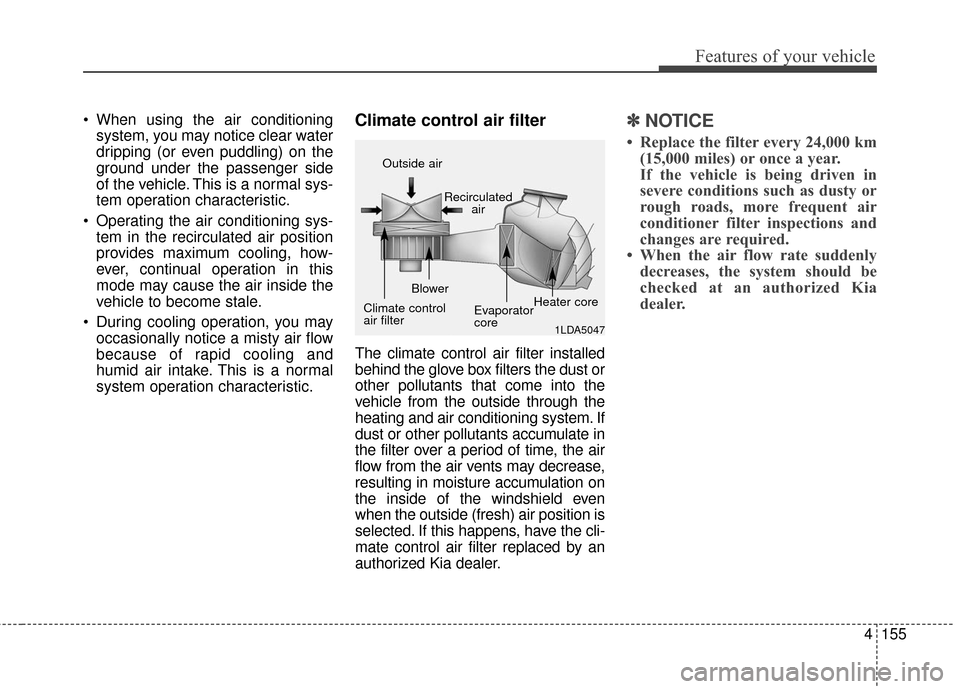
The climate control air filter installed
behind the glove box filters the dust or
other pollutants that come into the
vehicle from the outside through the
heating and air conditioning system. If
dust or other pollutants accumulate in
the filter over a period of time, the air
flow from the air vents may decrease,
resulting in moisture accumulation on
the inside of the windshield even
when the outside (fresh) air position is
selected. If this happens, have the cli-
mate control air filter replaced by an
authorized Kia dealer.
✽ ✽ NOTICE
• Replace the filter every 24,000 km
(15,000 miles) or once a year.
If the vehicle is being driven in
severe conditions such as dusty or
rough roads, more frequent air
conditioner filter inspections and
changes are required.
• When the air flow rate suddenly decreases, the system should be
checked at an authorized Kia
dealer.
1LDA5047
Outside air
Recirculatedair
Climate control
air filter Blower
Evaporator
coreHeater core
Page 242 of 595
4157
Features of your vehicle
For maximum defrosting, set thetemperature control to the extreme
right/hot position and the fan speed
control to the highest speed.
If warm air to the floor is desired while defrosting or defogging, set
the mode to the floor-defrost posi-
tion.
Before driving, clear all snow and ice from the windshield, rear win-
dow, outside rear view mirrors, and
all side windows.
Clear all snow and ice from the hood and air inlet in the cowl grill to
improve heater and defroster effi-
ciency and to reduce the probabili-
ty of fogging up the inside of the
windshield.Manual climate control system
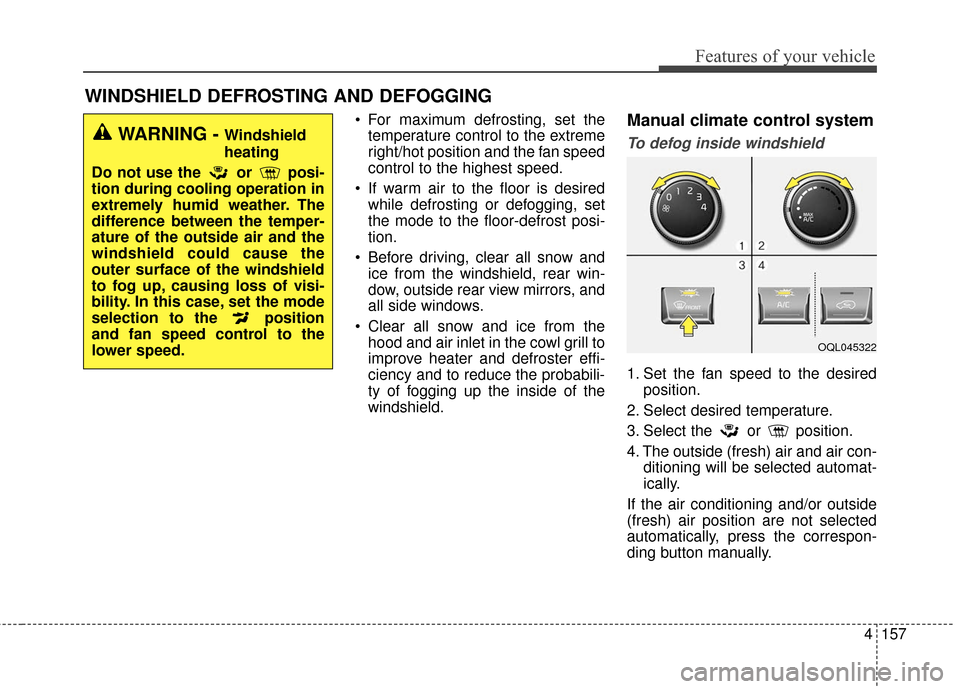
To defog inside windshield
1. Set the fan speed to the desired position.
2. Select desired temperature.
3. Select the or position.
4. The outside (fresh) air and air con- ditioning will be selected automat-
ically.
If the air conditioning and/or outside
(fresh) air position are not selected
automatically, press the correspon-
ding button manually.
WINDSHIELD DEFROSTING AND DEFOGGING
WARNING - Windshield
heating
Do not use the or posi-
tion during cooling operation in
extremely humid weather. The
difference between the temper-
ature of the outside air and the
windshield could cause the
outer surface of the windshield
to fog up, causing loss of visi-
bility. In this case, set the mode
selection to the position
and fan speed control to the
lower speed.
OQL045322
Page 251 of 595
Features of your vehicle
166
4
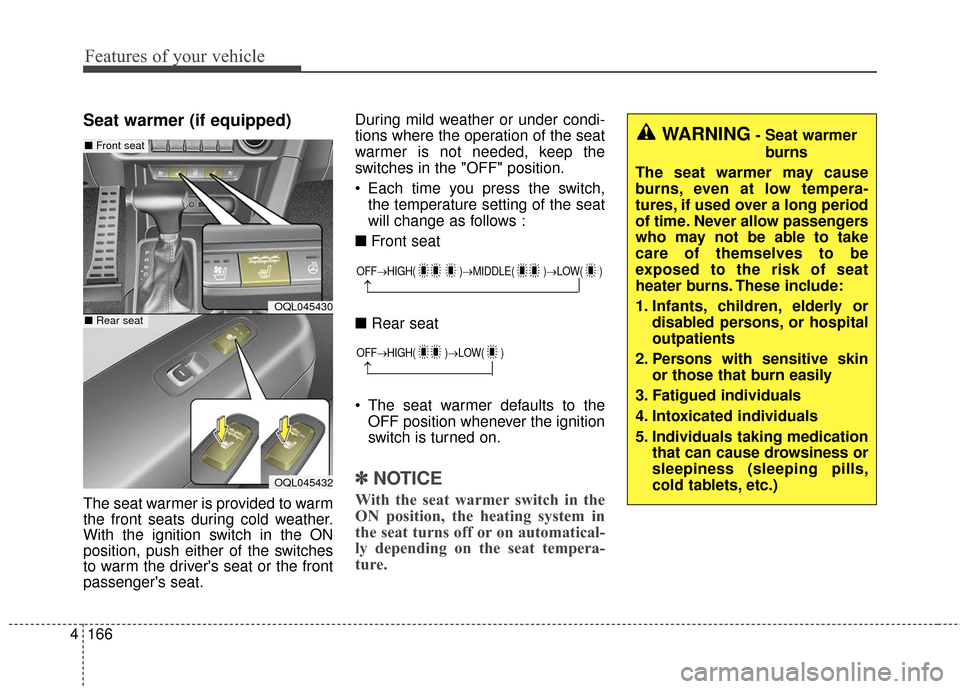
Seat warmer (if equipped)
The seat warmer is provided to warm
the front seats during cold weather.
With the ignition switch in the ON
position, push either of the switches
to warm the driver's seat or the front
passenger's seat. During mild weather or under condi-
tions where the operation of the seat
warmer is not needed, keep the
switches in the "OFF" position.
Each time you press the switch,
the temperature setting of the seat
will change as follows :
■ Front seat
■ Rear seat
The seat warmer defaults to the OFF position whenever the ignition
switch is turned on.
✽ ✽ NOTICE
With the seat warmer switch in the
ON position, the heating system in
the seat turns off or on automatical-
ly depending on the seat tempera-
ture.
OQL045430
OQL045432
■ Front seat
■Rear seat
OFF→ HIGH( )→ MIDDLE( )→LOW( )
→
OFF→HIGH( )→ LOW( )
→
WARNING- Seat warmer
burns
The seat warmer may cause
burns, even at low tempera-
tures, if used over a long period
of time. Never allow passengers
who may not be able to take
care of themselves to be
exposed to the risk of seat
heater burns. These include:
1. Infants, children, elderly or disabled persons, or hospital
outpatients
2. Persons with sensitive skin or those that burn easily
3. Fatigued individuals
4. Intoxicated individuals
5. Individuals taking medication that can cause drowsiness or
sleepiness (sleeping pills,
cold tablets, etc.)
Page 413 of 595
687
Driving your vehicle
The ESC system should be turned
OFF prior to rocking the vehicle.
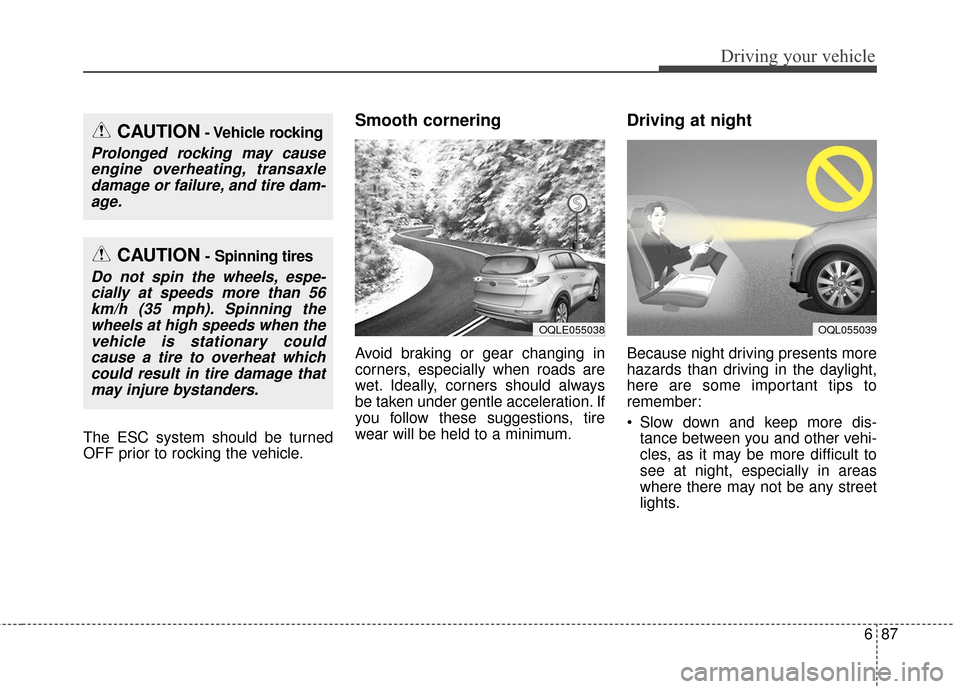
Smooth cornering
Avoid braking or gear changing in
corners, especially when roads are
wet. Ideally, corners should always
be taken under gentle acceleration. If
you follow these suggestions, tire
wear will be held to a minimum.
Driving at night
Because night driving presents more
hazards than driving in the daylight,
here are some important tips to
remember:
Slow down and keep more dis-tance between you and other vehi-
cles, as it may be more difficult to
see at night, especially in areas
where there may not be any street
lights.
CAUTION- Vehicle rocking
Prolonged rocking may causeengine overheating, transaxledamage or failure, and tire dam-age.
CAUTION- Spinning tires
Do not spin the wheels, espe-cially at speeds more than 56km/h (35 mph). Spinning thewheels at high speeds when thevehicle is stationary couldcause a tire to overheat whichcould result in tire damage thatmay injure bystanders.
OQLE055038OQL055039
Page 422 of 595
Driving your vehicle
96
6
Turn signals when towing a trailer
When you tow a trailer, your vehicle
has to have a different turn signal
flasher and extra wiring. The green
arrows on your instrument panel will
flash whenever you signal a turn or
lane change. Properly connected,
the trailer lights will also flash to alert
other drivers you’re about to turn,
change lanes, or stop.
When towing a trailer, the green
arrows on your instrument panel will
flash for turns even if the bulbs on
the trailer are burned out. Thus, you
may think drivers behind you are
seeing your signals when, in fact,
they are not. It’s important to check
occasionally to be sure the trailer
bulbs are still working. You must also
check the lights every time you dis-
connect and then reconnect the
wires.
Do not connect a trailer lighting sys-
tem directly to your vehicle’s lighting
system. Use only an approved trailer
wiring harness.
An authorized Kia dealer can assist
you in installing the wiring harness.
Driving on grades
Reduce speed and shift to a lower
gear before you start down a long or
steep downgrade. If you don’t shift
down, you might have to use your
brakes so much that they would get
hot and no longer operate efficiently.
On a long uphill grade, shift down
and reduce your speed to around 70
km/h (45 mph) to reduce the possi-
bility of engine and transaxle over-
heating.
If your trailer weighs more than the
maximum trailer weight without trail-
er brakes and you have an automat-
ic transaxle, you should drive in D
(Drive) when towing a trailer.
Operating your vehicle in D (Drive)
when towing a trailer will minimize
heat build up and extend the life of
your transaxle.CAUTION
Always use an approved trailer
wiring harness. Failure to usean approved trailer wiring har-ness could result in damage tothe vehicle electrical system.
Page 424 of 595
Driving your vehicle
98
6
When you are ready to leave after
parking on a hill
1. With the automatic transaxle in P
(Park), apply your brakes and hold
the brake pedal down while you:
and
2. Slowly remove your foot from the brake pedal.
3. Drive slowly until the trailer is clear of the chocks.
4. Stop and have someone pick up and store the chocks.Maintenance when trailer tow-
ing
Your vehicle will need service more
often when you regularly pull a trail-
er. Important items to pay particular
attention to include engine oil, auto-
matic transaxle fluid, axle lubricant
and cooling system fluid. Brake con-
dition is another important item to
frequently check. Each item is cov-
ered in this manual, and the Index
will help you find them quickly. If
you’re trailering, it’s a good idea to
review these sections before you
start your trip.
Don’t forget to also maintain your
trailer and hitch. Follow the mainte-
nance schedule that accompanied
your trailer and check it periodically.
Preferably, conduct the check at the
start of each day’s driving. Most
importantly, all hitch nuts and bolts
should be tight. When towing check transaxle fluid
more frequently.
CAUTION - Air condition
Do not use the A/C while usingyour vehicle to tow uphill. Dueto higher load during trailerusage, overheating might occuron hot days or during uphilldriving.
Page 439 of 595
77
What to do in an emergency
IF THE ENGINE OVERHEATS
If your temperature gauge indicates
overheating, you experience a loss
of power, or hear loud pinging or
knocking, the engine will probably be
too hot. If this happens, you should:
1. Pull off the road and stop as soonas it is safe to do so.
2. Place the shift lever in P (for Automatic transaxle) and set the
parking brake. If the air condition-
ing is on, turn it off.
3. If engine coolant is running out under the vehicle or steam is com-
ing out from underneath the hood,
stop the engine. Do not open the
hood until the coolant has stopped
running or the steaming has
stopped. If there is no visible loss
of engine coolant and no steam,
leave the engine running and
check to be sure the engine cool-
ing fan is operating. If the fan is not
running, turn the engine off. 4. Check to see if the water pump
drive belt is missing. If it is not
missing, check to see that it is
tight. If the drive belt seems to be
satisfactory, check for coolant
leaking from the radiator, hoses or
under the vehicle. (If the air condi-
tioning had been in use, it is nor-
mal for cold water to be draining
from it when you stop).
5. If the water pump drive belt is bro- ken or engine coolant is leaking
out, stop the engine immediately
and call the nearest authorized
Kia dealer for assistance. 6. If you cannot find the cause of the
overheating, wait until the engine
temperature has returned to nor-
mal. If coolant has been lost, care-
fully add coolant to the reservoir to
bring the fluid level in the reservoir
up to the halfway mark.
7. Proceed with caution, keeping alert for further signs of overheat-
ing. If overheating happens again,
call an authorized Kia dealer for
assistance.
Serious loss of coolant indicates
there is a leak in the cooling system
and this should be checked as soon
as possible by an authorized Kia
dealer.
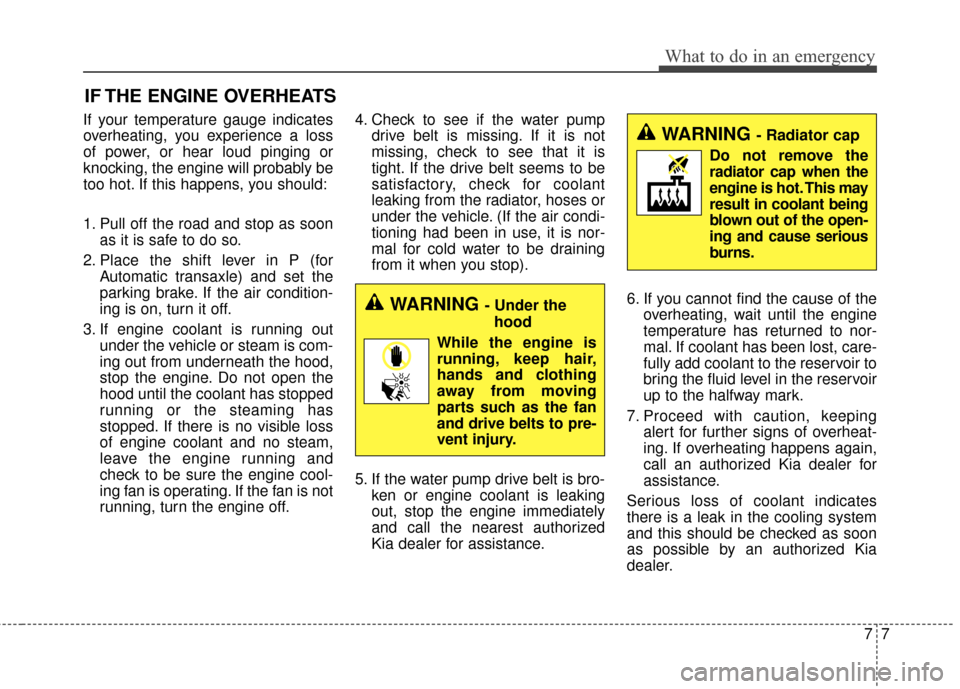
WARNING - Under the hood
While the engine is running, keep hair,
hands and clothing
away from moving
parts such as the fan
and drive belts to pre-
vent injury.
WARNING - Radiator cap
Do not remove the
radiator cap when the
engine is hot. This may
result in coolant being
blown out of the open-
ing and cause serious
burns.
Page 587 of 595
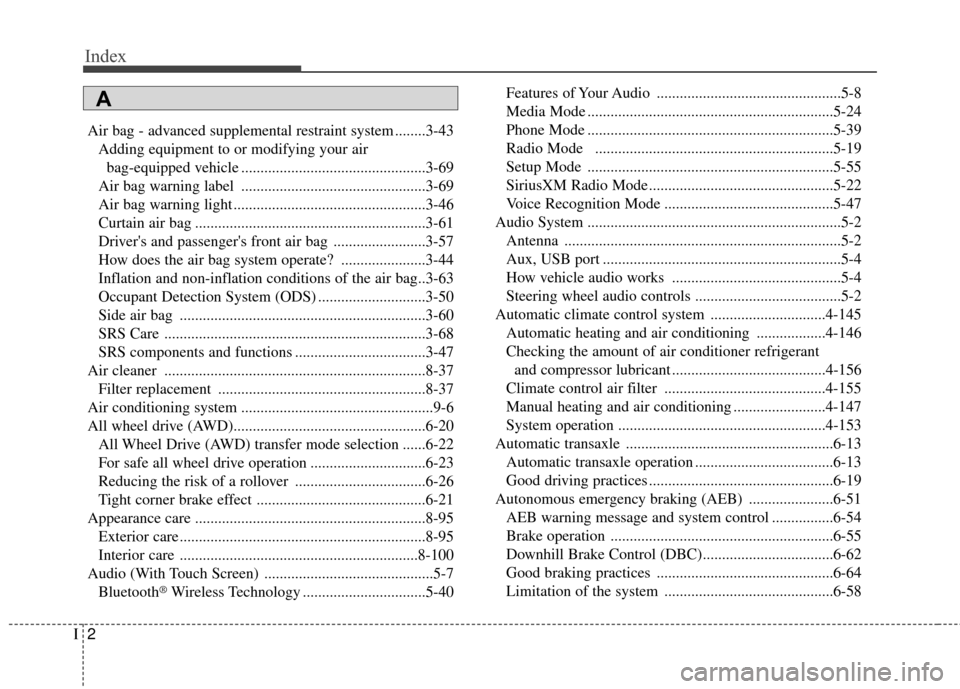
Index
2I
Air bag - advanced supplemental restraint system ........3-43Adding equipment to or modifying your airbag-equipped vehicle ................................................3-69
Air bag warning label ................................................3-69
Air bag warning light ..................................................3-46
Curtain air bag ............................................................3-61
Driver's and passenger's front air bag ........................3-57
How does the air bag system operate? ......................3-44
Inflation and non-inflation conditions of the air bag..3-63
Occupant Detection System (ODS) ............................3-50
Side air bag ................................................................3-60
SRS Care ....................................................................3-68\
SRS components and functions ..................................3-47
Air cleaner ....................................................................8-37\
Filter replacement ......................................................8-37
Air conditioning system ..................................................9-6
All wheel drive (AWD)..................................................6-20 All Wheel Drive (AWD) transfer mode selection ......6-22
For safe all wheel drive operation ..............................6-23
Reducing the risk of a rollover ..................................6-26
Tight corner brake effect ............................................6-21
Appearance care ............................................................8-95 Exterior care ................................................................8-95
Interior care ..............................................................8-100
Audio (With Touch Screen) ............................................5-7 Bluetooth
®Wireless Technology ................................5-40 Features of Your Audio ................................................5-8
Media Mode ................................................................5-24
Phone Mode ................................................................5-39
Radio Mode ..............................................................5-19
Setup Mode ................................................................5-55
SiriusXM Radio Mode ................................................5-22
Voice Recognition Mode ............................................5-47
Audio System ..................................................................5-2 Antenna ........................................................................\
5-2
Aux, USB port ..............................................................5-4
How vehicle audio works ............................................5-4
Steering wheel audio controls ......................................5-2
Automatic climate control system ..............................4-145 Automatic heating and air conditioning ..................4-146
Checking the amount of air conditioner refrigerant and compressor lubricant ........................................4-156
Climate control air filter ..........................................4-155
Manual heating and air conditioning ........................4-147
System operation ......................................................4-153
Automatic transaxle ......................................................6-13 Automatic transaxle operation ....................................6-13
Good driving practices ................................................6-19
Autonomous emergency braking (AEB) ......................6-51 AEB warning message and system control ................6-54
Brake operation ..........................................................6-55
Downhill Brake Control (DBC)..................................6-62
Good braking practices ..............................................6-64
Limitation of the system ............................................6-58
A
Page 592 of 595
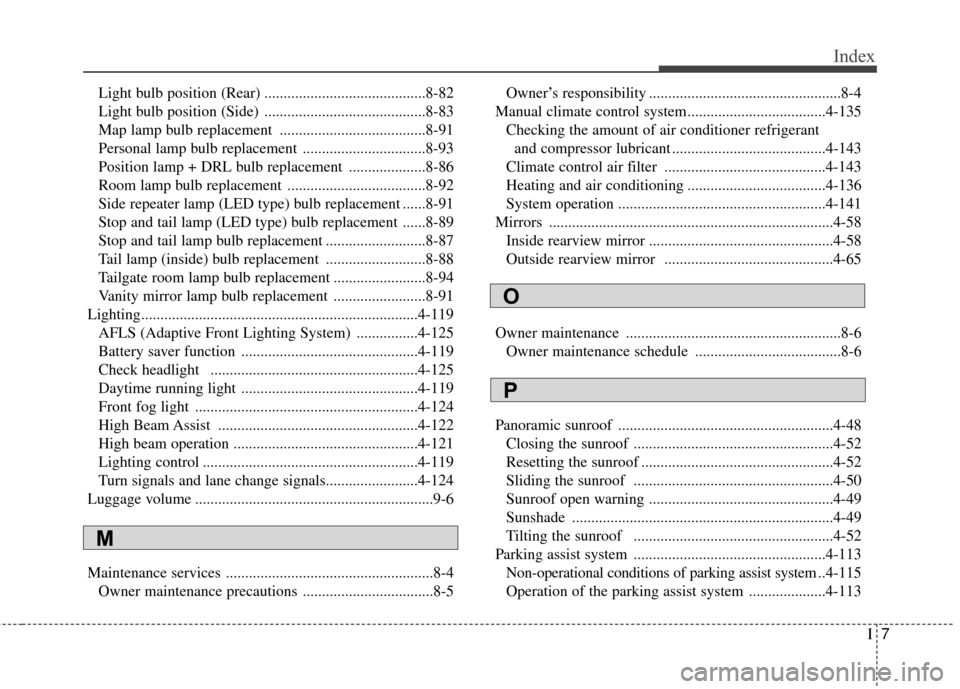
I7
Index
Light bulb position (Rear) ..........................................8-82
Light bulb position (Side) ..........................................8-83
Map lamp bulb replacement ......................................8-91
Personal lamp bulb replacement ................................8-93
Position lamp + DRL bulb replacement ....................8-86
Room lamp bulb replacement ....................................8-92
Side repeater lamp (LED type) bulb replacement ......8-91
Stop and tail lamp (LED type) bulb replacement ......8-89
Stop and tail lamp bulb replacement ..........................8-87
Tail lamp (inside) bulb replacement ..........................8-88
Tailgate room lamp bulb replacement ........................8-94
Vanity mirror lamp bulb replacement ........................8-91
Lighting........................................................................\
4-119 AFLS (Adaptive Front Lighting System) ................4-125
Battery saver function ..............................................4-119
Check headlight ......................................................4-125
Daytime running light ..............................................4-119
Front fog light ..........................................................4-124
High Beam Assist ....................................................4-122
High beam operation ................................................4-121
Lighting control ........................................................4-119
Turn signals and lane change signals........................4-124
Luggage volume ..............................................................9-6
Maintenance services ......................................................8-4 Owner maintenance precautions ..................................8-5 Owner’s responsibility ..................................................8-4
Manual climate control system....................................4-135 Checking the amount of air conditioner refrigerantand compressor lubricant ........................................4-143
Climate control air filter ..........................................4-143
Heating and air conditioning ....................................4-136
System operation ......................................................4-141
Mirrors ........................................................................\
..4-58 Inside rearview mirror ................................................4-58
Outside rearview mirror ............................................4-65
Owner maintenance ........................................................8-6 Owner maintenance schedule ......................................8-6
Panoramic sunroof ........................................................4-48 Closing the sunroof ....................................................4-52
Resetting the sunroof ..................................................4-52
Sliding the sunroof ....................................................4-50
Sunroof open warning ................................................4-49
Sunshade ....................................................................4-49\
Tilting the sunroof ....................................................4-52
Parking assist system ..................................................4-113 Non-operational conditions of parking assist system .. 4-115
Operation of the parking assist system ....................4-113
M
O
P