airbag KIA Sportage 2017 QL / 4.G Owner's Manual
[x] Cancel search | Manufacturer: KIA, Model Year: 2017, Model line: Sportage, Model: KIA Sportage 2017 QL / 4.GPages: 595, PDF Size: 16.22 MB
Page 48 of 595
Safety features of your vehicle
32
3
CHILD RESTRAINT SYSTEM (CRS)
Children Always in the RearChildren under age 13 must always
ride in the rear seats and must always
be properly restrained to minimize the
risk of injury in an accident, sudden
stop or sudden maneuver. According
to accident statistics, children are
safer when properly restrained in the
rear seats than in the front seat. Even
with air bags, children can be serious-
ly injured or killed. Children too large
for a child restraint must use the seat
belts provided.
Most countries have child restraint
laws which require children to travel
in approved child restraint devices.
The laws governing the age or
height/weight restrictions at which
seat belts can be used instead of
child restraints differs among coun-
tries, so you should be aware of the
specific requirements in your coun-
try, and where you are travelling. Child restraint systems must be
properly placed and installed in the
rear seat. You must use a commer-
cially available child restraint system
that meets the requirements of the
Safety Standards of your country.
Child restraint systems are generally
designed to be secured in a vehicle
seat by lap belt portion of a
lap/shoulder belt, or by a LATCH sys-
tem in the rear seats of the vehicle.
WARNING - Restraint
Location
Never install a child or infant
seat on the front passenger's
seat. A child riding in the front
passenger seat can be forceful-
ly struck by an inflating airbag
and seriously injured.
WARNING - Hot Child
Restraint
A child restraint system can
become very hot if it is left in a
closed vehicle on a sunny day.
Be sure to check the seat cover,
buckles and latches before
placing a child in the restraint
system.
Page 60 of 595
Safety features of your vehicle
44
3
How does the air bag system
operate?
Air bags are activated (able to
inflate if necessary) only when the
ignition switch is turned to the ON
or START position.
The appropriate air bags inflate instantly in the event of a serious
frontal collision or side collision in
order to help protect the occupants
from serious physical injury.
In normal conditions, the airbag is designed to deploy based on cer-
tain angle and intensity of the colli-
sion. These two factors are crucial
elements for deciding whether to
transmit airbag deployment signal
or start the electrical operation or
not.
The airbag will deploy based on angle and intensity of the collision.
It will not deploy in every crash or
collision situations The front air bags will completely
inflate and deflate in an instant.
It is virtually impossible for you to
see the air bags inflate during an
accident.
It is much more likely that you will
simply see the deflated air bags
hanging out of their storage com-
partments after the collision.
In addition to inflating in serious side collisions, side and/or curtain
air bags will inflate if the sensing
system detects a rollover.
When a rollover is detected curtain air bags will remain inflated longer
to help provide protection from
ejection, especially when used in
conjunction with the seat belts. In order to help provide protection,
the air bags must inflate rapidly.
The speed of the air bag inflation is
a consequence of extremely short
time in which to inflate the air bag
between the occupant and the
vehicle structures before the occu-
pant impacts those structures. This
speed of inflation reduces the risk
of serious or life-threatening
injuries and is thus a necessary
part of the air bag design.
However, air bag inflation can also
cause injuries which can include
facial abrasions, bruises and bro-
ken bones because the inflation
speed also causes the air bags to
expand with a great deal of force.
There are even circumstances under which contact with the
steering wheel or passenger air
bag can cause fatal injuries,
especially if the occupant is
positioned excessively close to
the steering wheel or passenger
air bag.
Page 61 of 595
345
Safety features of your vehicle
Noise and smoke
When inflated, the air bags make a
loud noise and leave smoke and
powder in the air inside the vehicle.
This is normal and is a result of the
ignition of the air bag inflator. After
the air bag inflates, you may feel sub-
stantial discomfort in breathing due
to the contact of your chest with both
the seat belt and the air bag, as well
as from breathing the smoke and
powder.Open your doors and/or
windows as soon as possible after
impact in order to reduce discom-
fort and prevent prolonged expo-
sure to the smoke and powder.
Though smoke and powder are non-
toxic, it may cause irritation to the
skin (eyes, nose and throat, etc). If
this is the case, wash and rinse with
cold water immediately and consult a
doctor if the symptom persists.WARNING- Hot compo-
nents
Do not touch the air bag storage
area's internal components
immediately after airbag infla-
tion. The air bag related parts in
the steering wheel, instrument
panel and the roof rails above
the front and rear doors are
very hot. Hot components can
result in burn injuries.WARNING- Airbag infla- tion
Sit as far back as possible from
the steering wheel while still
maintaining comfortable con-
trol of your vehicle. A distance
of at least 25 cm (10 in) from
your chest to the steering wheel
is recommended. Failure to do
so can result in airbag inflation
injuries to the driver.
Page 65 of 595
349
Safety features of your vehicle
A fully inflated air bag, in combina-
tion with a properly worn seat belt,
slows the driver's or the passenger's
forward motion, reducing the risk of
head and chest injury.
After complete inflation, the air bag
immediately starts deflating, enabling
the driver to maintain forward visibility
and the ability to steer or operate
other controls. If an air bag deploys, there may be
a loud noise followed by a fine dust
released in the vehicle. These con-
ditions are normal and are not haz-
ardous - the air bags are packed in
this fine powder. The dust generat-
ed during air bag deployment may
cause skin or eye irritation as well
as aggravate asthma for some per-
sons. Always wash all exposed
skin areas thoroughly with cold
water and a mild soap after an
accident in which the air bags were
deployed.
B240B03L
Driver’s front air bag (3)
B240B05L
Passenger’s front air bag
WARNING- Air bag
obstructions
Do not install or place any
accessories on the steering
wheel, instrument panel, or on
the front passenger's panel
above the glove box in a vehi-
cle. Such objects may become
dangerous projectiles if the air
bag deploys.
WARNING- Flying objects
Do not place any objects (an
umbrella, bag, etc.) between the
front door and the front seat.
Such objects may become dan-
gerous projectiles if the side
airbag inflates.
Page 69 of 595
353
Safety features of your vehicle
✽ ✽NOTICE
• Do not use car seat cushions that
cover up the surface of the seat
and aftermarket manufactured
passenger seat heaters.
• After conducting car interior cleaning using steam or detergent,
the seat should be dried properly.
Afterward, check for normal
operation of the “PASS AIR BAG
“OFF”” and air bag warning
lights.
• Any service related to the passen- ger seat and the ODS must be
done at Kia service center.
• After the passenger seat has been removed or installed for repair
purposes, check for normal opera-
tion of the “PASS AIR BAG
“OFF”” and air bag warning
lights with a person seated or not
seated in the passenger seat.
✽ ✽ NOTICE
When the “PASS AIR BAG “OFF””
symbol is illuminated, the passenger
air bag system will not operate. The
passenger air bag system will oper-
ate when necessary if the symbol is
not illuminated.
✽ ✽NOTICE
Do not modify or replace the front
passenger seat. Don't place anything
on or attach anything such as a blan-
ket, front seat cover or after market
seat heater to the front passenger
seat. This can adversely affect the
occupant detection system.
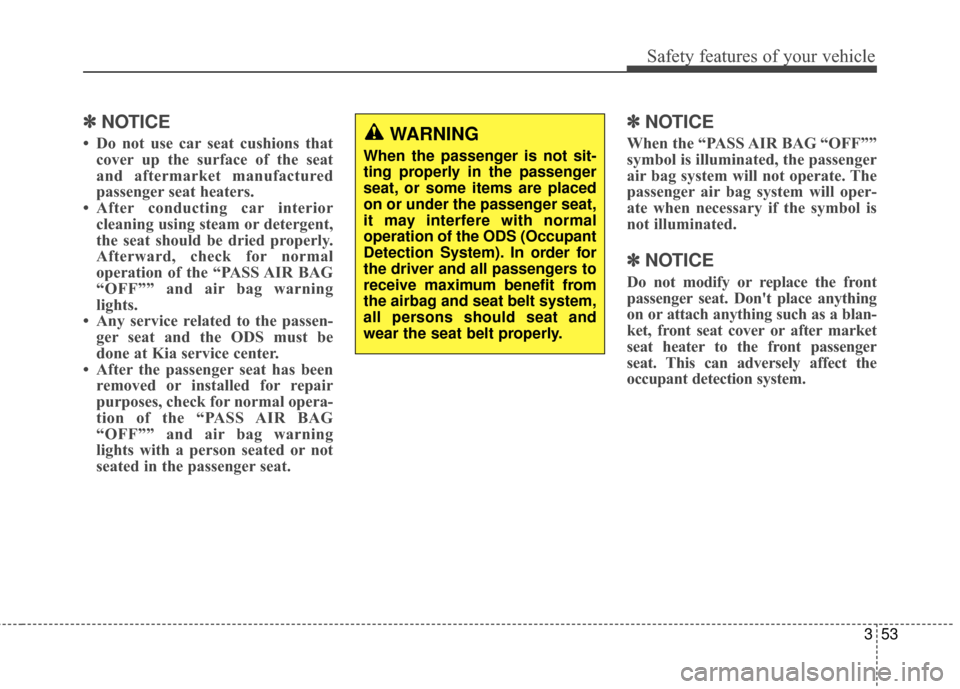
WARNING
When the passenger is not sit-
ting properly in the passenger
seat, or some items are placed
on or under the passenger seat,
it may interfere with normal
operation of the ODS (Occupant
Detection System). In order for
the driver and all passengers to
receive maximum benefit from
the airbag and seat belt system,
all persons should seat and
wear the seat belt properly.
Page 70 of 595
Safety features of your vehicle
54
3
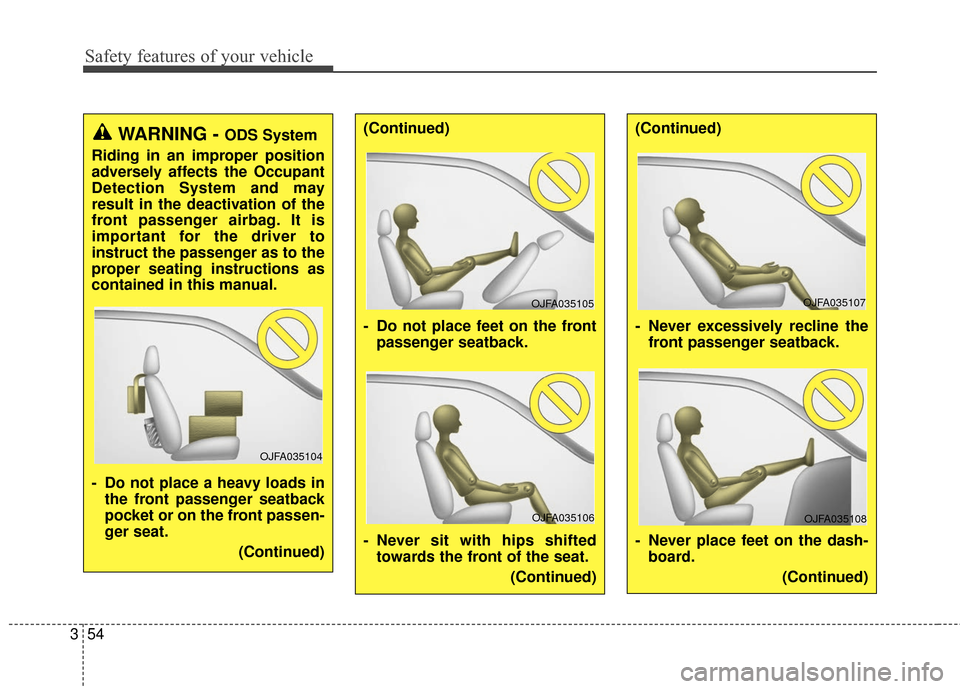
WARNING - ODS System
Riding in an improper position
adversely affects the Occupant
Detection System and may
result in the deactivation of the
front passenger airbag. It is
important for the driver to
instruct the passenger as to the
proper seating instructions as
contained in this manual.
- Do not place a heavy loads in the front passenger seatback
pocket or on the front passen-
ger seat.
(Continued)(Continued)
- Do not place feet on the frontpassenger seatback.
- Never sit with hips shifted towards the front of the seat.
(Continued)(Continued)
- Never excessively recline thefront passenger seatback.
- Never place feet on the dash- board.
(Continued)
OJFA035104
OJFA035105OJFA035107
OJFA035106OJFA035108
Page 75 of 595
359
Safety features of your vehicle
Advanced air bags are combined with
pre-tensioner seat belts to help pro-
vide enhanced occupant protection in
frontal crashes.
✽ ✽NOTICE
Air bags can only be used once –
have an authorized Kia dealer
replace the air bag immediately
after deployment.
Front air bags are not intended to
deploy in side-impact, rear-impact or
rollover crashes. However, when
frontal deployment threshold is satis-
fied at side-impact, front air bags
may deploy. In addition, front air bags
will not deploy in frontal crashes
below the deployment threshold.
WARNING- Replacement /
modifications
The front passenger seat, dash-
board or door should not be
replaced except by an author-
ized Kia dealer using original
Kia parts designed for this vehi-
cle and model. Any other such
replacement or modification
could adversely affect the oper-
ation of the occupant detection
system and your advanced air
bags.
WARNING- SRS Wiring
Do not tamper with or discon-
nect SRS wiring or other com-
ponents of the SRS system.
Doing so could result in injury,
due to accidental deployment of
the air bags or by rendering the
SRS inoperative.
WARNING - No attaching
objects
No objects (such as crash pad cover, cellular phone holder,
cup holder, perfume or stick-
ers) should be placed over or
near the air bag modules on
the steering wheel, instrument
panel, windshield glass, and
the front passenger's panel
above the glove box. Such
objects could cause harm if
the vehicle is in a crash
severe enough to cause the
air bags to deploy.
Never place or insert any object into any small opening
near side airbag labels
attached to the vehicle seats.
When the air bag deploys, the
object may affect the deploy-
ment and result in unexpected
accident or bodily harm.
Page 76 of 595
Safety features of your vehicle
60
3
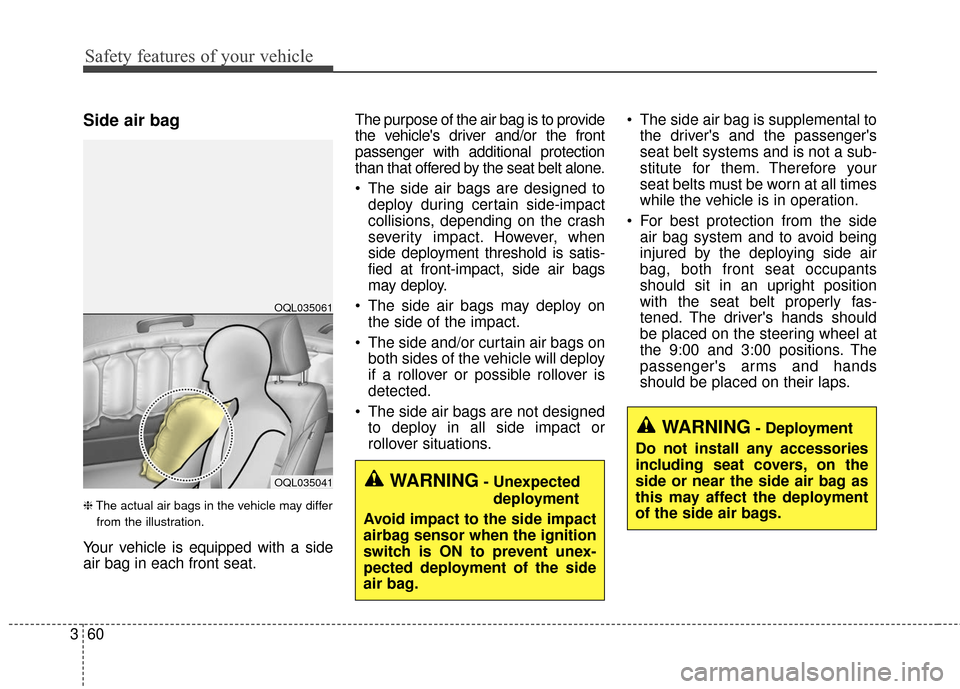
Side air bag
❈ The actual air bags in the vehicle may differ
from the illustration.
Your vehicle is equipped with a side
air bag in each front seat. The purpose of the air bag is to provide
the vehicle's driver and/or the front
passenger with additional protection
than that offered by the seat belt alone.
The side air bags are designed to
deploy during certain side-impact
collisions, depending on the crash
severity impact. However, when
side deployment threshold is satis-
fied at front-impact, side air bags
may deploy.
The side air bags may deploy on the side of the impact.
The side and/or curtain air bags on both sides of the vehicle will deploy
if a rollover or possible rollover is
detected.
The side air bags are not designed to deploy in all side impact or
rollover situations. The side air bag is supplemental to
the driver's and the passenger's
seat belt systems and is not a sub-
stitute for them. Therefore your
seat belts must be worn at all times
while the vehicle is in operation.
For best protection from the side air bag system and to avoid being
injured by the deploying side air
bag, both front seat occupants
should sit in an upright position
with the seat belt properly fas-
tened. The driver's hands should
be placed on the steering wheel at
the 9:00 and 3:00 positions. The
passenger's arms and hands
should be placed on their laps.
OQL035041
OQL035061
WARNING- Unexpected
deployment
Avoid impact to the side impact
airbag sensor when the ignition
switch is ON to prevent unex-
pected deployment of the side
air bag.
WARNING- Deployment
Do not install any accessories
including seat covers, on the
side or near the side air bag as
this may affect the deployment
of the side air bags.
Page 77 of 595
361
Safety features of your vehicle
If seat or seat cover is damaged,have the vehicle checked and
repaired by an authorized Kia deal-
er. Inform the dealer that your vehi-
cle is equipped with side air bags
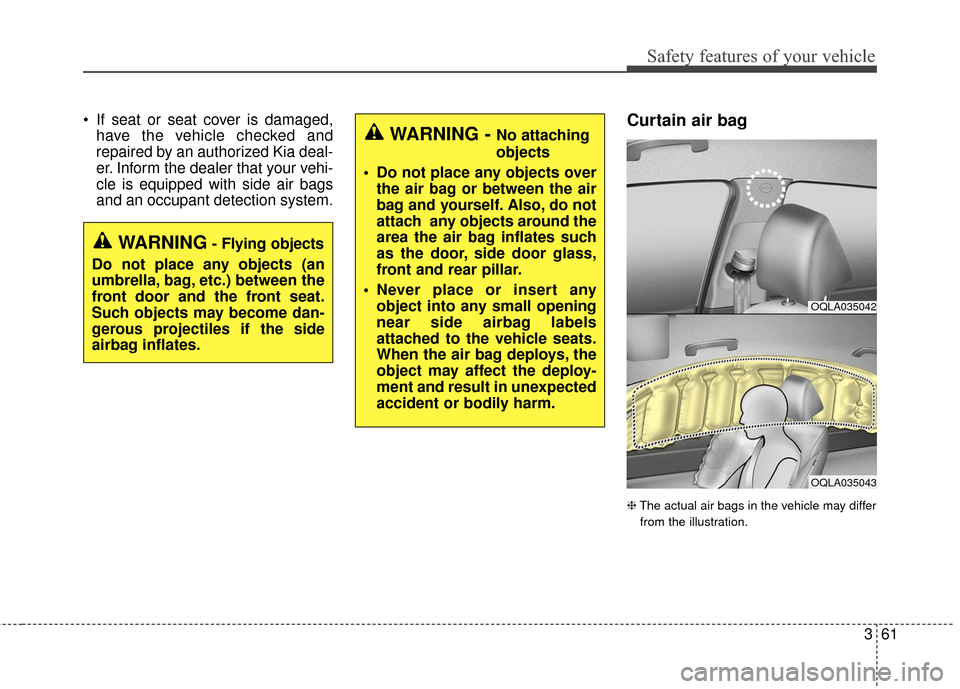
and an occupant detection system.Curtain air bag
❈ The actual air bags in the vehicle may differ
from the illustration.
WARNING- Flying objects
Do not place any objects (an
umbrella, bag, etc.) between the
front door and the front seat.
Such objects may become dan-
gerous projectiles if the side
airbag inflates.
OQLA035042
OQLA035043
WARNING - No attaching
objects
Do not place any objects over the air bag or between the air
bag and yourself. Also, do not
attach any objects around the
area the air bag inflates such
as the door, side door glass,
front and rear pillar.
Never place or insert any object into any small opening
near side airbag labels
attached to the vehicle seats.
When the air bag deploys, the
object may affect the deploy-
ment and result in unexpected
accident or bodily harm.
Page 587 of 595
Index
2I
Air bag - advanced supplemental restraint system ........3-43Adding equipment to or modifying your airbag-equipped vehicle ................................................3-69
Air bag warning label ................................................3-69
Air bag warning light ..................................................3-46
Curtain air bag ............................................................3-61
Driver's and passenger's front air bag ........................3-57
How does the air bag system operate? ......................3-44
Inflation and non-inflation conditions of the air bag..3-63
Occupant Detection System (ODS) ............................3-50
Side air bag ................................................................3-60
SRS Care ....................................................................3-68\
SRS components and functions ..................................3-47
Air cleaner ....................................................................8-37\
Filter replacement ......................................................8-37
Air conditioning system ..................................................9-6
All wheel drive (AWD)..................................................6-20 All Wheel Drive (AWD) transfer mode selection ......6-22
For safe all wheel drive operation ..............................6-23
Reducing the risk of a rollover ..................................6-26
Tight corner brake effect ............................................6-21
Appearance care ............................................................8-95 Exterior care ................................................................8-95
Interior care ..............................................................8-100
Audio (With Touch Screen) ............................................5-7 Bluetooth
®Wireless Technology ................................5-40 Features of Your Audio ................................................5-8
Media Mode ................................................................5-24
Phone Mode ................................................................5-39
Radio Mode ..............................................................5-19
Setup Mode ................................................................5-55
SiriusXM Radio Mode ................................................5-22
Voice Recognition Mode ............................................5-47
Audio System ..................................................................5-2 Antenna ........................................................................\
5-2
Aux, USB port ..............................................................5-4
How vehicle audio works ............................................5-4
Steering wheel audio controls ......................................5-2
Automatic climate control system ..............................4-145 Automatic heating and air conditioning ..................4-146
Checking the amount of air conditioner refrigerant and compressor lubricant ........................................4-156
Climate control air filter ..........................................4-155
Manual heating and air conditioning ........................4-147
System operation ......................................................4-153
Automatic transaxle ......................................................6-13 Automatic transaxle operation ....................................6-13
Good driving practices ................................................6-19
Autonomous emergency braking (AEB) ......................6-51 AEB warning message and system control ................6-54
Brake operation ..........................................................6-55
Downhill Brake Control (DBC)..................................6-62
Good braking practices ..............................................6-64
Limitation of the system ............................................6-58
A