lock KIA SPORTAGE 2021 Owners Manual
[x] Cancel search | Manufacturer: KIA, Model Year: 2021, Model line: SPORTAGE, Model: KIA SPORTAGE 2021Pages: 631, PDF Size: 10.56 MB
Page 342 of 631
Driving your vehicle
565
• Don't "ride" the brake pedal.Resting your foot on the brake
pedal while driving can be danger-
ous because the brakes might
overheat and lose their effective-
ness. It also increases the wear of
the brake components.
• If a tire goes flat while you are driv- ing, apply the brakes gently and
keep the vehicle pointed straight
ahead while you slow down. When
you are moving slowly enough for it
to be safe to do so, pull off the road
and stop in a safe place.
• If your vehicle is equipped with an Automatic Transmission, don't let
your vehicle creep forward. To
avoid creeping forward, keep your
foot firmly on the brake pedal when
the vehicle is stopped.
• Be cautious when parking on a hill. Firmly engage the parking brake
and place the shift lever in P (auto-
matic transmission). If your vehicle
is facing downhill, turn the front
wheels into the curb to help keep
the vehicle from rolling. If your vehicle is facing uphill, turn
the front wheels away from the
curb to help keep the vehicle from
rolling. If there is no curb or if it is
required by other conditions to
keep the vehicle from rolling, block
the wheels.
• Under some conditions your park- ing brake can freeze in the
engaged position. This is most like-
ly to happen when there is an
accumulation of snow or ice
around or near the rear brakes or if
the brakes are wet. If there is a risk
that the parking brake may freeze,
apply it only temporarily while you
put the shift lever in P (automatic
transmission) and block the rear
wheels so the vehicle cannot roll.
Then release the parking brake.
• Do not hold the vehicle on an incline with the accelerator pedal.
This can cause the transmission to
overheat. Always use the brake
pedal or parking brake.
Page 353 of 631
5 67
Driving your vehicle
Limitation of the system
Forward Collision-Avoidance Assist
(FCA) is designed to monitor the
vehicle or pedestrians ahead in the
roadway through camera recogni-
tion to warn the driver that a colli-
sion is imminent, and if necessary,
apply emergency braking.
In certain situations, the camera may
not be able to detect the vehicle or
pedestrians ahead. In these cases,
FCA may not operate normally. The
driver must pay careful attention in
the following situations where FCA
operation may be limited.
Recognizing vehicles
The sensor may be limited when:
• The front view camera is blockedwith a foreign object or debris
• The camera lens is contaminated due to tinted, filmed or coated
windshield, damaged glass, or
stuck of foreign matter (sticker,
bug, etc.) on the glass
• Inclement weather such as heavy rain or snow obscures the field of
view of camera
• There is interference by electro- magnetic waves
• The front view camera recognition is limited
• The vehicle in front is too small to be detected (for example a motor-
cycle etc.)
• The vehicle in front is an oversize vehicle or trailer that is too big to
be detected by the camera recog-
nition system (for example a tractor
trailer, etc.)
• The camera's field of view is not well illuminated (either too dark or
too much reflection or too much
backlight that obscures the field of
view) • The vehicle in front does not have
their rear lights or their rear lights
does not turned ON or their rear
lights are located unusually.
• The outside brightness changes suddenly, for example when enter-
ing or exiting a tunnel
• When light coming from a street light or an oncoming vehicle is
reflected on a wet road surface
such as a puddle in the road
• The field of view in front is obstructed by sun glare
• The vehicle in front is driving errat- ically
• The vehicle is on unpaved or uneven rough surfaces, or road
with sudden gradient changes.
• The vehicle drives inside a build- ing, such as a basement parking
lot
• The front view camera does not recognize the entire vehicle in
front.
Page 354 of 631
Driving your vehicle
685
• The front view camera is damaged.
• The brightness outside is too lowsuch as when the headlamps are
not on at night or the vehicle is
going through a tunnel.
• The shadow is on the road by a median strip, trees, etc.
• The vehicle drives through a toll- gate.
• The windshield glass is fogged up; a clear view of the road is obstruct-
ed.
• The rear part of the vehicle in front is not normally visible. (the vehicle
turns in other direction or the vehi-
cle is overturned.)
• The adverse road conditions cause excessive vehicle vibrations while
driving
• The sensor recognition changes suddenly when passing over a
speed bump• The vehicle in front
is moving longitudinally to the driv-
ing direction • The vehicle in front is stopped lon-
gitudinally
• The vehicle in front is driving towards your vehicle or reversing
• You are on a roundabout and the vehicle in front circles
• It is difficult to secure the field of view of the front view camera such
as backlight, reflected light, and
darkness.
• When the front camera is blocked by continuous washer spray and
wiper operation.
• The vehicle in front is a special purpose vehicle, a trailer, or a truck
loading with unusual shape of lug-
gage.
• The ambient light is too high or low.
• The front view camera is contami- nated by front glass tinting, attach-
ing film, water proof coating, dam-
aged, foreign material such as a
sticker, worm, etc. • If not using headlamp or using
weak light in the night or in a tun-
nel.
• Backlight is shining in the driving direction of the vehicle. (Including
oncoming vehicle headlights.)
• When the rear part of the front vehicle is small or low.
• When a trailer or other vehicle is towing the front vehicle.
• When the ground clearance of the front vehicle is high.
• When a front vehicle makes sud- den lane changes unexpectedly.
Page 358 of 631
Driving your vehicle
725
Detecting pedestrians
The sensor may be limited when:
• The pedestrian is not fully detectedby the camera recognition system,
for example, if the pedestrian is
leaning over or is not fully walking
upright
• The pedestrian is moving very quickly or appears abruptly in the
camera detection area
• The pedestrian is wearing clothing that easily blends into the back-
ground, making it difficult to be
detected by the camera recogni-
tion system
• The outside lighting is too bright (e.g. when driving in bright sunlight
or in sun glare) or too dark (e.g.
when driving on a dark rural road
at night)
• It is difficult to detect and distin- guish the pedestrian from other
objects in the surroundings, for
example, when there is a group of
pedestrians, or a large crowd. • There is an item similar to a per-
son's body structure
• The pedestrian is small
• The pedestrian has impaired mobility
• The sensor recognition is limited
• The camera is blocked with a for- eign object or debris
• Inclement weather such as heavy rain or snow obscures the field of
view of the radar sensor or camera
• When light coming from a street light or an oncoming vehicle is
reflected on a wet road surface
such as a puddle in the road
• The field of view in front is obstructed by sun glare
• The windshield glass is fogged up.
• Adverse road conditions cause excessive vehicle vibrations while
driving
• When the pedestrian suddenly appears in front of the vehicle • When there is any other electro-
magnetic interference
• When a construction area, rail or other metal object is near the
pedestrian.
Page 369 of 631
5 83
Driving your vehicle
Limitation of the system
FCA is an assistant system for a driv-
er in a certain risky driving condition
and it does not take every responsi-
bility for all risks from driving condi-
tion.
FCA monitors the driving situations
through the radar and the camera
sensor. Thus, for a situation out of
the sensing range, FCA may not nor-
mally operate. The driver should pay
great caution in the following situa-
tions. FCA operation may be limited.
Recognizing vehicles
The sensor may be limited when:
• The front view camera or frontradar sensor is blocked with a for-
eign object or debris
• The camera lens is contaminated due to tinted, filmed or coated
windshield, damaged glass, or
stuck of foreign matter (sticker,
bug, etc.) on the glass
• Inclement weather such as heavy rain or snow obscures the field of
view of the radar sensor or camera
• There is interference by electro- magnetic waves
• There is severe irregular reflection from the radar sensor
• The front view camera/front radar sensor recognition is limited
• The vehicle in front is too small to be detected (for example a motor-
cycle etc.)
• The vehicle in front is an oversize vehicle or trailer that is too big to
be detected by the camera recog-
nition system (for example a tractor
trailer, etc.)(Continued)
• The regular braking functionwill operate normally even if
There is a problem with the
FCA brake control system or
other functions. In this case,
the braking control will not
operate in an imminent colli-
sion.
• FCA may not activate accord- ing to driving condition, traffic
on the road, weather, road
condition, etc.
• FCA may not activate in response to all types of vehi-
cles.
Page 370 of 631
Driving your vehicle
845
• The camera's field of view is notwell illuminated (either too dark or
too much reflection or too much
backlight that obscures the field of
view)
• The vehicle in front does not have their rear lights or their rear lights
does not turned ON or their rear
lights are located unusually.
• The outside brightness changes suddenly, for example when enter-
ing or exiting a tunnel
• When light coming from a street light or an oncoming vehicle is
reflected on a wet road surface
such as a puddle in the road
• The field of view in front is obstructed by sun glare
• The vehicle in front is driving errat- ically
• The vehicle is on unpaved or uneven rough surfaces, or road
with sudden gradient changes.
• The vehicle is driven near areas containing metal substances as a
construction zone, railroad, etc. • The vehicle drives inside a build-
ing, such as a basement parking
lot
• The front view camera does not recognize the entire vehicle in
front.
• The front view camera is damaged.
• The brightness outside is too low such as when the headlamps are
not on at night or the vehicle is
going through a tunnel.
• The shadow is on the road by a median strip, trees, etc.
• The vehicle drives through a toll- gate.
• The windshield glass is fogged up; a clear view of the road is obstruct-
ed.
• The rear part of the vehicle in front is not normally visible. (the vehicle
turns in other direction or the vehi-
cle is overturned.)
• The adverse road conditions cause excessive vehicle vibrations while
driving
• The sensor recognition changes suddenly when passing over a
speed bump • The vehicle in front is moving lon-
gitudinally to the driving direction
• The vehicle in front is stopped lon- gitudinally
• The vehicle in front is driving towards your vehicle or reversing
• You are on a roundabout and the vehicle in front circles
• It is difficult to secure the field of view of the front view camera such
as backlight, reflected light, and
darkness.
• When the front camera is blocked by continuous washer spray and
wiper operation.
• The vehicle in front is a special purpose vehicle, a trailer, or a truck
loading with unusual shape of lug-
gage.
• The ambient light is too high or low.
• The front view camera is contami- nated by front glass tinting, attach-
ing film, water proof coating, dam-
aged, foreign material such as a
sticker, worm, etc.
• When the front view camera (including lens) or front radar is
damaged.
Page 389 of 631
5 103
Driving your vehicle
(Continued)Have the vehicle inspected by an
authorized Kia dealer.
• Do not apply foreign objects such as a bumper sticker or a bumper
guard near the radar sensor or
apply paint to the sensor area.
Doing so may adversely affect the
performance of the sensor.Warning message
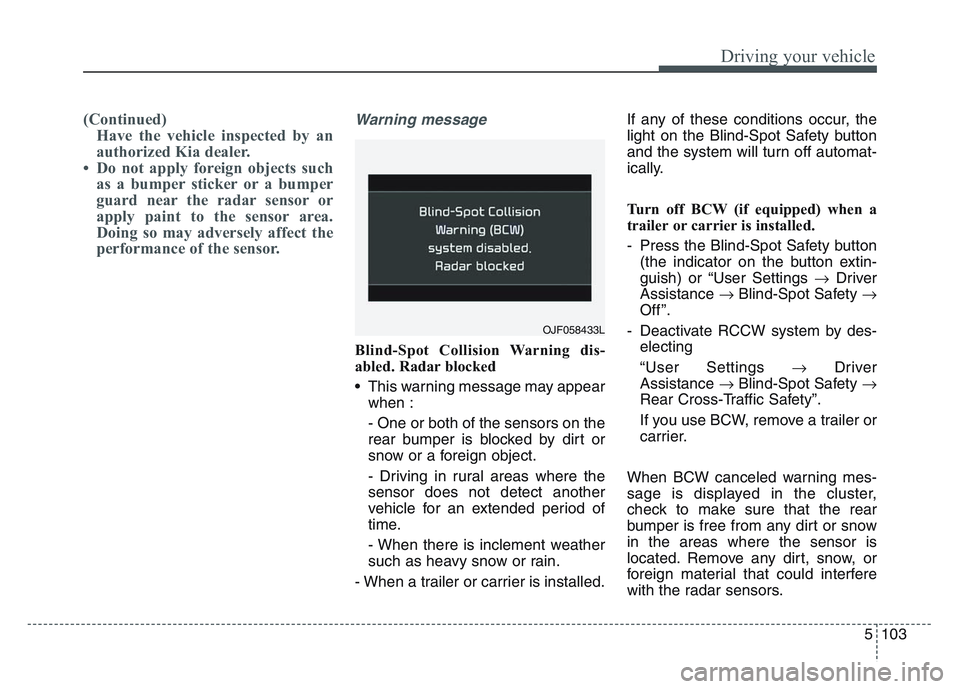
Blind-Spot Collision Warning dis-
abled. Radar blocked
• This warning message may appear
when :
- One or both of the sensors on the
rear bumper is blocked by dirt or
snow or a foreign object.
- Driving in rural areas where the
sensor does not detect another
vehicle for an extended period of
time.
- When there is inclement weather
such as heavy snow or rain.
- When a trailer or carrier is installed. If any of these conditions occur, the
light on the Blind-Spot Safety button
and the system will turn off automat-
ically.
Turn off BCW (if equipped) when a
trailer or carrier is installed.
- Press the Blind-Spot Safety button
(the indicator on the button extin-
guish) or “User Settings Driver
Assistance Blind-Spot Safety
Off ”.
- Deactivate RCCW system by des- electing
“User Settings Driver
Assistance Blind-Spot Safety
Rear Cross-Traffic Safety”.
If you use BCW, remove a trailer or
carrier.
When BCW canceled warning mes-
sage is displayed in the cluster,
check to make sure that the rear
bumper is free from any dirt or snow
in the areas where the sensor is
located. Remove any dirt, snow, or
foreign material that could interfere
with the radar sensors.
OJF058433L
Page 390 of 631
Driving your vehicle
1045
After any dirt or debris is removed,
BCW should operate normally after
about 10 minutes of driving the vehi-
cle.
If the system still does not operate
normally, have your vehicle inspect-
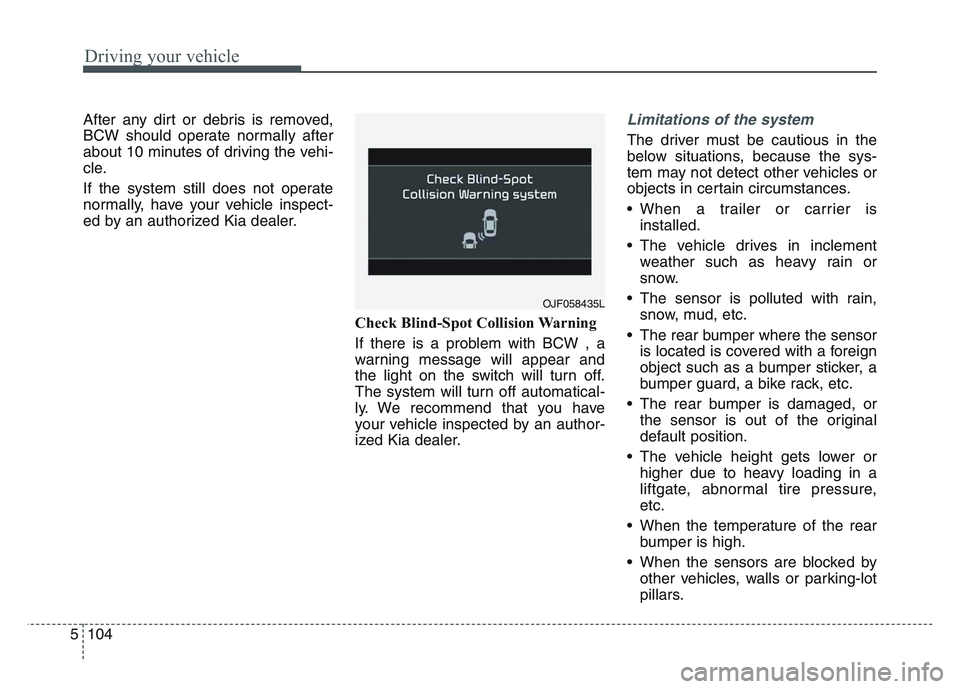
ed by an authorized Kia dealer.Check Blind-Spot Collision Warning
If there is a problem with BCW , a
warning message will appear and
the light on the switch will turn off.
The system will turn off automatical-
ly. We recommend that you have
your vehicle inspected by an author-
ized Kia dealer.Limitations of the system
The driver must be cautious in the
below situations, because the sys-
tem may not detect other vehicles or
objects in certain circumstances.
• When a trailer or carrier isinstalled.
• The vehicle drives in inclement weather such as heavy rain or
snow.
• The sensor is polluted with rain, snow, mud, etc.
• The rear bumper where the sensor is located is covered with a foreign
object such as a bumper sticker, a
bumper guard, a bike rack, etc.
• The rear bumper is damaged, or the sensor is out of the original
default position.
• The vehicle height gets lower or higher due to heavy loading in a
liftgate, abnormal tire pressure,
etc.
• When the temperature of the rear bumper is high.
• When the sensors are blocked by other vehicles, walls or parking-lot
pillars.
OJF058435L
Page 416 of 631
Driving your vehicle
1305
Warning message
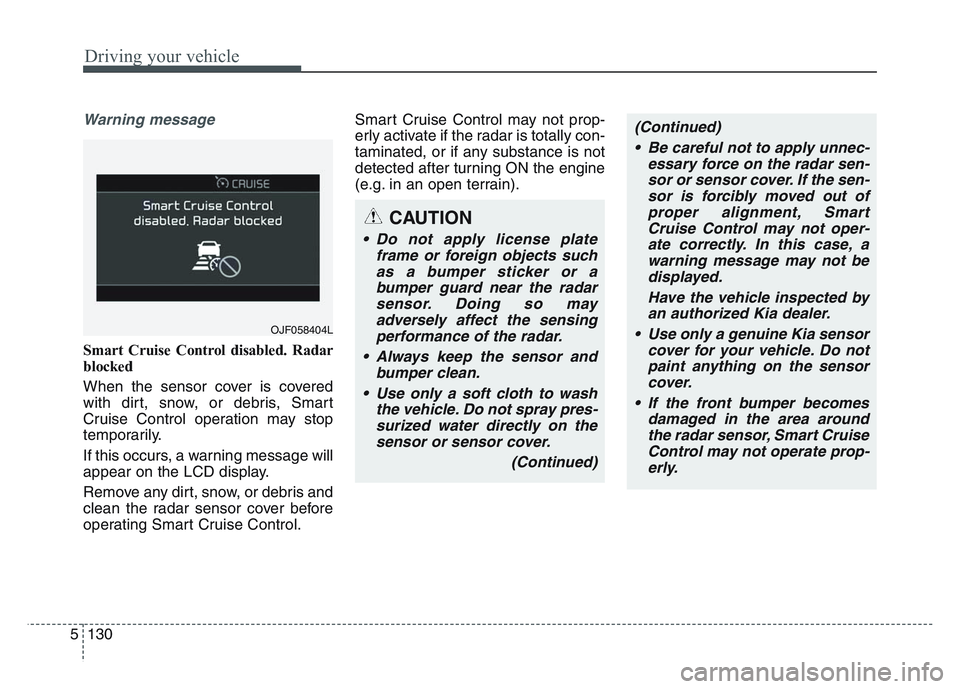
Smart Cruise Control disabled. Radar
blocked
When the sensor cover is covered
with dirt, snow, or debris, Smart
Cruise Control operation may stop
temporarily.
If this occurs, a warning message will
appear on the LCD display.
Remove any dirt, snow, or debris and
clean the radar sensor cover before
operating Smart Cruise Control.Smart Cruise Control may not prop-
erly activate if the radar is totally con-
taminated, or if any substance is not
detected after turning ON the engine
(e.g. in an open terrain).
OJF058404L
CAUTION
• Do not apply license plate
frame or foreign objects suchas a bumper sticker or abumper guard near the radarsensor. Doing so mayadversely affect the sensingperformance of the radar.
• Always keep the sensor and bumper clean.
• Use only a soft cloth to wash the vehicle. Do not spray pres-surized water directly on thesensor or sensor cover.
(Continued)
(Continued)• Be careful not to apply unnec- essary force on the radar sen-sor or sensor cover. If the sen-sor is forcibly moved out ofproper alignment, SmartCruise Control may not oper-ate correctly. In this case, awarning message may not bedisplayed.
Have the vehicle inspected byan authorized Kia dealer.
• Use only a genuine Kia sensor cover for your vehicle. Do notpaint anything on the sensorcover.
• If the front bumper becomes damaged in the area aroundthe radar sensor, Smart CruiseControl may not operate prop-erly.
Page 417 of 631
5 131
Driving your vehicle
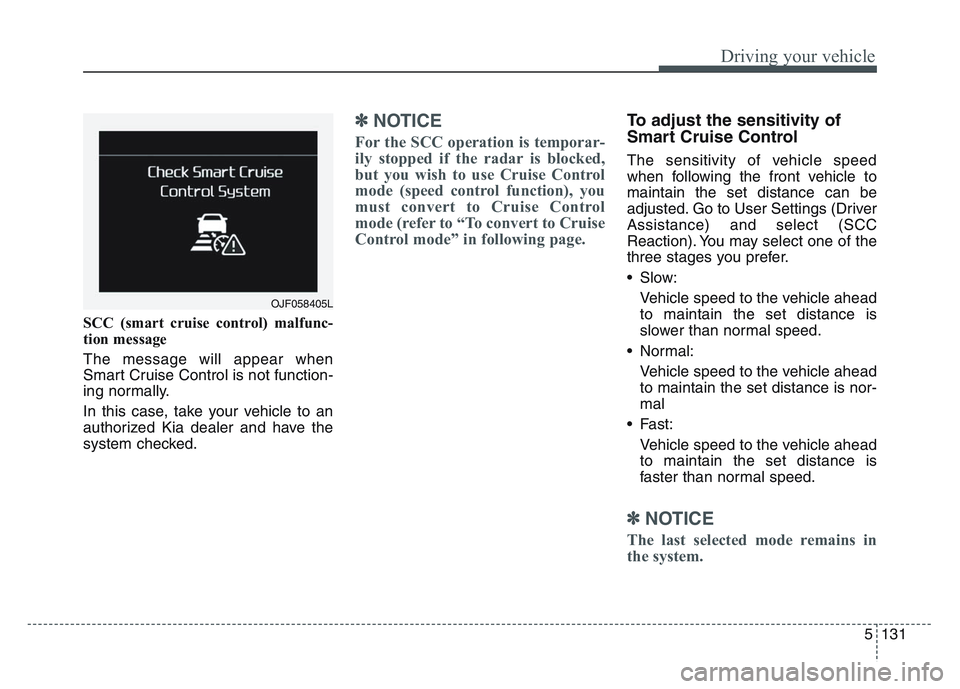
SCC (smart cruise control) malfunc-
tion message
The message will appear when
Smart Cruise Control is not function-
ing normally.
In this case, take your vehicle to an
authorized Kia dealer and have the
system checked.
✽NOTICE
For the SCC operation is temporar-
ily stopped if the radar is blocked,
but you wish to use Cruise Control
mode (speed control function), you
must convert to Cruise Control
mode (refer to “To convert to Cruise
Control mode” in following page.
To adjust the sensitivity of
Smart Cruise Control
The sensitivity of vehicle speed
when following the front vehicle to
maintain the set distance can be
adjusted. Go to User Settings (Driver
Assistance) and select (SCC
Reaction). You may select one of the
three stages you prefer.
• Slow:Vehicle speed to the vehicle ahead
to maintain the set distance is
slower than normal speed.
• Normal: Vehicle speed to the vehicle ahead
to maintain the set distance is nor-
mal
• Fast: Vehicle speed to the vehicle ahead
to maintain the set distance is
faster than normal speed.
✽NOTICE
The last selected mode remains in
the system.
OJF058405L