fog light KIA SPORTAGE 2021 User Guide
[x] Cancel search | Manufacturer: KIA, Model Year: 2021, Model line: SPORTAGE, Model: KIA SPORTAGE 2021Pages: 631, PDF Size: 10.56 MB
Page 358 of 631
Driving your vehicle
725
Detecting pedestrians
The sensor may be limited when:
• The pedestrian is not fully detectedby the camera recognition system,
for example, if the pedestrian is
leaning over or is not fully walking
upright
• The pedestrian is moving very quickly or appears abruptly in the
camera detection area
• The pedestrian is wearing clothing that easily blends into the back-
ground, making it difficult to be
detected by the camera recogni-
tion system
• The outside lighting is too bright (e.g. when driving in bright sunlight
or in sun glare) or too dark (e.g.
when driving on a dark rural road
at night)
• It is difficult to detect and distin- guish the pedestrian from other
objects in the surroundings, for
example, when there is a group of
pedestrians, or a large crowd. • There is an item similar to a per-
son's body structure
• The pedestrian is small
• The pedestrian has impaired mobility
• The sensor recognition is limited
• The camera is blocked with a for- eign object or debris
• Inclement weather such as heavy rain or snow obscures the field of
view of the radar sensor or camera
• When light coming from a street light or an oncoming vehicle is
reflected on a wet road surface
such as a puddle in the road
• The field of view in front is obstructed by sun glare
• The windshield glass is fogged up.
• Adverse road conditions cause excessive vehicle vibrations while
driving
• When the pedestrian suddenly appears in front of the vehicle • When there is any other electro-
magnetic interference
• When a construction area, rail or other metal object is near the
pedestrian.
Page 370 of 631
Driving your vehicle
845
• The camera's field of view is notwell illuminated (either too dark or
too much reflection or too much
backlight that obscures the field of
view)
• The vehicle in front does not have their rear lights or their rear lights
does not turned ON or their rear
lights are located unusually.
• The outside brightness changes suddenly, for example when enter-
ing or exiting a tunnel
• When light coming from a street light or an oncoming vehicle is
reflected on a wet road surface
such as a puddle in the road
• The field of view in front is obstructed by sun glare
• The vehicle in front is driving errat- ically
• The vehicle is on unpaved or uneven rough surfaces, or road
with sudden gradient changes.
• The vehicle is driven near areas containing metal substances as a
construction zone, railroad, etc. • The vehicle drives inside a build-
ing, such as a basement parking
lot
• The front view camera does not recognize the entire vehicle in
front.
• The front view camera is damaged.
• The brightness outside is too low such as when the headlamps are
not on at night or the vehicle is
going through a tunnel.
• The shadow is on the road by a median strip, trees, etc.
• The vehicle drives through a toll- gate.
• The windshield glass is fogged up; a clear view of the road is obstruct-
ed.
• The rear part of the vehicle in front is not normally visible. (the vehicle
turns in other direction or the vehi-
cle is overturned.)
• The adverse road conditions cause excessive vehicle vibrations while
driving
• The sensor recognition changes suddenly when passing over a
speed bump • The vehicle in front is moving lon-
gitudinally to the driving direction
• The vehicle in front is stopped lon- gitudinally
• The vehicle in front is driving towards your vehicle or reversing
• You are on a roundabout and the vehicle in front circles
• It is difficult to secure the field of view of the front view camera such
as backlight, reflected light, and
darkness.
• When the front camera is blocked by continuous washer spray and
wiper operation.
• The vehicle in front is a special purpose vehicle, a trailer, or a truck
loading with unusual shape of lug-
gage.
• The ambient light is too high or low.
• The front view camera is contami- nated by front glass tinting, attach-
ing film, water proof coating, dam-
aged, foreign material such as a
sticker, worm, etc.
• When the front view camera (including lens) or front radar is
damaged.
Page 374 of 631
Driving your vehicle
885
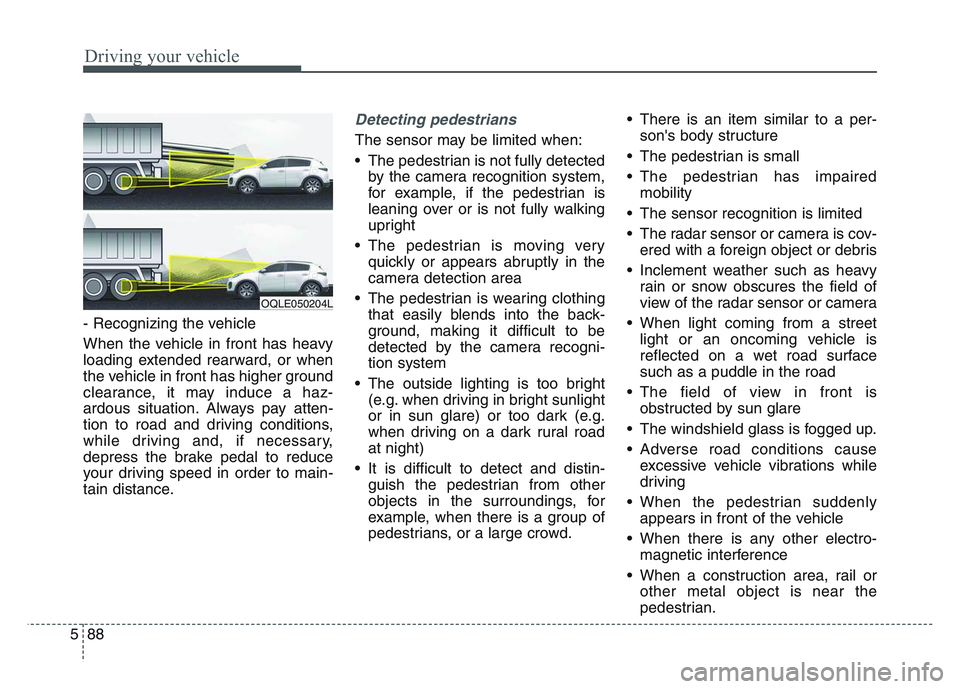
- Recognizing the vehicle
When the vehicle in front has heavy
loading extended rearward, or when
the vehicle in front has higher ground
clearance, it may induce a haz-
ardous situation. Always pay atten-
tion to road and driving conditions,
while driving and, if necessary,
depress the brake pedal to reduce
your driving speed in order to main-
tain distance.
Detecting pedestrians
The sensor may be limited when:
• The pedestrian is not fully detectedby the camera recognition system,
for example, if the pedestrian is
leaning over or is not fully walking
upright
• The pedestrian is moving very quickly or appears abruptly in the
camera detection area
• The pedestrian is wearing clothing that easily blends into the back-
ground, making it difficult to be
detected by the camera recogni-
tion system
• The outside lighting is too bright (e.g. when driving in bright sunlight
or in sun glare) or too dark (e.g.
when driving on a dark rural road
at night)
• It is difficult to detect and distin- guish the pedestrian from other
objects in the surroundings, for
example, when there is a group of
pedestrians, or a large crowd. • There is an item similar to a per-
son's body structure
• The pedestrian is small
• The pedestrian has impaired mobility
• The sensor recognition is limited
• The radar sensor or camera is cov- ered with a foreign object or debris
• Inclement weather such as heavy rain or snow obscures the field of
view of the radar sensor or camera
• When light coming from a street light or an oncoming vehicle is
reflected on a wet road surface
such as a puddle in the road
• The field of view in front is obstructed by sun glare
• The windshield glass is fogged up.
• Adverse road conditions cause excessive vehicle vibrations while
driving
• When the pedestrian suddenly appears in front of the vehicle
• When there is any other electro- magnetic interference
• When a construction area, rail or other metal object is near the
pedestrian.
OQLE050204L
Page 384 of 631
Driving your vehicle
985
(Continued)
• The lane marker is not visible dueto snow, rain, stain, a puddle or
other factors.
• A shadow is on the lane marker because of a median strip,
guardrail, noise barriers or other
objects.
• When the lane markers are com- plicated or a structure substitutes
for the lines such as a construc-
tion area.
• There are crosswalk signs or other symbols on the road.
• The lane suddenly disappears such as at the intersection.
• The lane marker in a tunnel is cov- ered with dirt or oil and etc.
• The lane is very wide or narrow.
When external conditions inter- vene
• The brightness outside changes suddenly when entering/exiting a
tunnel or passing under a bridge.
• The headlamps are not on at night or in a tunnel, or light level is low.
• There is a boundary structure in the roadway. (Continued)(Continued)
• The light of reflects from the
water on the road.
• When light shines brightly from behind the vehicle.
• The distance from the vehicle ahead is very short or the vehicle
ahead covers up the lane marker.
• You drive on a steep grade or a sharp curve.
• The vehicle vibrates heavily.
• The temperature near inside mir- ror is very high due to direct sun
light and etc.
When front visibility is poor
• The lens or windshield is covered by foreign materials.
• The sensor cannot detect the lane because of fog, heavy rain or snow.
• The windshield is fogged by humid air in the vehicle.
• Putting something on the crash pad and etc.
WARNING
Lane Keeping Assist is a sys-
tem to help prevent the driver
from leaving the lane. However,
the driver should not solely rely
on the system but always take
the necessary actions for safe
driving practices.
Page 499 of 631
• Radial-ply tires . . . . . . . . . . . . . . . . . . . . . . . . . . . . . . 7-59
• Low aspect ratio tire . . . . . . . . . . . . . . . . . . . . . . . . . . 7-59
Fuses . . . . . . . . . . . . . . . . . . . . . . . . . . . . . . . . . . . . \
7-61
• Inner panel fuse replacement . . . . . . . . . . . . . . . . . . . 7-63
• Engine compartment fuse replacement. . . . . . . . . . . 7-65
• Fuse/relay panel description. . . . . . . . . . . . . . . . . . . . 7-67
Light bulbs . . . . . . . . . . . . . . . . . . . . . . . . . . . . . . . 7-79
• Bulb replacement precaution . . . . . . . . . . . . . . . . . . . 7-79
• Light bulb position (Front) . . . . . . . . . . . . . . . . . . . . 7-81
• Light bulb position (Rear) . . . . . . . . . . . . . . . . . . . . . 7-82
• Light bulb position (Side) . . . . . . . . . . . . . . . . . . . . . . 7-83
• Headlamp (High/Low beam) bulb replacement . . . . 7-83
• Front turn signal lamp bulb replacement . . . . . . . . . 7-84
• Position lamp + DRL bulb replacement . . . . . . . . . . 7-85
• Front fog lamp (Bulb and LED type) bulbreplacement . . . . . . . . . . . . . . . . . . . . . . . . . . . . . . . . 7-86
• Stop and tail lamp bulb replacement . . . . . . . . . . . . 7-86
• Tail lamp (inside) bulb replacement . . . . . . . . . . . . . 7-87
• Stop and tail lamp (LED type) bulb replacement . . 7-88
• Back-up lamp and Rear turn signal lamp (Bulb type) bulb replacement . . . . . . . . . . . . . . . . . 7-89
• High mounted stop lamp (LED type) bulb replacement . . . . . . . . . . . . . . . . . . . . . . . . . . . . . . . . 7-89
• License plate lamp (Bulb type) bulb replacement . . 7-89
• Side repeater lamp (LED type) bulb replacement . . 7-90 • Map lamp (Bulb and LED type)
bulb replacement. . 7-90
• Vanity mirror lamp (Bulb type) bulb replacement . . 7-91
• Room lamp (Bulb type) bulb replacement . . . . . . . 7-91
• Personal lamp (LED type) bulb replacement . . . . . . 7-92
• Glove box lamp (Bulb type) bulb replacement . . . . 7-92
• Liftgate room lamp (Bulb type) bulb replacement . . 7-93
Appearance care . . . . . . . . . . . . . . . . . . . . . . . . . . . 7-94
• Exterior care . . . . . . . . . . . . . . . . . . . . . . . . . . . . . . . . 7-94
• Interior care . . . . . . . . . . . . . . . . . . . . . . . . . . . . . . . . . 7-99
Emission control system . . . . . . . . . . . . . . . . . . . 7-102
• Crankcase emission control system . . . . . . . . . . . . . 7-102
• Evaporative emission control (including ORVR: Onboard Refueling Vapor Recovery) system . . . . . 7-102
• Exhaust emission control system . . . . . . . . . . . . . . . 7-103
7
Page 576 of 631
7 79
Maintenance
LIGHT BULBS
Bulb replacement precaution
Please keep extra bulbs on hand
with appropriate wattage ratings in
case of emergencies.
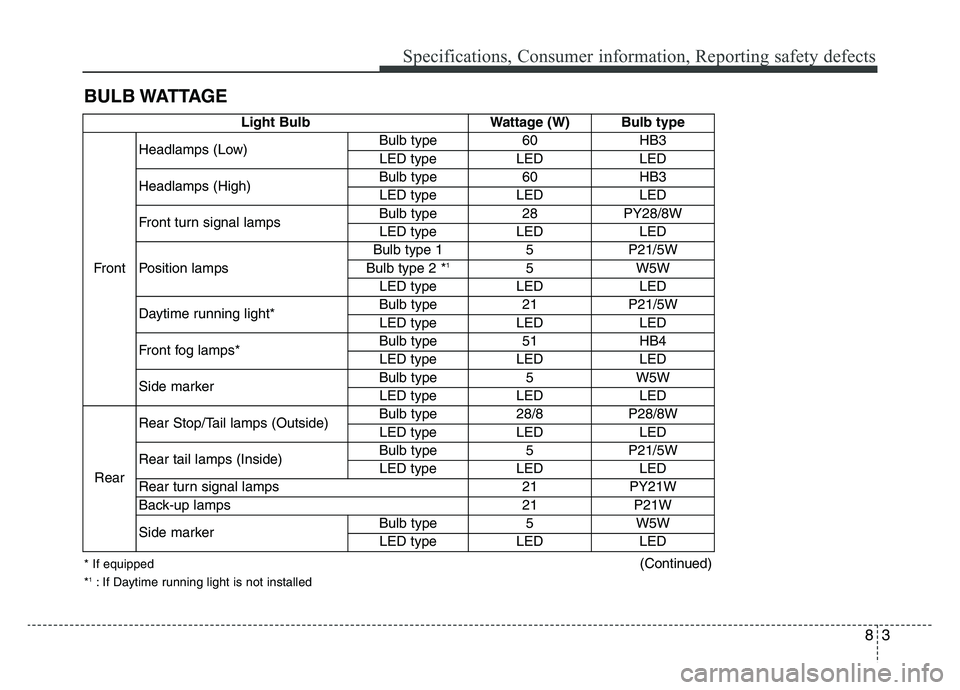
Refer to “Bulb Wattage” in chapter 8.
When changing lamps, first turn off
the engine at a safe place, firmly
apply the parking brake and detach
the battery’s negative (-) terminal.
Use only bulbs of the specifiedwattage.• Lamp part malfunction due to net-work failure
The headlamp, taillight, and fog light
may light up when the head lamp
switch is turned ON, and not light up
when the taillight or for light switch is
turned ON. This may be cause by
network failure or vehicle electrical
control system malfunction. If there is
a problem, we recommend the sys-
tem be serviced by an authorized Kia
dealer.
• Lamp part malfunction due to elec- trical control system stabilization
A normally functioning lamp may
flicker momentarily. This momentary
occurrence is due to the stabilization
function of the vehicle's electrical
control system. If the lamp stops
flickering after a few moments, the
vehicle does not require service.
However, if the lamp goes out after
the momentary flickering, or the flick-
ering continues, we recommend the
system be serviced by an authorized
Kia dealer.
WARNING- Working on the lights
Prior to working on the light,
firmly apply the parking brake,
ensure that the ignition switch
is turned to the LOCK position
and turn off the lights to avoid
sudden movement of the vehi-
cle and burning your fingers or
receiving an electric shock.
CAUTION -Light replace-
ment
Be sure to replace the burned- out bulb with one of the samewattage rating. Otherwise, itmay cause damage to the fuseor electric wiring system.
CAUTION -Headlamp
Lens
To prevent damage, do notclean the headlamp lens withchemical solvents or strongdetergents.
Page 578 of 631
7 81
Maintenance
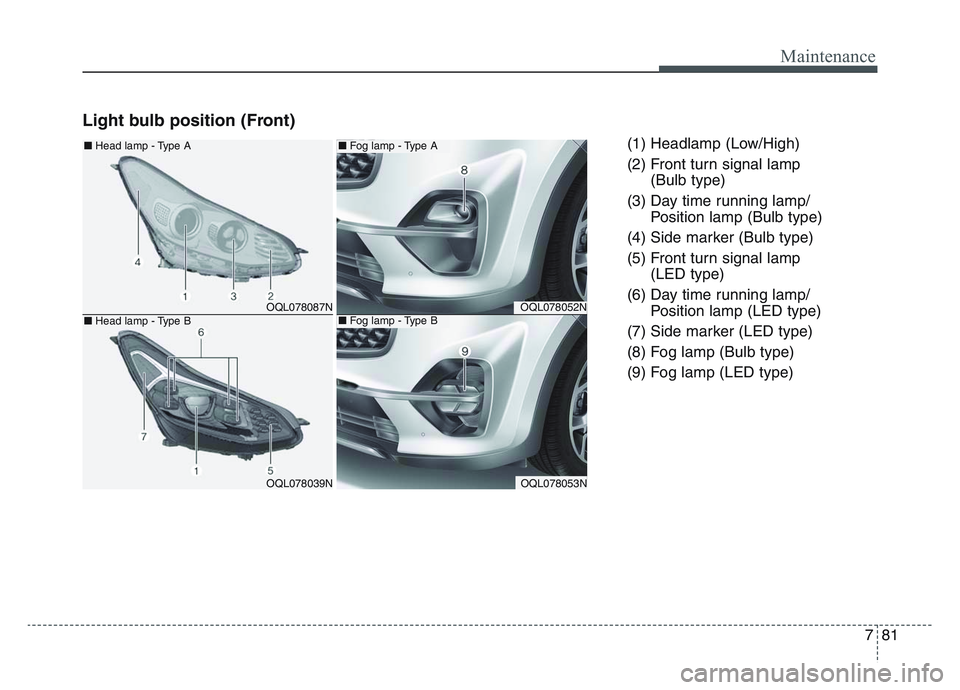
Light bulb position (Front)
(1) Headlamp (Low/High)
(2) Front turn signal lamp (Bulb type)
(3) Day time running lamp/ Position lamp (Bulb type)
(4) Side marker (Bulb type)
(5) Front turn signal lamp (LED type)
(6) Day time running lamp/ Position lamp (LED type)
(7) Side marker (LED type)
(8) Fog lamp (Bulb type)
(9) Fog lamp (LED type)
OQL078087N
OQL078039N
■ Head lamp - Type A
■Head lamp - Type BOQL078052N
OQL078053N
■Fog lamp - Type A
■Fog lamp - Type B
Page 583 of 631
Maintenance
867
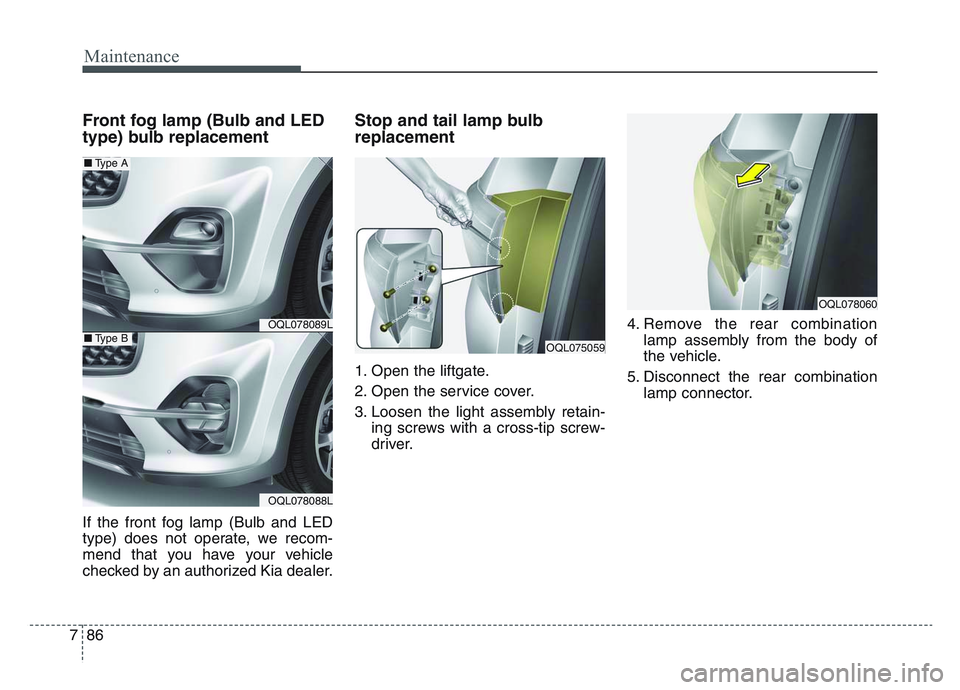
Front fog lamp (Bulb and LED
type) bulb replacement
If the front fog lamp (Bulb and LED
type) does not operate, we recom-
mend that you have your vehicle
checked by an authorized Kia dealer.
Stop and tail lamp bulb
replacement
1. Open the liftgate.
2. Open the service cover.
3. Loosen the light assembly retain-ing screws with a cross-tip screw-
driver. 4. Remove the rear combination
lamp assembly from the body of
the vehicle.
5. Disconnect the rear combination lamp connector.
OQL078089L
OQL078088L
■Type A
■Type BOQL075059
OQL078060
Page 605 of 631
83
Specifications, Consumer information, Reporting safety defects
BULB WATTAGE
Light BulbWattage (W) Bulb type
Front Headlamps (Low)
Bulb type
60HB3
LED type LEDLED
Headlamps (High) Bulb type
60HB3
LED type LEDLED
Front turn signal lamps Bulb type
28PY28/8W
LED type LEDLED
Position lamps Bulb type 1
5P21/5W
Bulb type 2 *
15 W5W
LED typeLEDLED
Daytime running light*Bulb type21P21/5W
LED typeLEDLED
Front fog lamps*Bulb type51HB4
LED typeLEDLED
Side markerBulb type5W5W
LED typeLEDLED
Rear Rear Stop/Tail lamps (Outside)
Bulb type
28/8P28/8W
LED type LEDLED
Rear tail lamps (Inside) Bulb type
5P21/5W
LED type LEDLED
Rear turn signal lamps 21PY21W
Back-up lamps 21P21W
Side marker Bulb type
5W5W
LED type LEDLED
* If equipped
*1: If Daytime running light is not installed
(Continued)
Page 626 of 631
I7
Index
Liftgate (for manual liftgate) ........................................4-28Closing the liftgate ......................................................4-28
Emergency liftgate safety release ..............................4-29
Opening the liftgate ....................................................4-28
Light bulbs ....................................................................7-79\
Back-up lamp and Rear turn signal lamp (Bulb type)bulb replacement ......................................................7-89
Bulb replacement precaution ......................................7-79
Front fog lamp (Bulb and LED type) bulb replacement ..............................................................7-86
Front turn signal lamp bulb replacement ....................7-84
Glove box lamp (Bulb type) bulb replacement ..........7-92
Headlamp (High/Low beam) bulb replacement..........7-83
High mounted stop lamp (LED type) bulb replacement ..............................................................7-89
License plate lamp (Bulb type) bulb replacement ......7-89
Liftgate room lamp (Bulb type) bulb replacement ....7-93
Light bulb position (Front) ........................................7-81
Light bulb position (Rear) ..........................................7-82
Light bulb position (Side) ..........................................7-83
Map lamp (Bulb and LED type) bulb replacement ....7-90
Personal lamp (LED type) bulb replacement ............7-92
Position lamp + DRL bulb replacement ....................7-85
Room lamp (Bulb type) bulb replacement ................7-91
Side repeater lamp (LED type) bulb replacement ......7-90
Stop and tail lamp (LED type) bulb replacement ......7-88
Stop and tail lamp bulb replacement ..........................7-86
Tail lamp (inside) bulb replacement ..........................7-87 Vanity mirror lamp (Bulb type) bulb replacement ....7-91
Lighting........................................................................\
4-127 Battery saver function ..............................................4-127
Check headlight ........................................................4-133
Daytime running light ..............................................4-127
Dynamic Bending Light (DBL) ................................4-134
Front fog light ..........................................................4-133
High Beam Assist (HBA) ........................................4-130
High beam operation ................................................4-129
Lighting control ........................................................4-127
Turn signals and lane change signals........................4-132
Luggage volume ..............................................................8-7
Maintenance services ......................................................7-4 Owner maintenance precautions ..................................7-5
Owner’s responsibility ..................................................7-4
Manual climate control system....................................4-144 Air Conditioning refrigerant label ............................4-153
Checking the amount of air conditioner refrigerant and compressor lubricant ........................................4-154
Climate control air filter ..........................................4-152
Heating and air conditioning ....................................4-145
System operation ......................................................4-150
Mirrors ........................................................................\
..4-62 Inside rearview mirror ................................................4-62
Outside rearview mirror ..............................................4-76
M