spark KIA SPORTAGE 2021 User Guide
[x] Cancel search | Manufacturer: KIA, Model Year: 2021, Model line: SPORTAGE, Model: KIA SPORTAGE 2021Pages: 631, PDF Size: 10.56 MB
Page 519 of 631
Maintenance
227
Vacuum crankcase ventilation
hoses
Inspect the surface of hoses for evi-
dence of heat and/or mechanical
damage. Hard and brittle rubber,
cracking, tears, cuts, abrasions, and
excessive swelling indicate deterio-
ration. Particular attention should be
paid to examine those hose surfaces
nearest to high heat sources, such
as the exhaust manifold.
Inspect the hose routing to assure
that the hoses do not come in con-
tact with any heat source, sharp
edges or moving component which
might cause heat damage or
mechanical wear. Inspect all hose
connections, such as clamps and
couplings, to make sure they are
secure, and that no leaks are pres-
ent. Hoses should be replaced
immediately if there is any evidence
of deterioration or damage.
Air cleaner filter
A Genuine Kia air cleaner filter is
recommended when the filter is
replaced.
Spark plugs
Make sure to install new spark plugs
of the correct heat range.
Valve clearance (if equipped)
Inspect excessive valve noise and/or
engine vibration and adjust if neces-
sary. An authorized Kia dealer
should perform the operation.
Cooling system
Check the cooling system compo-
nents, such as the radiator, coolant
reservoir, hoses and connections for
leakage and damage. Replace any
damaged parts.
Coolant
The coolant should be changed at
the intervals specified in the mainte-
nance schedule.
Page 531 of 631
Maintenance
347
WASHER FLUID
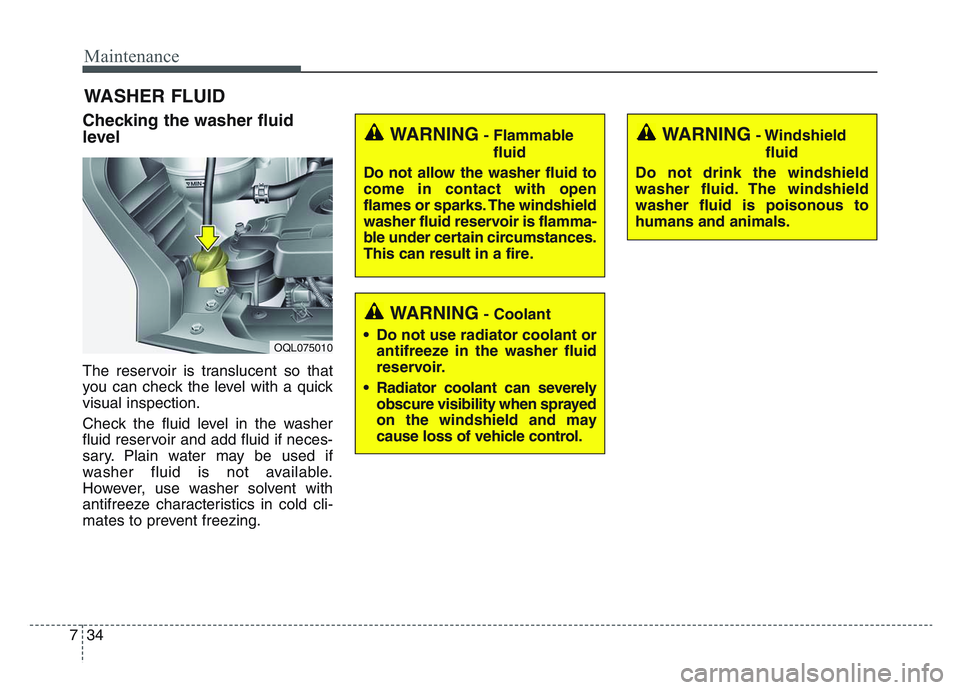
Checking the washer fluid
level
The reservoir is translucent so that
you can check the level with a quick
visual inspection.
Check the fluid level in the washer
fluid reservoir and add fluid if neces-
sary. Plain water may be used if
washer fluid is not available.
However, use washer solvent with
antifreeze characteristics in cold cli-
mates to prevent freezing.
WARNING- Flammablefluid
Do not allow the washer fluid to
come in contact with open
flames or sparks. The windshield
washer fluid reservoir is flamma-
ble under certain circumstances.
This can result in a fire.WARNING- Windshield fluid
Do not drink the windshield
washer fluid. The windshield
washer fluid is poisonous to
humans and animals.
WARNING- Coolant
• Do not use radiator coolant or antifreeze in the washer fluid
reservoir.
• Radiator coolant can severely obscure visibility when sprayed
on the windshield and may
cause loss of vehicle control.
OQL075010
Page 540 of 631
7 43
Maintenance
BATTERY
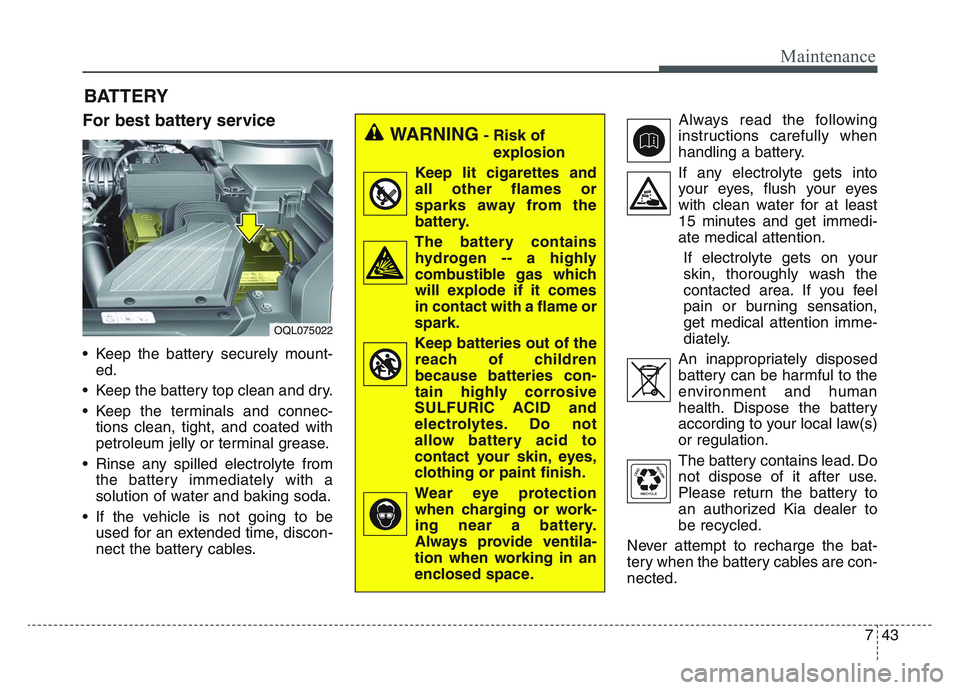
For best battery service
• Keep the battery securely mount-ed.
• Keep the battery top clean and dry.
• Keep the terminals and connec- tions clean, tight, and coated with
petroleum jelly or terminal grease.
• Rinse any spilled electrolyte from the battery immediately with a
solution of water and baking soda.
• If the vehicle is not going to be used for an extended time, discon-
nect the battery cables. Always read the following
instructions carefully when
handling a battery.
If any electrolyte gets into your eyes, flush your eyes
with clean water for at least
15 minutes and get immedi-
ate medical attention.
If electrolyte gets on your
skin, thoroughly wash the
contacted area. If you feel
pain or burning sensation,
get medical attention imme-
diately.
An inappropriately disposed battery can be harmful to the
environment and human
health. Dispose the battery
according to your local law(s)
or regulation.
The battery contains lead. Do
not dispose of it after use.
Please return the battery to
an authorized Kia dealer to
be recycled.
Never attempt to recharge the bat-
tery when the battery cables are con-
nected.
WARNING- Risk of explosion
Keep lit cigarettes and
all other flames or
sparks away from the
battery.
The battery contains hydrogen -- a highly
combustible gas which
will explode if it comes
in contact with a flame or
spark.
Keep batteries out of the reach of children
because batteries con-
tain highly corrosive
SULFURIC ACID and
electrolytes. Do not
allow battery acid to
contact your skin, eyes,
clothing or paint finish.
Wear eye protection when charging or work-
ing near a battery.
Always provide ventila-
tion when working in an
enclosed space.
OQL075022
Page 542 of 631
7 45
Maintenance
When recharging the battery,
observe the following precautions:
• The battery must be removed fromthe vehicle and placed in an area
with good ventilation.
• Do not allow cigarettes, sparks, or flame near the battery.
• Watch the battery during charging, and stop or reduce the charging
rate if the battery cells begin
gassing (boiling) violently or if the
temperature of the electrolyte of
any cell exceeds 120°F (49°C).
• Wear eye protection when check- ing the battery during charging.
• Disconnect the battery charger in the following order.
1. Turn off the battery charger main switch.
2. Unhook the negative clamp from the negative battery terminal.
3. Unhook the positive clamp from the positive battery terminal. • Before performing maintenance or
recharging the battery, turn off all
accessories and stop the engine.
• The negative battery cable must be removed first and installed last
when the battery is disconnected.Reset items
Items should be reset after the bat-
tery has been discharged or the bat-
tery has been disconnected.
• Auto up/down window
• Sunroof
• Trip computer
• Climate control system
• Driver position memory system
Page 630 of 631
I11
Index
Warning and indicator lights........................................4-104Indicator lights ..........................................................4-111
Warning lights ..........................................................4-104
Washer fluid ..................................................................7-34 Checking the washer fluid level..................................7-34
Welcome system ..........................................................4-142 Headlight (Headlamp) escort function......................4-142
Interior light ..............................................................4-142
Pocket lamp ..............................................................4-142
Windows ........................................................................\
4-41 Power windows ..........................................................4-42
Windshield defrosting and defogging..........................4-168 Automatic climate control system ............................4-169
Defogging logic ........................................................4-170
Manual climate control system ................................4-168
Winter driving ..............................................................5-156 Carry emergency equipment ....................................5-160
Change to "winter weight" oil if necessary ..............5-159
Check battery and cables ..........................................5-158
Check spark plugs and ignition system ....................5-159
Don’t let your parking brake freeze..........................5-159
Don't let ice and snow accumulate underneath ........5-159
To keep locks from freezing ....................................5-159
Use approved window washer anti-freeze in system .. 5-159
Use high quality ethylene glycol coolant ................5-158 Wiper blades ..................................................................7-40
Blade inspection ..........................................................7-40
Blade replacement ......................................................7-40
Wipers and washers ....................................................4-135 Front windshield washers ........................................4-136
Rear window wiper and washer switch ....................4-137
Windshield wipers ....................................................4-135
W