warning lights KIA STINGER 2018 Owner's Guide
[x] Cancel search | Manufacturer: KIA, Model Year: 2018, Model line: STINGER, Model: KIA STINGER 2018Pages: 551, PDF Size: 13.75 MB
Page 330 of 551
577
Driving your vehicle
- The radar or camera or cameralens is damaged.
- If the headlights of the vehicle are not used at night or in the tunnel
section, or the light is too weak
- If street light or the light of the vehi- cle coming from the opposite is
reflected or when sunlight is
reflected by the water on the road
surface
- When the back light is projected in the direction of the vehicle's motion
(including the headlights of vehi-
cles)
- Road sign, shadow on the road, tunnel entrance, toll gate, partial
pavement
- If the moist on the front windshield is not entirely removed or it is
frozen
- The weather is foggy
- The radar/camera sensor recogni- tion is limited.
✽ ✽ NOTICE
The system may temporarily cancel
due to the strong electric waves.
Pay great caution to the vehicle in
front, when it has heavy loading
extended rearward, or when it has
higher ground clearance.
The FCA system is designed to detect and monitor the vehicle
ahead or detect a pedestrian in the
roadway through radar signals and
camera recognition. It is not
designed to detect bicycles, motor-
cycles, or smaller wheeled objects
such as lug- gage bags, shopping
carts, or strollers.
The FCA does not operate in a cer- tain situation. Thus, never test-
operate the FCA against a person
or an object. It may cause a severe
injury or even death.
When replacing or reinstalling the windshield, front bumper or
radar/camera after removal, have
the vehicle inspected by a profes-
sional workshop. Kia recommends
to visit an authorized Kia
dealer/service partner.
WARNING - Testing the
FCA
The FCA does not operate in
certain situations. Thus, never
test-operate the FCA against a
person or an object. It may
cause a severe injury or even
death.
WARNING - FCA and
Towing
Cancel the FCA in the User
Settings on the LCD display,
before towing another vehicle.
While towing, the brake applica-
tion may adversely affect your
vehicle safety.
Page 354 of 551
5101
Driving your vehicle
Your vehicle may be equipped with
the ISG system, which reduces fuel
consumption by automatically shut-
ting down the engine, when the vehi-
cle is at a standstill. (For example :
red light, stop sign and traffic jam)
The engine starts automatically as
soon as the starting conditions are
met.
The ISG system is ON whenever the
engine is running.
✽ ✽NOTICE
When the engine automatically
starts by the ISG system, some
warning lights (ABS, ESC, ESC
OFF, EPS or Parking brake warn-
ing light) may turn on for a few sec-
onds.
This happens because of low battery
voltage. It does not mean the system
has malfunctioned.
Auto stop
To stop the engine in idle stop
mode
Stop the vehicle completely by
pressing the brake pedal and the
shift lever is in the D(Drive) or
N(Neutral) position
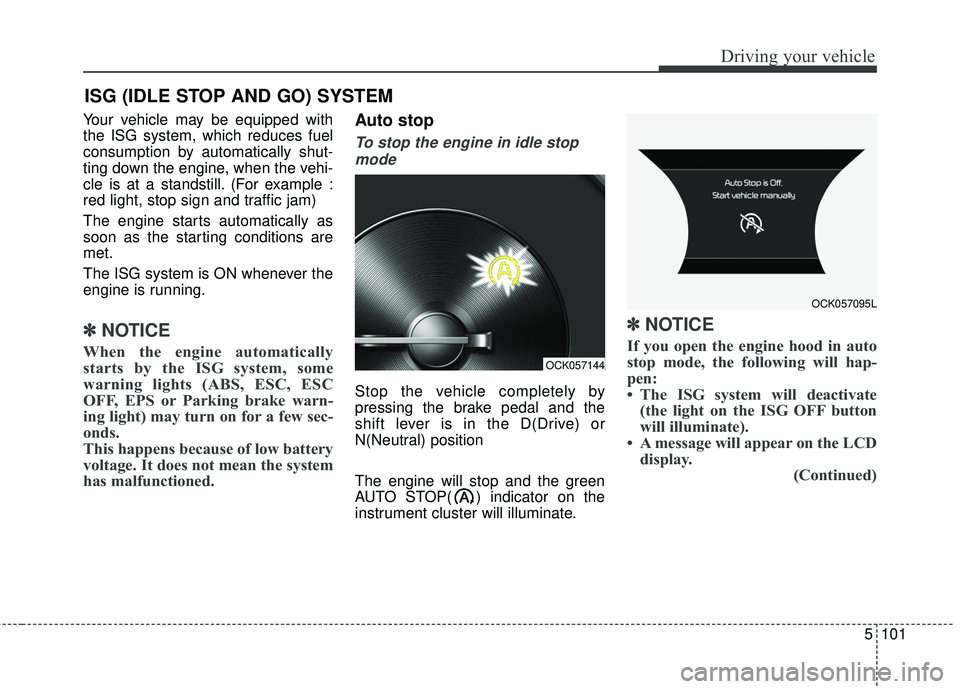
The engine will stop and the green
AUTO STOP( ) indicator on the
instrument cluster will illuminate.
✽ ✽ NOTICE
If you open the engine hood in auto
stop mode, the following will hap-
pen:
• The ISG system will deactivate
(the light on the ISG OFF button
will illuminate).
• A message will appear on the LCD display. (Continued)
ISG (IDLE STOP AND GO) SYSTEM
OCK057144
OCK057095L
Page 402 of 551
What to do in an emergency
26
ROAD WARNING
Hazard warning flasher
The hazard warning flasher serves
as a warning to other drivers to exer-
cise extreme caution when
approaching, overtaking, or passing
your vehicle.
It should be used whenever emer-
gency repairs are being made or
when the vehicle is stopped near the
edge of a roadway.
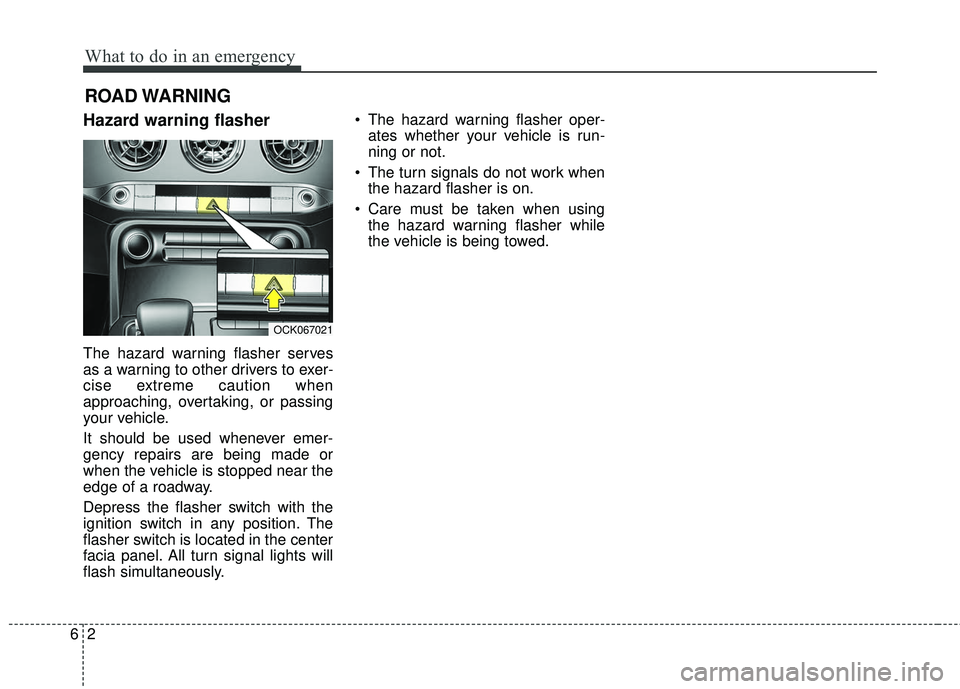
Depress the flasher switch with the
ignition switch in any position. The
flasher switch is located in the center
facia panel. All turn signal lights will
flash simultaneously.• The hazard warning flasher oper-
ates whether your vehicle is run-
ning or not.
The turn signals do not work when the hazard flasher is on.
Care must be taken when using the hazard warning flasher while
the vehicle is being towed.
OCK067021
Page 436 of 551
Maintenance
87
At least monthly:
Check the coolant level in theengine coolant reservoir.
Check the operation of all exterior lights, including the stoplights, turn
signals and hazard warning flash-
ers.
Check the inflation pressures of all tires including the spare.
At least twice a year
(i.e., every Spring and Fall) :
Check the radiator, heater and air conditioning hoses for leaks or
damage.
Check the windshield washer spray and wiper operation. Clean
the wiper blades with clean cloth
dampened with washer fluid.
Check the headlight alignment.
Check the muffler, exhaust pipes, shields and clamps.
Check the lap/shoulder belts for wear and function.
Check for worn tires and loose wheel lug nuts.
At least once a year :
Clean the body and door drainholes.
Lubricate the door hinges and check the hood hinges.
Lubricate the door and hood locks and latches.
Lubricate the door rubber weather- strips.
Check the air conditioning system.
Inspect and lubricate automatic transaxle linkage and controls.
Clean the battery and terminals.
Check the brake fluid level.
Page 482 of 551
Maintenance
54
7
FUSES
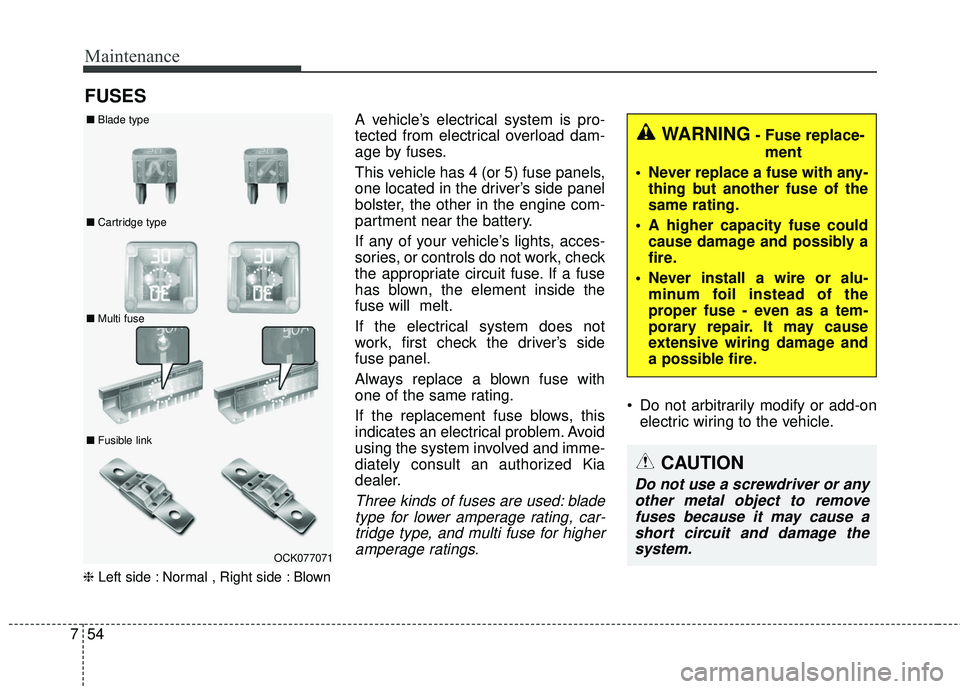
❈ Left side : Normal , Right side : Blown
A vehicle’s electrical system is pro-
tected from electrical overload dam-
age by fuses.
This vehicle has 4 (or 5) fuse panels,
one located in the driver’s side panel
bolster, the other in the engine com-
partment near the battery.
If any of your vehicle’s lights, acces-
sories, or controls do not work, check
the appropriate circuit fuse. If a fuse
has blown, the element inside the
fuse will melt.
If the electrical system does not
work, first check the driver’s side
fuse panel.
Always replace a blown fuse with
one of the same rating.
If the replacement fuse blows, this
indicates an electrical problem. Avoid
using the system involved and imme-
diately consult an authorized Kia
dealer.
Three kinds of fuses are used: blade
type for lower amperage rating, car-tridge type, and multi fuse for higheramperage ratings.
Do not arbitrarily modify or add-on electric wiring to the vehicle.
WARNING- Fuse replace-
ment
Never replace a fuse with any- thing but another fuse of the
same rating.
A higher capacity fuse could cause damage and possibly a
fire.
Never install a wire or alu- minum foil instead of the
proper fuse - even as a tem-
porary repair. It may cause
extensive wiring damage and
a possible fire.
CAUTION
Do not use a screwdriver or anyother metal object to removefuses because it may cause ashort circuit and damage thesystem.
OCK077071
■
Blade type
■ Cartridge type
■ Multi fuse
■ Fusible link
Page 505 of 551
777
Maintenance
LIGHT BULBS
Bulb replacement precaution
Please keep extra bulbs on hand
with appropriate wattage ratings in
case of emergencies.
Refer to “Bulb Wattage” in chapter 8.
When changing lamps, first turn off
the engine at a safe place, firmly
apply the parking brake and detach
the battery’s negative (-) terminal.
Use only bulbs of the specifiedwattage.✽ ✽ NOTICE
• If the light bulb or lamp connector
is removed while the lamp is still
on, the fuse box's electronic sys-
tem may log it as a malfunction.
Therefore, a lamp malfunction
incident may be recorded as a
Diagnostic Trouble Code (DTC) in
the fuse box.
• It is normal for an operating lamp to flicker momentarily. This is due
to a stabilization function of the
vehicle’s electronic control device.
If the lamp lights up normally
after momentarily blinking, then
it is functioning as normal.
However, if the lamp continues to
flicker several times or turns off
completely, there may be an error
in the vehicle’s electronic control
device. Please have the vehicle
checked by an authorized Kia
dealer immediately.
WARNING- Working on
the lights
Prior to working on the light,
firmly apply the parking brake,
ensure that the ignition switch
is turned to the LOCK position
and turn off the lights to avoid
sudden movement of the vehi-
cle and burning your fingers or
receiving an electric shock.
CAUTION -Light replace-
ment
Be sure to replace the burned- out bulb with one of the samewattage rating. Otherwise, itmay cause damage to the fuseor electric wiring system.
CAUTION -Headlamp
Lens
To prevent damage, do notclean the headlamp lens withchemical solvents or strongdetergents.
Page 547 of 551
Index
6I
Seat warmer . . . . . . . . . . . . . . . . . . . . . . . . . . . . . . 4-153
Sunvisor . . . . . . . . . . . . . . . . . . . . . . . . . . . . . . . . . 4-155
USB charger . . . . . . . . . . . . . . . . . . . . . . . . . . . . . . 4-157
Wireless smart phone charging system . . . . . . . . . 4-157
Interior lights . . . . . . . . . . . . . . . . . . . . . . . . . . . . . . . 4-126 Automatic turn off function . . . . . . . . . . . . . . . . . . 4-126
Door courtesy lamp . . . . . . . . . . . . . . . . . . . . . . . . 4-129
Glove box lamp . . . . . . . . . . . . . . . . . . . . . . . . . . . 4-128
Liftgate room lamp. . . . . . . . . . . . . . . . . . . . . . . . . 4-128
Map lamp . . . . . . . . . . . . . . . . . . . . . . . . . . . . . . . . 4-127
Room lamp . . . . . . . . . . . . . . . . . . . . . . . . . . . . . . . 4-126
Vanity mirror lamp . . . . . . . . . . . . . . . . . . . . . . . . . 4-128
Interior overview. . . . . . . . . . . . . . . . . . . . . . . . . . . . . . . 2-4
ISG (Idle Stop and Go) system . . . . . . . . . . . . . . . . . 5-101 Auto start . . . . . . . . . . . . . . . . . . . . . . . . . . . . . . . . 5-102
Auto stop . . . . . . . . . . . . . . . . . . . . . . . . . . . . . . . . 5-101
Condition of ISG system operation . . . . . . . . . . . . 5-103
ISG system deactivation . . . . . . . . . . . . . . . . . . . . . 5-103
ISG system malfunction . . . . . . . . . . . . . . . . . . . . . 5-104
Lane Keeping Assist (LKA) system . . . . . . . . . . . . . . 5-110 Driver's attention . . . . . . . . . . . . . . . . . . . . . . . . . . 5-116
LKA system function change. . . . . . . . . . . . . . . . . 5-118
LKA system malfunction . . . . . . . . . . . . . . . . . . . . 5-117
LKA system operation . . . . . . . . . . . . . . . . . . . . . . 5-112 LCD windows . . . . . . . . . . . . . . . . . . . . . . . . . . . . . . . . 4-73
Distance to empty. . . . . . . . . . . . . . . . . . . . . . . . . . . 4-81
LCD modes . . . . . . . . . . . . . . . . . . . . . . . . . . . . . . . 4-77
Over view . . . . . . . . . . . . . . . . . . . . . . . . . . . . . . . . . 4-73
Trip information (Trip computer) . . . . . . . . . . . . . . 4-73
User settings mode . . . . . . . . . . . . . . . . . . . . . . . . . . 4-82
Warning message . . . . . . . . . . . . . . . . . . . . . . . . . . . 4-87
Liftgate . . . . . . . . . . . . . . . . . . . . . . . . . . . . . . . . . . . . \
. 4-21 Emergency liftgate safety release. . . . . . . . . . . . . . . 4-28
Non-Powered liftgate . . . . . . . . . . . . . . . . . . . . . . . . 4-21
Power liftgate . . . . . . . . . . . . . . . . . . . . . . . . . . . . . . 4-23
Light bulbs . . . . . . . . . . . . . . . . . . . . . . . . . . . . . . . . . . 7-77\
Back-up lamp bulb replacement . . . . . . . . . . . . . . . 7-86
Bulb replacement precaution . . . . . . . . . . . . . . . . . . 7-77
Front turn signal lamp bulb replacement (Headlamp Type A) . . . . . . . . . . . . . . . . . . . . . . . . 7-82
Glove box lamp (LED type) bulb replacement . . . . 7-90
Headlamp (LED type) replacement (Headlamp Type B) . . . . . . . . . . . . . . . . . . . . . . . . 7-80
Headlamp (Low/High beam) bulb replacement (Headlamp Type A) . . . . . . . . . . . . . . . . . . . . . . . . 7-81
High mounted stop lamp (LED type) bulb replacement . . . . . . . . . . . . . . . . . . . . . . . . . . . . . . 7-88
License plate lamp (LED type) bulb replacement . . 7-88
Light bulb position (Front) . . . . . . . . . . . . . . . . . . . 7-78
Light bulb position (Rear) . . . . . . . . . . . . . . . . . . . . 7-79
Light bulb position (Side) . . . . . . . . . . . . . . . . . . . . 7-79
Luggage room lamp (LED type) bulb replacement . 7-90
L
Page 551 of 551
Index
10I
Vehicle weight . . . . . . . . . . . . . . . . . . . . . . . . . . . . . . 5-147
Warning and indicator lights. . . . . . . . . . . . . . . . . . . . . 4-92Indicator lights . . . . . . . . . . . . . . . . . . . . . . . . . . . . 4-100
Warning lights . . . . . . . . . . . . . . . . . . . . . . . . . . . . . 4-92
Washer fluid . . . . . . . . . . . . . . . . . . . . . . . . . . . . . . . . . 7-27 Checking the washer fluid level . . . . . . . . . . . . . . . . 7-27
Welcome system . . . . . . . . . . . . . . . . . . . . . . . . . . . . . 4-130 Headlight (Headlamp) escort function . . . . . . . . . . 4-130
Interior light . . . . . . . . . . . . . . . . . . . . . . . . . . . . . . 4-130
Pocket lamp . . . . . . . . . . . . . . . . . . . . . . . . . . . . . . 4-130
Wide sunroof. . . . . . . . . . . . . . . . . . . . . . . . . . . . . . . . . 4-45 Closing the sunroof . . . . . . . . . . . . . . . . . . . . . . . . . 4-49
Resetting the sunroof . . . . . . . . . . . . . . . . . . . . . . . . 4-50
Sliding the sunroof . . . . . . . . . . . . . . . . . . . . . . . . . . 4-47
Sunroof open warning . . . . . . . . . . . . . . . . . . . . . . . 4-46
Sunshade. . . . . . . . . . . . . . . . . . . . . . . . . . . . . . . . . . 4-47\
Tilting the sunroof . . . . . . . . . . . . . . . . . . . . . . . . . . 4-49
Windows . . . . . . . . . . . . . . . . . . . . . . . . . . . . . . . . . . . . \
4-34 Power windows . . . . . . . . . . . . . . . . . . . . . . . . . . . . 4-35
Windshield defrosting and defogging. . . . . . . . . . . . . 4-146 Automatic climate control system . . . . . . . . . . . . . 4-146
Automatic ventilation . . . . . . . . . . . . . . . . . . . . . . . 4-149
Defogging logic . . . . . . . . . . . . . . . . . . . . . . . . . . . 4-147
Smart ventilation . . . . . . . . . . . . . . . . . . . . . . . . . . 4-149 Winter driving . . . . . . . . . . . . . . . . . . . . . . . . . . . . . . . 5-140
Carry emergency equipment . . . . . . . . . . . . . . . . . 5-142
Change to “winter weight” oil if necessary . . . . . . 5-141
Check battery and cables . . . . . . . . . . . . . . . . . . . . 5-141
Check spark plugs and ignition system . . . . . . . . . 5-141
Don’t let your parking brake freeze . . . . . . . . . . . . 5-142
Don't let ice and snow accumulate underneath . . . 5-142
Snowy or icy conditions . . . . . . . . . . . . . . . . . . . . . 5-140
To keep locks from freezing. . . . . . . . . . . . . . . . . . 5-141
Use approved window washeranti-freeze in system . 5-141
Use high quality ethylene glycol coolant. . . . . . . . 5-141
Wiper blades . . . . . . . . . . . . . . . . . . . . . . . . . . . . . . . . . 7-32 Blade inspection . . . . . . . . . . . . . . . . . . . . . . . . . . . . 7-32
Blade replacement . . . . . . . . . . . . . . . . . . . . . . . . . . 7-32
Wipers and washers . . . . . . . . . . . . . . . . . . . . . . . . . . 4-122 Front windshield washers. . . . . . . . . . . . . . . . . . . . 4-124
Windshield wipers . . . . . . . . . . . . . . . . . . . . . . . . . 4-122
W