tire type KIA STINGER 2021 Owners Manual
[x] Cancel search | Manufacturer: KIA, Model Year: 2021, Model line: STINGER, Model: KIA STINGER 2021Pages: 585, PDF Size: 10.87 MB
Page 301 of 585
Driving your vehicle
40 5
✽
✽
NOTICE
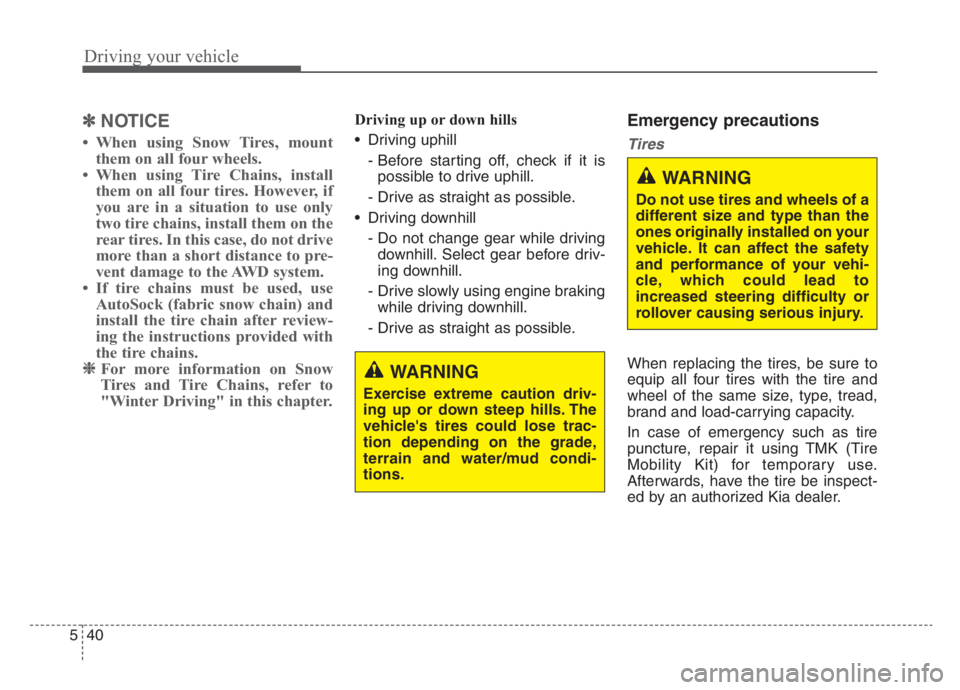
• When using Snow Tires, mount
them on all four wheels.
• When using Tire Chains, install
them on all four tires. However, if
you are in a situation to use only
two tire chains, install them on the
rear tires. In this case, do not drive
more than a short distance to pre-
vent damage to the AWD system.
• If tire chains must be used, use
AutoSock (fabric snow chain) and
install the tire chain after review-
ing the instructions provided with
the tire chains.
❈ ❈
For more information on Snow
Tires and Tire Chains, refer to
"Winter Driving" in this chapter.
Driving up or down hills
Driving uphill
- Before starting off, check if it is
possible to drive uphill.
- Drive as straight as possible.
Driving downhill
- Do not change gear while driving
downhill. Select gear before driv-
ing downhill.
- Drive slowly using engine braking
while driving downhill.
- Drive as straight as possible.Emergency precautions
Tires
When replacing the tires, be sure to
equip all four tires with the tire and
wheel of the same size, type, tread,
brand and load-carrying capacity.
In case of emergency such as tire
puncture, repair it using TMK (Tire
Mobility Kit) for temporary use.
Afterwards, have the tire be inspect-
ed by an authorized Kia dealer.WARNING
Exercise extreme caution driv-
ing up or down steep hills. The
vehicle's tires could lose trac-
tion depending on the grade,
terrain and water/mud condi-
tions.
WARNING
Do not use tires and wheels of a
different size and type than the
ones originally installed on your
vehicle. It can affect the safety
and performance of your vehi-
cle, which could lead to
increased steering difficulty or
rollover causing serious injury.
Page 404 of 585

5143
Driving your vehicle
Severe weather conditions in the
winter result in greater wear and
other problems. To minimize the
problems of winter driving, you
should follow these suggestions:Snowy or icy conditions
To drive your vehicle in deep snow, it
may be necessary to use snow tires
or to install tire chains on your tires.
If snow tires are needed, it is neces-
sary to select tires equivalent in size
and type of the original equipment
tires. Failure to do so may adversely
affect the safety and handling of your
vehicle. Furthermore, speeding,
rapid acceleration, sudden brake
applications, and sharp turns are
potentially very hazardous practices.
During deceleration, use engine
braking to the fullest extent. Sudden
brake applications on snowy or icy
roads may cause skids to occur. You
need to keep sufficient distance
between the vehicle in operation in
front of your vehicle. Also, apply the
brake gently. It should be noted that
installing tire chains on the tire will
provide a greater driving force, but
will not prevent side skids.
Tire chains are not legal in all states.
Check state laws before fitting tire
chains.
Snow tires
If you mount snow tires on your vehi-
cle, make sure they are radial tires of
the same size and load range as the
original tires. Mount snow tires on all
four wheels to balance your vehicle’s
handling in all weather conditions.
Keep in mind that the traction provid-
ed by snow tires on dry roads may
not be as high as your vehicle's orig-
inal equipment tires. You should drive
cautiously even when the roads are
clear. Check with the tire dealer for
maximum speed recommendations.
Do not install studded tires without
first checking local, state and munic-
ipal regulations for possible restric-
tions against their use.
WINTER DRIVING
WARNING - Driving with
summer tires
Summer tires are equipped to
provide the best driving per-
formance on dry roads, varying
according to specification.
Do not use summer tires at tem-
peratures below 45°F (7°C) or
when driving on snow or ice. At
temperatures below 45°F (7°C),
summer tires can lose elastici-
ty, and therefore traction and
braking power as well. Change
the tires on your vehicle to win-
ter or all-weather tires of the
same size as the standard tires
of the vehicle. Both types of
tires are identified by the M+S
(Mud and Snow) marking. Using
summer tires at very cold tem-
peratures could cause cracks to
form, thereby damaging the
tires permanently.
WARNING - Snow tire size
Snow tires should be equivalent
in size and type to the vehicle's
standard tires. Otherwise, the
safety and handling of your vehi-
cle may be adversely affected.
Page 405 of 585

Driving your vehicle
144 5
Tire chains
Since the sidewalls on some radial
tires are thinner than other types of
tires, they may be damaged by
mounting certain types of tire chains
on them. Therefore, the use of snow
tires is recommended instead of tire
chains. Do not mount tire chains on
vehicles equipped with aluminum
wheels; if unavoidable, use AutoSock
(fabric snow chain). Install the tire
chain after reviewing the instructions
provided with the tire chains.
Damage to your vehicle caused by
improper tire chain use is not cov-
ered by your vehicle manufacturer’s
warranty.
✽ ✽
NOTICE
• Install AutoSock (fabric snow
chain) on the rear tires for 2WD
vehicles or for AWD vehicles. It
should be noted that installing
AutoSock (fabric snow chain) on the
tires will provide a greater driving
force, but will not prevent side skids.
• Do not install studded tires with-
out first checking local and munic-
ipal regulations for possible
restrictions against their use.
✽ ✽
NOTICE
If you hear noise caused by chains
contacting the body, retighten the
chain to prevent contact with the
vehicle body.
OCK057168
CAUTION
When using AutoSock (fabric
snow chain):
Wrong size chains or improp-
erly installed chains can dam-
age your vehicle's brake lines,
suspension, body and wheels.
To prevent body damage,
retighten the chains after driv-
ing 0.3 ~ 0.6 miles (0.5 ~ 1.0 km).
Page 439 of 585

625
What to do in an emergency
Notes on the safe use of the
Tire Mobility Kit
Park your car at the side of the
road so that you can work with the
Tire Mobility Kit away from moving
traffic. Place your warning triangle
in a prominent place to make pass-
ing vehicles aware of your location.
To be sure your vehicle will not
move, even when you're on fairly
level ground, always set your park-
ing brake.
Only use the Tire Mobility Kit for
sealing/inflation passenger car
tires. Do not use on motorcycles,
bicycles or any other type of tires.
Do not remove any foreign objects-
such as nails or screws -that have
penetrated the tire.
Before using the Tire Mobility Kit,
read the precautionary advice
printed on the sealant bottle! Provided the car is outdoors, leave
the engine running. Otherwise
operating the compressor may
eventually drain the car battery.
Never leave the Tire Mobility Kit
unattended while it is being used.
Do not leave the compressor run-
ning for more than 10 min. at a time
or it may overheat.
Do not use the Tire Mobility Kit if
the ambient temperature is below
-22°F (-30°C).
When the tire and wheel are dam-
aged, do not use Tire Mobility Kit
for your safety.
WARNING
Do not use the Tire Mobility Kit
if a tire is severely damaged.
Only punctured areas located
within the tread region of the
tire can be sealed using the Tire
Mobility Kit.
Page 454 of 585

• Summer tires . . . . . . . . . . . . . . . . . . . . . . . . . . . . . . . . 7-51
• Snow tires . . . . . . . . . . . . . . . . . . . . . . . . . . . . . . . . . . . 7-52
• Tire chains . . . . . . . . . . . . . . . . . . . . . . . . . . . . . . . . . . 7-52
• Radial-ply tires . . . . . . . . . . . . . . . . . . . . . . . . . . . . . . 7-52
• Low aspect ratio tire . . . . . . . . . . . . . . . . . . . . . . . . . . 7-53
Fuses . . . . . . . . . . . . . . . . . . . . . . . . . . . . . . . . . . . . 7-55
• Inner panel fuse replacement . . . . . . . . . . . . . . . . . . . 7-57
• Engine compartment fuse replacement. . . . . . . . . . . 7-59
• Fuse/relay panel description. . . . . . . . . . . . . . . . . . . . 7-61
Light bulbs . . . . . . . . . . . . . . . . . . . . . . . . . . . . . . . 7-78
• Bulb replacement precaution . . . . . . . . . . . . . . . . . . . 7-78
• Light bulb position (Front). . . . . . . . . . . . . . . . . . . . . 7-80
• Light bulb position (Rear) . . . . . . . . . . . . . . . . . . . . . 7-80
• Light bulb position (Side) . . . . . . . . . . . . . . . . . . . . . . 7-81
• Headlamp (LED type) replacement
(Headlamp Type B) . . . . . . . . . . . . . . . . . . . . . . . . . . 7-82
• Side marker bulb replacement (Headlamp Type A) . 7-82
• Position lamp + DRL (LED type) bulb replacement
(Headlamp Type A) . . . . . . . . . . . . . . . . . . . . . . . . . . 7-82
• Headlamp (Low/High beam) bulb replacement
(Headlamp Type A) . . . . . . . . . . . . . . . . . . . . . . . . . . 7-83
• Front turn signal lamp bulb replacement
(Headlamp Type A) . . . . . . . . . . . . . . . . . . . . . . . . . . 7-84
• Stop and tail lamp (LED type) bulb replacement . . 7-85
• Rear side marker (LED type) bulb replacement . . . 7-86• Rear turn signal lamp (LED type) bulb
replacement . . . . . . . . . . . . . . . . . . . . . . . . . . . . . . . . 7-86
• Rear turn signal lamp (bulb type) bulb
replacement . . . . . . . . . . . . . . . . . . . . . . . . . . . . . . . . 7-86
• Back-up lamp bulb replacement . . . . . . . . . . . . . . . . 7-88
• High mounted stop lamp (LED type) bulb
replacement . . . . . . . . . . . . . . . . . . . . . . . . . . . . . . . . 7-90
• License plate lamp (LED type) bulb replacement . . 7-90
• Side repeater lamp (LED type) bulb replacement . . 7-90
• Map lamp (LED type) bulb replacement . . . . . . . . . 7-91
• Vanity mirror lamp (LED type) bulb replacement . 7-91
• Room lamp (LED type) bulb replacement . . . . . . . . 7-91
• Glove box lamp (LED type) bulb replacement . . . . 7-92
• Luggage room lamp (LED type) bulb replacement . 7-92
Appearance care . . . . . . . . . . . . . . . . . . . . . . . . . . . 7-93
• Exterior care . . . . . . . . . . . . . . . . . . . . . . . . . . . . . . . . 7-93
• Interior care . . . . . . . . . . . . . . . . . . . . . . . . . . . . . . . . . 7-98
Emission control system . . . . . . . . . . . . . . . . . . . 7-101
• Crankcase emission control system . . . . . . . . . . . . . 7-101
• Evaporative emission control (including ORVR:
Onboard Refueling Vapor Recovery) system . . . . 7-101
• Exhaust emission control system . . . . . . . . . . . . . . . 7-1027
Page 497 of 585

745
Maintenance
Tire sidewall labeling
This information identifies and
describes the fundamental charac-
teristics of the tire and also provides
the tire identification number (TIN)
for safety standard certification. The
TIN can be used to identify the tire in
case of a recall.
1. Manufacturer or brand name
Manufacturer or Brand name is
shown.
2. Tire size designation
A tire’s sidewall is marked with a tire
size designation. You will need this
information when selecting replace-
ment tires for your car. The following
explains what the letters and num-
bers in the tire size designation
mean.
Example tire size designation:
(These numbers are provided as an
example only; your tire size designa-
tor could vary depending on your
vehicle.)
P205/55R16 89H
P - Applicable vehicle type (tires
marked with the prefix “P’’ are
intended for use on passenger
vehicles or light trucks; however,
not all tires have this marking).
205 - Tire width in millimeters.
55 - Aspect ratio. The tire’s section
height as a percentage of its
width.
R - Tire construction code (Radial).
16 - Rim diameter in inches.89 - Load Index, a numerical code
associated with the maximum
load the tire can carry.
H - Speed Rating Symbol. See the
speed rating chart in this section
for additional information.
Wheel size designation
Wheels are also marked with impor-
tant information that you need if you
ever have to replace one. The follow-
ing explains what the letters and
numbers in the wheel size designa-
tion mean.
Example wheel size designation:
6.0JX16
6.0 - Rim width in inches.
J - Rim contour designation.
16 - Rim diameter in inches.
OJF085008L
Page 503 of 585

751
Maintenance
Vehicle Maximum Load on the
Tire:Load on an individual tire due
to curb and accessory weight plus
maximum occupant and cargo
weight.
Vehicle Normal Load on the Tire:
Load on an individual tire that is
determined by distributing to each
axle its share of the curb weight,
accessory weight, and normal occu-
pant weight and driving by 2.
Vehicle Placard:A label permanent-
ly attached to a vehicle showing the
original equipment tire size and rec-
ommended inflation pressure.All season tires
Kia specifies all season tires on
some models to provide good per-
formance for use all year round,
including snowy and icy road condi-
tions. All season tires are identified
by ALL SEASON and/or M+S (Mud
and Snow) on the tire sidewall. Snow
tires have better snow traction than
all season tires and may be more
appropriate in some areas.
Summer tires
Kia specifies summer tires on some
models to provide superior perform-
ance on dry roads. Summer tire per-
formance is substantially reduced in
snow and ice. Summer tires do not
have the tire traction rating M+S
(Mud and Snow) on the tire side wall.
If you plan to operate your vehicle in
snowy or icy conditions, Kia recom-
mends the use of snow tires or all
season tires on all four wheels.
WARNING
Do not use summer tires at tem-
peratures below 45°F (7°C) or
when driving on snow or ice. At
temperatures below 45°F (7°C),
summer tires can lose elastici-
ty, and therefore traction and
braking power as well. Change
the tires on your vehicle to win-
ter or all-weather tires of the
same size as the standard tires
of the vehicle. Both types of
tires are identified by the M+S
(Mud and Snow) marking. Using
summer tires at very cold tem-
peratures could cause cracks to
form, thereby damaging the
tires permanently.
Page 569 of 585

Specifications, Consumer information, Reporting safety defects
12 8
Roadside Assistance is provided on all new current
model year Kia Vehicles from the date the vehicle is deliv-
ered to the first retail buyer or otherwise put into use (in-
service date), whichever is earlier, for a period of 60
months or 60,000 miles, whichever is earlier, subject to
the terms, conditions and exclusions set forth in the Kia
Warranty and Consumer Information Manual applicable
to your model year vehicle.
KMA reserves the right to limit or deny services or other
benefits to any owner or driver when, in KMA's judgment,
the claims and/or service requests are excessive in fre-
quency or type of occurrence.
Toll free consumer assistance
Kia's toll-free Consumer Assistance hot line is staffed
from 5:00 AM to 6:00 PM PST, Monday through Friday
and is accessible by dialing 1-800-333-4Kia (4542).
For more information regarding assistance available,
please refer to your Kia Warranty & Consumer
Information Manual.
Emergency roadside assistance
Kia's toll free Roadside Assistance hot line is staffed 24
hours a day, 365 days a year and is accessible by dialing
1-800-333-4Kia (4542).
Please note that you must provide your Vehicle
Identification Number (VIN) to verify coverage at the time
of your call. The VIN can be found on the dash of your
vehicle on the driver’s side, on the door jamb of the dri-
ver’s door, your vehicle’s registration or proof of insur-
ance card.
Kia utilizes a network of over 30,000 roadside assistance
providers. Should you accidentally run out of fuel, require
a battery jump, or need help changing a tire, a Kia
Roadside Assistance Representative will dispatch some-
one to deliver a small quantity of gas, change a flat tire
with your inflated spare, or arrange a battery jump to
allow you to proceed to your destination. We have access
to a network of over 10,000 locksmiths to help you should
you become locked out of your Kia.
In the event that mechanical difficulty renders your vehi-
cle undriveable due to a warranty-related concern, Kia’s
Roadside Assistance Representative will arrange to
transport your vehicle to the nearest Kia dealer or to an
authorized Kia alternative service location.
CONSUMER ASSISTANCE (U.S. ONLY)