engine KIA STONIC 2018 Owners Manual
[x] Cancel search | Manufacturer: KIA, Model Year: 2018, Model line: STONIC, Model: KIA STONIC 2018Pages: 523, PDF Size: 24.99 MB
Page 445 of 523
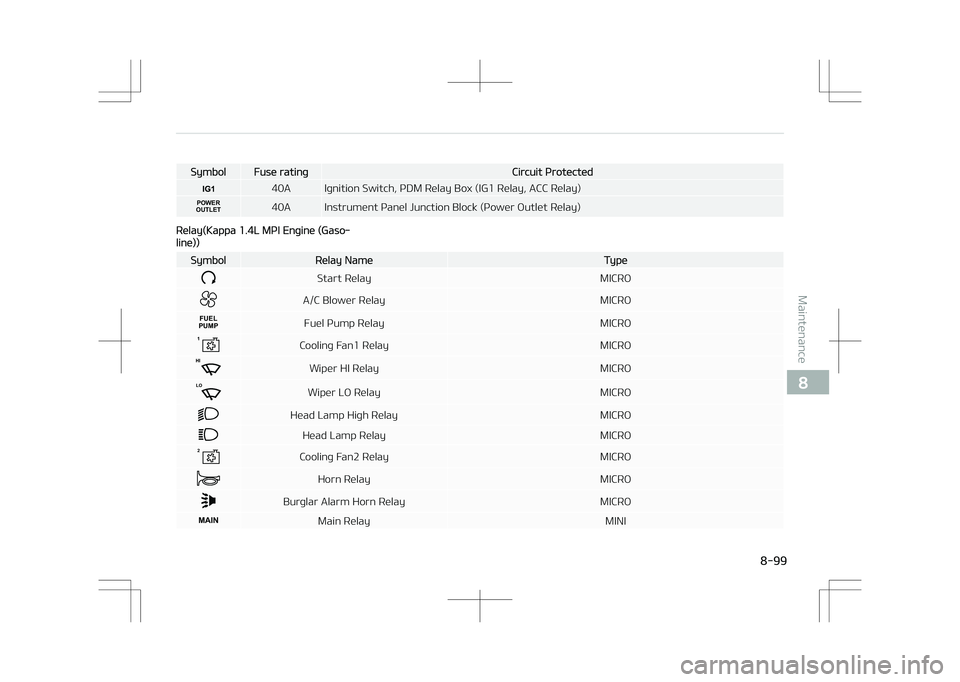
SymbolFuse ratingCircuit Protected
40A Ignition Switch, PDM Relay Box (IG1 Relay, ACC Relay)
POWER
OUTLET40A Instrument Panel Junction Block (Power Outlet Relay)
Relay(Kappa 1.4L MPI Engine (Gaso‐
line))
SymbolRelay NameType
Start Relay MICRO
A/C Blower Relay MICRO
FUEL
PUMPFuel Pump Relay MICRO
Cooling Fan1 Relay MICRO
Wiper HI RelayMICRO
LOWiper LO Relay MICRO
Head Lamp High Relay MICRO
Head Lamp RelayMICRO
2Cooling Fan2 Relay MICRO
Horn RelayMICRO
Burglar Alarm Horn Relay MICRO
MAINMain RelayMINI
8-99
8
Maintenance
Page 446 of 523
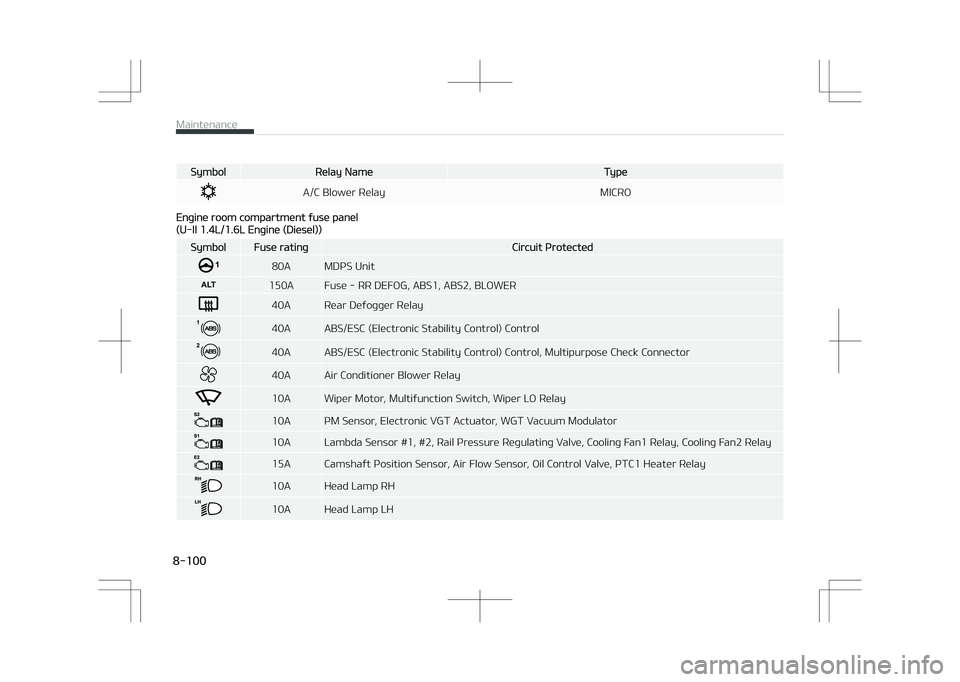
SymbolRelay NameType
A/C Blower RelayMICRO
Engine room compartment fuse panel
(U-II 1.4L/1.6L Engine (Diesel))
SymbolFuse ratingCircuit Protected
80A MDPS Unit
ALT150A Fuse - RR DEFOG, ABS1, ABS2, BLOWER
40A Rear Defogger Relay
140A ABS/ESC (Electronic Stability Control) Control
40A ABS/ESC (Electronic Stability Control) Control, Multipurpose Check Connector
40A Air Conditioner Blower Relay
10A Wiper Motor, Multifunction Switch, Wiper LO Relay
10A PM Sensor, Electronic VGT Actuator, WGT Vacuum Modulator
10A Lambda Sensor #1, #2, Rail Pressure Regulating Valve, Cooling Fan1 Relay, Cooling Fan2 Relay
15A Camshaft Position Sensor, Air Flow Sensor, Oil Control Valve, PTC1 Heater Relay
10A Head Lamp RH
10A Head Lamp LH
Maintenance
8-100
Page 448 of 523
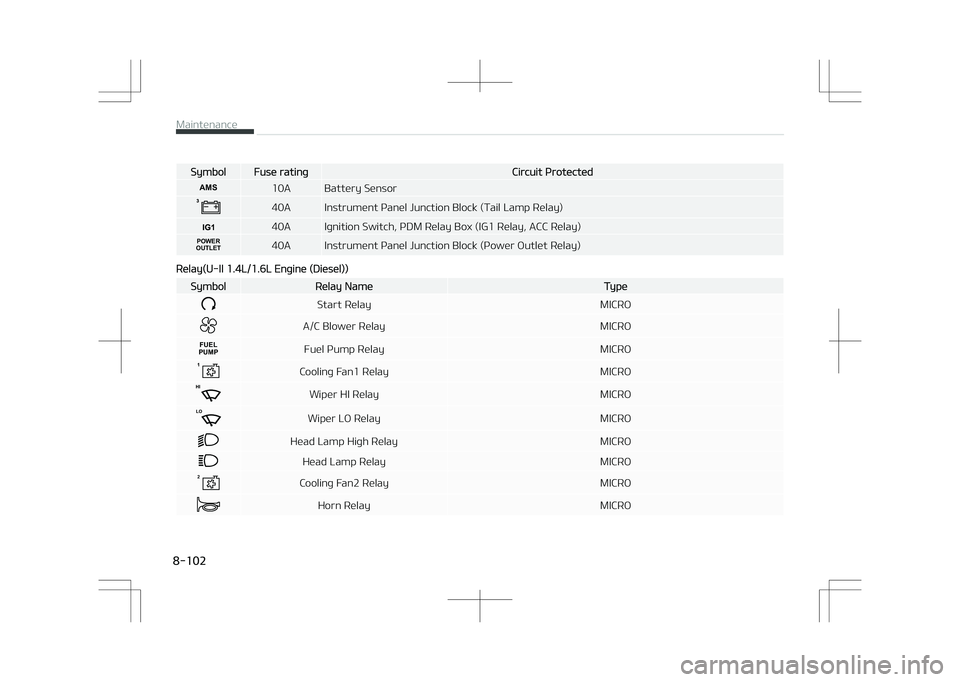
SymbolFuse ratingCircuit Protected
AMS10A Battery Sensor
40A Instrument Panel Junction Block (Tail Lamp Relay)
40A Ignition Switch, PDM Relay Box (IG1 Relay, ACC Relay)
POWER
OUTLET40A Instrument Panel Junction Block (Power Outlet Relay)
Relay(U-II 1.4L/1.6L Engine (Diesel))
SymbolRelay NameType
Start Relay MICRO
A/C Blower Relay MICRO
FUEL
PUMPFuel Pump Relay MICRO
Cooling Fan1 Relay MICRO
Wiper HI RelayMICRO
LOWiper LO Relay MICRO
Head Lamp High Relay MICRO
Head Lamp RelayMICRO
2Cooling Fan2 Relay MICRO
Horn RelayMICRO
Maintenance
8-102
Page 449 of 523
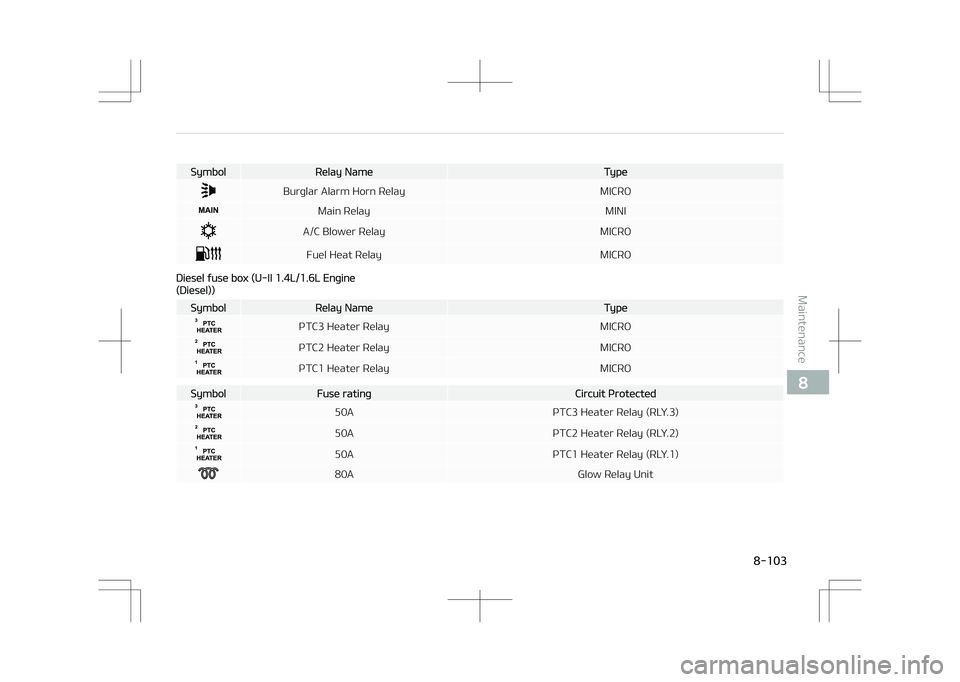
SymbolRelay NameType
Burglar Alarm Horn RelayMICRO
MAINMain RelayMINI
A/C Blower Relay MICRO
Fuel Heat RelayMICRO
Diesel fuse box (U-II 1.4L/1.6L Engine
(Diesel))
SymbolRelay NameType
PTC3 Heater Relay MICRO
PTC2 Heater RelayMICRO
PTC1 Heater RelayMICRO
SymbolFuse ratingCircuit Protected
50APTC3 Heater Relay (RLY.3)
50APTC2 Heater Relay (RLY.2)
50APTC1 Heater Relay (RLY.1)
80A Glow Relay Unit
8-103
8
Maintenance
Page 475 of 523
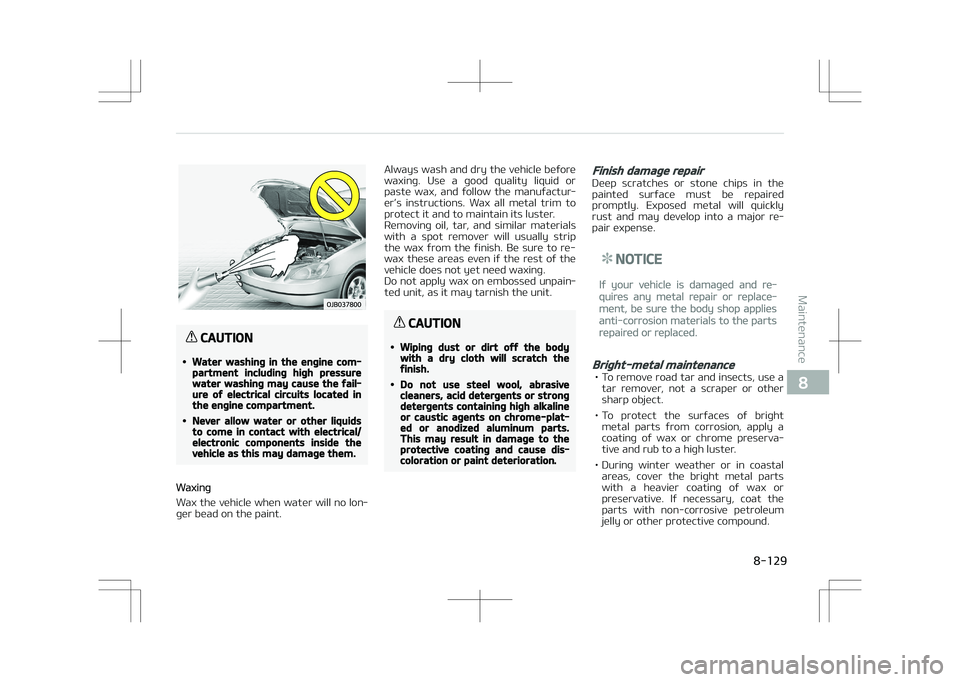
CAUTION
•Water washing in the engine com‐partment including high pressurewater washing may cause the fail‐ure of electrical circuits located inthe engine compartment.
•Never allow water or other liquidsto come in contact with electrical/electronic components inside thevehicle as this may damage them.
Waxing
Wax the vehicle when water will no lon‐
ger bead on the paint. Always wash and dry the vehicle before
waxing. Use a good quality liquid or
paste wax, and follow the manufactur‐
er’s instructions. Wax all metal trim to protect it and to maintain its luster.
Removing oil, tar, and similar materials
with a spot remover will usually strip
the wax from the finish. Be sure to re- wax these areas even if the rest of the
vehicle does not yet need waxing.
Do not apply wax on embossed unpain‐
ted unit, as it may tarnish the unit.
CAUTION
•Wiping dust or dirt off the bodywith a dry cloth will scratch thefinish.
•Do not use steel wool, abrasivecleaners, acid detergents or strongdetergents containing high alkalineor caustic agents on chrome-plat‐ed or anodized aluminum parts.This may result in damage to theprotective coating and cause dis‐coloration or paint deterioration.
Finish damage repair
Deep scratches or stone chips in the
painted surface must be repaired
promptly. Exposed metal will quickly rust and may develop into a major re‐
pair expense.
NOTICE
If your vehicle is damaged and re‐
quires any metal repair or replace‐
ment, be sure the body shop applies
anti-corrosion materials to the parts
repaired or replaced.
Bright-metal maintenance
• To remove road tar and insects, use a tar remover, not a scraper or other
sharp object.
• To protect the surfaces of bright metal parts from corrosion, apply a
coating of wax or chrome preserva‐
tive and rub to a high luster.
• During winter weather or in coastal areas, cover the bright metal parts
with a heavier coating of wax or preservative. If necessary, coat the
parts with non-corrosive petroleum
jelly or other protective compound.
8-129
8
Maintenance
Page 480 of 523
EMISSION CONTROL SYSTEM (IF EQUIPPED)
The emission control system of your vehicle is covered by a written limited
warranty. Please see the warranty in‐
formation contained in the Warranty & Maintenance book in your vehicle.
Your vehicle is equipped with an emis‐
sion control system to meet all applica‐
ble emission regulations.
There are three emission control sys‐ tems, as follows. 1. Crankcase emission control system
2. Evaporative emission control sys‐ tem
3. Exhaust emission control system
In order to assure the proper function
of the emission control systems, have
your vehicle inspected and maintained by a professional workshop in accord‐
ance with the maintenance schedule in
this manual. Kia recommends to visit an
authorized Kia dealer/service partner.
Caution for the Inspection and Mainte‐nance Test (With Electronic StabilityControl (ESC) system)
•To prevent the vehicle from misfiringduring dynamometer testing, turnthe Electronic Stability Control (ESC)system off by pressing the ESCswitch. •
After dynamometer testing is com‐pleted, turn the ESC system back onby pressing the ESC switch again.
1. Crankcase emission control
system
The positive crankcase ventilation sys‐
tem is employed to prevent air pollu‐ tion caused by blow-by gases being
emitted from the crankcase.
This system supplies fresh filtered air
to the crankcase through the air intake hose. Inside the crankcase, the fresh air
mixes with blow-by gases, which then
pass through the PCV valve into the in‐ duction system.
2. Evaporative emission control
system
The Evaporative Emission Control Sys‐
tem is designed to prevent fuel vapors from escaping into the atmosphere.
Canister
Fuel vapors generated inside the fuel
tank are absorbed and stored in the on‐ board canister. When the engine is run‐
ning, the fuel vapors absorbed in the
canister are drawn into the surge tank through the purge control solenoid
valve.
Purge Control Solenoid Valve (PCSV)
The purge control solenoid valve is con‐
trolled by the Engine Control Module (ECM); when the engine coolant tem‐
perature is low during idling, the PCSV
closes so that evaporated fuel is not taken into the engine. After the engine
warms up during ordinary driving, the
PCSV opens to introduce evaporated fuel to the engine.
3. Exhaust emission control
system
The Exhaust Emission Control System
is a highly effective system which con‐
trols exhaust emissions while maintain‐
ing good vehicle performance.
Vehicle modifications
This vehicle should not be modified.
Modification of your vehicle could affect
its performance, safety or durability and may even violate governmental
safety and emissions regulations.
In addition, damage or performance
problems resulting from any modifica‐ tion may not be covered under warran‐
ty.
Maintenance
8-134
Page 481 of 523
• If you use unauthorized electronicdevices, it may cause the vehicle to
operate abnormally, wire damage, battery discharge and fire. For your
safety, do not use unauthorized elec‐
tronic devices.
Engine exhaust gas precautions
(carbon monoxide)
• Carbon monoxide can be present with other exhaust fumes. Therefore, if
you smell exhaust fumes of any kind inside your vehicle, have it inspected
and repaired immediately. If you ever
suspect exhaust fumes are coming
into your vehicle, drive it only with all
the windows fully open. Have your vehicle checked and repaired immedi‐
ately.
WARNING
nExhaust
Engine exhaust gases contain carbonmonoxide (CO). Though colorless andodorless, it is dangerous and couldbe lethal if inhaled. Follow the in‐structions on this page to avoid COpoisoning.
• Do not operate the engine in confined or closed areas (such as garages) any
more than what is necessary to move the vehicle in or out of the area.
• When the vehicle is stopped in an open area for more than a short time
with the engine running, adjust the
ventilation system (as needed) to
draw outside air into the vehicle.
• Never sit in a parked or stopped vehi‐ cle for any extended time with the
engine running.
• When the engine stalls or fails to start, excessive attempts to restart
the engine may cause damage to the
emission control system.
Operating precautions for catalytic
converters (if equipped)
WARNING
nFire
(Continued)
(Continued)
•A hot exhaust system can igniteflammable items under your vehi‐cle. Do not park the vehicle over ornear flammable objects, such asgrass, vegetation, paper, leaves,etc.
•The exhaust system and catalyticsystem are very hot while the en‐gine is running or immediately af‐ter the engine is turned off. Keepaway from the exhaust systemand catalytic, you may get burned.Also, do not remove the heat sinkaround the exhaust system, donot seal the bottom of the vehicleor do not coat the vehicle for cor‐rosion control. It may present afire risk under certain conditions.
Your vehicle is equipped with a catalytic
converter emission control device.
Therefore, the following precautions must be observed: • Make sure to refuel your vehicle ac‐ cording to the L
Page 482 of 523
• Do not misuse or abuse the engine.Examples of misuse are coasting with
the ignition off and descending steep grades in gear with the ignition off.
• Do not operate the engine at high idle speed for extended periods (5 mi‐
nutes or more).
• Do not modify or tamper with any part of the engine or emission control
system. All inspections and adjust‐ ments must be made by a professio‐
nal workshop. Kia recommends to
visit an authorized Kia dealer/service
center.
• Avoid driving with an extremely low fuel level. Running out of fuel couldcause the engine to misfire, damag‐
ing the catalytic converter.
Failure to observe these precautions
could result in damage to the catalytic converter and to your vehicle.
Additionally, such actions could void
your warranties.
Diesel particulate filter (if
equipped)
The Diesel Particulate Filter (DPF) sys‐
tem removes the soot in the exhaust gas. Unlike a disposable air filter, the DPF
system automatically burns (oxidizes)
and removes the accumulated soot ac‐ cording to the driving condition. In other
words, the active burning by engine
control system and high exhaust gas temperature caused by normal/high
driving condition burns and removes
the accumulated soot.
However, if the vehicle continues to be driven at repeated short distance or
driven at low speed for a long time, the
accumulated soot may not be auto‐ matically removed because of low ex‐
haust gas temperature. More than a
certain amount of soot deposited, the malfunction indicator light (
) illumi‐
nates.
When the malfunction indicator light
blinks, it may stop blinking by driving
the vehicle at more than 60 km/h (37 mph) or at more than second gear
with 1500 ~ 2500 engine rpm for a cer‐
tain time (for about 25 minutes).
If the malfunction indicator light (
)
continues to be blinked or the warning
massage "Check exhaust system" illu‐ minates in spite of the procedure, visit
a professional workshop and check the
DPF system. Kia recommends to visit an authorized Kia dealer/service part‐
ner. If you continue to drive with the mal‐
function indicator light blinking for a long time, the DPF system can be dam‐
aged and fuel consumption can be wor‐
sen.
CAUTION
Diesel Fuel (if equipped with DPF)It is recommended to use the regula‐ted automotive diesel fuel for dieselvehicle equipped with the DPF sys‐tem.If you use diesel fuel including highsulfur (more than 50 ppm sulfur)and unspecified additives, it cancause the DPF system to be dam‐aged and white smoke can be emit‐ted.
Lean NOx trap (if equipped)
The Lean NOx Trap (LNT) system re‐
moves the nitrogen oxide in the ex‐ haust gas. The smell can occur in the
exhaust gas depending on the quality
of the fuel and it can degrade NOx re‐ duction performance, please use the
regulated automotive diesel fuel.
Maintenance
8-136
Page 483 of 523
Engine..........................................................................................9-02
Dimensions................................................................................. 9-03
Bulb wattage..............................................................................9-04
Tires and wheels....................................................................... 9-06
Weight/Volume.......................................................................... 9-11
Air conditioning system........................................................... 9-12
Recommended lubricants and capacities.............................. 9-13Recommended SAE viscosity number............................... 9-15
Vehicle identification number (VIN)........................................9-17
Vehicle certification label ........................................................ 9-18
Tire specification and pressure label..................................... 9-19
Engine number.......................................................................... 9-20
Air conditioner compressor label............................................ 9-21
Refrigerant label ...................................................................... 9-22
Declaration of conformity....................................................... 9-23
Specifications & Consumer information
9
Page 484 of 523
![KIA STONIC 2018 Owners Manual ENGINE
ItemGasoline 1.0Gasoline 1.2Gasoline 1.4Diesel 1.4Diesel 1.6
Displacement 998 (60.9) 1,248 (76.2) 1,368 (83.48) 1,396 (85.12) 1,582 (96.53)
[cc (cu.in)]
Bore x Stroke 71 x 84 (2.8 x
3.3) 71 x 7](/img/2/40480/w960_40480-483.png "KIA STONIC 2018 Owners Manual ENGINE
ItemGasoline 1.0Gasoline 1.2Gasoline 1.4Diesel 1.4Diesel 1.6
Displacement 998 (60.9) 1,248 (76.2) 1,368 (83.48) 1,396 (85.12) 1,582 (96.53)
[cc (cu.in)]
Bore x Stroke 71 x 84 (2.8 x
3.3) 71 x 7")
ENGINE
ItemGasoline 1.0Gasoline 1.2Gasoline 1.4Diesel 1.4Diesel 1.6
Displacement 998 (60.9) 1,248 (76.2) 1,368 (83.48) 1,396 (85.12) 1,582 (96.53)
[cc (cu.in)]
Bore x Stroke 71 x 84 (2.8 x
3.3) 71 x 78.8 (2.80
x 3.10) 72 x 84 (2.83 x
3.30) 75 x 79 (2.95 x
3.11) 77.2 x 84.5
(3.03 x 3.32)
[mm (in)]
Firing order 1-2-3 1-3-4-2 1-3-4-2 1-3-4-2 1-3-4-2
No. of cylinders 3 4, In-line 4, In-line 4, In-line 4, In-line
Specifications & Consumer information
9-02