fuel filter KIA STONIC 2018 User Guide
[x] Cancel search | Manufacturer: KIA, Model Year: 2018, Model line: STONIC, Model: KIA STONIC 2018Pages: 523, PDF Size: 24.99 MB
Page 381 of 523
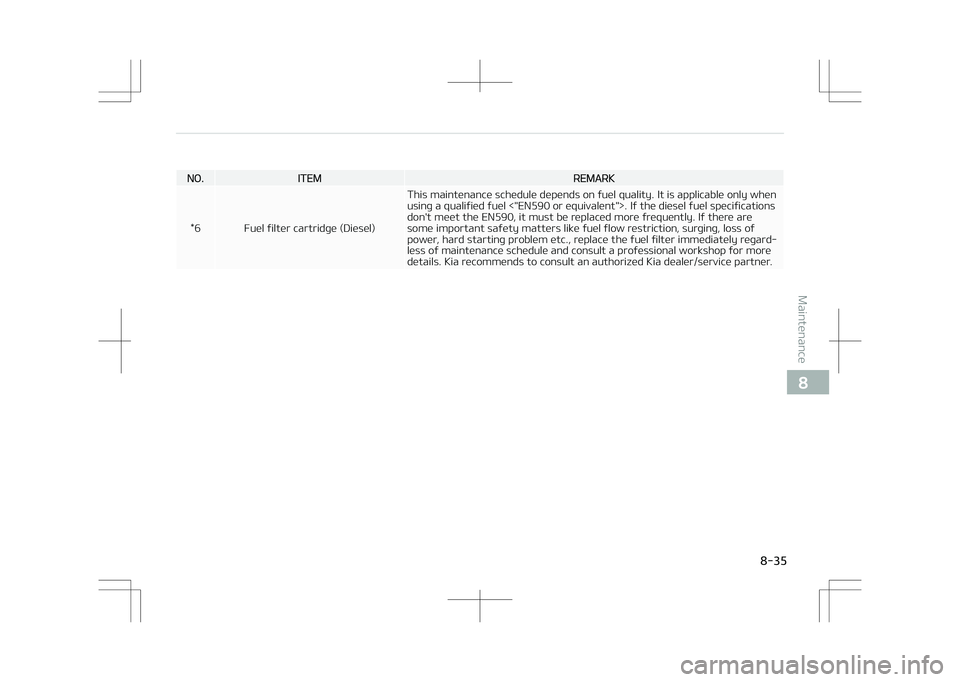
NO.ITEMREMARK
*6 Fuel filter cartridge (Diesel) This maintenance schedule depends on fuel quality. It is applicable only when using a qualified fuel <"EN590 or equivalent">. If the diesel fuel specifications
don't meet the EN590, it must be replaced more frequently. If there are
some important safety matters like fuel flow restriction, surging, loss of
power, hard starting problem etc., replace the fuel filter immediately regard‐
less of maintenance schedule and consult a professional workshop for more
details. Kia recommends to consult an authorized Kia dealer/service partner.
8-35
8
Maintenance
Page 382 of 523
![KIA STONIC 2018 User Guide Normal Maintenance Schedule - For Diesel Engine [Except Europe (Including Russia)] (continued)
MAINTENANCE IN‐TERVALS
Normal Maintenance Schedule - For Diesel Engine [Except Europe (Including Russia](/img/2/40480/w960_40480-381.png "KIA STONIC 2018 User Guide Normal Maintenance Schedule - For Diesel Engine [Except Europe (Including Russia)] (continued)
MAINTENANCE IN‐TERVALS
Normal Maintenance Schedule - For Diesel Engine [Except Europe (Including Russia")
Normal Maintenance Schedule - For Diesel Engine [Except Europe (Including Russia)] (continued)
MAINTENANCE IN‐TERVALS
Normal Maintenance Schedule - For Diesel Engine [Except Europe (Including Russia)]
Number of months or driving distance, whichever comes first
Months1224364860728496
Miles×1,0001020304050607080
Km×1,000153045607590105120
MAINTENANCE ITEM
Engine oil and en‐ gine oil filter *1
,*2
U-II 1.4L, U-II 1.6L For Russia, Australia and New Zealand :
Replace every 15,000 km(10,000 miles) or 12 months Except Russia, Australia and New Zealand :
Replace every 10,000 km (6,500 miles) or 12 months
Coolant (Engine) *3
At first, Replace 210,000 km (140,000 miles) or 120 months
after that, Replace every 30,000 km (20,000 miles) or 24 months
Drive belts (Engine) *4
At first, Inspect 90,000 km (60,000 miles) or 48 months
after that, Inspect every 30,000 km (20,000 miles) or 24 months
Automatic transaxle fluid - - - I - - - I Manual transaxle fluid *5
- - - I - - - I
Drive shaft and boots - I - I - I - IFuel filter cartridge (Diesel) *6
- I - R - I - R
Fuel lines, hoses and connections - I - I - I - I Air cleaner filter Except China, India, Middle East
I I R I I R I I
For China, India, Mid‐dle East R R R R R R R R
Maintenance
8-36
Page 387 of 523
EXPLANATION OF SCHEDULED MAINTENANCE ITEMS
Engine oil and filter
The engine oil and filter should be
changed at the intervals specified in the maintenance schedule. If the vehi‐
cle is being driven in severe conditions,
more frequent oil and filter changes are required.
Drive belts
Inspect all drive belts for evidence of
cuts, cracks, excessive wear or oil satu‐ ration and replace if necessary. Drive
belts should be checked periodically for
proper tension and adjusted as neces‐
sary.
CAUTION
When you are inspecting the belt,place the ignition switch in theLOCK/OFF or ACC position.
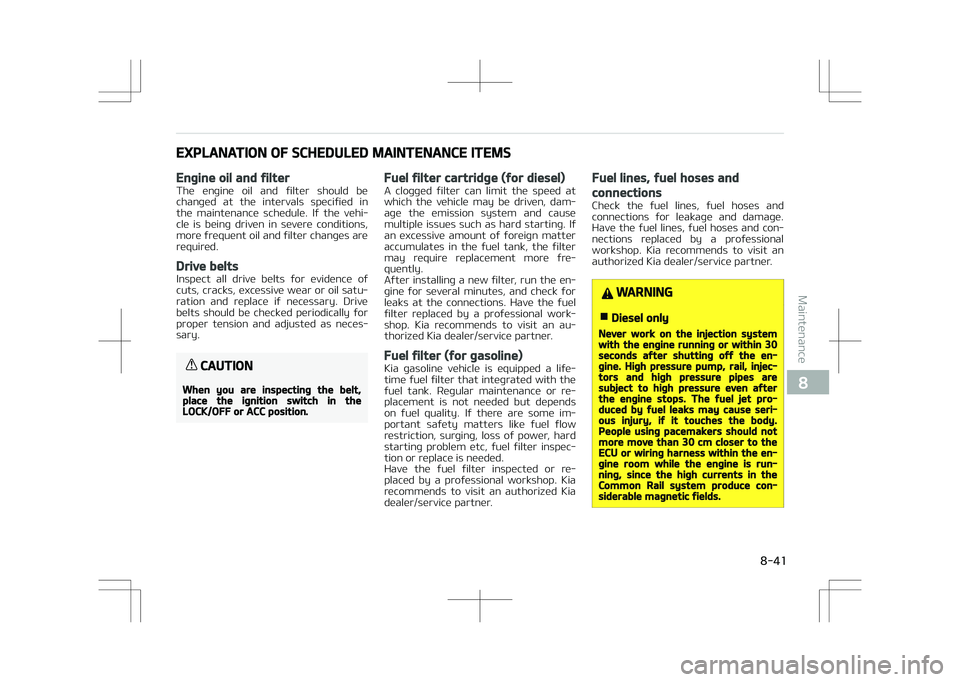
Fuel filter cartridge (for diesel)
A clogged filter can limit the speed at
which the vehicle may be driven, dam‐
age the emission system and cause multiple issues such as hard starting. If
an excessive amount of foreign matter
accumulates in the fuel tank, the filter may require replacement more fre‐
quently.
After installing a new filter, run the en‐
gine for several minutes, and check for leaks at the connections. Have the fuel
filter replaced by a professional work‐
shop. Kia recommends to visit an au‐ thorized Kia dealer/service partner.
Fuel filter (for gasoline)
Kia gasoline vehicle is equipped a life‐
time fuel filter that integrated with the fuel tank. Regular maintenance or re‐
placement is not needed but depends
on fuel quality. If there are some im‐ portant safety matters like fuel flow
restriction, surging, loss of power, hard
starting problem etc, fuel filter inspec‐ tion or replace is needed.
Have the fuel filter inspected or re‐
placed by a professional workshop. Kia
recommends to visit an authorized Kia dealer/service partner.
Fuel lines, fuel hoses and
connections
Check the fuel lines, fuel hoses and
connections for leakage and damage. Have the fuel lines, fuel hoses and con‐
nections replaced by a professional
workshop. Kia recommends to visit an authorized Kia dealer/service partner.
WARNING
nDiesel only
Never work on the injection systemwith the engine running or within 30seconds after shutting off the en‐gine. High pressure pump, rail, injec‐tors and high pressure pipes aresubject to high pressure even afterthe engine stops. The fuel jet pro‐duced by fuel leaks may cause seri‐ous injury, if it touches the body.People using pacemakers should notmore move than 30 cm closer to theECU or wiring harness within the en‐gine room while the engine is run‐ning, since the high currents in theCommon Rail system produce con‐siderable magnetic fields.
8-41
8
Maintenance
Page 388 of 523
Vapor hose (for gasoline engine)
and fuel filler cap
The vapor hose and fuel filler cap
should be inspected at those intervals specified in the maintenance schedule.
Make sure that a new vapor hose or
fuel filler cap is correctly replaced.
Vacuum crankcase ventilation
hoses (if equipped)
Inspect the surface of hoses for evi‐
dence of heat and/or mechanical dam‐ age. Hard and brittle rubber, cracking,
tears, cuts, abrasions, and excessive
swelling indicate deterioration. Particu‐ lar attention should be paid to examine
those hose surfaces nearest to high
heat sources, such as the exhaust manifold.
Inspect the hose routing to assure that
the hoses do not come in contact with
any heat source, sharp edges or mov‐ ing component which might cause heat
damage or mechanical wear. Inspect all
hose connections, such as clamps and couplings, to make sure they are se‐
cure, and that no leaks are present. Ho‐
ses should be replaced immediately if there is any evidence of deterioration
or damage.
Air cleaner filter
Have the air cleaner filter replaced by a
professional workshop. Kia recom‐ mends to visit an authorized Kia dealer/
service partner.
Spark plugs (for gasoline engine)
Make sure to install new spark plugs of
the correct heat range.
WARNING
Do not disconnect and inspect sparkplugs when the engine is hot. Youmay burn yourself.
Valve clearance (for Kappa 1.0L
T-GDI engine)
Inspect for excessive valve noise and/or
engine vibration and adjust if necessa‐ ry. In this case, have the system serv‐
iced by a professional workshop. Kia
recommends to visit an authorized Kia dealer/service partner.
Cooling system
Check the cooling system components,
such as the radiator, coolant reservoir, hoses and connections for leakage and
damage. Replace any damaged parts.
Coolant
The coolant should be changed at the
intervals specified in the maintenance
schedule.
Manual transaxle fluid (if
equipped)
Inspect the manual transaxle fluid ac‐
cording to the maintenance schedule.
Automatic transaxle fluid (if
equipped)
Automatic transaxle fluid should not be
checked under normal usage conditions.
Have the automatic transmission fluid changed by a professional workshop
according to the maintenance schedule.
Kia recommends to visit an authorized Kia dealer/service partner.
NOTICE
Automatic transaxle fluid color is ba‐
sically red.
As the vehicle is driven, the auto‐
matic transaxle fluid will begin to
look darker. It is normal condition
and you should not judge the need
(Continued)
Maintenance
8-42
Page 403 of 523
FUEL FILTER (FOR DIESEL)
Draining water from the fuel
filter
The fuel filter for diesel engine plays an
important role of separating water
from fuel and accumulating the water in its bottom.
If water accumulates in the fuel filter,
the warning light comes on when the
ignition switch is in the ON position.
If this warning light illumi‐ nates, take your car to a pro‐
fessional workshop and havedrain the water and check the
system. Kia recommends tovisit an authorized Kia dealer/
service partner.
CAUTION
If the water accumulated in the fuelfilter is not drained at proper times,damages to the major parts such asthe fuel system can be caused bywater permeation in the fuel filter.
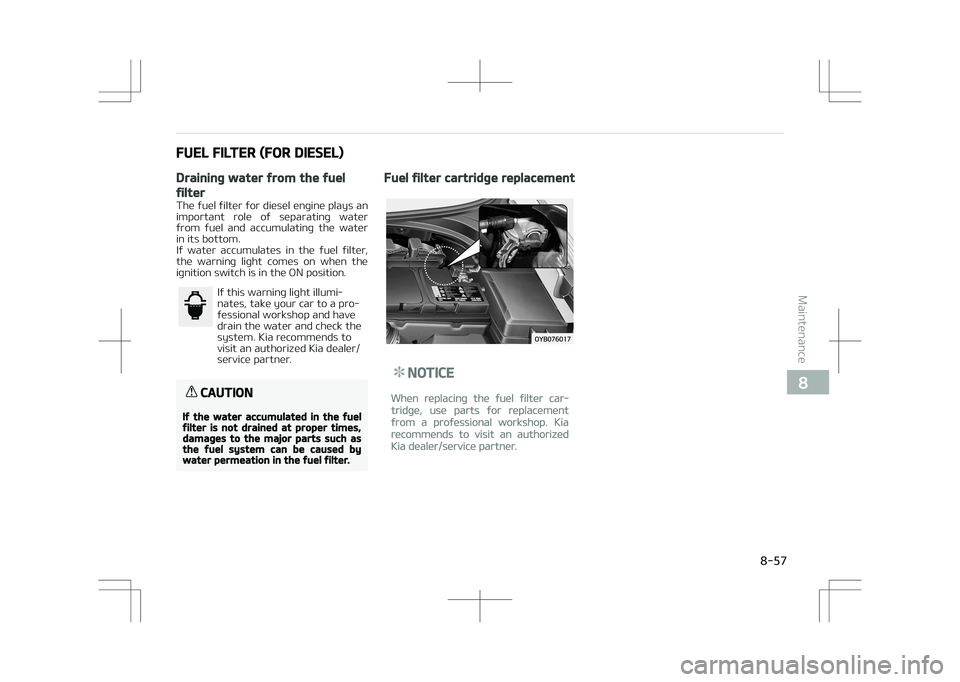
Fuel filter cartridge replacement
NOTICE
When replacing the fuel filter car‐
tridge, use parts for replacement
from a professional workshop. Kia
recommends to visit an authorized
Kia dealer/service partner.
8-57
8
Maintenance
Page 432 of 523
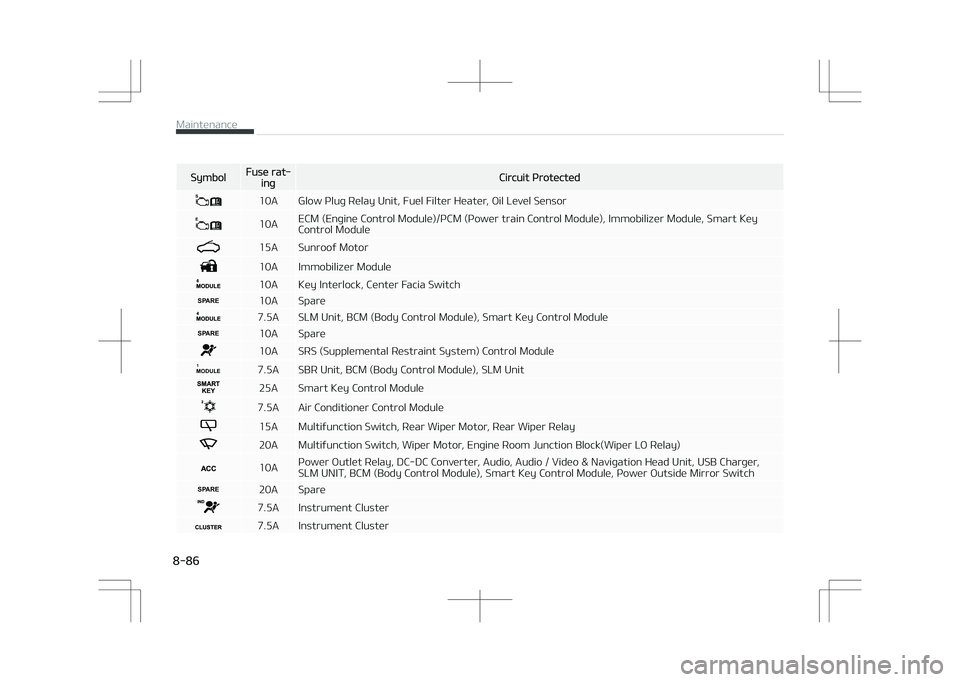
SymbolFuse rat‐ingCircuit Protected
S10A Glow Plug Relay Unit, Fuel Filter Heater, Oil Level Sensor
E10AECM (Engine Control Module)/PCM (Power train Control Module), Immobilizer Module, Smart Key
Control Module
15A Sunroof Motor
10A Immobilizer Module
10A Key Interlock, Center Facia Switch
SPARE10A Spare
7.5A SLM Unit, BCM (Body Control Module), Smart Key Control Module
SPARE10A Spare
10A SRS (Supplemental Restraint System) Control Module
MODULE17.5A SBR Unit, BCM (Body Control Module), SLM Unit
25A Smart Key Control Module
7.5A Air Conditioner Control Module
15A Multifunction Switch, Rear Wiper Motor, Rear Wiper Relay
20A Multifunction Switch, Wiper Motor, Engine Room Junction Block(Wiper LO Relay)
10APower Outlet Relay, DC-DC Converter, Audio, Audio / Video & Navigation Head Unit, USB Charger,
SLM UNIT, BCM (Body Control Module), Smart Key Control Module, Power Outside Mirror Switch
SPARE20A Spare
7.5A Instrument Cluster
7.5A Instrument Cluster
Maintenance
8-86
Page 480 of 523
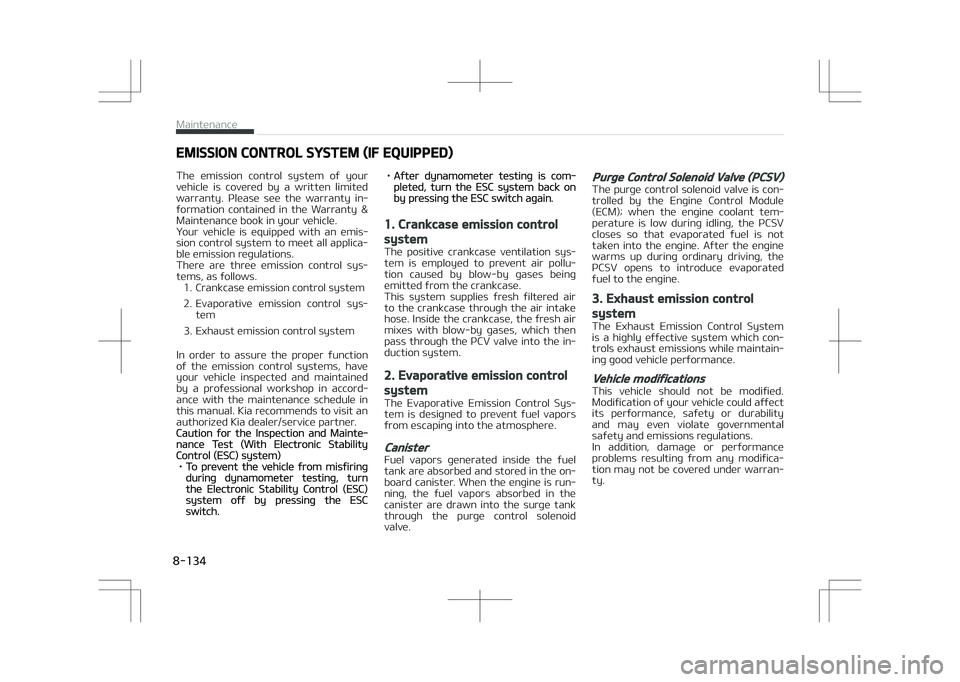
EMISSION CONTROL SYSTEM (IF EQUIPPED)
The emission control system of your vehicle is covered by a written limited
warranty. Please see the warranty in‐
formation contained in the Warranty & Maintenance book in your vehicle.
Your vehicle is equipped with an emis‐
sion control system to meet all applica‐
ble emission regulations.
There are three emission control sys‐ tems, as follows. 1. Crankcase emission control system
2. Evaporative emission control sys‐ tem
3. Exhaust emission control system
In order to assure the proper function
of the emission control systems, have
your vehicle inspected and maintained by a professional workshop in accord‐
ance with the maintenance schedule in
this manual. Kia recommends to visit an
authorized Kia dealer/service partner.
Caution for the Inspection and Mainte‐nance Test (With Electronic StabilityControl (ESC) system)
•To prevent the vehicle from misfiringduring dynamometer testing, turnthe Electronic Stability Control (ESC)system off by pressing the ESCswitch. •
After dynamometer testing is com‐pleted, turn the ESC system back onby pressing the ESC switch again.
1. Crankcase emission control
system
The positive crankcase ventilation sys‐
tem is employed to prevent air pollu‐ tion caused by blow-by gases being
emitted from the crankcase.
This system supplies fresh filtered air
to the crankcase through the air intake hose. Inside the crankcase, the fresh air
mixes with blow-by gases, which then
pass through the PCV valve into the in‐ duction system.
2. Evaporative emission control
system
The Evaporative Emission Control Sys‐
tem is designed to prevent fuel vapors from escaping into the atmosphere.
Canister
Fuel vapors generated inside the fuel
tank are absorbed and stored in the on‐ board canister. When the engine is run‐
ning, the fuel vapors absorbed in the
canister are drawn into the surge tank through the purge control solenoid
valve.
Purge Control Solenoid Valve (PCSV)
The purge control solenoid valve is con‐
trolled by the Engine Control Module (ECM); when the engine coolant tem‐
perature is low during idling, the PCSV
closes so that evaporated fuel is not taken into the engine. After the engine
warms up during ordinary driving, the
PCSV opens to introduce evaporated fuel to the engine.
3. Exhaust emission control
system
The Exhaust Emission Control System
is a highly effective system which con‐
trols exhaust emissions while maintain‐
ing good vehicle performance.
Vehicle modifications
This vehicle should not be modified.
Modification of your vehicle could affect
its performance, safety or durability and may even violate governmental
safety and emissions regulations.
In addition, damage or performance
problems resulting from any modifica‐ tion may not be covered under warran‐
ty.
Maintenance
8-134
Page 482 of 523
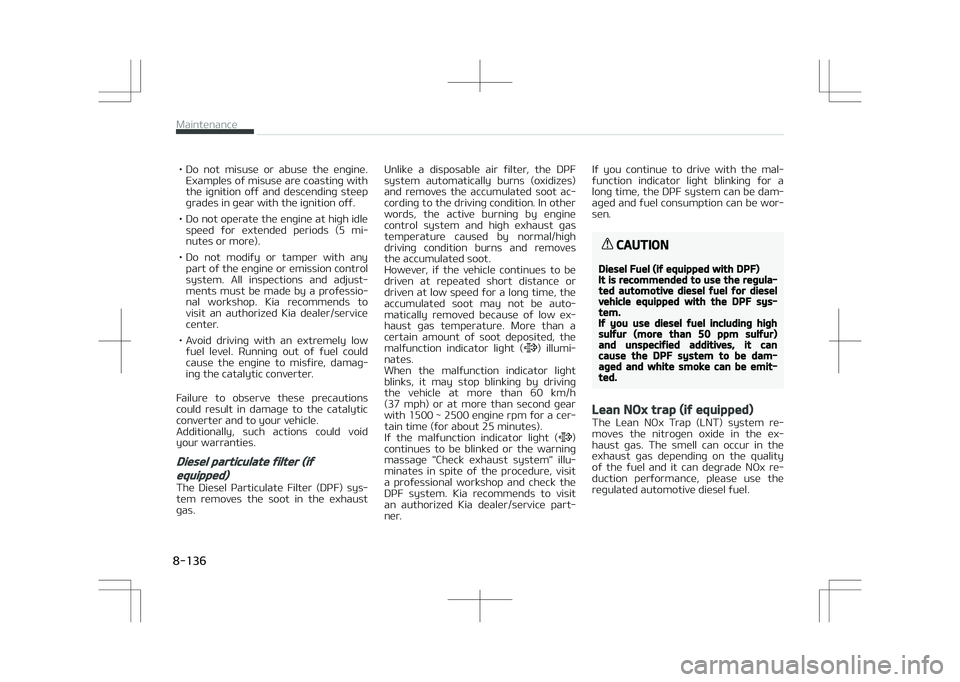
• Do not misuse or abuse the engine.Examples of misuse are coasting with
the ignition off and descending steep grades in gear with the ignition off.
• Do not operate the engine at high idle speed for extended periods (5 mi‐
nutes or more).
• Do not modify or tamper with any part of the engine or emission control
system. All inspections and adjust‐ ments must be made by a professio‐
nal workshop. Kia recommends to
visit an authorized Kia dealer/service
center.
• Avoid driving with an extremely low fuel level. Running out of fuel couldcause the engine to misfire, damag‐
ing the catalytic converter.
Failure to observe these precautions
could result in damage to the catalytic converter and to your vehicle.
Additionally, such actions could void
your warranties.
Diesel particulate filter (if
equipped)
The Diesel Particulate Filter (DPF) sys‐
tem removes the soot in the exhaust gas. Unlike a disposable air filter, the DPF
system automatically burns (oxidizes)
and removes the accumulated soot ac‐ cording to the driving condition. In other
words, the active burning by engine
control system and high exhaust gas temperature caused by normal/high
driving condition burns and removes
the accumulated soot.
However, if the vehicle continues to be driven at repeated short distance or
driven at low speed for a long time, the
accumulated soot may not be auto‐ matically removed because of low ex‐
haust gas temperature. More than a
certain amount of soot deposited, the malfunction indicator light (
) illumi‐
nates.
When the malfunction indicator light
blinks, it may stop blinking by driving
the vehicle at more than 60 km/h (37 mph) or at more than second gear
with 1500 ~ 2500 engine rpm for a cer‐
tain time (for about 25 minutes).
If the malfunction indicator light (
)
continues to be blinked or the warning
massage "Check exhaust system" illu‐ minates in spite of the procedure, visit
a professional workshop and check the
DPF system. Kia recommends to visit an authorized Kia dealer/service part‐
ner. If you continue to drive with the mal‐
function indicator light blinking for a long time, the DPF system can be dam‐
aged and fuel consumption can be wor‐
sen.
CAUTION
Diesel Fuel (if equipped with DPF)It is recommended to use the regula‐ted automotive diesel fuel for dieselvehicle equipped with the DPF sys‐tem.If you use diesel fuel including highsulfur (more than 50 ppm sulfur)and unspecified additives, it cancause the DPF system to be dam‐aged and white smoke can be emit‐ted.
Lean NOx trap (if equipped)
The Lean NOx Trap (LNT) system re‐
moves the nitrogen oxide in the ex‐ haust gas. The smell can occur in the
exhaust gas depending on the quality
of the fuel and it can degrade NOx re‐ duction performance, please use the
regulated automotive diesel fuel.
Maintenance
8-136