inflation pressure KIA STONIC 2018 User Guide
[x] Cancel search | Manufacturer: KIA, Model Year: 2018, Model line: STONIC, Model: KIA STONIC 2018Pages: 523, PDF Size: 24.99 MB
Page 348 of 523
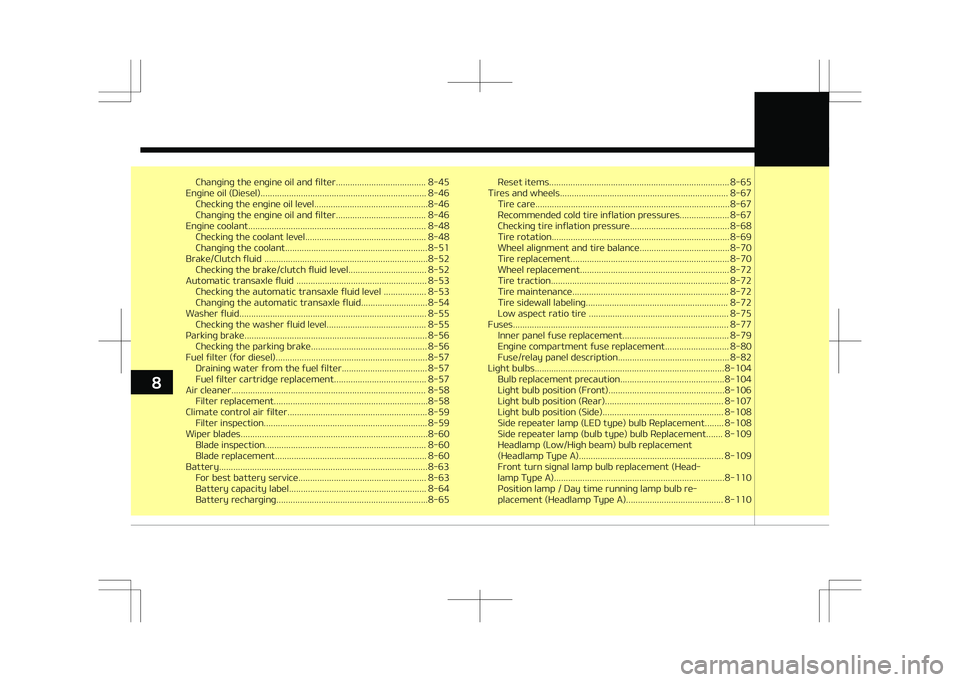
Changing the engine oil and filter...................................... 8-45
Engine oil (Diesel)...................................................................... 8-46 Checking the engine oil level................................................8-46
Changing the engine oil and filter...................................... 8-46
Engine coolant........................................................................... 8-48 Checking the coolant level................................................... 8-48
Changing the coolant............................................................ 8-51
Brake/Clutch fluid .....................................................................8-52 Checking the brake/clutch fluid level................................. 8-52
Automatic transaxle fluid ....................................................... 8-53 Checking the automatic transaxle fluid level .................. 8-53
Changing the automatic transaxle fluid............................ 8-54
Washer fluid............................................................................... 8-55 Checking the washer fluid level.......................................... 8-55
Parking brake............................................................................. 8-56 Checking the parking brake................................................. 8-56
Fuel filter (for diesel)................................................................ 8-57 Draining water from the fuel filter.................................... 8-57
Fuel filter cartridge replacement....................................... 8-57
Air cleaner.................................................................................. 8-58 Filter replacement.................................................................8-58
Climate control air filter........................................................... 8-59 Filter inspection..................................................................... 8-59
Wiper blades...............................................................................8-60 Blade inspection.................................................................... 8-60
Blade replacement................................................................ 8-60
Battery........................................................................................8-63 For best battery service...................................................... 8-63
Battery capacity label.......................................................... 8-64
Battery recharging................................................................8-65 Reset items............................................................................ 8-65
Tires and wheels....................................................................... 8-67 Tire care.................................................................................. 8-67
Recommended cold tire inflation pressures..................... 8-67
Checking tire inflation pressure.......................................... 8-68
Tire rotation........................................................................... 8-69
Wheel alignment and tire balance...................................... 8-70
Tire replacement................................................................... 8-70
Wheel replacement............................................................... 8-72
Tire traction........................................................................... 8-72
Tire maintenance.................................................................. 8-72
Tire sidewall labeling............................................................ 8-72
Low aspect ratio tire ........................................................... 8-75
Fuses........................................................................................... 8-77 Inner panel fuse replacement............................................. 8-79
Engine compartment fuse replacement........................... 8-80
Fuse/relay panel description............................................... 8-82
Light bulbs................................................................................8-104 Bulb replacement precaution............................................8-104
Light bulb position (Front).................................................8-106
Light bulb position (Rear).................................................. 8-107
Light bulb position (Side)................................................... 8-108
Side repeater lamp (LED type) bulb Replacement........ 8-108
Side repeater lamp (bulb type) bulb Replacement....... 8-109
Headlamp (Low/High beam) bulb replacement
(Headlamp Type A)............................................................. 8-109
Front turn signal lamp bulb replacement (Head‐
lamp Type A)........................................................................8-110
Position lamp / Day time running lamp bulb re‐
placement (Headlamp Type A)......................................... 8-110
8
Page 413 of 523
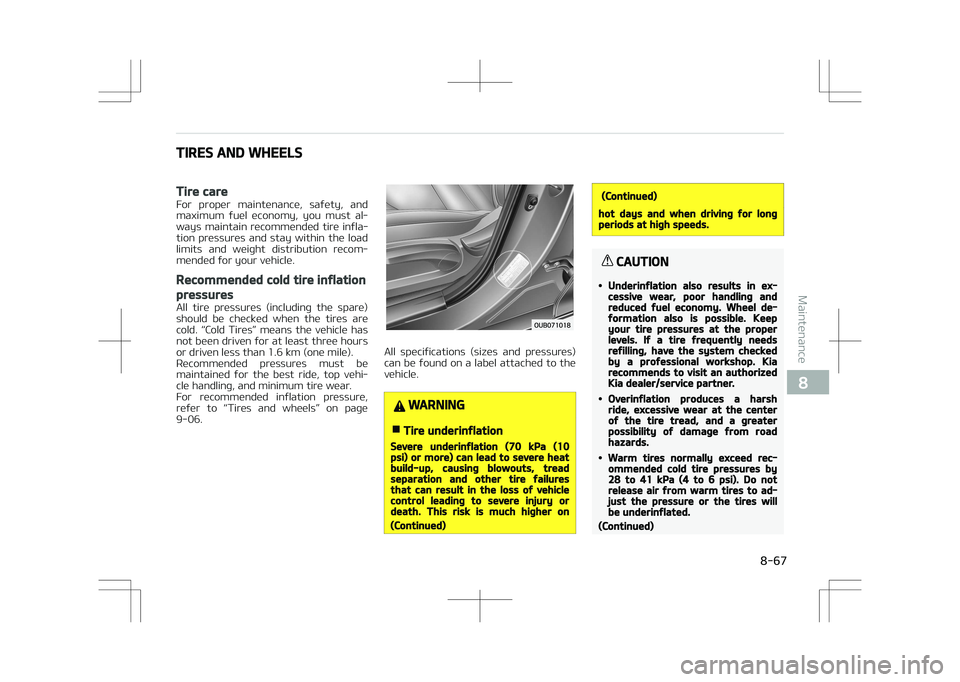
TIRES AND WHEELS
Tire care
For proper maintenance, safety, and
maximum fuel economy, you must al‐
ways maintain recommended tire infla‐ tion pressures and stay within the load
limits and weight distribution recom‐
mended for your vehicle.
Recommended cold tire inflation
pressures
All tire pressures (including the spare)
should be checked when the tires are cold. L
Page 414 of 523
(Continued)
•Be sure to reinstall the tire infla‐tion valve caps. Without the valvecap, dirt or moisture could get intothe valve core and cause air leak‐age. If a valve cap is missing, in‐stall a new one as soon as possi‐ble.
WARNING
nTire Inflation
Overinflation or underinflation canreduce tire life, adversely affect ve‐hicle handling, and lead to suddentire failure. This could result in lossof vehicle control and potential in‐jury.
CAUTION
nTire pressure
Always observe the following:
(Continued)
(Continued)
•Check tire pressure when the tiresare cold. (After vehicle has beenparked for at least three hours orhasn't been driven more than 1.6km (one mile) since startup.)
•Check the pressure of your sparetire each time you check the pres‐sure of other tires.
•Never overload your vehicle. Becareful not to overload a vehicleluggage rack if your vehicle isequipped with one.
•Worn, old tires can cause acci‐dents. If your tread is badly worn,or if your tires have been dam‐aged, replace them.
Checking tire inflation pressure
Check your tires once a month or more.
Also, check the tire pressure of the
spare tire.
How to check
Use a good quality gauge to check tire
pressure. You can not tell if your tires
are properly inflated simply by looking
at them. Radial tires may look properly
inflated even when they're underinfla‐ ted. Check the tire's inflation pressure when
the tires are cold. - "Cold" means your
vehicle has been sitting for at least three hours or driven no more than 1.6
km (1 mile).
Remove the valve cap from the tire
valve stem. Press the tire gauge firmly onto the valve to get a pressure meas‐
urement. If the cold tire inflation pres‐
sure matches the recommended pres‐ sure on the tire and loading information
label, no further adjustment is necessa‐
ry. If the pressure is low, add air until
you reach the recommended amount.
If you overfill the tire, release air by pushing on the metal stem in the cen‐
ter of the tire valve. Recheck the tire
pressure with the tire gauge. Be sure to put the valve caps back on the valve
stems. They help prevent leaks by
keeping out dirt and moisture.
WARNING
•Inspect your tires frequently forproper inflation as well as wearand damage. Always use a tirepressure gauge.
(Continued)
Maintenance
8-68
Page 420 of 523
WARNING
nTire age
Tires degrade over time, even whenthey are not being used.Regardless of the remaining tread,we recommend that tires be re‐placed after approximately six (6)years of normal service. Heat causedby hot climates or frequent highloading conditions can accelerate theaging process. Failure to follow thiswarning can result in sudden tirefailure, which could lead to a loss ofcontrol and an accident involving se‐rious injury or death.
4. Tire ply composition and material
The number of layers or plies of rub‐
ber-coated fabric in the tire. Tire man‐ ufacturers also must indicate the ma‐
terials in the tire, which include steel,
nylon, polyester, and others. The letter "R" means radial ply construction; the
letter "D" means diagonal or bias ply
construction; and the letter "B" means belted-bias ply construction.
5. Maximum permissible inflation
pressure
This number is the greatest amount of
air pressure that should be put in the
tire. Do not exceed the maximum per‐ missible inflation pressure. Refer to the
Tire and Loading Information label for
recommended inflation pressure.
6. Maximum load rating
This number indicates the maximum
load in kilograms and pounds that can be carried by the tire. When replacing
the tires on the vehicle, always use a
tire that has the same load rating as the factory installed tire.
7. Uniform tire quality grading
Quality grades can be found where ap‐
plicable on the tire sidewall between tread shoulder and maximum section
width.
For example:TREADWEAR 200TRACTION AA
TEMPERATURE A
Tread wear
The tread wear grade is a comparative
rating based on the wear rate of the tire when tested under controlled con‐
ditions on a specified government test
course. For example, a tire graded 150 would wear one-and-a-half times (1½)
as well on the government course as a
tire graded 100.
The relative performance of tires de‐ pends upon the actual conditions of
their use, however, and may depart sig‐
nificantly from the norm due to varia‐
tions in driving habits, service practices and differences in road characteristics
and climate.
These grades are molded on the side-
walls of passenger vehicle tires. The tires available as standard or optional
equipment on your vehicle may vary
with respect to grade.
Traction - AA, A, B & C
The traction grades, from highest to lowest, are AA, A, B and C. Those
grades represent the tire’s ability to
stop on wet pavement as measured under controlled conditions on specified
government test surfaces of asphalt
and concrete. A tire marked C may have poor traction performance.
Maintenance
8-74
Page 489 of 523
![KIA STONIC 2018 User Guide ItemTire sizeWheel size
Load CapacitySpeed capacityInflation pressure [bar (psi, kPa)]Wheellug nuttorqueKgf·m(lbf·ft,N·m)
Normal loadMaximum load
LI *1KgSS *2Km/hFrontRearFrontRear
Full size tire 1](/img/2/40480/w960_40480-488.png "KIA STONIC 2018 User Guide ItemTire sizeWheel size
Load CapacitySpeed capacityInflation pressure [bar (psi, kPa)]Wheellug nuttorqueKgf·m(lbf·ft,N·m)
Normal loadMaximum load
LI *1KgSS *2Km/hFrontRearFrontRear
Full size tire 1")
ItemTire sizeWheel size
Load CapacitySpeed capacityInflation pressure [bar (psi, kPa)]Wheellug nuttorqueKgf·m(lbf·ft,N·m)
Normal loadMaximum load
LI *1KgSS *2Km/hFrontRearFrontRear
Full size tire 185/65R15 6.0J x 15 88 560 H 210 2.35 2.15 2.4 2.5
11 ~ 13
(79 ~ 94, 107 ~127)
(34,
235) (31,
215) (35,
240) (36,
250)
2.5 2.3 2.5 2.5
(36,
250) (33,
230) (36,
250) (36,
250)
(F/C
Pack) (F/C
Pack) (F/C
Pack) (F/C
Pack)
2.6 2.6 2.6 2.6
(38,
260) (38,
260) (38,
260) (38,
260)
(Eco
pack) (Eco
pack) (Eco
pack) (Eco
pack)
195/55R16 6.0J x 16 87 545 H 210 2.3 2.1 2.4 2.6
(34,
235) (31,
215) (35,
240) (37,
260)
205/45R17 6.5J x 17 88 560 V 240 2.3 2.1 2.4 2.6
(34,
235) (31,
215) (35,
240) (37,
260)
*1 Load Index
*2 Speed Symbol
9-07
9
Specifications & Consumer information
Page 490 of 523
![KIA STONIC 2018 User Guide ItemTire sizeWheel size
Load CapacitySpeed capacityInflation pressure [bar (psi, kPa)]Wheellug nuttorqueKgf·m(lbf·ft,N·m)
Normal loadMaximum load
LI *1KgSS *2Km/hFrontRearFrontRear
Full size tire 2](/img/2/40480/w960_40480-489.png "KIA STONIC 2018 User Guide ItemTire sizeWheel size
Load CapacitySpeed capacityInflation pressure [bar (psi, kPa)]Wheellug nuttorqueKgf·m(lbf·ft,N·m)
Normal loadMaximum load
LI *1KgSS *2Km/hFrontRearFrontRear
Full size tire 2")
ItemTire sizeWheel size
Load CapacitySpeed capacityInflation pressure [bar (psi, kPa)]Wheellug nuttorqueKgf·m(lbf·ft,N·m)
Normal loadMaximum load
LI *1KgSS *2Km/hFrontRearFrontRear
Full size tire 205/55R17 6.5J x 17 95 690 V 240 2.35 2.1 2.4 2.6
11 ~ 13
(79 ~ 94, 107 ~127)
(34,
235) (31,
215) (35,
240) (37,
260)
Compact
spare tire T125/80D15 3.5J x 15 95 690 M 130
4.2 4.2 4.2 4.2
(60,
420) (60,
420) (60,
420) (60,
420)
T125/80D16 4.0T x 16 97 730 M 130 4.2 4.2 4.2 4.2
(60,
420) (60,
420) (60,
420) (60,
420)
*1 Load Index
*2 Speed Symbol
Specifications & Consumer information
9-08
Page 491 of 523
![KIA STONIC 2018 User Guide Except Europe
ItemTire sizeWheel size
Load CapacitySpeed capacityInflation pressure [bar(psi, kPa)]Wheellug nuttorqueKgf·m(lbf·ft,N·m)
Normal loadMaximum load
LI *1KgSS *2Km/hFrontRearFrontRear
Ful](/img/2/40480/w960_40480-490.png "KIA STONIC 2018 User Guide Except Europe
ItemTire sizeWheel size
Load CapacitySpeed capacityInflation pressure [bar(psi, kPa)]Wheellug nuttorqueKgf·m(lbf·ft,N·m)
Normal loadMaximum load
LI *1KgSS *2Km/hFrontRearFrontRear
Ful")
Except Europe
ItemTire sizeWheel size
Load CapacitySpeed capacityInflation pressure [bar(psi, kPa)]Wheellug nuttorqueKgf·m(lbf·ft,N·m)
Normal loadMaximum load
LI *1KgSS *2Km/hFrontRearFrontRear
Full size tire 185/65R15 6.0J X 15 88 560 H 210
2.3 2.3 2.3 2.3
11 ~ 13
79 ~ 94, 107 ~127)
(33,
230) (33,
230) (33,
230) (33,
230)
195/55R16 6.0J X 16 87 545 H 210 2.3 2.3 2.3 2.3
(33,
230) (33,
230) (33,
230) (33,
230)
205/45R17 6.5J X 17 88 560 V 240 2.3 2.3 2.3 2.3
(33,
230) (33,
230) (33,
230) (33,
230)
Compact
spare tire T125/80D15 3.5J x 15 95 690 M 130 4.2 4.2 4.2 4.2
(60,
420) (60,
420) (60,
420) (60,
420)
*1 Load Index
*2 Speed Symbol
9-09
9
Specifications & Consumer information