air conditioning KIA STONIC 2018 Owner's Manual
[x] Cancel search | Manufacturer: KIA, Model Year: 2018, Model line: STONIC, Model: KIA STONIC 2018Pages: 523, PDF Size: 24.99 MB
Page 202 of 523
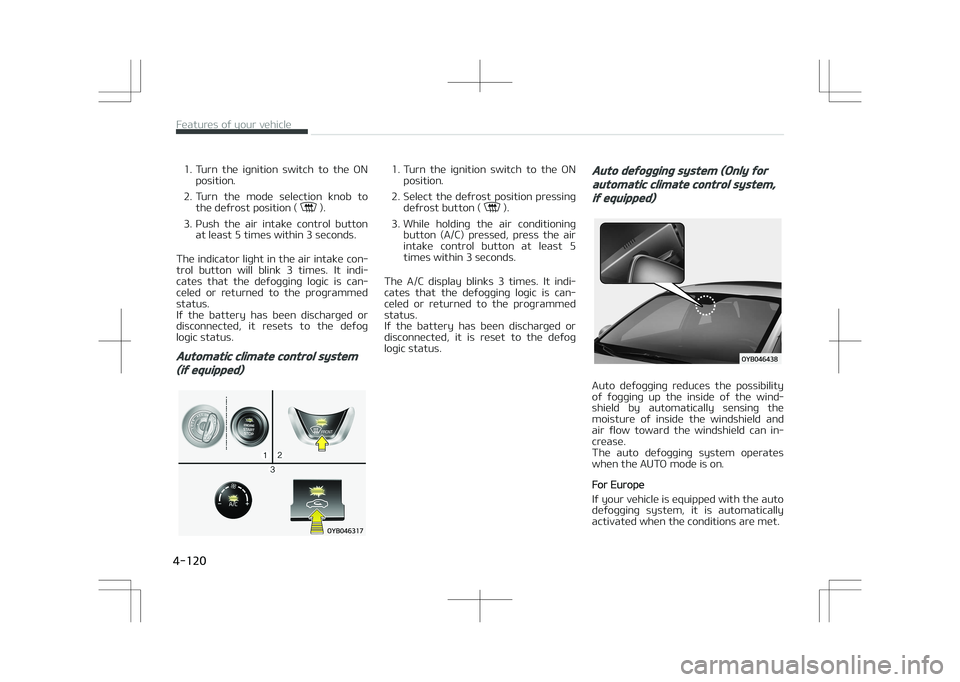
1. Turn the ignition switch to the ONposition.
2. Turn the mode selection knob to the defrost position (
).
3. Push the air intake control button at least 5 times within 3 seconds.
The indicator light in the air intake con‐
trol button will blink 3 times. It indi‐ cates that the defogging logic is can‐
celed or returned to the programmed
status.
If the battery has been discharged or disconnected, it resets to the defog
logic status.
Automatic climate control system
(if equipped)
1. Turn the ignition switch to the ON position.
2. Select the defrost position pressing defrost button (
).
3. While holding the air conditioning button (A/C) pressed, press the air
intake control button at least 5
times within 3 seconds.
The A/C display blinks 3 times. It indi‐ cates that the defogging logic is can‐
celed or returned to the programmed
status.
If the battery has been discharged or disconnected, it is reset to the defog
logic status.
Auto defogging system (Only for
automatic climate control system,
if equipped)
Auto defogging reduces the possibility
of fogging up the inside of the wind‐ shield by automatically sensing the
moisture of inside the windshield and
air flow toward the windshield can in‐ crease.
The auto defogging system operates
when the AUTO mode is on.
For Europe
If your vehicle is equipped with the auto
defogging system, it is automatically
activated when the conditions are met.
Features of your vehicle
4-120
Page 240 of 523
The engine will also restart
automatically without the driver's
any actions if the following occurs:
-The fan speed of manual climate con‐
trol system is set above the 3rd posi‐
tion when the air conditioning is on.
- The fan speed of automatic climate
control system is set above the 6th
position when the air conditioning is on.
- When a certain amount of time has
passed with the climate control sys‐
tem on.
- When the defroster is on.
- The brake vacuum pressure is low.
- The battery charging status is low.
- The vehicle speed exceeds 5 km/h.
The green AUTO STOP indicator (
) on
the instrument cluster will blink for 5
seconds.
Condition of ISG system
operation
The ISG system will operate under
the following condition:
- The driver’s seat belt is fastened. -
The driver’s door and hood are closed.
- The brake vacuum pressure is ade‐
quate.
- The battery is sufficiently charged.
- The outside temperature is more
than -2°C (28.4°F).
- The outside temperature is under
32°C (89.6°F).
- The engine coolant temperature is
not too low.
NOTICE
•If the ISG system does not meet
that operation condition, the ISG
system is deactivated. The light on
the ISG OFF button will illuminate.
•If the light comes on continuously,
please check the operation condi‐
tion.
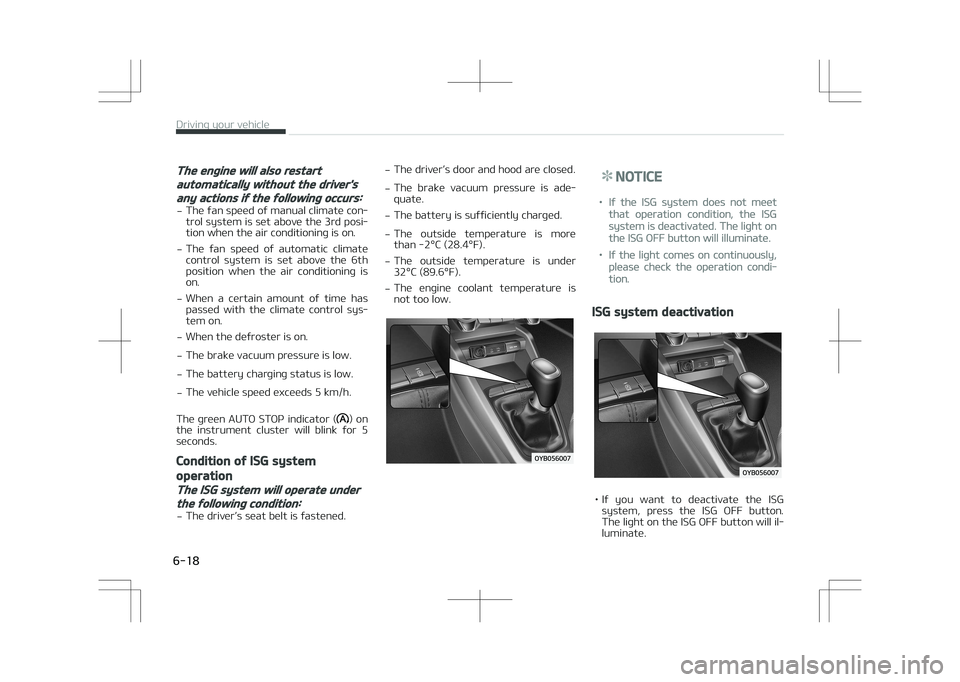
ISG system deactivation
• If you want to deactivate the ISG system, press the ISG OFF button.
The light on the ISG OFF button will il‐ luminate.
Driving your vehicle
6-18
Page 299 of 523
• Use your air conditioning sparingly.The air conditioning system is oper‐
ated by engine power so your fuel economy is reduced when you use it.
• Open windows at high speeds can re‐ duce fuel economy.
• Fuel economy is less in crosswinds and headwinds. To help offset some
of this loss, slow down when driving
in these conditions.
Keeping a vehicle in good operating
condition is important both for econo‐
my and safety. Therefore, have the system serviced by a professional
workshop.
Kia recommends to visit an authorized
Kia dealer/service partner.
WARNING
nEngine off during motion
Never turn the engine off to coastdown hills or anytime the vehicle isin motion. The power steering andpower brakes will not function prop‐erly without the engine running. In‐stead, keep the engine on and down‐
(Continued)
(Continued)
shift to an appropriate gear for en‐gine braking effect. In addition, turn‐ing off the ignition while drivingcould engage the steering wheel lockresulting in loss of vehicle steeringwhich could cause serious injury ordeath.
6-77
6
Driving your vehicle
Page 323 of 523
IF THE ENGINE OVERHEATS
If your temperature gauge indicates
overheating, you will experience a loss of power, or hear loud pinging or knock‐
ing, the engine is probably too hot. If
this happens, you should: 1. Pull off the road and stop as soon as it is safe to do so.
2. Place the shift lever in P (automatic transaxle) or neutral (manual
transaxle) and set the parking
brake. If the air conditioning is on, turn it off.
3. If engine coolant is running out un‐ der the vehicle or steam is coming
out from the hood, stop the engine.
Do not open the hood until the
coolant has stopped running or the
steaming has stopped. If there is no
visible loss of engine coolant and no
steam, leave the engine running
and check to be sure the engine
cooling fan is operating. If the fan is
not running, turn the engine off.
4. Check to see if the water pump drive belt is missing. If it is not
missing, check to see that it is
tight.
If the drive belt seems to be satis‐
factory, check for coolant leaking
from the radiator, hoses or under
the vehicle. (If the air conditioning had been in use, it is normal for
cold water to be draining from it
when you stop).
WARNING
While the engine is running, keephair, hands and clothing away frommoving parts such as the fan anddrive belts to prevent injury.
5. If the water pump drive belt is bro‐ ken or engine coolant is leaking out,
stop the engine immediately and
call a professional workshop. Kia
recommends to call an authorized
Kia dealer/service partner.
WARNING
Do not remove the radiator capwhen the engine is hot. This can al‐low coolant to blow out of the open‐ing and cause serious burns.
6. If you cannot find the cause of the overheating, wait until the engine
temperature has returned to nor‐
mal. Then, if coolant has been lost,
carefully add coolant to the reser‐
voir to bring the fluid level in the
reservoir up to the halfway mark.
7. Proceed with caution, keeping alert for further signs of overheating. Ifoverheating happens again, call a
professional workshop. Kia recom‐
mends to call an authorized Kia
dealer/service partner.
CAUTION
•Serious loss of coolant indicatesthere is a leak in the cooling sys‐tem. In this case, have the sys‐tem checked by a professionalworkshop. Kia recommends tovisit an authorized Kia dealer/service partner.
•When the engine overheats fromlow engine coolant, suddenlyadding engine coolant may causecracks in the engine. To preventdamage, add engine coolantslowly in small quantities.
7-07
7
What to do in an emergency
Page 347 of 523
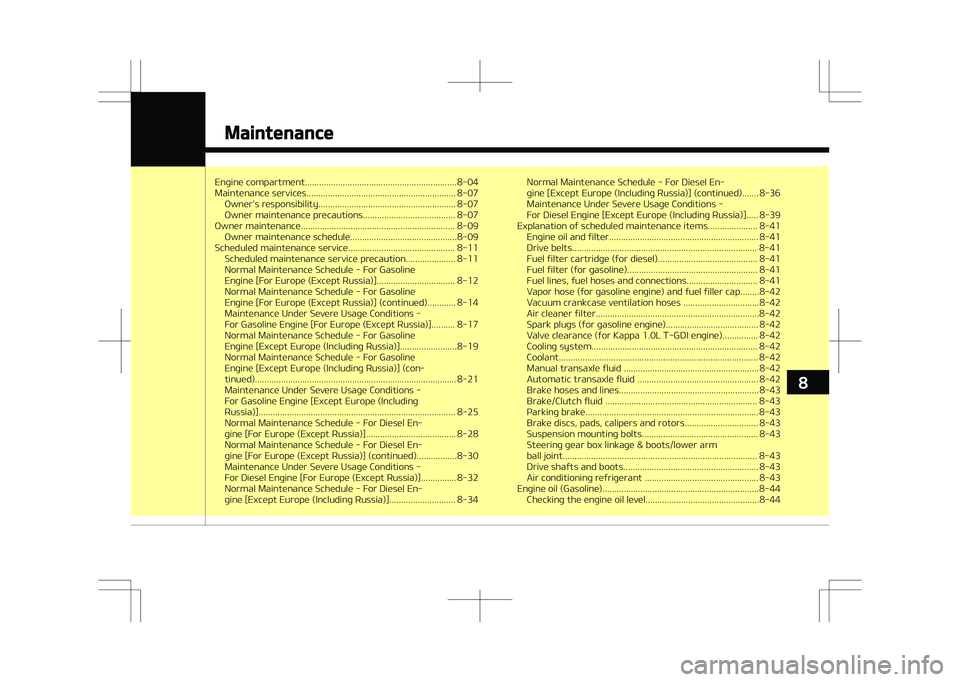
Engine compartment................................................................ 8-04
Maintenance services............................................................... 8-07Owner’s responsibility.......................................................... 8-07
Owner maintenance precautions....................................... 8-07
Owner maintenance................................................................. 8-09 Owner maintenance schedule.............................................8-09
Scheduled maintenance service............................................. 8-11 Scheduled maintenance service precaution..................... 8-11
Normal Maintenance Schedule - For Gasoline
Engine [For Europe (Except Russia)]................................. 8-12
Normal Maintenance Schedule - For Gasoline
Engine [For Europe (Except Russia)] (continued)............ 8-14
Maintenance Under Severe Usage Conditions -
For Gasoline Engine [For Europe (Except Russia)].......... 8-17
Normal Maintenance Schedule - For Gasoline
Engine [Except Europe (Including Russia)]........................8-19
Normal Maintenance Schedule - For Gasoline
Engine [Except Europe (Including Russia)] (con‐
tinued)..................................................................................... 8-21
Maintenance Under Severe Usage Conditions -
For Gasoline Engine [Except Europe (Including
Russia)]................................................................................... 8-25
Normal Maintenance Schedule - For Diesel En‐
gine [For Europe (Except Russia)]...................................... 8-28
Normal Maintenance Schedule - For Diesel En‐
gine [For Europe (Except Russia)] (continued).................8-30
Maintenance Under Severe Usage Conditions -
For Diesel Engine [For Europe (Except Russia)]............... 8-32
Normal Maintenance Schedule - For Diesel En‐
gine [Except Europe (Including Russia)]............................ 8-34 Normal Maintenance Schedule - For Diesel En‐
gine [Except Europe (Including Russia)] (continued)....... 8-36
Maintenance Under Severe Usage Conditions -
For Diesel Engine [Except Europe (Including Russia)]..... 8-39
Explanation of scheduled maintenance items..................... 8-41 Engine oil and filter............................................................... 8-41
Drive belts.............................................................................. 8-41
Fuel filter cartridge (for diesel).......................................... 8-41
Fuel filter (for gasoline)....................................................... 8-41
Fuel lines, fuel hoses and connections.............................. 8-41
Vapor hose (for gasoline engine) and fuel filler cap........8-42
Vacuum crankcase ventilation hoses ................................8-42
Air cleaner filter.....................................................................8-42
Spark plugs (for gasoline engine)....................................... 8-42
Valve clearance (for Kappa 1.0L T-GDI engine)............... 8-42
Cooling system...................................................................... 8-42
Coolant.................................................................................... 8-42
Manual transaxle fluid .........................................................8-42
Automatic transaxle fluid ................................................... 8-42
Brake hoses and lines........................................................... 8-43
Brake/Clutch fluid ................................................................ 8-43
Parking brake......................................................................... 8-43
Brake discs, pads, calipers and rotors............................... 8-43
Suspension mounting bolts................................................. 8-43Steering gear box linkage & boots/lower arm
ball joint.................................................................................. 8-43
Drive shafts and boots......................................................... 8-43
Air conditioning refrigerant ................................................ 8-43
Engine oil (Gasoline)..................................................................8-44 Checking the engine oil level................................................8-44
Maintenance
8
Page 356 of 523
• Check the lap/shoulder belts for wearand function.
• Check for worn tires and loose wheel lug nuts.
At least once a year:
• Clean the body and door drain holes.
• Lubricate the door hinges and checks,and hood hinges.
• Lubricate the door and hood locks and latches.
• Lubricate the door rubber weather‐ strips.
• Check the air conditioning system.
• Inspect and lubricate the automatic transaxle linkage and controls.
• Clean the battery and terminals.
• Check the brake fluid level.
Maintenance
8-10
Page 483 of 523
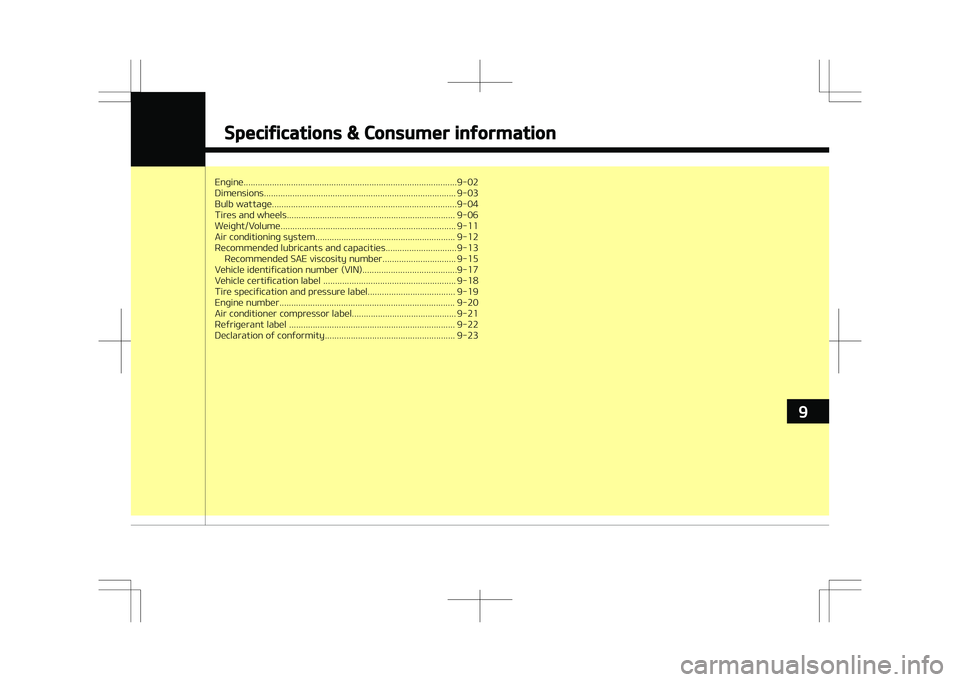
Engine..........................................................................................9-02
Dimensions................................................................................. 9-03
Bulb wattage..............................................................................9-04
Tires and wheels....................................................................... 9-06
Weight/Volume.......................................................................... 9-11
Air conditioning system........................................................... 9-12
Recommended lubricants and capacities.............................. 9-13Recommended SAE viscosity number............................... 9-15
Vehicle identification number (VIN)........................................9-17
Vehicle certification label ........................................................ 9-18
Tire specification and pressure label..................................... 9-19
Engine number.......................................................................... 9-20
Air conditioner compressor label............................................ 9-21
Refrigerant label ...................................................................... 9-22
Declaration of conformity....................................................... 9-23
Specifications & Consumer information
9
Page 494 of 523
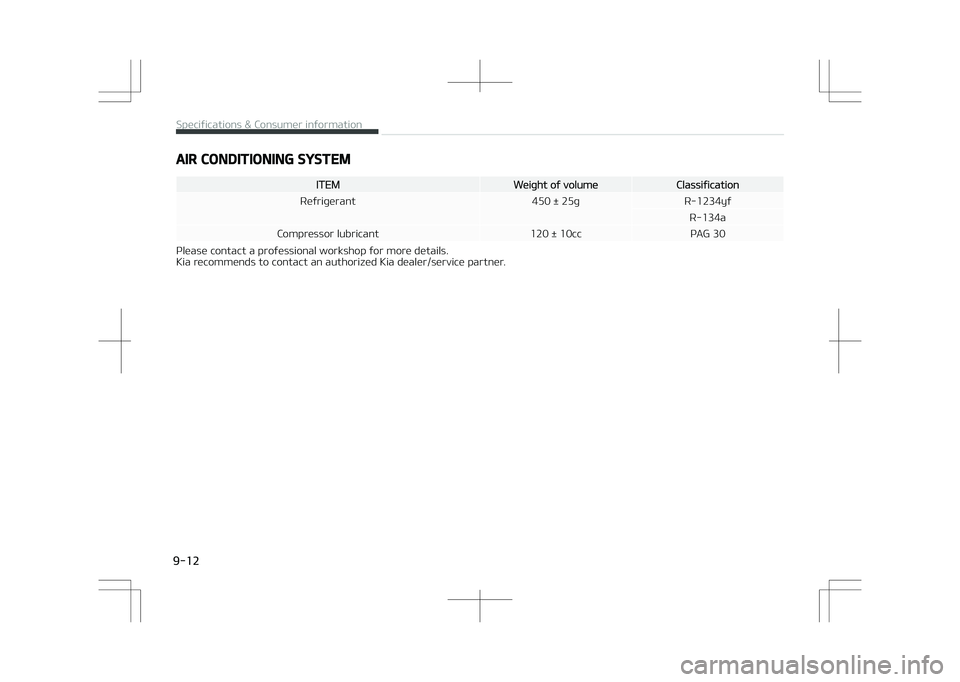
AIR CONDITIONING SYSTEM
ITEMWeight of volumeClassification
Refrigerant 450 ± 25g R-1234yf
R-134a
Compressor lubricant 120 ± 10cc PAG 30
Please contact a professional workshop for more details.
Kia recommends to contact an authorized Kia dealer/service partner.
Specifications & Consumer information
9-12