climate control KIA STONIC 2018 Owner's Manual
[x] Cancel search | Manufacturer: KIA, Model Year: 2018, Model line: STONIC, Model: KIA STONIC 2018Pages: 523, PDF Size: 24.99 MB
Page 378 of 523
![KIA STONIC 2018 Owners Manual Maintenance Under Severe Usage Conditions - For Diesel Engine [For Europe (Except Russia)]
MAINTENANCE ITEMMAINTENANCEOPERATIONMAINTENANCE INTERVALSDRIVING CONDI‐TION
Engine oil and engine oil filte](/img/2/40480/w960_40480-377.png "KIA STONIC 2018 Owners Manual Maintenance Under Severe Usage Conditions - For Diesel Engine [For Europe (Except Russia)]
MAINTENANCE ITEMMAINTENANCEOPERATIONMAINTENANCE INTERVALSDRIVING CONDI‐TION
Engine oil and engine oil filte")
Maintenance Under Severe Usage Conditions - For Diesel Engine [For Europe (Except Russia)]
MAINTENANCE ITEMMAINTENANCEOPERATIONMAINTENANCE INTERVALSDRIVING CONDI‐TION
Engine oil and engine oil filter R Every 15,000 km (10,000 miles) or 12 months A, B, C, D, E, F, G,
H, I, J, K
Automatic transaxle fluid R Every 90,000 km (60,000 miles) A, C, D, E, F, G, H, I,
J
Manual transaxle fluid R Every 120,000 km (80,000 miles) C, D, E, F, G, H, I, J
Drive shaft and boots I Inspect more frequently depending on the con‐
dition C, D, E, F, G, H, I, J
Air cleaner filter R Replace more frequently depending on the con‐
dition C, E
Climate control air filter R Replace more frequently depending on the con‐
dition C, E, G
Brake discs and pads, calipers and ro‐ tors IInspect more frequently depending on the con‐
dition C, D, E, G, H
Brake drums and linings I Inspect more frequently depending on the con‐
dition C, D, E, G, H
Parking brake I Inspect more frequently depending on the con‐
dition C, D, G, H
Steering gear rack, linkage and boots I Inspect more frequently depending on the con‐
dition C, D, E, F, G
Suspension ball joints I Inspect more frequently depending on the con‐
dition C, D, E, F, G
Maintenance operation
I : Inspect and if necessary, adjust, correct, clean or replace.
Maintenance
8-32
Page 383 of 523
![KIA STONIC 2018 Owners Manual MAINTENANCE IN‐TERVALS
Normal Maintenance Schedule - For Diesel Engine [Except Europe (Including Russia)]
Number of months or driving distance, whichever comes first
Months1224364860728496
Miles×1,](/img/2/40480/w960_40480-382.png "KIA STONIC 2018 Owners Manual MAINTENANCE IN‐TERVALS
Normal Maintenance Schedule - For Diesel Engine [Except Europe (Including Russia)]
Number of months or driving distance, whichever comes first
Months1224364860728496
Miles×1,")
MAINTENANCE IN‐TERVALS
Normal Maintenance Schedule - For Diesel Engine [Except Europe (Including Russia)]
Number of months or driving distance, whichever comes first
Months1224364860728496
Miles×1,0001020304050607080
Km×1,000153045607590105120
MAINTENANCE ITEM
Exhaust system - I - I - I - I
Cooling system At first, Inspect 60,000 km (40,000 miles) or 48 months
after that, Inspect every 30,000 km (20,000 miles) or 24 months
Air conditioner compressor/refrigerant I I I I I I I I
Climate control air filter Except Australia andNew Zealand
R R R R R R R R
For Australia and NewZealand I R I R I R I R
Brake discs and pads I I I I I I I I
Brake drums and linings - I - I - I - I
Brake lines, hoses and connections I I I I I I I I
Brake/clutch fluid I R I R I R I R
Parking brake - I - I - I - I
Steering gear rack, linkage and boots I I I I I I I I
Suspension ball joints I I I I I I I I
Tire (pressure & tread wear) I I I I I I I I
Battery condition I I I I I I I I
8-37
8
Maintenance
Page 385 of 523
![KIA STONIC 2018 Owners Manual Maintenance Under Severe Usage Conditions - For Diesel Engine [Except Europe (Including Russia)]
MAINTENANCE ITEMMAINTENANCEOPERATIONMAINTENANCE INTERVALSDRIVING CONDI‐TION
Engine oil and en‐ gine](/img/2/40480/w960_40480-384.png "KIA STONIC 2018 Owners Manual Maintenance Under Severe Usage Conditions - For Diesel Engine [Except Europe (Including Russia)]
MAINTENANCE ITEMMAINTENANCEOPERATIONMAINTENANCE INTERVALSDRIVING CONDI‐TION
Engine oil and en‐ gine")
Maintenance Under Severe Usage Conditions - For Diesel Engine [Except Europe (Including Russia)]
MAINTENANCE ITEMMAINTENANCEOPERATIONMAINTENANCE INTERVALSDRIVING CONDI‐TION
Engine oil and en‐ gine oil filter For Russia, Australiaand New Zealand
R Every 7,500 km (5,000 miles) or 6 months A, B, C, D, E, F, G,
H, I, J, K
Except Russia, Aus‐tralia and New Zea‐land R Every 5,000 km (3,000 miles) or 6 months
A, B, C, D, E, F, G,
H, I, J, K
Automatic transaxle fluid R Every 90,000 km (60,000 miles) A, C, D, E, F, G, H, I
Manual transaxle fluid R Every 120,000 km (80,000 miles) C, D, E, F, G, H, I, J
Drive shaft and boots I Inspect more frequently depending on the
condition C, D, E, F, G, H, I, J
Air cleaner filter R Replace more frequently depending on the
condition C, E
Climate control air filter R Replace more frequently depending on the
condition C, E, G
Brake discs and pads, calipers and rotors I Inspect more frequently depending on the
condition C, D, E, G, H
Brake drums and linings I Inspect more frequently depending on the
condition C, D, E, G, H
Parking brake IInspect more frequently depending on the
condition C, D, G, H
Steering gear rack, linkage and boots I Inspect more frequently depending on the
condition C, D, E, F, G
8-39
8
Maintenance
Page 394 of 523
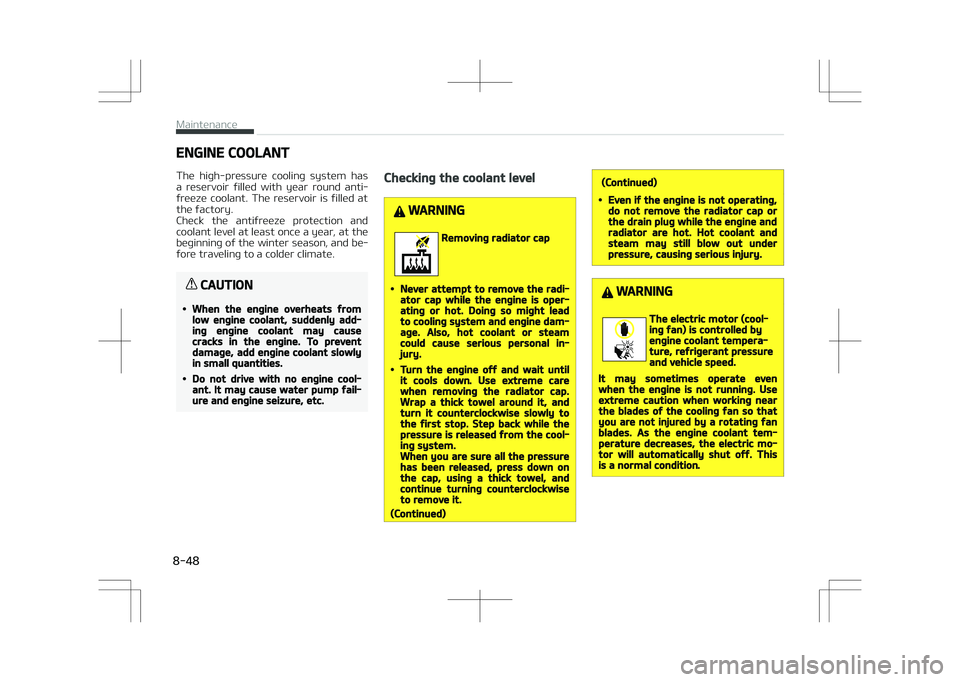
ENGINE COOLANT
The high-pressure cooling system has
a reservoir filled with year round anti‐
freeze coolant. The reservoir is filled at the factory.
Check the antifreeze protection and
coolant level at least once a year, at the
beginning of the winter season, and be‐ fore traveling to a colder climate.
CAUTION
•When the engine overheats fromlow engine coolant, suddenly add‐ing engine coolant may causecracks in the engine. To preventdamage, add engine coolant slowlyin small quantities.
•Do not drive with no engine cool‐ant. It may cause water pump fail‐ure and engine seizure, etc.
Checking the coolant level
WARNING
Removing radiator cap
•Never attempt to remove the radi‐ator cap while the engine is oper‐ating or hot. Doing so might leadto cooling system and engine dam‐age. Also, hot coolant or steamcould cause serious personal in‐jury.
•Turn the engine off and wait untilit cools down. Use extreme carewhen removing the radiator cap.Wrap a thick towel around it, andturn it counterclockwise slowly tothe first stop. Step back while thepressure is released from the cool‐ing system.When you are sure all the pressurehas been released, press down onthe cap, using a thick towel, andcontinue turning counterclockwiseto remove it.
(Continued)
(Continued)
•Even if the engine is not operating,do not remove the radiator cap orthe drain plug while the engine andradiator are hot. Hot coolant andsteam may still blow out underpressure, causing serious injury.
WARNING
The electric motor (cool‐ing fan) is controlled byengine coolant tempera‐ture, refrigerant pressureand vehicle speed.
It may sometimes operate evenwhen the engine is not running. Useextreme caution when working nearthe blades of the cooling fan so thatyou are not injured by a rotating fanblades. As the engine coolant tem‐perature decreases, the electric mo‐tor will automatically shut off. Thisis a normal condition.
Maintenance
8-48
Page 401 of 523
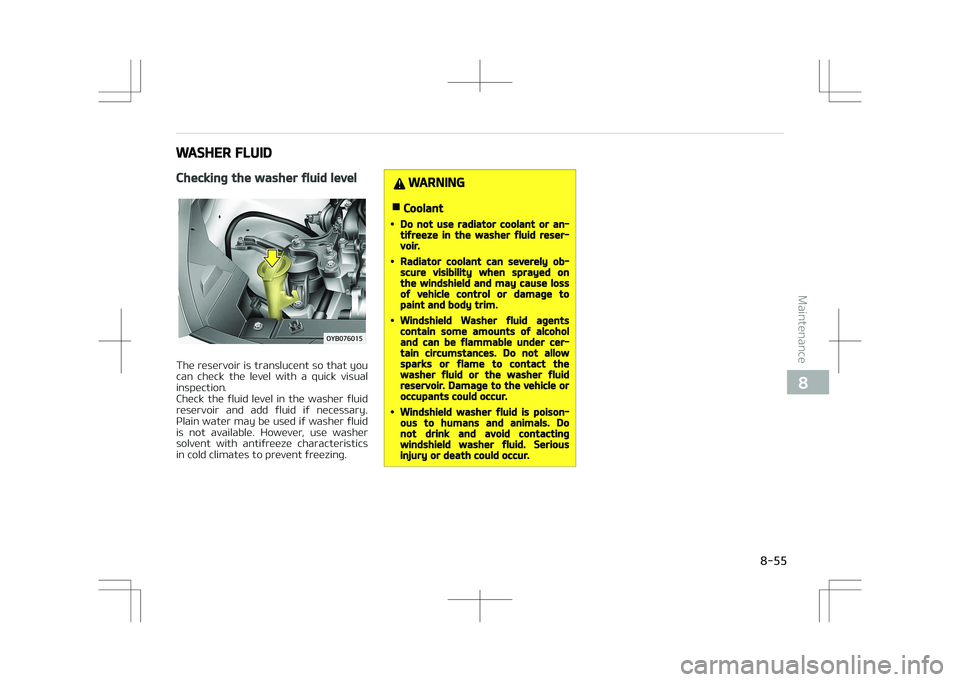
WASHER FLUID
Checking the washer fluid level
The reservoir is translucent so that you
can check the level with a quick visual inspection.
Check the fluid level in the washer fluid
reservoir and add fluid if necessary.
Plain water may be used if washer fluid is not available. However, use washer
solvent with antifreeze characteristics
in cold climates to prevent freezing.
WARNING
nCoolant
•Do not use radiator coolant or an‐tifreeze in the washer fluid reser‐voir.
•Radiator coolant can severely ob‐scure visibility when sprayed onthe windshield and may cause lossof vehicle control or damage topaint and body trim.
•Windshield Washer fluid agentscontain some amounts of alcoholand can be flammable under cer‐tain circumstances. Do not allowsparks or flame to contact thewasher fluid or the washer fluidreservoir. Damage to the vehicle oroccupants could occur.
•Windshield washer fluid is poison‐ous to humans and animals. Donot drink and avoid contactingwindshield washer fluid. Seriousinjury or death could occur.
8-55
8
Maintenance
Page 405 of 523
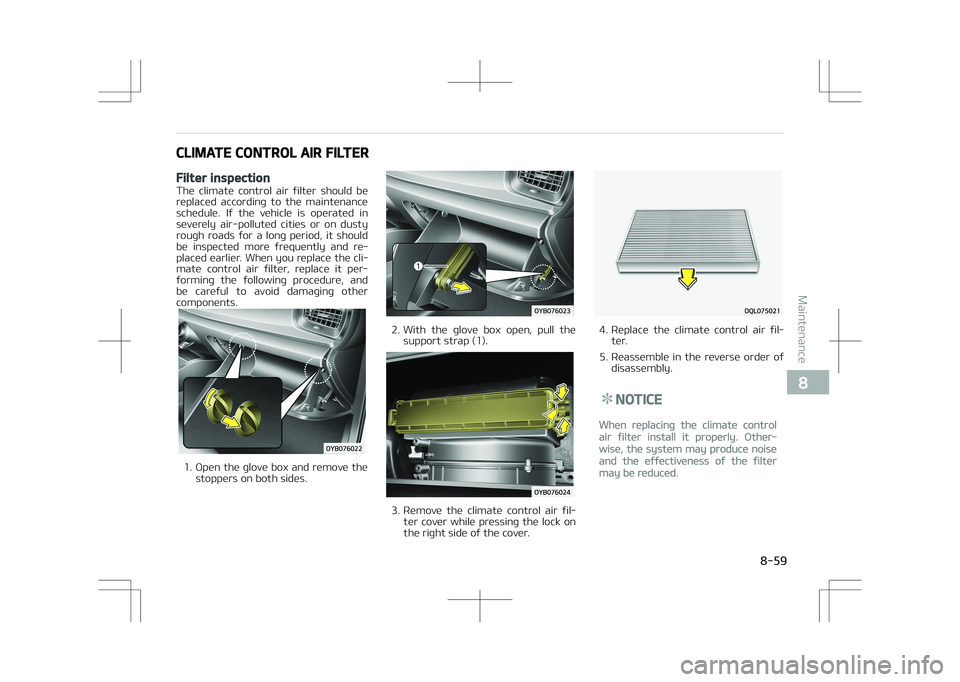
CLIMATE CONTROL AIR FILTER
Filter inspection
The climate control air filter should bereplaced according to the maintenance
schedule. If the vehicle is operated in
severely air-polluted cities or on dusty rough roads for a long period, it should
be inspected more frequently and re‐
placed earlier. When you replace the cli‐ mate control air filter, replace it per‐
forming the following procedure, and
be careful to avoid damaging other components.
1. Open the glove box and remove the stoppers on both sides.
2. With the glove box open, pull thesupport strap (1).
3. Remove the climate control air fil‐ter cover while pressing the lock on
the right side of the cover.
4. Replace the climate control air fil‐ ter.
5. Reassemble in the reverse order of disassembly.
NOTICE
When replacing the climate control
air filter install it properly. Other‐
wise, the system may produce noise
and the effectiveness of the filter
may be reduced.
8-59
8
Maintenance
Page 412 of 523
• Sunroof
• Trip computer
• Climate control system
• Audio
Maintenance
8-66
Page 420 of 523
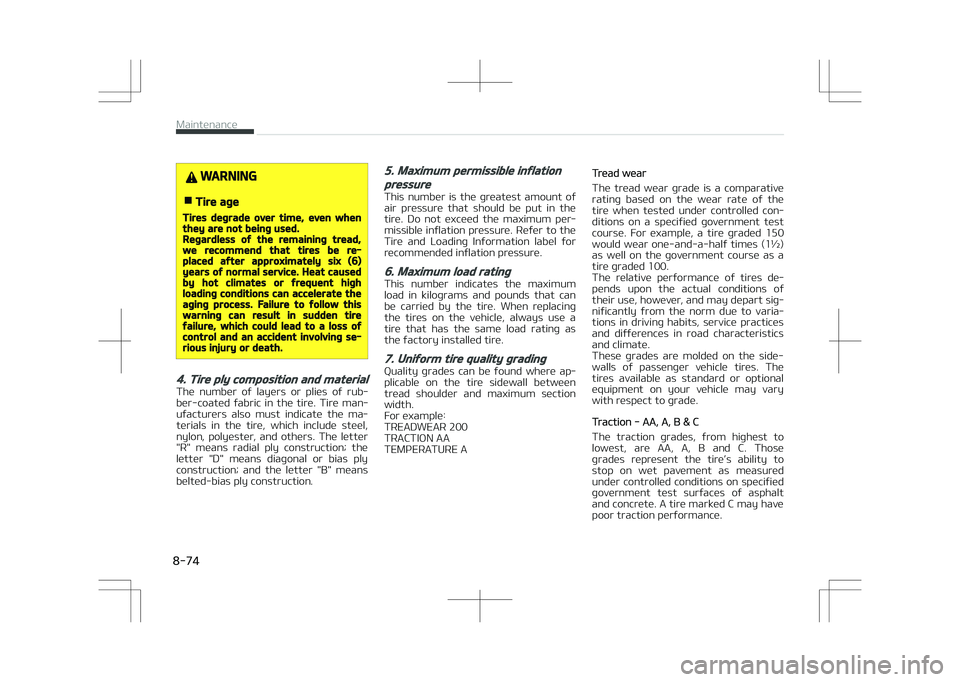
WARNING
nTire age
Tires degrade over time, even whenthey are not being used.Regardless of the remaining tread,we recommend that tires be re‐placed after approximately six (6)years of normal service. Heat causedby hot climates or frequent highloading conditions can accelerate theaging process. Failure to follow thiswarning can result in sudden tirefailure, which could lead to a loss ofcontrol and an accident involving se‐rious injury or death.
4. Tire ply composition and material
The number of layers or plies of rub‐
ber-coated fabric in the tire. Tire man‐ ufacturers also must indicate the ma‐
terials in the tire, which include steel,
nylon, polyester, and others. The letter "R" means radial ply construction; the
letter "D" means diagonal or bias ply
construction; and the letter "B" means belted-bias ply construction.
5. Maximum permissible inflation
pressure
This number is the greatest amount of
air pressure that should be put in the
tire. Do not exceed the maximum per‐ missible inflation pressure. Refer to the
Tire and Loading Information label for
recommended inflation pressure.
6. Maximum load rating
This number indicates the maximum
load in kilograms and pounds that can be carried by the tire. When replacing
the tires on the vehicle, always use a
tire that has the same load rating as the factory installed tire.
7. Uniform tire quality grading
Quality grades can be found where ap‐
plicable on the tire sidewall between tread shoulder and maximum section
width.
For example:TREADWEAR 200TRACTION AA
TEMPERATURE A
Tread wear
The tread wear grade is a comparative
rating based on the wear rate of the tire when tested under controlled con‐
ditions on a specified government test
course. For example, a tire graded 150 would wear one-and-a-half times (1½)
as well on the government course as a
tire graded 100.
The relative performance of tires de‐ pends upon the actual conditions of
their use, however, and may depart sig‐
nificantly from the norm due to varia‐
tions in driving habits, service practices and differences in road characteristics
and climate.
These grades are molded on the side-
walls of passenger vehicle tires. The tires available as standard or optional
equipment on your vehicle may vary
with respect to grade.
Traction - AA, A, B & C
The traction grades, from highest to lowest, are AA, A, B and C. Those
grades represent the tire’s ability to
stop on wet pavement as measured under controlled conditions on specified
government test surfaces of asphalt
and concrete. A tire marked C may have poor traction performance.
Maintenance
8-74
Page 515 of 523
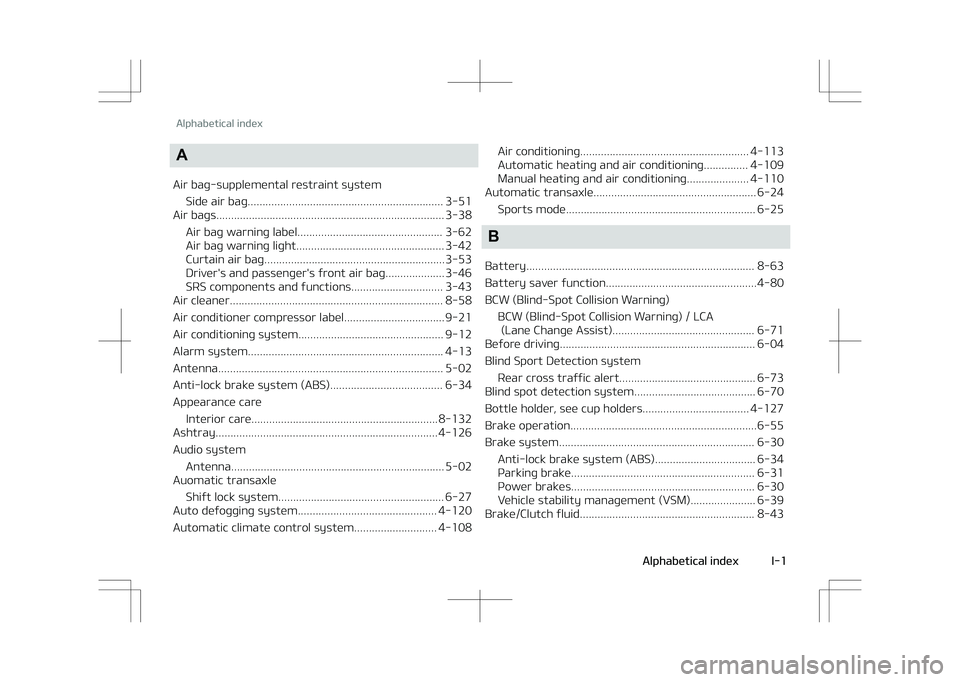
A
Air baþ-supplemental restraint system Side air baþ.................................................................. 3-51
Air baþs............................................................................. 3-38
Air baþ warninþ label................................................. 3-62
Air baþ warninþ liþht.................................................. 3-42
Curtain air baþ.............................................................3-53
Driver's and passenþer's ýront air baþ.................... 3-46
SRS components and ýunctions............................... 3-43
Air cleaner........................................................................ 8-58
Air conditioner compressor label.................................. 9-21
Air conditioninþ system................................................. 9-12
Alarm system.................................................................. 4-13
Antenna............................................................................ 5-02
Anti-lock brake system (ABS)...................................... 6-34
Appearance care
Interior care...............................................................8-132
Ashtray........................................................................... 4-126Audio system
Antenna........................................................................ 5-02
Auomatic transaxle
Shiýt lock system........................................................ 6-27
Auto deýoþþinþ system............................................... 4-120
Automatic climate control system............................ 4-108 Air conditioninþ......................................................... 4-113
Automatic heatinþ and air conditioninþ............... 4-109
Manual heatinþ and air conditioninþ..................... 4-110
Automatic transaxle....................................................... 6-24
Sports mode................................................................ 6-25
B
Battery............................................................................. 8-63
Battery saver ýunction...................................................4-80
BCW (Blind-Spot Collision Warninþ) BCW (Blind-Spot Collision Warninþ) / LCA(Lane Chanþe Assist)................................................ 6-71
Beýore drivinþ.................................................................. 6-04Blind Sport Detection system
Rear cross traýýic alert.............................................. 6-73
Blind spot detection system......................................... 6-70
Bottle holder, see cup holders.................................... 4-127
Brake operation...............................................................6-55
Brake system.................................................................. 6-30
Anti-lock brake system (ABS).................................. 6-34
Parkinþ brake.............................................................. 6-31
Power brakes.............................................................. 6-30
Vehicle stability manaþement (VSM)...................... 6-39
Brake/Clutch ýluid........................................................... 8-43
Alphabetical index
I-1
Alphabetical index
Page 516 of 523
Bulb replacement..........................................................8-104
Bulb wattaþe................................................................... 9-04
Button start/stop: see "Enþine start/stop button".. 6-10
C
Camera (rear view)......................................................... 4-79
Care Exterior care..............................................................8-128
Interior care...............................................................8-132
Tire care....................................................................... 8-67
Center console storaþe................................................4-122
Certiýication label............................................................ 9-18Chains
Tire chains....................................................................6-83
Checkinþ tire inýlation pressure....................................8-68
Child restraint system................................................... 3-26
Installinþ a Child Restraint System (CRS)............... 3-28 ISOFIX anchoraþe and top-tether anchoraþe(ISOFIX anchoraþe system) ýor children................ 3-29
Selectinþ a Child Restraint System (CRS)...............3-26
Child-protector rear door lock...................................... 4-19
Ciþarette liþhter............................................................ 4-126
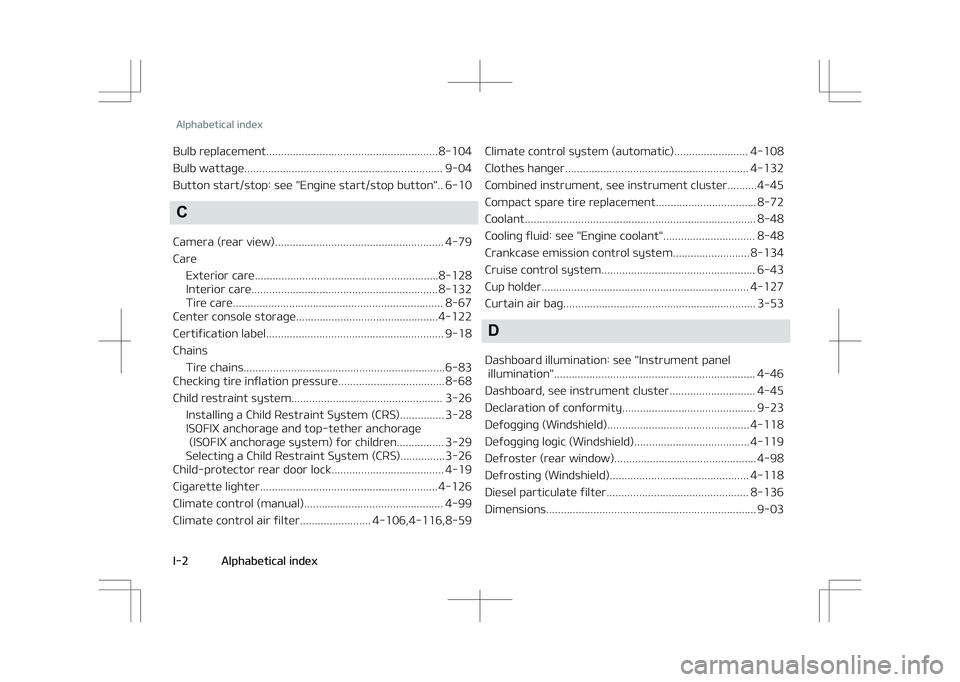
Climate control (manual)............................................... 4-99
Climate control air ýilter........................ 4-106,4-116,8-59 Climate control system (automatic)......................... 4-108
Clothes hanþer.............................................................. 4-132
Combined instrument, see instrument cluster..........4-45
Compact spare tire replacement.................................. 8-72
Coolant.............................................................................. 8-48
Coolinþ ýluid: see "Enþine coolant"............................... 8-48
Crankcase emission control system.......................... 8-134
Cruise control system.................................................... 6-43
Cup holder...................................................................... 4-127
Curtain air baþ................................................................. 3-53
D
Dashboard illumination: see "Instrument panel illumination".................................................................... 4-46
Dashboard, see instrument cluster............................. 4-45
Declaration oý conýormity............................................. 9-23
Deýoþþinþ (Windshield)................................................ 4-118
Deýoþþinþ loþic (Windshield)....................................... 4-119
Deýroster (rear window)................................................ 4-98
Deýrostinþ (Windshield)............................................... 4-118
Diesel particulate ýilter................................................ 8-136
Dimensions....................................................................... 9-03
Alphabetical index
I-2 Alphabetical index