heating KIA STONIC 2018 Owner's Manual
[x] Cancel search | Manufacturer: KIA, Model Year: 2018, Model line: STONIC, Model: KIA STONIC 2018Pages: 523, PDF Size: 24.99 MB
Page 303 of 523
Driving off-road
Drive carefully off-road because your
vehicle may be damaged by rocks or roots of trees. Become familiar with
the off-road conditions where you are
going to drive before you begin driving.
Highway driving
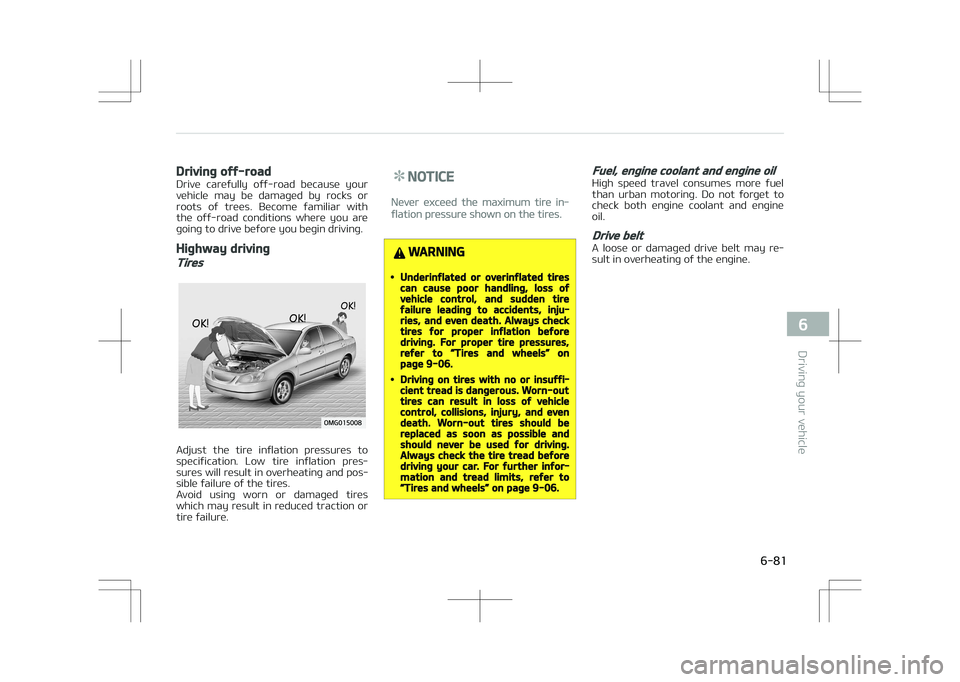
Tires
Adjust the tire inflation pressures to
specification. Low tire inflation pres‐ sures will result in overheating and pos‐
sible failure of the tires.
Avoid using worn or damaged tires
which may result in reduced traction or tire failure.
NOTICE
Never exceed the maximum tire in‐
flation pressure shown on the tires.
WARNING
•Underinflated or overinflated tirescan cause poor handling, loss ofvehicle control, and sudden tirefailure leading to accidents, inju‐ries, and even death. Always checktires for proper inflation beforedriving. For proper tire pressures,refer to L
Page 311 of 523
Making turns
When you’re turning with a trailer,
make wider turns than normal. Do this so your trailer won’t strike soft should‐
ers, curbs, road signs, trees, or other
objects. Avoid jerky or sudden maneu‐ vers. Signal well in advance.
Turn signals when towing a trailer
When you tow a trailer, your vehicle
has to have a different turn signal flasher and extra wiring. The green ar‐
rows on your instrument panel will
flash whenever you signal a turn or lane change. Properly connected, the
trailer lights will also flash to alert oth‐
er drivers you’re about to turn, change lanes, or stop.
When towing a trailer, the green ar‐
rows on your instrument panel will
flash for turns even if the bulbs on the trailer are burned out. Thus, you may
think drivers behind you are seeing
your signals when, in fact, they are not. It’s important to check occasionally to
be sure the trailer bulbs are still work‐
ing. You must also check the lights ev‐ ery time you disconnect and then re‐
connect the wires.
Do not connect a trailer lighting system
directly to your vehicle’s lighting sys‐ tem. Use only an approved trailer wir‐
ing harness. Have yourself assisted by a professio‐
nal workshop in installing the wiring harness.
Kia recommends to visit an authorized
Kia dealer/service partner.
WARNING
Failure to use an approved trailerwiring harness could result in dam‐age to the vehicle electrical systemand/or personal injury.
Driving on grades
Reduce the speed and shift to a lower
gear before you start down a long or steep downgrade. If you don’t shift
down, you might have to use your
brakes so much that they would get hot and no longer operate efficiently.
On a long uphill grade, shift down and
reduce your speed to around 70 km/h
(45 mph) to reduce the possibility of engine and transaxle overheating.
If your trailer weighs more than the
maximum trailer weight without trailer
brakes and you have an automatic transaxle, you should drive in D (Drive)
when towing a trailer. Operating your vehicle in D (Drive)
when towing a trailer will minimize heat build up and extend the life of
your transaxle.
CAUTION
•When towing a trailer on steepgrades (in excess of 6%) pay closeattention to the engine coolanttemperature gauge to ensure theengine does not overheat. If theneedle of the coolant temperaturegauge moves across the dial to‐wards L
Page 313 of 523
Maintenance when trailer
towing
Your vehicle will need service more of‐
ten when you regularly pull a trailer.
Important items to pay particular at‐ tention to include engine oil, automatic
transaxle fluid, axle lubricant and cool‐
ing system fluid. Brake condition is an‐ other important item to frequently
check. Each item is covered in this man‐
ual, and the Index will help you find them quickly. If you’re trailering, it’s a
good idea to review these sections be‐
fore you start your trip.
Don’t forget to also maintain your trail‐ er and hitch. Follow the maintenance
schedule that accompanied your trailer
and check it periodically. Preferably, conduct the check at the start of each
day’s driving. Most importantly, all
hitch nuts and bolts should be tight.
CAUTION
•Due to higher load during trailerusage, overheating might occur inhot days or during uphill driving. Ifthe coolant gauge indicates over‐heating, switch off the A/C andstop the vehicle in a safe area tocool down the engine.
•When towing, check the transaxlefluid more frequently.
•If your vehicle is not equipped withan air conditioner, you should in‐stall a condenser fan to improveengine performance when towinga trailer.
If you do decide to pull a trailer
Here are some important points if you
decide to pull a trailer:
• Consider using a sway control. You can ask a hitch dealer about swaycontrol. • Do not do any towing with your car
during its first 2,000 km (1,200 miles)
in order to allow the engine to prop‐
erly break in. Failure to heed this cau‐
tion may result in serious engine or transaxle damage.
• When towing a trailer, Kia recom‐ mends that you consult an author‐
ized Kia dealer/service partner on ad‐
ditional requirements such as a tow‐
ing kit, etc.
• Always drive your vehicle at a moder‐ ate speed (less than 100 km/h
(60 mph)).
• On a long uphill grade, do not exceed 70 km/h (45 mph) or the posted tow‐
ing speed limit, whichever is lower.
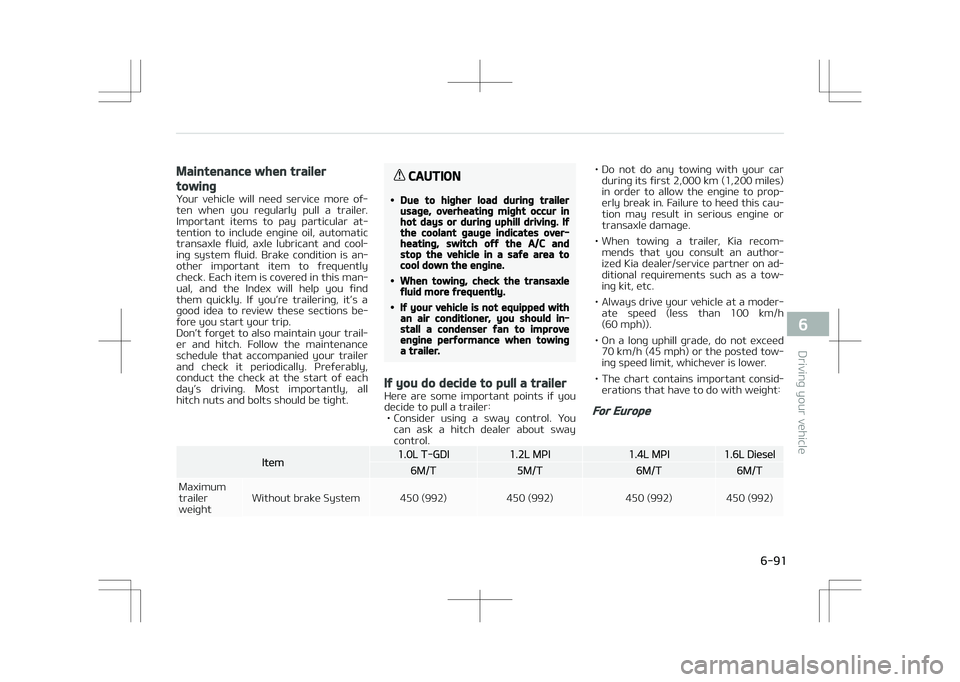
• The chart contains important consid‐ erations that have to do with weight:
For Europe
Item1.0L T-GDI1.2L MPI1.4L MPI1.6L Diesel
6M/T5M/T6M/T6M/T
Maximum trailerweight Without brake System 450 (992) 450 (992) 450 (992) 450 (992)
6-91
6
Driving your vehicle
Page 323 of 523
IF THE ENGINE OVERHEATS
If your temperature gauge indicates
overheating, you will experience a loss of power, or hear loud pinging or knock‐
ing, the engine is probably too hot. If
this happens, you should: 1. Pull off the road and stop as soon as it is safe to do so.
2. Place the shift lever in P (automatic transaxle) or neutral (manual
transaxle) and set the parking
brake. If the air conditioning is on, turn it off.
3. If engine coolant is running out un‐ der the vehicle or steam is coming
out from the hood, stop the engine.
Do not open the hood until the
coolant has stopped running or the
steaming has stopped. If there is no
visible loss of engine coolant and no
steam, leave the engine running
and check to be sure the engine
cooling fan is operating. If the fan is
not running, turn the engine off.
4. Check to see if the water pump drive belt is missing. If it is not
missing, check to see that it is
tight.
If the drive belt seems to be satis‐
factory, check for coolant leaking
from the radiator, hoses or under
the vehicle. (If the air conditioning had been in use, it is normal for
cold water to be draining from it
when you stop).
WARNING
While the engine is running, keephair, hands and clothing away frommoving parts such as the fan anddrive belts to prevent injury.
5. If the water pump drive belt is bro‐ ken or engine coolant is leaking out,
stop the engine immediately and
call a professional workshop. Kia
recommends to call an authorized
Kia dealer/service partner.
WARNING
Do not remove the radiator capwhen the engine is hot. This can al‐low coolant to blow out of the open‐ing and cause serious burns.
6. If you cannot find the cause of the overheating, wait until the engine
temperature has returned to nor‐
mal. Then, if coolant has been lost,
carefully add coolant to the reser‐
voir to bring the fluid level in the
reservoir up to the halfway mark.
7. Proceed with caution, keeping alert for further signs of overheating. Ifoverheating happens again, call a
professional workshop. Kia recom‐
mends to call an authorized Kia
dealer/service partner.
CAUTION
•Serious loss of coolant indicatesthere is a leak in the cooling sys‐tem. In this case, have the sys‐tem checked by a professionalworkshop. Kia recommends tovisit an authorized Kia dealer/service partner.
•When the engine overheats fromlow engine coolant, suddenlyadding engine coolant may causecracks in the engine. To preventdamage, add engine coolantslowly in small quantities.
7-07
7
What to do in an emergency