heating KIA VENGA 2013 Owner's Manual
[x] Cancel search | Manufacturer: KIA, Model Year: 2013, Model line: VENGA, Model: KIA VENGA 2013Pages: 751, PDF Size: 27.49 MB
Page 259 of 751
555
Driving your vehicle
Following distance
Stay at least twice as far behind the vehi-
cle ahead as you would when driving
your vehicle without a trailer. This can
help you avoid situations that require
heavy braking and sudden turns.
Passing
You’ll need more passing distance up
ahead when you’re towing a trailer. And,
because of the increased vehicle length,
you’ll need to go much farther beyond the
passed vehicle before you can return to
your lane.
Backing up
Hold the bottom of the steering wheel
with one hand. Then, to move the trailer
to the left, just move your hand to the left.
To move the trailer to the right, move your
hand to the right. Always back up slowly
and, if possible, have someone guide
you.
Making turns
When you’re turning with a trailer, make
wider turns than normal. Do this so your
trailer won’t strike soft shoulders, curbs,
road signs, trees, or other objects. Avoid
jerky or sudden maneuvers. Signal well
in advance.
Turn signals when towing a trailer
When you tow a trailer, your vehicle has
to have a different turn signal flasher and
extra wiring. The green arrows on your
instrument panel will flash whenever you
signal a turn or lane change. Properly
connected, the trailer lights will also flash
to alert other drivers you’re about to turn,
change lanes, or stop.
When towing a trailer, the green arrows
on your instrument panel will flash for
turns even if the bulbs on the trailer are
burned out. Thus, you may think drivers
behind you are seeing your signals
when, in fact, they are not. It’s important
to check occasionally to be sure the trail-
er bulbs are still working. You must also
check the lights every time you discon-
nect and then reconnect the wires.
Do not connect a trailer lighting system
directly to your vehicle’s lighting system.
Use only an approved trailer wiring har-
ness.We recommend that you contact an
authorized Kia dealer to assist you in
installing the wiring harness.
Driving on grades
Reduce speed and shift to a lower gear
before you start down a long or steep
downgrade. If you don’t shift down, you
might have to use your brakes so much
that they would get hot and no longer
operate efficiently.
On a long uphill grade, shift down and
reduce your speed to around 70 km/h (45mph) to reduce the possibility of engine
and transaxle overheating.
If your trailer weighs more than the max-
imum trailer weight without trailer brakes
and you have an automatic transaxle,
you should drive in D (Drive) when tow-
ing a trailer.
Operating your vehicle in D (Drive) when
towing a trailer will minimize heat build up
and extend the life of your transaxle.
WARNING
Failure to use an approved trailer wiring harness could result in dam-
age to the vehicle electrical system
and/or personal injury.
YN ENG 5.QXP 4/16/2012 10:04 AM Page 55
Page 260 of 751
Driving your vehicle
56
5
Parking on hills
Generally, if you have a trailer attached to
your vehicle, you should not park your
vehicle on a hill. People can be seriously
or fatally injured, and both your vehicle
and the trailer can be damaged if unex-
pectedly roll down hill.
However, if you ever have to park your
trailer on a hill, here's how to do it:
1. Pull the vehicle into the parking space.
Turn the steering wheel in the direction
of the curb (right if headed down hill,left if headed up hill).
2. If the vehicle has a manual transaxle, place the car in neutral. If the vehicle
has an automatic transaxle, place the
car in P (Park).
3. Set the parking brake and shut off the vehicle.
4. Place chocks under the trailer wheels on the down hill side of the wheels. 5. Start the vehicle, hold the brakes, shift
to neutral, release the parking brake
and slowly release the brakes until the
trailer chocks absorb the load.
6. Reapply the brakes, reapply the park- ing brake and shift the vehicle to R
(Reverse) for manual transaxle or P
(Park) for automatic transaxle.
7. Shut off the vehicle and release the vehicle brakes but leave the parking
brake set.CAUTION
When towing a trailer on steep
grades (in excess of 6%) pay
close attention to the enginecoolant temperature gauge toensure the engine does not over- heat. If the coolant temperature
red warning light illuminates, pullover and stop as soon as it is safeto do so, and allow the engine to
idle until it cools down. You mayproceed once the engine hascooled sufficiently.
You must decide the driving speed depending on trailer
weight and uphill grade to reduce the possibility of engine andtransaxle overheating.
WARNING - Parking on a
hill
Parking your vehicle on a hill with a
trailer attached could cause seri-
ous injury or death, should the trail-
er break loose.
WARNING - Parking brake
It can be dangerous to get out of
your vehicle if the parking brake is
not firmly set.
If you have left the engine running,
the vehicle can move suddenly. You
or others could be seriously or
fatally injured.
YN ENG 5.QXP 4/16/2012 10:04 AM Page 56
Page 261 of 751
557
Driving your vehicle
When you are ready to leave after park- ing on a hill
1. With the manual transaxle in Neutralor automatic transaxle in P (Park),
apply your brakes and hold the brake
pedal down while you:
Start your engine;
Shift into gear; and
Release the parking brake.
2. Slowly remove your foot from the brake pedal.
3. Drive slowly until the trailer is clear of the chocks.
4. Stop and have someone pick up and store the chocks. Maintenance when trailer towing
Your vehicle will need service more often
when you regularly pull a trailer.
Important items to pay particular atten-tion to include engine oil, automatic
transaxle fluid, axle lubricant and cooling
system fluid. Brake condition is another
important item to frequently check. Each
item is covered in this manual, and the
Index will help you find them quickly. If
you’re trailering, it’s a good idea to review
these sections before you start your trip.
Don’t forget to also maintain your trailer
and hitch. Follow the maintenance
schedule that accompanied your trailer
and check it periodically. Preferably, con-
duct the check at the start of each day’s
driving. Most importantly, all hitch nutsand bolts should be tight.CAUTION
Due to higher load during trailer
usage, overheating might occur
in hot days or during uphill driv- ing. If the coolant gauge indicatesover-heating, switch off the A/Cand stop the vehicle in a safe area
to cool down the engine.
When towing, check the transaxle fluid more frequently.
If your vehicle is not equipped with an air conditioner, you
should install a condenser fan to improve engine performancewhen towing a trailer.
YN ENG 5.QXP 4/16/2012 10:04 AM Page 57
Page 270 of 751
What to do in an emergency
6
6
IF THE ENGINE OVERHEATS
If your temperature gauge indicates over-
heating, you will experience a loss of
power, or hear loud pinging or knocking,
the engine is probably too hot. If this hap-
pens, you should:
1. Pull off the road and stop as soon as it is safe to do so.
2. Place the shift lever in P (automatic transaxle) or Neutral (manual
transaxle) and set the parking brake. If
the air conditioning is on, turn it off.
3. If engine coolant is running out under the vehicle or steam is coming out
from the hood, stop the engine. Do notopen the hood until the coolant has
stopped running or the steaming has
stopped. If there is no visible loss of
engine coolant and no steam, leave
the engine running and check to be
sure the engine cooling fan is operat-
ing. If the fan is not running, turn the
engine off. 4. Check to see if the water pump drive
belt is missing. If it is not missing,
check to see that it is tight. If the drive
belt seems to be satisfactory, check for
coolant leaking from the radiator,
hoses or under the vehicle. (If the air
conditioning had been in use, it is nor-
mal for cold water to be draining from
it when you stop).
5. If the water pump drive belt is broken or engine coolant is leaking out, stop
the engine immediately and we recom-
mend that you call an authorized Kia
dealer. 6. If you cannot find the cause of over-
heating, wait until the engine tempera-
ture has returned to normal. Then, ifcoolant has been lost, carefully add
coolant to the reservoir to bring the
fluid level in the reservoir up to the
halfway mark.
7. Proceed with caution, keeping alert for further signs of overheating. If overheat-
ing happens again, we recommend that
you call an authorized Kia dealer.
WARNING
While the engine is running, keep
hair, hands and clothing away from
moving parts such as the fan and
drive belts to prevent injury.
WARNING
Do not remove the radiator cap
when the engine is hot. This can
allow coolant to be blown out of the
opening and cause serious burns.
CAUTION
Serious loss of coolant indicates there is a leak in the cooling systemand we recommend that the systembe checked by an authorized Kia dealer.
YN ENG 6.QXP 4/16/2012 10:05 AM Page 6
Page 385 of 751
Index
2
I
Air bag warning label . . . . . . . . . . . . . . . . . . . . . . . . . . 3-59
Air bag warning light . . . . . . . . . . . . . . . . . . . . . . . . . . 3-40
Air bags. . . . . . . . . . . . . . . . . . . . . . . . . . . . . . . . . . . . . 3-37
Air bag warning label . . . . . . . . . . . . . . . . . . . . . . . . . 3-59
Air bag warning light . . . . . . . . . . . . . . . . . . . . . . . . . 3-40
Curtain air bag . . . . . . . . . . . . . . . . . . . . . . . . . . . . . . 3-51
Driver's and passenger's front air bag . . . . . . . . . . . . 3-44
Side impact air bag . . . . . . . . . . . . . . . . . . . . . . . . . . . 3-49
SRS components and functions . . . . . . . . . . . . . . . . . 3-42
Air cleaner . . . . . . . . . . . . . . . . . . . . . . . . . . . . . . . . . . 7-33
Alarm system . . . . . . . . . . . . . . . . . . . . . . . . . . . . . . . . 4-11
Antenna . . . . . . . . . . . . . . . . . . . . . . . . . . . . . . . . . . . . 4-100
Anti-lock brake system (ABS) . . . . . . . . . . . . . . . . . . . 5-27
Appearance care . . . . . . . . . . . . . . . . . . . . . . . . . . . . . . 7-72 Exterior care . . . . . . . . . . . . . . . . . . . . . . . . . . . . . . . . 7-72
Interior care . . . . . . . . . . . . . . . . . . . . . . . . . . . . . . . . 7-77
Ashtray . . . . . . . . . . . . . . . . . . . . . . . . . . . . . . . . . . . . . 4-94
Audio system . . . . . . . . . . . . . . . . . . . . . . . . . . . . . . . 4-100 Antenna. . . . . . . . . . . . . . . . . . . . . . . . . . . . . . . . . . . 4-100
Auto seat warmer(front) . . . . . . . . . . . . . . . . . . . . . . . . . 3-8
Automatic climate control system . . . . . . . . . . . . . . . . 4-81 Air conditioning . . . . . . . . . . . . . . . . . . . . . . . . . . . . . 4-87
Automatic heating and air conditioning . . . . . . . . . . . 4-82
Manual heating and air conditioning . . . . . . . . . . . . . 4-83 Automatic transaxle . . . . . . . . . . . . . . . . . . . . . . . . . . . 5-19
Aux, USB and iPod port . . . . . . . . . . . . . . . . . . . . . . . . 4-96
Battery. . . . . . . . . . . . . . . . . . . . . . . . . . . . . . . . . . . . . . 7-39
Battery saver function. . . . . . . . . . . . . . . . . . . . . . . . . . 4-61
Before driving . . . . . . . . . . . . . . . . . . . . . . . . . . . . . . . . . 5-3
Bottle holders, see cup holders . . . . . . . . . . . . . . . . . . . 4-94
Brake system. . . . . . . . . . . . . . . . . . . . . . . . . . . . . . . . . 5-24
Anti-lock brake system (ABS) . . . . . . . . . . . . . . . . . . 5-27
Electronic stability program (ESP) . . . . . . . . . . . . . . 5-29
Parking brake . . . . . . . . . . . . . . . . . . . . . . . . . . . . . . . 5-25
Power brakes . . . . . . . . . . . . . . . . . . . . . . . . . . . . . . . 5-24
Emergency Stop Signal . . . . . . . . . . . . . . . . . . . . . . . 5-32
Hill-start assist control . . . . . . . . . . . . . . . . . . . . . . . . 5-32
Vehicle stability management. . . . . . . . . . . . . . . . . . . 5-33
Brakes fluid. . . . . . . . . . . . . . . . . . . . . . . . . . . . . . . . . . 7-28
Bulb replacement . . . . . . . . . . . . . . . . . . . . . . . . . . . . . 7-63
Bulb wattage . . . . . . . . . . . . . . . . . . . . . . . . . . . . . . . . . . 8-2
Button start/stop, see engine start/stop button . . . . . . . . 5-8
Camera (Rear view) . . . . . . . . . . . . . . . . . . . . . . . . . . . 4-60
Capacities (Lubricants) . . . . . . . . . . . . . . . . . . . . . . . . . . 8-4
A
C
B
YN eng INDEX.QXP 2011.09.22. 16:35 Page 2
Page 389 of 751
Index
6
I
Power outlet . . . . . . . . . . . . . . . . . . . . . . . . . . . . . . . . 4-96
Sunvisor . . . . . . . . . . . . . . . . . . . . . . . . . . . . . . . . . . . 4-95
Interior light . . . . . . . . . . . . . . . . . . . . . . . . . . . . . . . . . 4-70
Interior overview . . . . . . . . . . . . . . . . . . . . . . . . . . . . . . 2-2
ISG (Idle stop and go) system . . . . . . . . . . . . . . . . . . . 5-14
ISOFIX system . . . . . . . . . . . . . . . . . . . . . . . . . . . . . . . 3-32
Jack and tools . . . . . . . . . . . . . . . . . . . . . . . . . . . . . . . . . 6-7
Jump starting. . . . . . . . . . . . . . . . . . . . . . . . . . . . . . . . . . 6-4
Key positions . . . . . . . . . . . . . . . . . . . . . . . . . . . . . . . . . 5-4
Keys . . . . . . . . . . . . . . . . . . . . . . . . . . . . . . . . . . . . . . . . 4-2 Label Air bag warning label . . . . . . . . . . . . . . . . . . . . . . . . . 3-59
Tire sidewall labeling . . . . . . . . . . . . . . . . . . . . . . . . . 7-48
Tire specification and pressure label . . . . . . . . . . . . . . 8-8
Vehicle certification label . . . . . . . . . . . . . . . . . . . . . . . 8-7
Lap/shoulder belt . . . . . . . . . . . . . . . . . . . . . . . . . . . . . 3-16
Light bulbs . . . . . . . . . . . . . . . . . . . . . . . . . . . . . . . . . . 7-63 Lighting. . . . . . . . . . . . . . . . . . . . . . . . . . . . . . . . . . . . . 4-61
Battery saver function . . . . . . . . . . . . . . . . . . . . . . . . 4-61
Lubricants and capacities . . . . . . . . . . . . . . . . . . . . . . . . 8-4
Main fuse, see memory fuse . . . . . . . . . . . . . . . . . . . . . 7-54 Maintenance Explanation of scheduled maintenance items . . . . . . 7-20
Maintenance services . . . . . . . . . . . . . . . . . . . . . . . . . . 7-3
Maintenance under severe usage conditions . . . . . 7-12,18
Normal maintenance schedule. . . . . . . . . . . . . . . . . 7-8,14
Owner maintenance . . . . . . . . . . . . . . . . . . . . . . . . . . . 7-5
Scheduled maintenance service . . . . . . . . . . . . . . . . . . 7-7
Tire maintenance . . . . . . . . . . . . . . . . . . . . . . . . . . . . 7-47
Maintenance schedule Maintenance under severe usage conditions . . . . . 7-12,18
Normal maintenance schedule. . . . . . . . . . . . . . . . . 7-8,14
Maintenance services . . . . . . . . . . . . . . . . . . . . . . . . . . . 7-7
Manual climate control system. . . . . . . . . . . . . . . . . . . 4-72 Air conditioning . . . . . . . . . . . . . . . . . . . . . . . . . . . . . 4-77
Climate control air filter . . . . . . . . . . . . . . . . . . . . . . . 4-79
Heating and air conditioning . . . . . . . . . . . . . . . . . . . 4-73
Manual transaxle. . . . . . . . . . . . . . . . . . . . . . . . . . . . . . 5-16
Manual window . . . . . . . . . . . . . . . . . . . . . . . . . . . . . . 4-23
Memory fuse . . . . . . . . . . . . . . . . . . . . . . . . . . . . . . . . . 7-54
J
K
L
M
YN eng INDEX.QXP 2011.09.22. 16:35 Page 6
Page 399 of 751
Introduction
4
1
Fuel Additives
Kia recommends that you use good qual- ity petrols meet Europe Fuel standards
(EN228) or equivalents.
For customers who do not use good
quality petrols including fuel additives
regularly, and have problems starting or
the engine does not run smoothly, one
bottle of additives added to the fuel tank at
every 15,000km (For Europe)/ 5,000km
(Except Europe). Additives are available
from your authorised Kia dealer along with
information on how to use them. Do not
mix other additives.
Operation in foreign countries
If you are going to drive your vehicle in
another country, be sure to:
Observe all regulations regarding reg- istration and insurance.
Determine that acceptable fuel is avail- able. Diesel engine
Diesel fuel
Diesel engine must be operated only on
commercially available diesel fuel that
complies with EN 590 or comparable
standard. (EN stands for "European
Norm"). Do not use marine diesel fuel,
heating oils, or non-approved fuel addi-
tives, as this will increase wear andcause damage to the engine and fuel
system. The use of non-approved fuels
and / or fuel additives will result in a limi-
tation of your warranty rights.
Diesel fuel of above cetane 51 is used in
your vehicle. If two types of diesel fuel
are available, use summer or winter fuel
properly according to the following tem-
perature conditions.
Above -5°C(23°F) ... Summer type
diesel fuel.
Below -5°C(23°F) ... Winter type diesel fuel.
Watch the fuel level in the tank very care-
fully : If the engine stops through fuel fail-
ure, the circuits must be completely
purged to permit restarting.
CAUTION
Do not let any petrol or water enter the tank. This would make it neces-
sary to drain it out and to bleed thelines to avoid jamming the injectionpump and damaging the engine.
CAUTION
Your New Vehicle Limited Warrantymay not cover damage to the fuel
system and any performance prob-lems that are caused by the use offuels containing methanol or fuels containing MTBE (Methyl Tertiary
Butyl Ether) over 15.0% vol.(Oxygen Content 2.7% weight.)
CAUTION - Diesel Fuel
(if equipped with DPF)
It is recommended to use the regu- lated automotive diesel fuel fordiesel vehicle equipped with the DPF system.
If you use diesel fuel including highsulfur (more than 50 ppm sulfur) and unspecified additives, it cancause the DPF system to be dam-
aged and white smoke can be emit-ted.
YN RHD 1.QXP 3/31/2012 4:00 PM Page 4
Page 414 of 751
39
Safety features of your vehicle
Seatback pocket (if equipped)Rear seat adjustment
Forward and backward
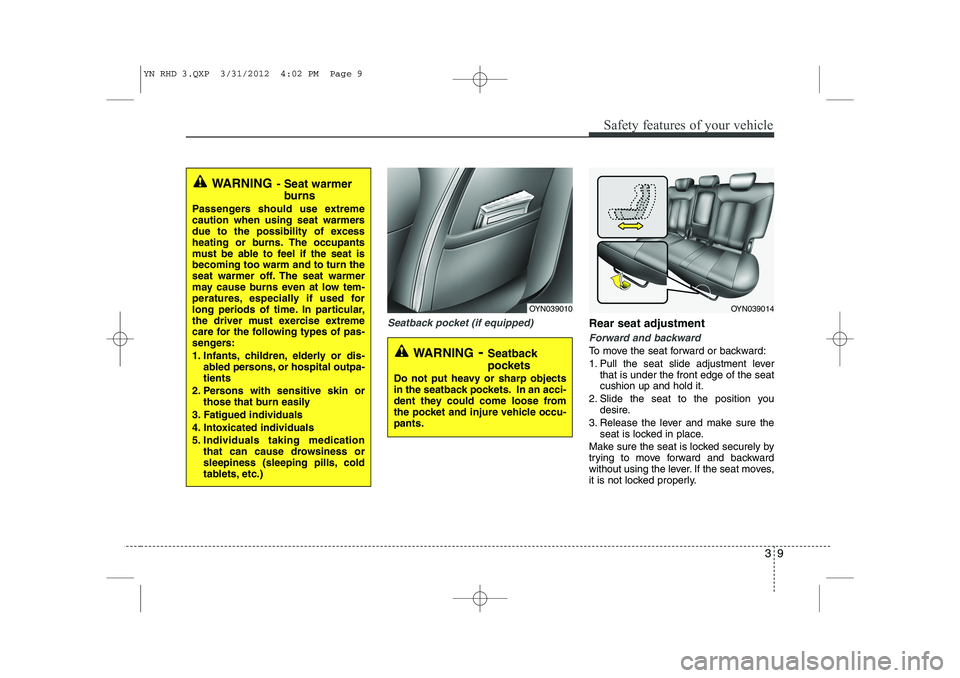
To move the seat forward or backward:
1. Pull the seat slide adjustment leverthat is under the front edge of the seat cushion up and hold it.
2. Slide the seat to the position you desire.
3. Release the lever and make sure the seat is locked in place.
Make sure the seat is locked securely by
trying to move forward and backward
without using the lever. If the seat moves,
it is not locked properly.
WARNING - Seat warmer
burns
Passengers should use extreme
caution when using seat warmers
due to the possibility of excess
heating or burns. The occupants
must be able to feel if the seat isbecoming too warm and to turn the
seat warmer off. The seat warmer
may cause burns even at low tem-
peratures, especially if used for
long periods of time. In particular,
the driver must exercise extreme
care for the following types of pas-
sengers:
1. Infants, children, elderly or dis- abled persons, or hospital outpa- tients
2. Persons with sensitive skin or those that burn easily
3. Fatigued individuals
4. Intoxicated individuals
5. Individuals taking medication that can cause drowsiness or
sleepiness (sleeping pills, cold
tablets, etc.)
WARNING - Seatback
pockets
Do not put heavy or sharp objects
in the seatback pockets. In an acci-
dent they could come loose from
the pocket and injure vehicle occu-pants.
OYN039010OYN039014
YN RHD 3.QXP 3/31/2012 4:02 PM Page 9
Page 515 of 751
451
Features of your vehicle
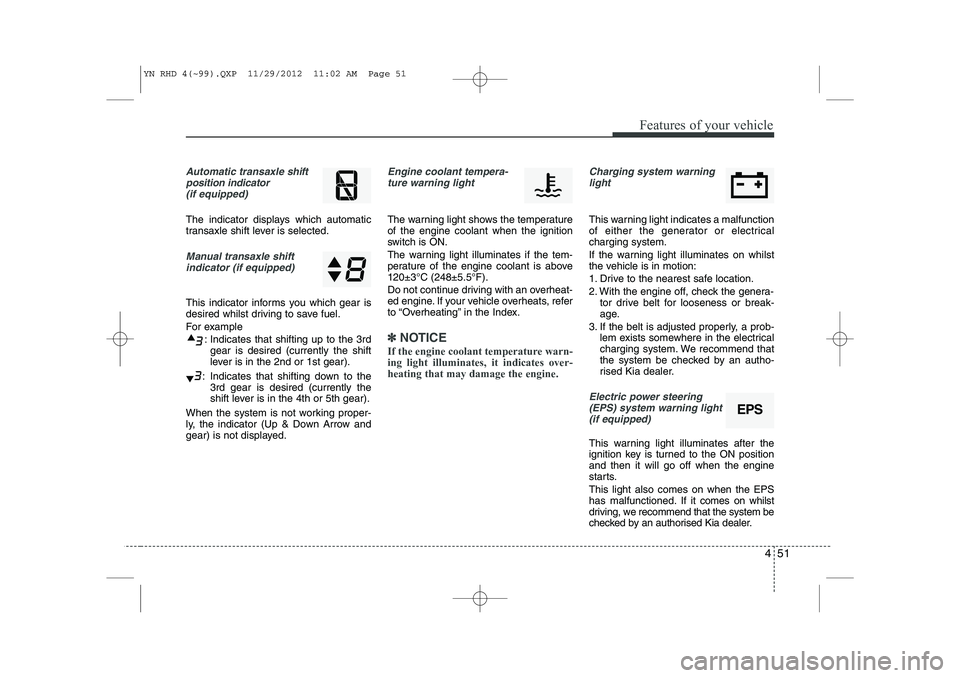
Automatic transaxle shiftposition indicator (if equipped)
The indicator displays which automatic
transaxle shift lever is selected.
Manual transaxle shiftindicator (if equipped)
This indicator informs you which gear is
desired whilst driving to save fuel.
For example
: Indicates that shifting up to the 3rdgear is desired (currently the shift
lever is in the 2nd or 1st gear).
: Indicates that shifting down to the 3rd gear is desired (currently the
shift lever is in the 4th or 5th gear).
When the system is not working proper-
ly, the indicator (Up & Down Arrow and
gear) is not displayed.
Engine coolant tempera- ture warning light
The warning light shows the temperature of the engine coolant when the ignition
switch is ON.
The warning light illuminates if the tem-
perature of the engine coolant is above120±3°C (248±5.5°F).
Do not continue driving with an overheat-
ed engine. If your vehicle overheats, refer
to “Overheating” in the Index.
✽✽ NOTICE
If the engine coolant temperature warn- ing light illuminates, it indicates over-heating that may damage the engine.
Charging system warning light
This warning light indicates a malfunction
of either the generator or electricalcharging system.
If the warning light illuminates on whilst
the vehicle is in motion:
1. Drive to the nearest safe location.
2. With the engine off, check the genera- tor drive belt for looseness or break-
age.
3. If the belt is adjusted properly, a prob- lem exists somewhere in the electrical
charging system. We recommend that
the system be checked by an autho-
rised Kia dealer.
Electric power steering
(EPS) system warning light(if equipped)
This warning light illuminates after the
ignition key is turned to the ON positionand then it will go off when the engine
starts. This light also comes on when the EPS
has malfunctioned. If it comes on whilst
driving, we recommend that the system be
checked by an authorised Kia dealer.
EPS
YN RHD 4(~99).QXP 11/29/2012 11:02 AM Page 51
Page 520 of 751
Features of your vehicle
56
4
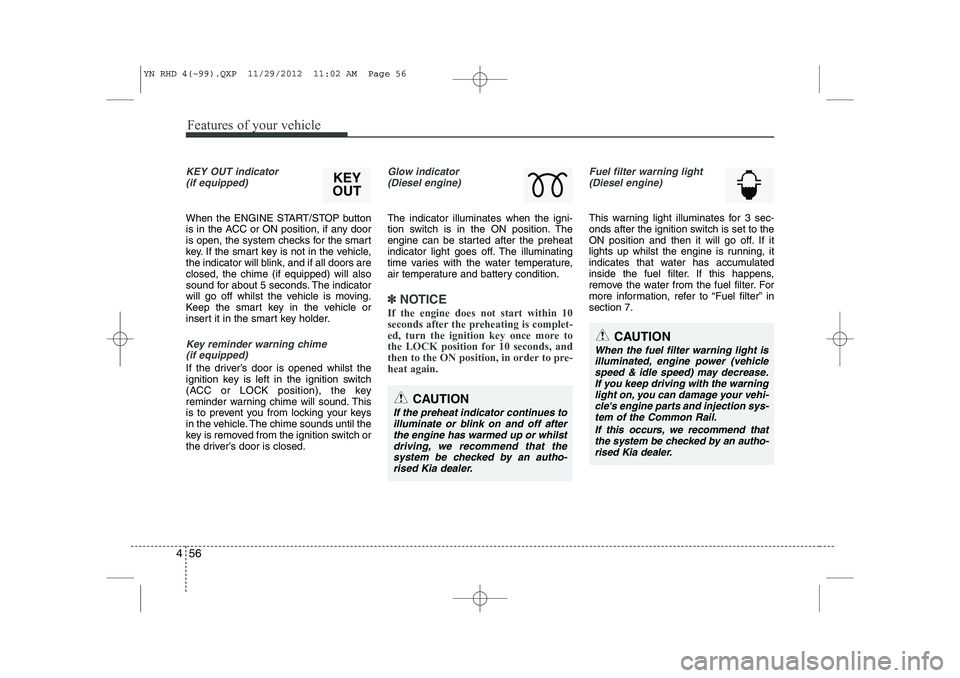
KEY OUT indicator
(if equipped)
When the ENGINE START/STOP button
is in the ACC or ON position, if any door
is open, the system checks for the smart
key. If the smart key is not in the vehicle,
the indicator will blink, and if all doors areclosed, the chime (if equipped) will also
sound for about 5 seconds. The indicator
will go off whilst the vehicle is moving.
Keep the smart key in the vehicle or
insert it in the smart key holder.
Key reminder warning chime
(if equipped)
If the driver’s door is opened whilst the
ignition key is left in the ignition switch
(ACC or LOCK position), the key
reminder warning chime will sound. This
is to prevent you from locking your keys
in the vehicle. The chime sounds until the
key is removed from the ignition switch or
the driver’s door is closed.
Glow indicator (Diesel engine)
The indicator illuminates when the igni-
tion switch is in the ON position. The
engine can be started after the preheat
indicator light goes off. The illuminating
time varies with the water temperature,
air temperature and battery condition.
✽✽ NOTICE
If the engine does not start within 10
seconds after the preheating is complet-
ed, turn the ignition key once more to
the LOCK position for 10 seconds, and
then to the ON position, in order to pre-heat again.
Fuel filter warning light (Diesel engine)
This warning light illuminates for 3 sec-
onds after the ignition switch is set to the
ON position and then it will go off. If it
lights up whilst the engine is running, it
indicates that water has accumulated
inside the fuel filter. If this happens,
remove the water from the fuel filter. For
more information, refer to “Fuel filter” insection 7.
CAUTION
When the fuel filter warning light isilluminated, engine power (vehicle
speed & idle speed) may decrease. If you keep driving with the warninglight on, you can damage your vehi-cle's engine parts and injection sys-
tem of the Common Rail.
If this occurs, we recommend thatthe system be checked by an autho-rised Kia dealer.
CAUTION
If the preheat indicator continues to illuminate or blink on and off afterthe engine has warmed up or whilst
driving, we recommend that the system be checked by an autho-rised Kia dealer.
KEY
OUT
YN RHD 4(~99).QXP 11/29/2012 11:02 AM Page 56