ABS Lancia Thema 2013 Owner handbook (in English)
[x] Cancel search | Manufacturer: LANCIA, Model Year: 2013, Model line: Thema, Model: Lancia Thema 2013Pages: 336, PDF Size: 3.87 MB
Page 33 of 336
With the ignition in the ON/RUN po-
sition, the Trunk Open symbol will
display in the instrument cluster indi-
cating that the trunk is open. The
odometer display will reappear once
the trunk is closed.
With the ignition in the OFF position,
the Trunk Open symbol will display
until the trunk is closed.
Refer to “Keyless EnterNGo™” in
“Things To Know Before Starting
Your Vehicle” for more information
on trunk operation with the Passive
Entry feature.
TRUNK SAFETY
WARNINGWARNING!Do not allow children to have access
to the trunk, either by climbing into
the trunk from outside, or through
the inside of the vehicle. Always
close the trunk lid when your vehicle
is unattended. Once in the trunk,
young children may not be able to
(Continued)
WARNING!(Continued)escape, even if they entered through
the rear seat. If trapped in the trunk,
children can die from suffocation or
heat stroke.TRUNK EMERGENCY
RELEASE
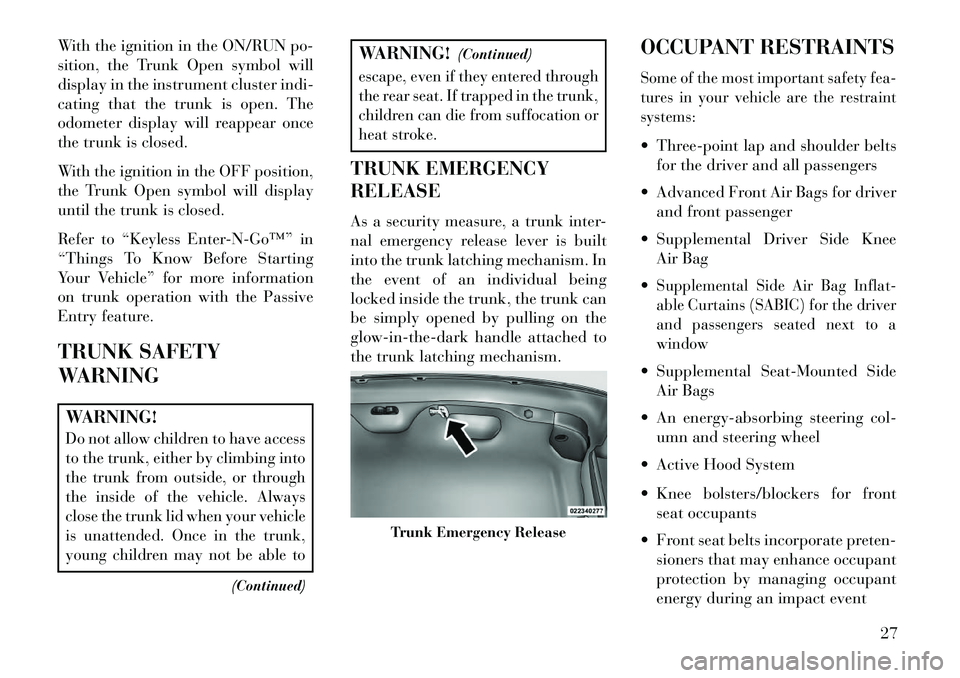
As a security measure, a trunk inter-
nal emergency release lever is built
into the trunk latching mechanism. In
the event of an individual being
locked inside the trunk, the trunk can
be simply opened by pulling on the
glow-in-the-dark handle attached to
the trunk latching mechanism. OCCUPANT RESTRAINTS
Some of the most important safety fea-
tures in your vehicle are the restraint
systems: Three-point lap and shoulder belts
for the driver and all passengers
Advanced Front Air Bags for driver and front passenger
Supplemental Driver Side Knee Air Bag
Supplemental Side Air Bag Inflat-
able Curtains (SABIC) for the driver
and passengers seated next to a
window Supplemental Seat-Mounted Side Air Bags
An energy-absorbing steering col- umn and steering wheel
Active Hood System
Knee bolsters/blockers for front seat occupants
Front seat belts incorporate preten- sioners that may enhance occupant
protection by managing occupant
energy during an impact event
Trunk Emergency Release
27
Page 131 of 336

An Anti-Lock Brake System (ABS)event occurs.
If the transmission is shifted into NEUTRAL.
The Electronic Stability Control/
Traction Control System (ESC/TCS)
activates.NOTE: If ACC is resumed or set
with the ESC/TCS off, ESC will
automatically be re-engaged.
TO TURN OFF
The system will turn off and erase the
set speed in memory if:
You push and release the ON/OFF button.
You turn OFF the ignition. TO RESUME SPEED
Press the RES
+button and release.
Then remove your foot from the ac-
celerator pedal. The EVIC will dis-
play the last set speed.
NOTE:
You can resume ACC from
a minimum of 32 km/h.
WARNING!
The Resume function should only
be used if traffic and road condi-
tions permit. Resuming a set speed
that is too high or too low for pre-
vailing traffic and road conditions
could cause the vehicle to acceler-
ate or decelerate too sharply for
safe operation. Failure to follow
these warnings can result in a colli-
sion and death or serious personal
injury.
TO VARY THE SPEED
SETTING
While ACC is set, you can increase the
set speed by pressing and holding the
RES +button. The increase in set
speed is reflected in the EVIC display: While in US Mode, if the button is
continually pressed, the set speed will
continue to increase in 8 km/h incre-
ments. While in Metric Mode, if the
button is continually pressed, the set
speed will continue to increase in
10 km/h increments.
While in US Mode, pressing the RES
+
button once will result in a 1.6 km/h
increase in set speed. Each subse-
quent tap of the button results in in-
crease of 1.6 km/h. While in Metric
Mode, pressing the RES +button once
will result in a 1.0 km/h increase in set
speed. Each subsequent tap of the
button results in increase of 1.0 km/h.
While ACC is set, the set speed can be
decreased by pressing and holding the
SET -button.
If the button is held while in US Mode,
the set speed will continue to decrease
in 8 km/h increments.
If the button is held while in Metric
Mode, the set speed will continue to
decrease in 10 km/h increments.
Adaptive Cruise Control (ACC) Cancelled
125
Page 155 of 336
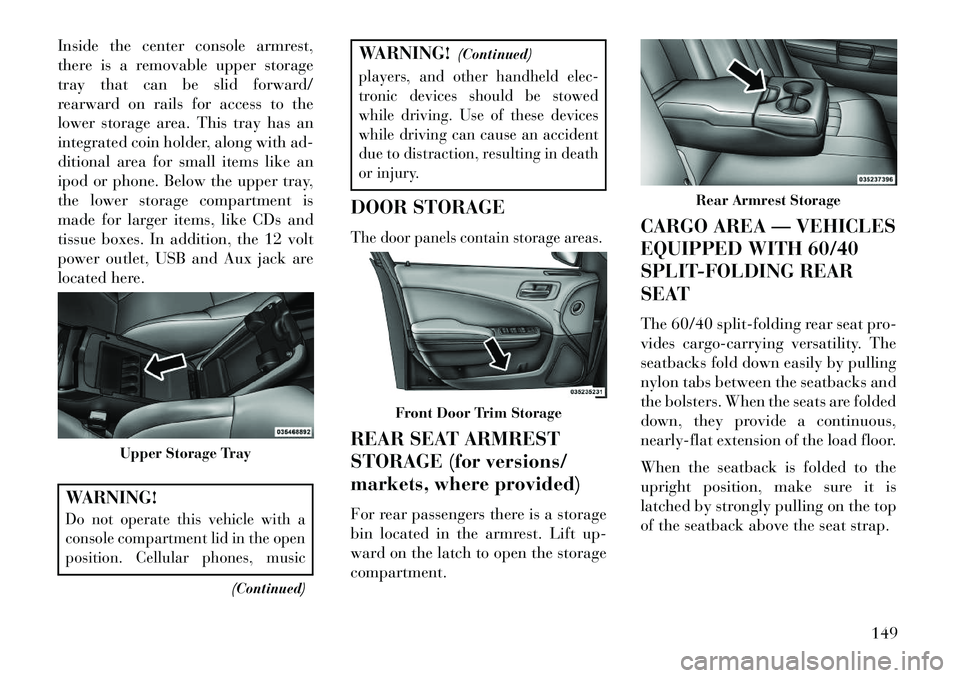
Inside the center console armrest,
there is a removable upper storage
tray that can be slid forward/
rearward on rails for access to the
lower storage area. This tray has an
integrated coin holder, along with ad-
ditional area for small items like an
ipod or phone. Below the upper tray,
the lower storage compartment is
made for larger items, like CDs and
tissue boxes. In addition, the 12 volt
power outlet, USB and Aux jack are
located here.WARNING!Do not operate this vehicle with a
console compartment lid in the open
position. Cellular phones, music
(Continued)
WARNING!(Continued)players, and other handheld elec-
tronic devices should be stowed
while driving. Use of these devices
while driving can cause an accident
due to distraction, resulting in death
or injury.DOOR STORAGEThe door panels contain storage areas.REAR SEAT ARMREST
STORAGE (for versions/
markets, where provided)
For rear passengers there is a storage
bin located in the armrest. Lift up-
ward on the latch to open the storage
compartment. CARGO AREA — VEHICLES
EQUIPPED WITH 60/40
SPLIT-FOLDING REAR
SEAT
The 60/40 split-folding rear seat pro-
vides cargo-carrying versatility. The
seatbacks fold down easily by pulling
nylon tabs between the seatbacks and
the bolsters. When the seats are folded
down, they provide a continuous,
nearly-flat extension of the load floor.
When the seatback is folded to the
upright position, make sure it is
latched by strongly pulling on the top
of the seatback above the seat strap.
Upper Storage Tray
Front Door Trim Storage
Rear Armrest Storage
149
Page 158 of 336
If the sunshade is in the raised posi-
tion and the vehicle is placed in
REVERSE, the sunshade will auto-
matically fully lower. When the trans-
mission is shifted out of REVERSE
the sunshade will automatically re-
turn to the fully raised position after
approximately five seconds.
NOTE: The rear sunshade con-
trol switch can be locked out with
the rear passenger window con-
trols from the driver switch win-
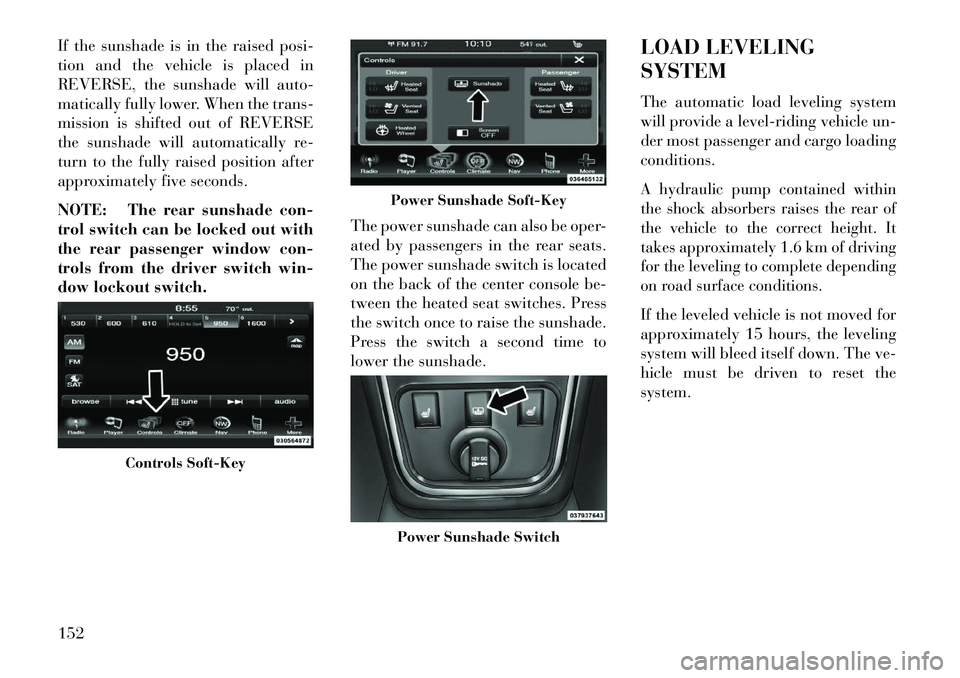
dow lockout switch.The power sunshade can also be oper-
ated by passengers in the rear seats.
The power sunshade switch is located
on the back of the center console be-
tween the heated seat switches. Press
the switch once to raise the sunshade.
Press the switch a second time to
lower the sunshade.LOAD LEVELING
SYSTEM
The automatic load leveling system
will provide a level-riding vehicle un-
der most passenger and cargo loading
conditions.
A hydraulic pump contained within
the shock absorbers raises the rear of
the vehicle to the correct height. It
takes approximately 1.6 km of driving
for the leveling to complete depending
on road surface conditions.If the leveled vehicle is not moved for
approximately 15 hours, the leveling
system will bleed itself down. The ve-
hicle must be driven to reset the
system.
Controls Soft-Key
Power Sunshade Soft-KeyPower Sunshade Switch
152
Page 166 of 336
Certain conditions, such as poor fuel
quality, etc., may illuminate the MIL
after engine start. The vehicle should be
serviced if the light stays on through
several of your typical driving cycles. In
most situations, the vehicle will drive
normally and will not require towing.CAUTION!
Prolonged driving with the MIL on
could cause damage to the engine
control system. It also could affect
fuel economy and drivability. If the
MIL is flashing, severe catalytic
converter damage and power loss
will soon occur. Immediate service
is required.WARNING!A malfunctioning catalytic con-
verter, as referenced above, can
reach higher temperatures than in
normal operating conditions. This
can cause a fire if you drive slowly or
park over flammable substances
such as dry plants, wood, cardboard,
etc. This could result in death or
serious injury to the driver, occu-
pants or others.
10. Speedometer
Indicates vehicle speed.
11. Fuel Door ReminderThe arrow in this symbol is
a reminder that the Fuel
Filler Door is located on the
left side of the vehicle.
12. Fuel Gauge
The pointer shows the level of fuel in
the fuel tank when the ignition switch
is in the ON/RUN position.
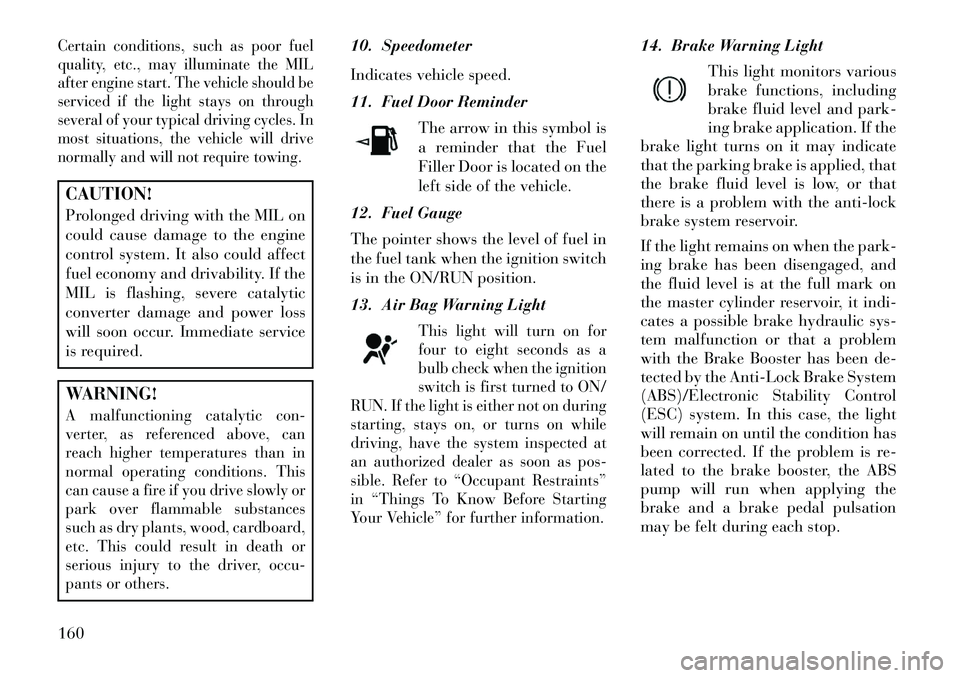
13. Air Bag Warning Light
This light will turn on for
four to eight seconds as a
bulb check when the ignition
switch is first turned to ON/
RUN. If the light is either not on during
starting, stays on, or turns on while
driving, have the system inspected at
an authorized dealer as soon as pos-
sible. Refer to “Occupant Restraints”
in “Things To Know Before Starting
Your Vehicle” for further information.
14. Brake Warning Light
This light monitors various
brake functions, including
brake fluid level and park-
ing brake application. If the
brake light turns on it may indicate
that the parking brake is applied, that
the brake fluid level is low, or that
there is a problem with the anti-lock
brake system reservoir.
If the light remains on when the park-
ing brake has been disengaged, and
the fluid level is at the full mark on
the master cylinder reservoir, it indi-
cates a possible brake hydraulic sys-
tem malfunction or that a problem
with the Brake Booster has been de-
tected by the Anti-Lock Brake System
(ABS)/Electronic Stability Control
(ESC) system. In this case, the light
will remain on until the condition has
been corrected. If the problem is re-
lated to the brake booster, the ABS
pump will run when applying the
brake and a brake pedal pulsation
may be felt during each stop.
160
Page 167 of 336
The dual brake system provides a re-
serve braking capacity in the event of
a failure to a portion of the hydraulic
system. A leak in either half of the
dual brake system is indicated by the
Brake Warning Light, which will turn
on when the brake fluid level in the
master cylinder has dropped below a
specified level.
The light will remain on until the
cause is corrected.
NOTE:
The light may flash mo-
mentarily during sharp cornering
maneuvers, which change fluid
level conditions. The vehicle should
have service performed, and the
brake fluid level checked.
If brake failure is indicated, immedi-
ate repair is necessary.WARNING!
Driving a vehicle with the red brake
light on is dangerous. Part of the
brake system may have failed. It
will take longer to stop the vehicle.
You could have a collision. Have the
vehicle checked immediately. Vehicles equipped with the Anti-Lock
Brake System (ABS), are also
equipped with Electronic Brake Force
Distribution (EBD). In the event of an
EBD failure, the Brake Warning Light
will turn on along with the ABS Light.
Immediate repair to the ABS system is
required.
Operation of the Brake Warning Light
can be checked by turning the ignition
switch from the OFF position to the
ON/RUN position. The light should
illuminate for approximately two sec-
onds. The light should then turn off
unless the parking brake is applied or
a brake fault is detected. If the light
does not illuminate, have the light
inspected by an authorized dealer.
The light also will turn on when the
parking brake is applied with the igni-
tion switch in the ON/RUN position.NOTE: This light shows only
that the parking brake is applied.
It does not show the degree of
brake application.
15. Anti-Lock Brake (ABS) Light
This light monitors the
Anti-Lock Brake System
(ABS). The light will turn
on when the ignition switch
is turned to the ON/RUN position and
may stay on for as long as four sec-
onds.
If the ABS light remains on or turns on
while driving, it indicates that the
Anti-Lock portion of the brake sys-
tem is not functioning and that service
is required. However, the conven-
tional brake system will continue to
operate normally if the BRAKE warn-
ing light is not on.
If the ABS light is on, the brake sys-
tem should be serviced as soon as
possible to restore the benefits of
Anti-Lock brakes. If the ABS light
does not turn on when the ignition
switch is turned to the ON/RUN posi-
tion, have the light inspected by an
authorized dealer.
161
Page 198 of 336

ALL-WHEEL DRIVE (AWD)(for versions/markets, where provided) . . . . . . . .210
DRIVING ON SLIPPERY SURFACES . . . . . . . . . .210 ACCELERATION. . . . . . . . . . . . . . . . . . . . . . . .210
TRACTION . . . . . . . . . . . . . . . . . . . . . . . . . . . .211
DRIVING THROUGH WATER . . . . . . . . . . . . . . .211
FLOWING/RISING WATER. . . . . . . . . . . . . . . .211
SHALLOW STANDING WATER. . . . . . . . . . . . .211
POWER STEERING . . . . . . . . . . . . . . . . . . . . . . .212
PARKING BRAKE . . . . . . . . . . . . . . . . . . . . . . . .213
ANTI-LOCK BRAKE SYSTEM . . . . . . . . . . . . . . .214
ELECTRONIC BRAKE CONTROL SYSTEM . . . . .216
ANTI-LOCK BRAKE SYSTEM (ABS) . . . . . . . .216
TRACTION CONTROL SYSTEM (TCS) . . . . . . .216
BRAKE ASSIST SYSTEM (BAS) . . . . . . . . . . . .216
ELECTRONIC STABILITY CONTROL (ESC) . . . .217 HILL START ASSIST (HSA) . . . . . . . . . . . . . . .218
READY ALERT BRAKING . . . . . . . . . . . . . . . .220
RAIN BRAKE SUPPORT . . . . . . . . . . . . . . . . . .220
ESC ACTIVATION/MALFUNCTION INDICATOR
LIGHT AND ESC OFF INDICATOR LIGHT . . . . .220 SYNCHRONIZING ESC . . . . . . . . . . . . . . . . . . .221
TIRE SAFETY INFORMATION . . . . . . . . . . . . . . .221
Tire Markings . . . . . . . . . . . . . . . . . . . . . . . . .221
Tire Identification Number (TIN) . . . . . . . . . . .223
Tire Terminology And Definitions. . . . . . . . . . .224
Tire Loading And Tire Pressure . . . . . . . . . . . .225
192
Page 220 of 336
When parking on a hill, it is important
to turn the front wheels toward the
curb on a downhill grade and away
from the curb on an uphill grade.
Apply the parking brake before plac-
ing the shift lever in PARK, otherwise
the load on the transmission locking
mechanism may make it difficult to
move the shift lever out of PARK. The
parking brake should always be ap-
plied whenever the driver is not in the
vehicle.WARNING!
Never use the PARK position as asubstitute for the parking brake.
Always apply the parking brake
fully when parked to guard
against vehicle movement and
possible injury or damage.
When leaving the vehicle, always
remove the key fob from the igni-
tion and lock your vehicle.
(Continued)
WARNING!(Continued)
Never leave children alone in a vehicle, or with access to an un-
locked vehicle. Allowing children
to be in a vehicle unattended is
dangerous for a number of rea-
sons. A child or others could be
seriously or fatally injured. Chil-
dren should be warned not to
touch the parking brake, brake
pedal or the shift lever.
Do not leave the key fob in or near the vehicle, and do not leave a
vehicle equipped with Keyless
EnterNGo™ in the ACC or ON/
RUN mode. A child could operate
power windows, other controls, or
move the vehicle.
Be sure the parking brake is fully disengaged before driving; failure
to do so can lead to brake failure
and a collision.
WARNING! (Continued)
Always fully apply the parking
brake when leaving your vehicle,
or it may roll and cause damage or
injury. Also be certain to leave the
transmission in PARK. Failure to
do so may allow the vehicle to roll
and cause damage or injury.CAUTION!
If the “Brake Warning Light” re-
mains on with the parking brake
released, a brake system malfunc-
tion is indicated. Have the brake
system serviced by an authorized
dealer immediately.
ANTI-LOCK BRAKE
SYSTEM
The Anti-Lock Brake System (ABS)
provides increased vehicle stability
and brake performance under most
braking conditions. The system auto-
matically “pumps” the brakes during
severe braking conditions to prevent
wheel lock-up.
214
Page 221 of 336
The Electronic Brake Force Distribu-
tion (EBD) prevents the rear wheels
from over-braking and provides
greater control of available braking
forces applied to the rear axle.
When the vehicle is driven over
11 km/h, you may also hear a slight
clicking sound as well as some related
motor noises. These noises are the sys-
tem performing its self check cycle to
ensure that the ABS is working prop-
erly. This self check occurs each time
the vehicle is started and accelerated
past 11 km/h.
ABS is activated during braking un-
der certain road or stopping condi-
tions. ABS-inducing conditions can
include ice, snow, gravel, bumps, rail-
road tracks, loose debris, or panic
stops.
You also may experience the following
when the brake system goes into Anti-
Lock:
The ABS motor running (it maycontinue to run for a short time
after the stop), The clicking sound of solenoid
valves,
Brake pedal pulsations, and
A slight drop or fall away of the brake pedal at the end of the stop.
These are all normal characteristics of
ABS.
WARNING!
The ABS contains sophisticated electronic equipment that may be
susceptible to interference caused
by improperly installed or high
output radio transmitting equip-
ment. This interference can cause
possible loss of anti-lock braking
capability. Installation of such
equipment should be performed
by qualified professionals.
Pumping of the Anti-Lock Brakes will diminish their effectiveness
and may lead to a collision.
Pumping makes the stopping dis-
tance longer. Just press firmly on
your brake pedal when you need
to slow down or stop.
(Continued)
WARNING!(Continued)
The ABS cannot prevent the natu-
ral laws of physics from acting on
the vehicle, nor can it increase
braking or steering efficiency be-
yond that afforded by the condi-
tion of the vehicle brakes and tires
or the traction afforded. The ABS cannot prevent colli- sions, including those resulting
from excessive speed in turns,
following another vehicle too
closely, or hydroplaning.
The capabilities of an ABS
equipped vehicle must never be
exploited in a reckless or danger-
ous manner that could jeopardize
the user's safety or the safety of
others.
All vehicle wheels and tires must be
the same size and type and tires must
be properly inflated to produce accu-
rate signals for the computer.
215
Page 222 of 336

ELECTRONIC BRAKE
CONTROL SYSTEM
Your vehicle is equipped with an ad-
vanced electronic brake control sys-
tem that include Anti-Lock Brake
System (ABS), Traction Control Sys-
tem (TCS), Brake Assist System
(BAS), and the Electronic Stability
Control (ESC). All four of these sys-
tems work together to enhance vehicle
stability and control in various driv-
ing conditions.Also, your vehicle may be equipped
with Hill Start Assist (HSA), Ready
Alert Braking, and Rain Brake Support.ANTI-LOCK BRAKE
SYSTEM (ABS)
This system aids the driver in main-
taining vehicle control under adverse
braking conditions by controlling hy-
draulic brake pressure. This prevents
wheel lock-up to help avoid skidding
on slippery surfaces during braking.
Refer to “Anti-Lock Brake System” in
“Starting and Operating” for further
information.
WARNING!
The ABS cannot prevent the natu-
ral laws of physics from acting on
the vehicle, nor can it increase the
traction afforded by prevailing
road conditions. The ABS cannot
prevent collisions, including those
resulting from excessive speed in
turns, driving on very slippery sur-
faces, or hydroplaning. The capa-
bilities of an ABS-equipped vehicle
must never be exploited in a reck-
less or dangerous manner that
could jeopardize the user's safety or
the safety of others.
TRACTION CONTROL
SYSTEM (TCS)
This system monitors the amount of
wheel spin of each driven wheel. If
wheel spin is detected, brake pressure
is applied to the slipping wheel(s) and
engine power is reduced to provide
enhanced acceleration and stability. BRAKE ASSIST SYSTEM
(BAS)
This system complements the ABS by
optimizing the vehicle braking capa-
bility during emergency brake ma-
neuvers. This system detects an emer-
gency braking situation by sensing
the rate and amount of brake applica-
tion and then applies optimum pres-
sure to the brakes. This can help re-
duce braking distances.
Applying the brakes very quickly re-
sults in the best BAS assistance. To
receive the benefits of this system, you
must apply continuous brake pedal
pressure during the stopping se-
quence. Do not reduce brake pedal
pressure unless braking is no longer
desired. Once the brake pedal is re-
leased, the BAS is deactivated.
WARNING!
The BAS cannot prevent the natu-
ral laws of physics from acting on
the vehicle, nor can it increase the
traction afforded by prevailing
road conditions. The BAS cannot
(Continued)
216