spare tire Lancia Thema 2013 Owner handbook (in English)
[x] Cancel search | Manufacturer: LANCIA, Model Year: 2013, Model line: Thema, Model: Lancia Thema 2013Pages: 336, PDF Size: 3.87 MB
Page 64 of 336
WARNING!(Continued)
If required, mounting posts must be
properly installed, if not equipped
from the factory.Failure to properly follow floor mat
installation or mounting can cause
interference with the brake pedal
and accelerator pedal operation
causing loss of control of the vehicle.Periodic Safety Checks You
Should Make Outside The
Vehicle
TiresExamine tires for excessive tread wear
and uneven wear patterns. Check for
stones, nails, glass, or other objects
lodged in the tread or sidewall. Inspect
the tread for cuts and cracks. Inspect
sidewalls for cuts, cracks and bulges.
Check the wheel nuts for tightness.
Check the tires (including spare) for
proper cold inflation pressure.
Lights
Have someone observe the operation
of brake lights and exterior lights
while you work the controls. Check
turn signal and high beam indicator
lights on the instrument panel.
Door Latches
Check for positive closing, latching,
and locking.
Fluid Leaks
Check area under vehicle after over-
night parking for fuel, engine coolant,
oil, or other fluid leaks. Also, if gaso-
line fumes are detected or if fuel,
power steering fluid (2500/3500), or
brake fluid leaks are suspected, the
cause should be located and corrected
immediately.
58
Page 164 of 336
INSTRUMENT CLUSTER
DESCRIPTIONS
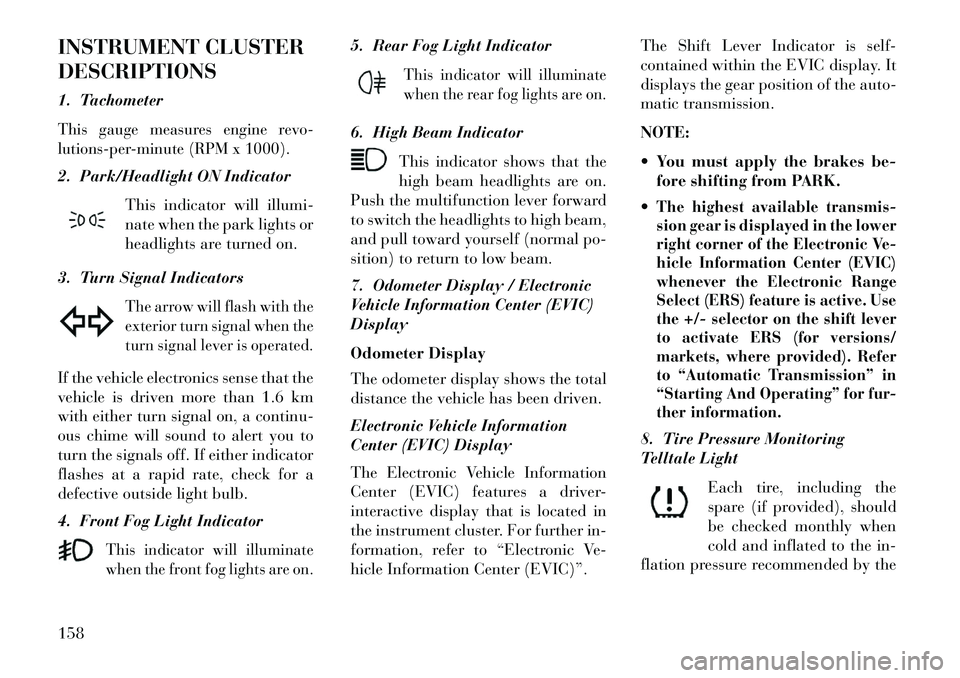
1. TachometerThis gauge measures engine revo-
lutions-per-minute (RPM x 1000).2. Park/Headlight ON IndicatorThis indicator will illumi-
nate when the park lights or
headlights are turned on.
3. Turn Signal Indicators
The arrow will flash with the
exterior turn signal when the
turn signal lever is operated.
If the vehicle electronics sense that the
vehicle is driven more than 1.6 km
with either turn signal on, a continu-
ous chime will sound to alert you to
turn the signals off. If either indicator
flashes at a rapid rate, check for a
defective outside light bulb.
4. Front Fog Light Indicator
This indicator will illuminate
when the front fog lights are on.
5. Rear Fog Light Indicator
This indicator will illuminate
when the rear fog lights are on.
6. High Beam Indicator This indicator shows that the
high beam headlights are on.
Push the multifunction lever forward
to switch the headlights to high beam,
and pull toward yourself (normal po-
sition) to return to low beam.
7. Odometer Display / Electronic
Vehicle Information Center (EVIC)
Display
Odometer Display
The odometer display shows the total
distance the vehicle has been driven.
Electronic Vehicle Information
Center (EVIC) Display
The Electronic Vehicle Information
Center (EVIC) features a driver-
interactive display that is located in
the instrument cluster. For further in-
formation, refer to “Electronic Ve-
hicle Information Center (EVIC)”. The Shift Lever Indicator is self-
contained within the EVIC display. It
displays the gear position of the auto-
matic transmission.
NOTE:
You must apply the brakes be-
fore shifting from PARK.
The highest available transmis-
sion gear is displayed in the lower
right corner of the Electronic Ve-
hicle Information Center (EVIC)
whenever the Electronic Range
Select (ERS) feature is active. Use
the +/- selector on the shift lever
to activate ERS (for versions/
markets, where provided). Refer
to “Automatic Transmission” in
“Starting And Operating” for fur-
ther information.8. Tire Pressure Monitoring
Telltale Light
Each tire, including the
spare (if provided), should
be checked monthly when
cold and inflated to the in-
flation pressure recommended by the
158
Page 199 of 336

TIRES — GENERAL INFORMATION . . . . . . . . . .228 TIRE PRESSURE . . . . . . . . . . . . . . . . . . . . . . .228
TIRE INFLATION PRESSURES . . . . . . . . . . . .228
TIRE PRESSURES FOR HIGH SPEEDOPERATION . . . . . . . . . . . . . . . . . . . . . . . . . .229
RADIAL PLY TIRES . . . . . . . . . . . . . . . . . . . . .229
COMPACT SPARE TIRE (for versions/markets, where provided) . . . . . .230
LIMITED-USE SPARE (for versions/markets, where provided) . . . . . .230
TIRE SPINNING . . . . . . . . . . . . . . . . . . . . . . . .230
TREAD WEAR INDICATORS . . . . . . . . . . . . . .231
LIFE OF TIRE . . . . . . . . . . . . . . . . . . . . . . . . .231
REPLACEMENT TIRES . . . . . . . . . . . . . . . . . .231
TIRE CHAINS (TRACTION DEVICES) . . . . . . . . .232
TIRE ROTATION RECOMMENDATIONS . . . . . . .233
TIRE PRESSURE MONITOR SYSTEM (TPMS) . . . .234 PREMIUM SYSTEM . . . . . . . . . . . . . . . . . . . . .235
TPMS DEACTIVATION . . . . . . . . . . . . . . . . . . .237
FUEL REQUIREMENTS — GASOLINE ENGINES . . . . . . . . . . . . . . . . . . . . . .238
3.6L ENGINE . . . . . . . . . . . . . . . . . . . . . . . . . .238
FUEL REQUIREMENTS — DIESEL ENGINES . . . . . . . . . . . . . . . . . . . . . . . .240
ADDING FUEL . . . . . . . . . . . . . . . . . . . . . . . . . .241 EMERGENCY FUEL FILLER DOORRELEASE . . . . . . . . . . . . . . . . . . . . . . . . . . . . .242
193
Page 227 of 336

SYNCHRONIZING ESCIf the power supply is inter-
rupted (battery discon-
nected or discharged), the
“ESC Activation/Malfunc-
tion Indicator Light” may illuminate
with the engine running. If this should
occur, turn the steering wheel com-
pletely to the left and then to the right.
The “ESC Activation/Malfunction In-
dicator Light” should go out. How-
ever, if the light remains on, have the
ESC and BAS checked at your autho-
rized dealer as soon as possible. TIRE SAFETY
INFORMATION
Tire Markings
NOTE:
P (Passenger) - Metric tire sizing
is based on U.S. design stan-
dards. P-Metric tires have the
letter “P” molded into the side-
wall preceding the size designa-
tion. Example: P215/65R15 95H.
European-Metric tire sizing is
based on European design stan-
dards. Tires designed to this stan-
dard have the tire size molded into the sidewall beginning with
the section width. The letter "P" is
absent from this tire size designa-
tion. Example: 215/65R15 96H.
LT (Light Truck) - Metric tire siz-
ing is based on U.S. design stan-
dards. The size designation for
LT-Metric tires is the same as for
P-Metric tires except for the let-
ters “LT” that are molded into the
sidewall preceding the size desig-
nation. Example: LT235/85R16.Temporary spare tires are spares
designed for temporary emer-
gency use only. Temporary high
pressure compact spare tires have
the letter “T” or “S” molded into
the sidewall preceding the size
designation. Example: T145/
80D18 103M. High flotation tire sizing is
based on U.S. design standards
and it begins with the tire diam-
eter molded into the sidewall.
Example: 31x10.5 R15 LT.
1 — U.S. DOT Safety
Standards Code (TIN) 4 — Maximum Load
2 — Size Designation 5 — Maximum Pres-
sure
3 — Service Descrip-
tion 6 — Treadwear,
Traction and Tem-
perature Grades
221
Page 228 of 336

Tire Sizing Chart
EXAMPLE:
Size Designation: P= Passenger car tire size based on U.S. design standards
"....blank...." = Passenger car tire based on European design standards
LT = Light truck tire based on U.S. design standards
T or S = Temporary spare tire
31 = Overall diameter in inches (in)
215 = Section width in millimeters (mm)
65 = Aspect ratio in percent (%)
— Ratio of section height to section width of tire
10.5 = Section width in inches (in)
R = Construction code
— "R" means radial construction
— "D" means diagonal or bias construction
15 = Rim diameter in inches (in)
Service Description: 95= Load Index
— A numerical code associated with the maximum load a tire can carry
H = Speed Symbol
— A symbol indicating the range of speeds at which a tire can carry a load corresponding to its load
index under certain operating conditions
— The maximum speed corresponding to the speed symbol should only be achieved under specified
operating conditions (i.e., tire pressure, vehicle loading, road conditions, and posted speed limits)
222
Page 231 of 336

Tire Loading And Tire
Pressure
Tire And Loading Information
Placard Location
NOTE: The proper cold tire in-
flation pressure is listed on the
driver’s side B-Pillar or the rear
edge of the driver's side door.Tire And Loading Information
Placard
This placard tells you important
information about the:
1) number of people that can be
carried in the vehicle
2) total weight your vehicle can
carry
3) tire size designed for your ve-
hicle
4) cold tire inflation pressures for
the front, rear, and spare tires.
Loading
The vehicle maximum load on the tire
must not exceed the load carrying ca-
pacity of the tire on your vehicle. You
will not exceed the tire's load carrying
capacity if you adhere to the loading
conditions, tire size, and cold tire in-
flation pressures specified on the Tire
and Loading Information placard and
in the “Vehicle Loading” section of
this manual. NOTE:
Under a maximum loaded
vehicle condition, gross axle weight
ratings (GAWRs) for the front and
rear axles must not be exceeded.
For further information on GAWRs,
vehicle loading, and trailer towing,
refer to “Vehicle Loading” in this
section.
To determine the maximum loading
conditions of your vehicle, locate the
statement “The combined weight of
occupants and cargo should never ex-
ceed XXX lbs or XXX kg” on the Tire
and Loading Information placard.
The combined weight of occupants,
cargo/luggage and trailer tongue
weight (if applicable) should never
exceed the weight referenced here.
Tire Placard Location
225
Page 236 of 336

COMPACT SPARE TIRE
(for versions/markets,
where provided)The compact spare is for temporary
emergency use only. You can identify if
your vehicle is equipped with a com-
pact spare by looking at the spare tire
description on the Tire and Loading
Information Placard located on the
driver’s side door opening or on the
sidewall of the tire. Compact spare tire
descriptions begin with the letter “T”
or “S” preceding the size designation.
Example: T145/80D18 103M.T, S = Temporary Spare TireSince this tire has limited tread life the
original equipment tire should be re-
paired (or replaced) and reinstalled on
your vehicle at the first opportunity.Do not install a wheel cover or at-
tempt to mount a conventional tire on
the compact spare wheel, since the
wheel is designed specifically for the
compact spare tire. Do not install
more than one compact spare tire and
wheel on the vehicle at any given time
WARNING!
Compact spares are for temporary
emergency use only. With these
spares, do not drive more than
50 mph (80 km/h). Temporary use
spares have limited tread life. When
the tread is worn to the tread wear
indicators, the temporary use spare
tire needs to be replaced. Be sure to
follow the warnings, which apply to
your spare. Failure to do so could
result in spare tire failure and loss
of vehicle control.
LIMITED-USE SPARE
(for versions/markets,
where provided)
The limited-use spare tire is for tem-
porary emergency use only. This tire is
identified by a label located on the
limited-use spare wheel. This label
contains the driving limitations for
this spare. This tire may look like the
original equipped tire on the front or
rear axle of your vehicle, but it is not.
Installation of this limited-use spare
tire affects vehicle handling. Since it is not the same as your original equip-
ment tire, replace (or repair) the origi-
nal equipment tire and reinstall on the
vehicle at the first opportunity.
WARNING!
Limited-use spares are for emer-
gency use only. Installation of this
limited-use spare tire affects ve-
hicle handling. With this tire, do
not drive more than the speed listed
on the limit-use spare wheel. Keep
inflated to the cold tire inflation
pressure listed on your Tire and
Loading Information Placard lo-
cated on the driver’s side door
opening. Replace (or repair) the
original equipment tire at the first
opportunity and reinstall it on your
vehicle. Failure to do so could result
in loss of vehicle control.
TIRE SPINNING
When stuck in mud, sand, snow, or ice
conditions, do not spin your vehicle's
wheels faster than 48 km/h or for
longer than 30 seconds continuously
without stopping when you are stuck.
230
Page 237 of 336

WARNING!
Fast spinning tires can be danger-
ous. Forces generated by excessive
wheel speeds may cause tire dam-
age or failure. A tire could explode
and injure someone. Do not spin
your vehicle's wheels faster than
48 km/h or for more than 30 sec-
onds continuously when you are
stuck, and do not let anyone near a
spinning wheel, no matter what the
speed.TREAD WEAR INDICATORSTread wear indicators are in the origi-
nal equipment tires to help you in
determining when your tires should
be replaced.These indicators are molded into the
bottom of the tread grooves. They will
appear as bands when the tread depth
becomes 2 mm. When the tread is
worn to the tread wear indicators, the
tire should be replaced.
LIFE OF TIRE
The service life of a tire is dependent
upon varying factors including, but
not limited to:
Driving style
Tire pressure
Distance driven
WARNING!
Tires and the spare tire should be
replaced after six years, regardless
of the remaining tread. Failure to
follow this warning can result in
sudden tire failure. You could lose
control and have a collision result-
ing in serious injury or death.
Keep dismounted tires in a cool, dry
place with as little exposure to light as
possible. Protect tires from contact
with oil, grease, and gasoline. REPLACEMENT TIRES
The tires on your new vehicle provide
a balance of many characteristics.
They should be inspected regularly
for wear and correct cold tire inflation
pressure. The manufacturer strongly
recommends to always respect the
sizes of the tires given in the Registra-
tion Documentation/Certificate and
that you use tires equivalent to the
originals in size, quality and perfor-
mance when replacement is needed.
(Refer to the paragraph on “Tread
Wear Indicators”). Refer to the “Tire
and Loading Information” placard
for the size designation of your tire.
The Load Index and Speed Symbol
for your tire will be found on the
original equipment tire sidewall. See
the Tire Sizing Chart example found
in the Tire Safety Information section
of this manual for more information
relating to the Load Index and Speed
Symbol of a tire.
It is recommended to replace the two
front tires or two rear tires as a pair.
Replacing just one tire can seriously
affect your vehicle’s handling. If you
ever replace a wheel, make sure that
1 — Worn Tire
2 — New Tire
231
Page 238 of 336

the wheel’s specifications match those
of the original wheels.
It is recommended you contact your
original equipment or an authorized
tire dealer with any questions you
may have on tire specifications or ca-
pability. Failure to use equivalent re-
placement tires may adversely affect
the safety, handling, and ride of your
vehicle.WARNING!
Do not use a tire, wheel size or
rating other than that specified for
your vehicle. Some combinations
of unapproved tires and wheels
may change suspension dimen-
sions and performance character-
istics, resulting in changes to steer-
ing, handling, and braking of your
vehicle. This can cause unpredict-
able handling and stress to steer-
ing and suspension components.
You could lose control and have a
collision resulting in serious injury
or death. Use only the tire and
wheel sizes with load ratings ap-
proved for your vehicle.
(Continued)
WARNING!(Continued)
Never use a tire with a smaller load
index or capacity, other than what
was originally equipped on your
vehicle. Using a tire with a smaller
load index could result in tire over-
loading and failure. You could lose
control and have a collision.Failure to equip your vehicle with
tires having adequate speed capa-
bility can result in sudden tire fail-
ure and loss of vehicle control.CAUTION!Replacing original tires with tires of a
different size may result in false
speedometer and odometer readings.TIRE CHAINS
(TRACTION DEVICES)
Use of Security Chain Company
(SCC) Super Z6 SZ143 or Iceman Z6
IZ-643 cables or equivalent are rec-
ommended on 225/65R17 tires. NOTE:
These chains can be found at an
authorized LANCIA Dealership.
Do not use tire chains on a com- pact spare tire.
Use of traction devices require suffi-
cient tire-to-body clearance. Follow
these recommendations to guard
against damage.
Traction device must be of proper size for the tire, as recommended by
the traction device manufacturer.
Install on Rear Tires Only.
Due to limited clearance, the Security
Chain Company (SCC) Super Z6 low
profile traction device or equivalent is
recommended on P215/65R17,
P225/60R18 or P235/55R18 tires. For an All Wheel Drive vehicle, P235/55R19 tire with the use of a
traction device that meets the SAE
type “Class S” specification is rec-
ommended.
232
Page 239 of 336

WARNING!
Using tires of different size and type
(M+S, Snow) between front and
rear axles can cause unpredictable
handling. You could lose control
and have a collision.CAUTION!
To avoid damage to your vehicle or
tires, observe the following precau-
tions:
Because of restricted traction de-
vice clearance between tires and
other suspension components, it is
important that only traction de-
vices in good condition are used.
Broken devices can cause serious
damage. Stop the vehicle immedi-
ately if noise occurs that could in-
dicate device breakage. Remove
the damaged parts of the device
before further use. Install device as tightly as pos-sible and then retighten after
driving about ½ mile (0.8 km).
Do not exceed 48 km/h.
(Continued)
CAUTION!(Continued)
Drive cautiously and avoid severe turns and large bumps, especially
with a loaded vehicle.
Do not drive for prolonged period on dry pavement.
Observe the traction device manu-
facturer’s instructions on the
method of installation, operating
speed, and conditions for use. Al-
ways use the suggested operating
speed of the device manufactur-
er’s if it is less than 48 km/h. Do not use traction devices on a compact spare tire.
NOTE:
In order to avoid damage
to tires, chains, and your vehicle do
not drive for a prolonged period on
dry pavement. Observe the tire
chain manufacturer's instructions
on method of installation, operating
speed, and conditions for usage.
Always use the lower suggested operat-
ing speed if both the chain manufac-
turer and vehicle manufacturer suggest
a maximum speed. This notice applies
to all chain traction devices, including
link and cable (radial) chains.
TIRE ROTATION
RECOMMENDATIONS
Tires on the front and rear axles of
vehicles operate at different loads and
perform different steering, driving,
and braking functions. For these rea-
sons, they wear at unequal rates.These effects can be reduced by timely
rotation of tires. The benefits of rotation
are especially worthwhile with aggres-
sive tread designs such as those on all
season type tires. Rotation will increase
tread life, help to maintain mud, snow,
and wet traction levels, and contribute
to a smooth, quiet ride.Refer to the “Maintenance Schedule”
for the proper maintenance intervals.
The reasons for any rapid or unusual
wear should be corrected prior to ro-
tation being performed.
233