snow Lancia Ypsilon 2001 Owner handbook (in English)
[x] Cancel search | Manufacturer: LANCIA, Model Year: 2001, Model line: Ypsilon, Model: Lancia Ypsilon 2001Pages: 191, PDF Size: 2.45 MB
Page 51 of 191
48
G
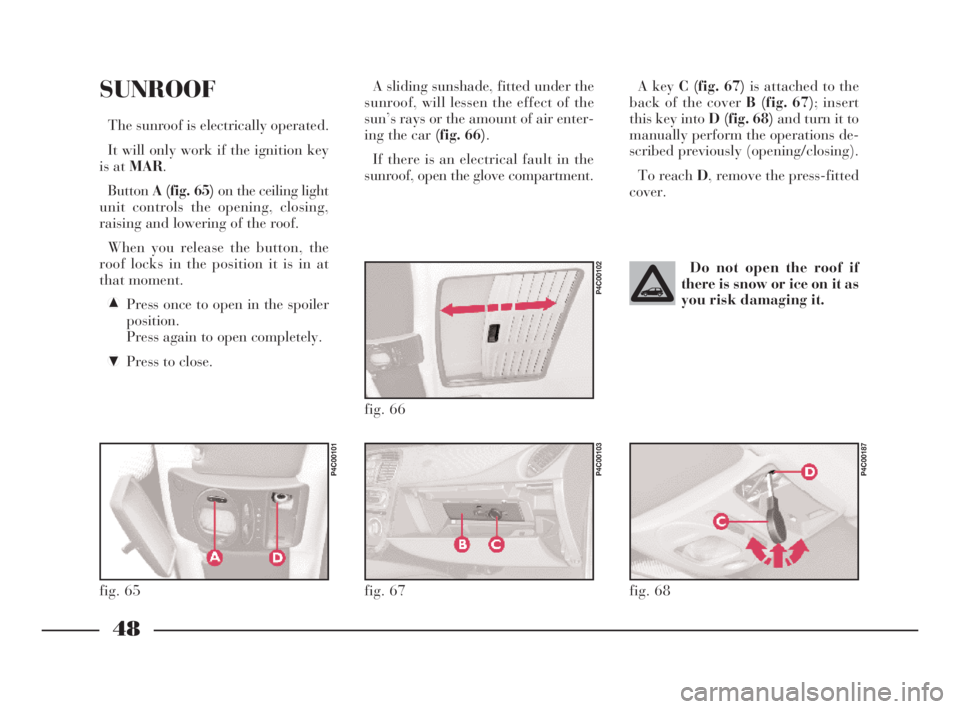
A key C (fig. 67)is attached to the
back of the cover B (fig. 67); insert
this key into D (fig. 68) and turn it to
manually perform the operations de-
scribed previously (opening/closing).
To reach D, remove the press-fitted
cover.
fig. 68
P4C00187
Do not open the roof if
there is snow or ice on it as
you risk damaging it.
SUNROOF
The sunroof is electrically operated.
It will only work if the ignition key
is at MAR.
ButtonA (fig. 65)on the ceiling light
unit controls the opening, closing,
raising and lowering of the roof.
When you release the button, the
roof locks in the position it is in at
that moment.
£Press once to open in the spoiler
position.
Press again to open completely.
¢Press to close.
fig. 65
P4C00101
A sliding sunshade, fitted under the
sunroof, will lessen the effect of the
sun’s rays or the amount of air enter-
ing the car (fig. 66).
If there is an electrical fault in the
sunroof, open the glove compartment.
fig. 66
P4C00102
fig. 67
P4C00103
4C001-067 ING 11-03-2008 11:57 Pagina 48
Page 60 of 191

57
G
In the case of failure, although the
anti-locking system is no longer avail-
able, the car braking capacity is not
interfered with.
If you have never driven a car with
ABS it is advised to familiarise by
making a few preliminary trials on
slippery ground, obviously maintain-
ing safety conditions and respecting
the Highway Code of the country
where you are travelling. Before start-
ing, read carefully the notes below.
The advantage of ABS as compared
with the traditional system is that it
permits maximum manoeuvrability
even when pressing the brakes right
down on roads with poor grip, pre-
venting the wheels from locking.
However, this does not mean that
with ABS the braking distance is al-
ways reduced. For example, on soft
gravel surfaces or fresh snow on a
slippery surface the distance could in-
crease.In order to get the best out of the
anti-lock system when necessary, fol-
low these hints.
If the ABS triggers it
means that the car is
reaching the limit of ad-
herence between the tyres and the
road surface. Slow down to adapt
the speed to the road grip.
ABS exploits the avail-
able grip, but it is not able
to increase it. Therefore
drive carefully on slippery surfaces
and do not take undue risks.
If there is a system fail-
ure, indicated by warning
light>lighting up on the
instrument panel, drive slowly and
go immediately to a LANCIA Deal-
ership to have the system checked.
When braking round a bend be very
careful, even with the aid of ABS.
However, the most important advice
is the following:
When the ABS switches
on and you feel the pedal
throbbing, no not lighten
the pressure, but keep the pedal
pressed well down and do not
worry. In this way you will be able
to stop within the minimum dis-
tance possible, according to the
road surface.
Following these instructions you will
be always have the best braking con-
ditions.
4C001-067 ING 11-03-2008 11:57 Pagina 57
Page 62 of 191
59
G
Europe and most other countries
world-wide.
In the event of front collisions at low
speed, the restraining action of the
seat belts is sufficient and the airbag
is not inflated.
For impacts against very deformable
or mobile objects (traffic sign poles,
heaps of gravel or snow, parked vehi-
cles), side impacts, wedging under
other vehicles or barriers (e.g. under
a truck or guard rail), the airbag is
not necessary and may even be unde-
sirable.
The fact that the airbag is not trig-
gered in these situations, this does not
signify a malfunction.
fig. 85
P4C00348
PASSENGER’S FRONT AIRBAG
The passenger side airbag was de-
signed and calibrated to protect a per-
son wearing seat belts.
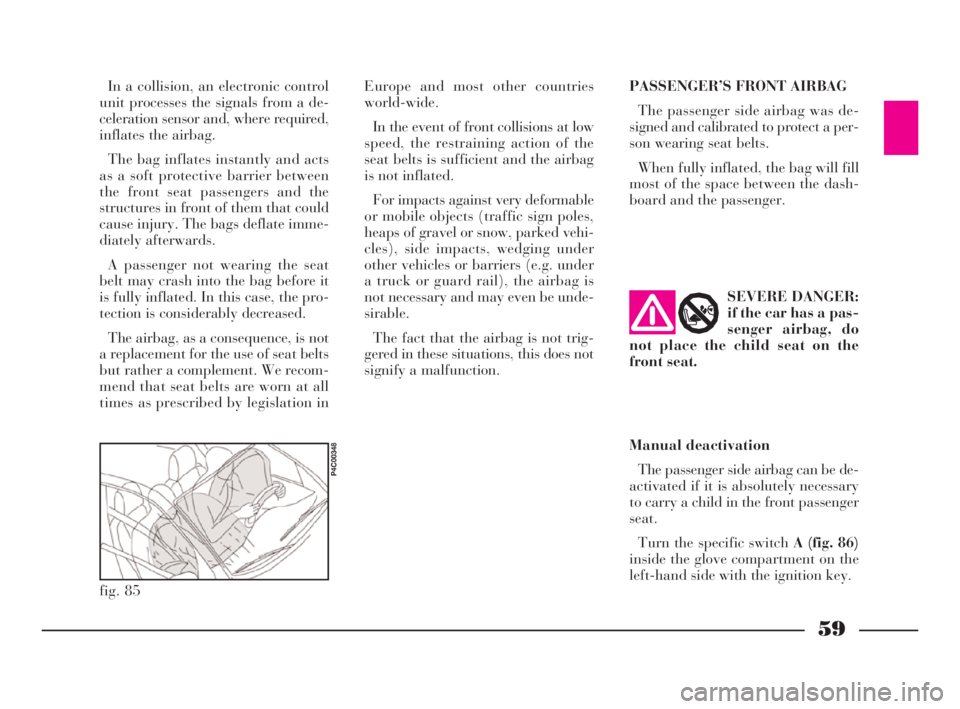
When fully inflated, the bag will fill
most of the space between the dash-
board and the passenger. In a collision, an electronic control
unit processes the signals from a de-
celeration sensor and, where required,
inflates the airbag.
The bag inflates instantly and acts
as a soft protective barrier between
the front seat passengers and the
structures in front of them that could
cause injury. The bags deflate imme-
diately afterwards.
A passenger not wearing the seat
belt may crash into the bag before it
is fully inflated. In this case, the pro-
tection is considerably decreased.
The airbag, as a consequence, is not
a replacement for the use of seat belts
but rather a complement. We recom-
mend that seat belts are worn at all
times as prescribed by legislation inSEVERE DANGER:
if the car has a pas-
senger airbag, do
not place the child seat on the
front seat.
Manual deactivation
The passenger side airbag can be de-
activated if it is absolutely necessary
to carry a child in the front passenger
seat.
Turn the specific switch A (fig. 86)
inside the glove compartment on the
left-hand side with the ignition key.
4C001-067 ING 11-03-2008 11:57 Pagina 59
Page 71 of 191
DRIVING YOUR CAR
To help you handle your car in the best and
safest possible way, and above all use it to its fullest
potential, we have given you some hints in this
chapter on “what to do, what not to do and what
to avoid” when at the wheel of your Lancia Y.
Most of the time, these suggestions apply to
other cars as well. Sometimes, however, the tip
may apply to an exclusive Lancia Y feature. You
are therefore strongly recommended to pay the
closest attention to this section for helpful hints
on optimum driving practices and usage of the car
that will help you get the most out of your car. STARTING THE ENGINE .............................. 69
PARKING ....................................................... 71
GEAR USE ..................................................... 72
AT THE FILLING STATION .......................... 73
SAFE DRIVING .............................................. 75
CONTAINING RUNNING COSTS
AND POLLUTION ......................................... 81
CHEAP RUNNING THAT RESPECTS
THE ENVIRONMENT ................................... 83
TOWING A TRAILER .................................... 84
SNOW CHAINS .............................................. 85
SNOW TYRES ................................................ 86
STORING THE CAR ...................................... 87
REPEATED CHECKS AND CHECKS
BEFORE LONG TRIPS .................................. 88
ACCESSORIES PURCHASED
BY THE OWNER ........................................... 88
USEFUL ACCESSORIES ............................... 89
68
G
4C068-089 ING 11-03-2008 11:59 Pagina 68
Page 77 of 191
LIGHT BULBS
Dipped beam headlights: 12V-55W.
Main beam headlights: 12V-55W.
Side and taillights: 12V-5W.
Front foglights: 12V-55W.
Front direction indicators: 12V-21W.
Rear direction indicators: 12V-21W.
Side direction indicators: 12V-5W.
Stop/taillights: 12V-21/5W.Reversing lights: 12V-21W.
Rear foglights: 12V-21W.
Number plate lights: 12V-5W.
Ceiling lights: 12V-10W.
Map reading light: 12V-6W
(LX version).
Boot light: 12V-10W.
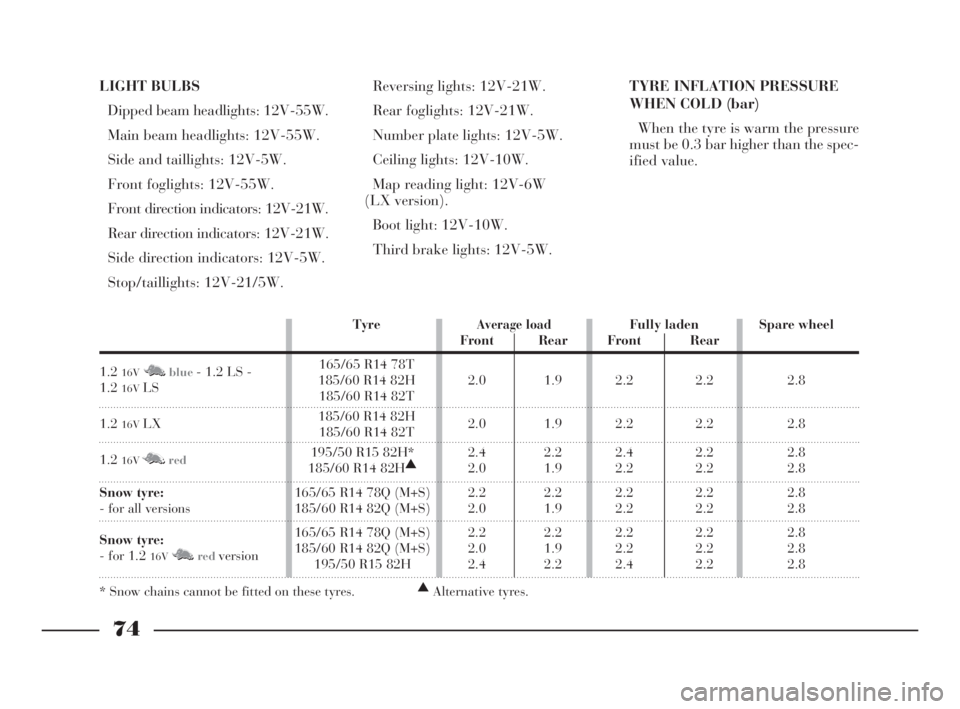
Third brake lights: 12V-5W.TYRE INFLATION PRESSURE
WHEN COLD (bar)
When the tyre is warm the pressure
must be 0.3 bar higher than the spec-
ified value.
74
G
TyreAverage loadFully laden Spare wheel
Front Rear Front Rear
1.2
16VM Nblue- 1.2 LS - 165/65 R14 78T
1.2
16VLS185/60 R14 82H 2.0 1.9 2.2 2.2 2.8185/60 R14 82T
1.2
16VLX185/60 R14 82H
2.0 1.9 2.2 2.2 2.8185/60 R14 82T
1.2
16VM Nred195/50 R15 82H* 2.4 2.2 2.4 2.2 2.8
185/60 R14 82H▲
2.0 1.9 2.2 2.2 2.8
Snow tyre:165/65 R14 78Q (M+S) 2.2 2.2 2.2 2.2 2.8
- for all versions 185/60 R14 82Q (M+S) 2.0 1.9 2.2 2.2 2.8
Snow tyre:165/65 R14 78Q (M+S) 2.2 2.2 2.2 2.2 2.8
- for 1.2
16VM Nredversion185/60 R14 82Q (M+S) 2.0 1.9 2.2 2.2 2.8195/50 R15 82H 2.4 2.2 2.4 2.2 2.8
* Snow chains cannot be fitted on these tyres.▲
Alternative tyres.
4C068-089 ING 11-03-2008 11:59 Pagina 74
Page 82 of 191
79
G
DRIVING IN THE MOUNTAINS
– When driving downhill use the en-
gine braking effect by engaging a low
gear so as not to overheat the brakes.
– Under no circumstances should
you drive downhill with the engine off
or with the car in neutral, let alone
with the ignition key out.
– Drive at a moderate speed without
cutting corners.
– Remember that overtaking while
going uphill is slower and therefore re-
quires more free road. If you are being
overtaken while driving uphill, make
it easier for the other vehicle to pass.DRIVING ON SNOW OR ICE
Here are some tips for driving in
these conditions.
– Before starting off, check that the
windscreen wiper blades are not stuck
to the windscreen.
– Remove any snow from the climate
control system air intake.
– Keep your speed down.
– Use chains or snow tyres if the
roads are covered in snow, see the re-
spective paragraphs in this chapter.
– Do not keep the engine running for
long periods in deep snow as the snow
could push exhaust gases into the pas-
senger compartment.– Mainly use the braking effect of
the engine and under all circum-
stances avoid braking sharply.
– When braking in a car not fitted
with ABS, avoid the wheels locking by
varying the pressure you exert on the
brake pedal.
– Do not accelerate suddenly and
avoid swerving.
– In the winter, even apparently dry
roads may have icy patches. Be care-
ful therefore when driving over
stretches that do not get much expo-
sure to the sun or that are lined by
trees and rocks, where ice might not
have melted.
– Keep a good distance from the ve-
hicles in front.
4C068-089 ING 11-03-2008 11:59 Pagina 79
Page 88 of 191

85
G
The ABS system with
which the car may be fitted
does not control the brak-
ing system of a trailer. Special care
must therefore be taken on slip-
pery surfaces.
Under no circumstances
modify the car’s braking
system for trailer braking
control. The trailer’s braking sys-
tem must be completely indepen-
dent of the car’s hydraulic system.The weight the trailer exerts on the
car’s tow hitch coupling reduces the
car’s carrying capacity by the same
amount.
In order to be sure you are not ex-
ceeding the maximum towing weight
(given on the car’s registration pa-
pers), you have to take into account
the trailer’s weight fully laden in-
cluding the accessories and personal
luggage.
Do not exceed the speed limits for
towing a trailer in the country you are
driving in. In any case, do not exceed
the top speed of 100 km/h.SNOW CHAINS
The use of snow chains is regulated
by the legislation in force in the coun-
try the car is driven in.
The chains may only be applied to
the drive wheel tyres (front wheels).
Use only low profile chains (maxi-
mum height off the tyre: 12 mm).
Check the tautness of the chains af-
ter driving some twenty to thirty me-
tres.
IMPORTANTAs the spare wheel is
small (space-saver), it is not possible
to fit snow chains to it. If a front tyre
is punctured, first exchange a rear
wheel with the spare tyre and then
change the flat tyre with the rear wheel
thus removed. This way there will be
two ordinary wheels at the front and
the snow chains can be fitted.
Remember that the wheels should
always be exchanged on the same side
of the vehicle; never change wheels
over from one side of the car to the
other.
4C068-089 ING 11-03-2008 11:59 Pagina 85
Page 89 of 191

86
G
Standard tyre Snow tyre
165/65 R14 78T
185/60 R14 82H165/65 R14 78Q (M+S) (*)
185/60 R14 82T185/60 R14 82Q (M+S) (*)
195/50 R15 82H195/50 R15 82H
(*) See the warnings concerning maxi-
mum speed on the next page.
SNOW TYRES
These are tyres that have been
specifically designed for driving on
snow and ice, to be fitted in place of
the car’s standard tyres.
Only replace with the type of tyre in-
dicated in the table below:LANCIA Dealershipis pleased to
offer advice concerning the choice of
the most suitable tyre according to the
use required by the Customer.
Refer to the pressure of standard
tyres of the same size to find the cor-
rect inflation pressure: see “Tyre pres-
sure” in the “Technical Specifica-
tions” section.
The winter characteristics for snow
tyres are considerably less when the
tread is less than 4 mm. In such cases
it is safer to replace them.
The snow tyre characteristics are
such that, with normal environmen-
tal conditions or on long journeys on
the motorway their performance is
lower than that of standard tyres. Keep you speed
down when snow
chains are fitted.
Avoid potholes, steps and kerbs.
Do not drive for long distances on
roads free from snow as not to
damage the car and the road sur-
face.
The 1.2 16VM Nredcar is
fitted with 195/50 R15 82H
tyres; snow chains cannot
be fitted on these tyres. Alterna-
tively, have 185/60 R14 82H tyres
fitted on which snow chains can be
mounted. If it is desired to use
snow tyres see the section “Snow
tyres”.
#
4C068-089 ING 11-03-2008 11:59 Pagina 86
Page 90 of 191
87
G
The maximum speed of
snow tyres with a “Q” in-
dication must never ex-
ceed 160 km/h and in any case
must always observe the regula-
tions of the Highway Code.Therefore they should only be used
for the purpose for which they have
been homologated (“Q” indicates that
the tyre is designed for a speed of less
than 160 km/h).
IMPORTANTWhen using snow
tyres with a maximum speed index
that is less than the capacity of the car
(increased by 5%), place in the pas-
senger compartment, well in sight, a
warning that indicates the maximum
speed permitted by the snow tyres (in
accordance with the EC Directive).
Fit four identical tyres (same make
and tread) on the wheels to ensure
safety when driving and when brak-
ing as well as easy handling.
Do not reverse the direction of rota-
tion of the tyres.STORING THE CAR
Do the following if the car is not to
be used for more than a month:
– Park the car in covered, dry and if
possible well-ventilated premises.
– Engage a gear.
– Remove the cables from the bat-
tery terminals (first remove the cable
to the negative terminal) and check
the battery charge. This check should
be carried out once every three
months while the car is in storage.
Recharge the battery if the no-load
voltage is less than 12.5V.
– Make sure the handbrake is not
engaged.
– Clean and protect the painted
parts using protective wax.
4C068-089 ING 11-03-2008 11:59 Pagina 87
Page 99 of 191

96
G
Never fit a standard tyre to a rim
to be used for the space-saver
spare wheel. Have the punctured
tyre repaired and fitted back on as
soon as possible.
No more than one space-saver
spare wheel must be used at the
same time.
Do not grease the bolt threads be-
fore fitting them, they could un-
screw themselves.
The jack must only be used to
change wheels on the vehicle with
which it is supplied or on vehicles
of the same model. All other uses,
for example raising other vehicles,
must be excluded. Under no cir-
cumstances use the jack to carry
out repairs under the vehicle.
If the jack is not used correctly,
the raised vehicle may fall.Do not use the jack to lift weights
above that indicated on the label
attached to the jack itself.
Never start the engine while the
car is raised by the jack. If travel-
ling with a trailer, detach the
trailer before raising the car.
Snow chains cannot be fitted to
the spare wheel, consequently if a
front tyre is punctured (front drive)
and snow chains need to be fitted,
a standard wheel must be removed
from the back axle and the space-
saver spare wheel fitted in its
place. In this way there will be two
standard wheels on the front and
the snow chains can be fitted.
Incorrect fitting of the wheel hub
could result in the hub coming off
when the vehicle is travelling.Never tamper with the inflation
valve.
Do not insert any type of tool be-
tween the rim and the tyre.
Periodically check the tyre pres-
sure including that of the spare-
saver spare wheel as per the val-
ues given in “Technical Specifica-
tions”.
fig. 3
P4C00401
fig. 2
P4C00400
4C090-119 ING 11-03-2008 12:00 Pagina 96