suspension LAND ROVER DISCOVERY 1999 Owner's Manual
[x] Cancel search | Manufacturer: LAND ROVER, Model Year: 1999, Model line: DISCOVERY, Model: LAND ROVER DISCOVERY 1999Pages: 1529, PDF Size: 34.8 MB
Page 149 of 1529

MAINTENANCE
10-26 PROCEDURES
2.Check/tighten front suspension RH radius arm
fixings.
3.Check/tighten front suspension Panhard rod
fixingsCheck rear axle suspension fixings
1.Check and tighten if necessary all rear axle
suspension fixings.
+ TORQUE WRENCH SETTINGS, Rear
suspension.
Page 151 of 1529

MAINTENANCE
10-28 PROCEDURES
Check – Height sensors
SLS height sensors
1.Check height sensors for condition and
security.
2.Check electrical harness for chafing and
damage.
Front and rear axle suspension links
Check
Rear suspension
Front suspension
1.Check condition of front and rear axle
suspension link mounting rubbers.
2.Check security of fixings.
+ TORQUE WRENCH SETTINGS,
Front suspension.
+ TORQUE WRENCH SETTINGS, Rear
suspension.
Page 154 of 1529
MAINTENANCE
PROCEDURES 10-31
Road/roller test
WARNING: Roller test must be restricted to 3
mph (5 km/h). If 2 wheel rolling road is to be used,
disconnect propeller shaft from the transfer box
output shaft driving the axle which is NOT on the
rolling road.
Testing
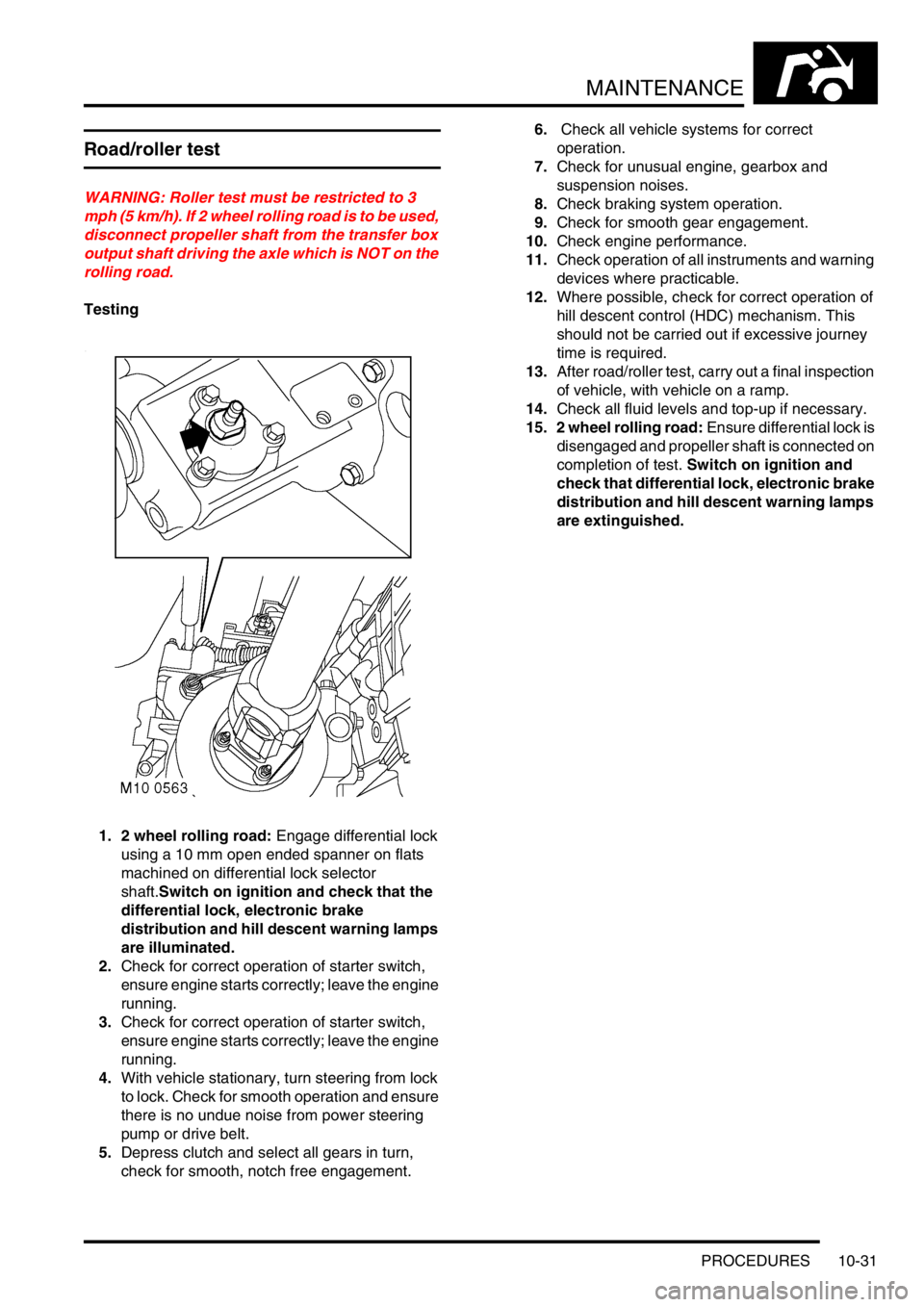
1. 2 wheel rolling road: Engage differential lock
using a 10 mm open ended spanner on flats
machined on differential lock selector
shaft.Switch on ignition and check that the
differential lock, electronic brake
distribution and hill descent warning lamps
are illuminated.
2.Check for correct operation of starter switch,
ensure engine starts correctly; leave the engine
running.
3.Check for correct operation of starter switch,
ensure engine starts correctly; leave the engine
running.
4.With vehicle stationary, turn steering from lock
to lock. Check for smooth operation and ensure
there is no undue noise from power steering
pump or drive belt.
5.Depress clutch and select all gears in turn,
check for smooth, notch free engagement.6. Check all vehicle systems for correct
operation.
7.Check for unusual engine, gearbox and
suspension noises.
8.Check braking system operation.
9.Check for smooth gear engagement.
10.Check engine performance.
11.Check operation of all instruments and warning
devices where practicable.
12.Where possible, check for correct operation of
hill descent control (HDC) mechanism. This
should not be carried out if excessive journey
time is required.
13.After road/roller test, carry out a final inspection
of vehicle, with vehicle on a ramp.
14.Check all fluid levels and top-up if necessary.
15. 2 wheel rolling road: Ensure differential lock is
disengaged and propeller shaft is connected on
completion of test. Switch on ignition and
check that differential lock, electronic brake
distribution and hill descent warning lamps
are extinguished.
Page 667 of 1529

REAR AXLE
51-2 DESCRIPTION AND OPERATION
Description
General
The rear axle consists of an axle casing with a differential unit attached to the right of the vehicle centre line. A wheel
hub is installed in each end of the axle casing and connected to the differential unit by a drive shaft.
Axle casing
The axle casing is of welded construction, with brackets on the casing exterior for attachment to the rear suspension.
A differential cover on the rear of the axle casing contains an oil level plug for checking and replenishment of the
differential unit lubricating oil. A magnetic drain plug is installed on the underside of the axle casing.
The interior of the axle casing is ventilated through a breather tube inserted in a red plastic sleeve in the top of the
casing. The open end of the breather tube is located between the chassis and the left rear wheelarch.
Differential unit
The differential unit is of the spiral bevel type, lubricated by splash oil. The unit consists of a differential carrier
attached to a pinion housing. In the pinion housing, the pinion is splined to a pinion flange which is secured with a bolt
and washer. An oil seal prevents leakage past the pinion flange.
Centralising peg
The centralising peg is a press fit in the centre of the pinion flange and provides a positive location for the rear
propellor shaft to ensure it is centralised with the flange.
Page 681 of 1529

FRONT AXLE
54-2 DESCRIPTION AND OPERATION
Description
General
The front axle consists of an axle casing with a differential unit attached to the right of the vehicle centre line. A wheel
hub is installed in a steering knuckle at each end of the axle casing and connected to the differential unit by a drive
shaft.
Axle casing
The axle casing is of welded construction, with brackets on the casing exterior for attachment to the front suspension.
Yokes at each end of the casing incorporate upper and lower ball joints for attachment of the steering knuckles.
A differential cover on the front of the axle casing contains an oil level plug for checking and replenishment of the
differential lubricating oil. A magnetic drain plug is installed on the underside of the casing. An oil seal is installed in
each end of the axle casing to prevent leakage past the drive shafts.
The interior of the axle casing is ventilated through a breather tube inserted in a red plastic sleeve in the top of the
casing. The open end of the breather tube is located in the left rear corner of the engine compartment.
Differential unit
The differential unit is of the spiral bevel type, lubricated by splash oil. The unit consists of a differential carrier
attached to a pinion housing. In the pinion housing, the pinion is splined to a drive flange which is secured with a bolt
and washer. An oil seal prevents leakage past the drive flange.
Steering knuckle
The steering knuckles are mounted on upper and lower ball joints in the yokes at the end of the axle casing. A tension
collet, in the lower mounting point of each steering knuckle, accommodates manufacturing tolerances to enable the
correct tightening of both ball joints. Lugs are incorporated on the steering knuckles for attachment of the steering
system drag link and track rod.
Page 690 of 1529

FRONT AXLE
REPAIRS 54-11
Constant velocity joint - drive shaft
$% 54.20.21
Remove
1.Remove wheel hub.
+ FRONT SUSPENSION, REPAIRS,
Wheel hub.
2.Place drive shaft in vice.
3.Release both securing bands from gaiter and
discard.
4.Compress gaiter to gain access to joint.
5.Using a suitable drift against the inner part of
the joint, remove joint from shaft.
6.Remove circlip from shaft and discard.
7.Remove spacer from shaft.
8.Remove gaiter from shaft and inspect for
damage. Renew if necessary. Refit
1.Clean drive shaft and gaiter.
2.Clean spacer.
3.Fit new inner securing band to gaiter.
4.Fit gaiter to shaft.
5.Fit spacer to shaft.
6.Fit new circlip to shaft.
7.Position joint to shaft. Use a screwdriver to
press circlip into its groove and push joint fully
onto shaft.
8.Apply grease from the sachet to the joint.
9.Position gaiter to joint and fit new outer
securing band.
10.Use a Band-it thriftool to secure inner and outer
securing bands.
11.Fit wheel hub.
+ FRONT SUSPENSION, REPAIRS,
Wheel hub.
Page 712 of 1529
STEERING
ADJUSTMENTS 57-19
5.Adjust drag link so that taper joint is centralised
in drop arm, then tighten drag link clamp bolts:
Tighten M8 bolts to 22 Nm (16 lbf.ft) and M10
bolts to 33 Nm (24 lbf.ft).
6.Connect drag link to drop arm and tighten nut to
80 Nm (59 lbf.ft).
7.Remove steering box centralising bolt.
8.Remove stand(s) and lower vehicle.
9.Road test the vehicle and check that the
steering wheel is centralised. If steering wheel
is not centralised, proceed as follows.
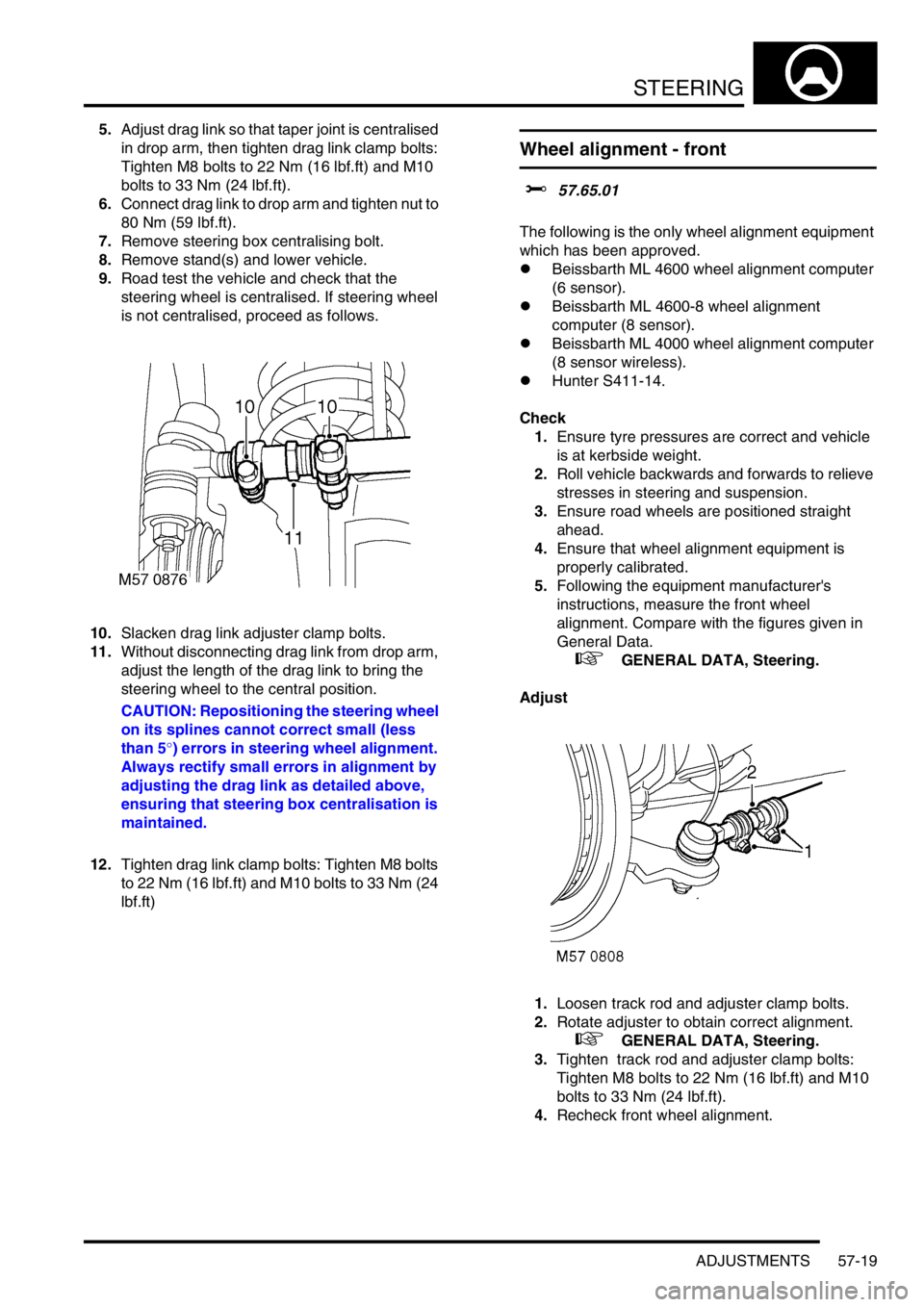
10.Slacken drag link adjuster clamp bolts.
11.Without disconnecting drag link from drop arm,
adjust the length of the drag link to bring the
steering wheel to the central position.
CAUTION: Repositioning the steering wheel
on its splines cannot correct small (less
than 5°) errors in steering wheel alignment.
Always rectify small errors in alignment by
adjusting the drag link as detailed above,
ensuring that steering box centralisation is
maintained.
12.Tighten drag link clamp bolts: Tighten M8 bolts
to 22 Nm (16 lbf.ft) and M10 bolts to 33 Nm (24
lbf.ft)
Wheel alignment - front
$% 57.65.01
The following is the only wheel alignment equipment
which has been approved.
lBeissbarth ML 4600 wheel alignment computer
(6 sensor).
lBeissbarth ML 4600-8 wheel alignment
computer (8 sensor).
lBeissbarth ML 4000 wheel alignment computer
(8 sensor wireless).
lHunter S411-14.
Check
1.Ensure tyre pressures are correct and vehicle
is at kerbside weight.
2.Roll vehicle backwards and forwards to relieve
stresses in steering and suspension.
3.Ensure road wheels are positioned straight
ahead.
4.Ensure that wheel alignment equipment is
properly calibrated.
5.Following the equipment manufacturer's
instructions, measure the front wheel
alignment. Compare with the figures given in
General Data.
+ GENERAL DATA, Steering.
Adjust
1.Loosen track rod and adjuster clamp bolts.
2.Rotate adjuster to obtain correct alignment.
+ GENERAL DATA, Steering.
3.Tighten track rod and adjuster clamp bolts:
Tighten M8 bolts to 22 Nm (16 lbf.ft) and M10
bolts to 33 Nm (24 lbf.ft).
4.Recheck front wheel alignment.
Page 746 of 1529
FRONT SUSPENSION
DESCRIPTION AND OPERATION 60-1
FRONT SUSPENSION DESCRIPTION AND OPERAT ION
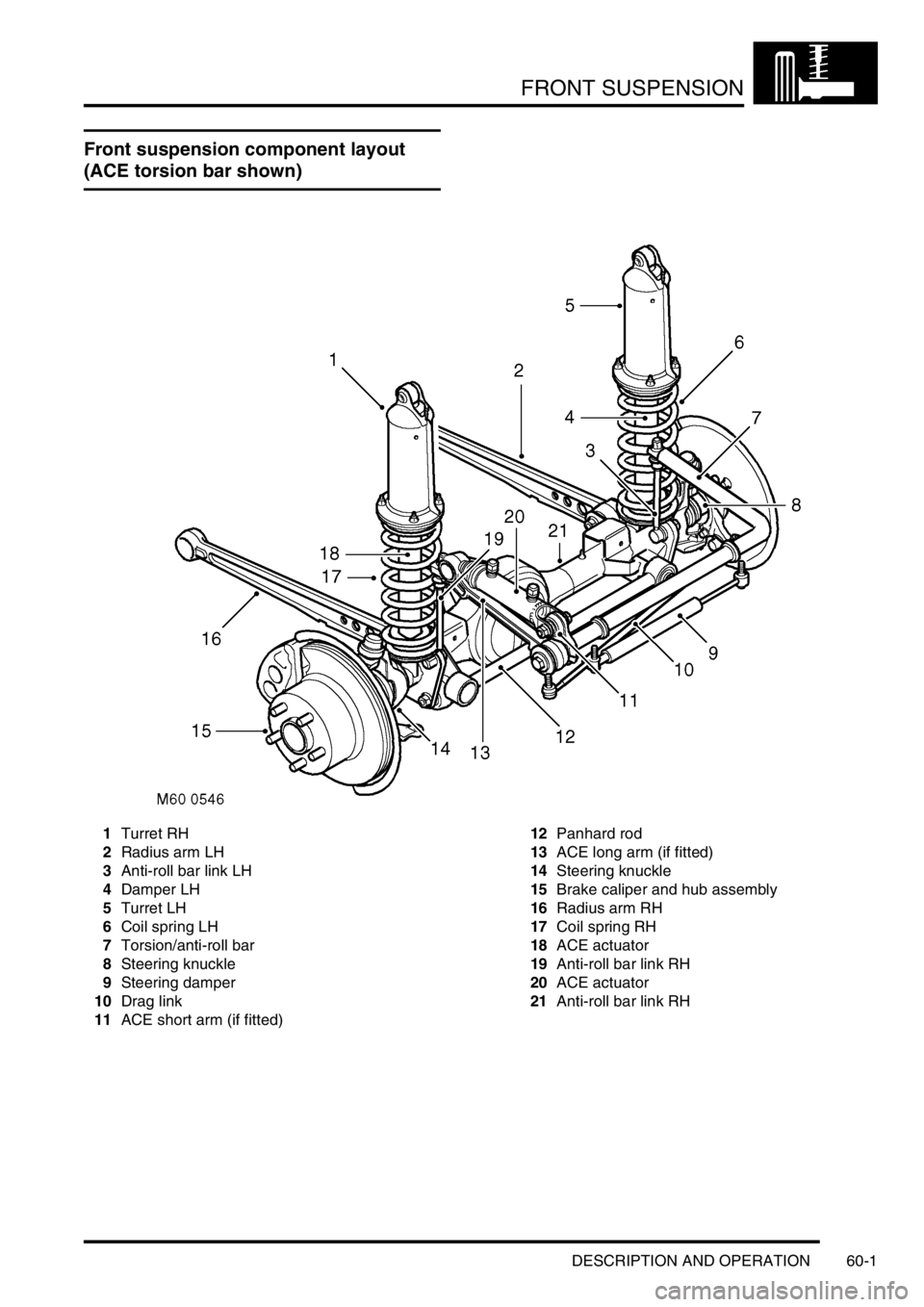
Front suspension component layout
(ACE torsion bar shown)
1Turret RH
2Radius arm LH
3Anti-roll bar link LH
4Damper LH
5Turret LH
6Coil spring LH
7Torsion/anti-roll bar
8Steering knuckle
9Steering damper
10Drag link
11ACE short arm (if fitted)12Panhard rod
13ACE long arm (if fitted)
14Steering knuckle
15Brake caliper and hub assembly
16Radius arm RH
17Coil spring RH
18ACE actuator
19Anti-roll bar link RH
20ACE actuator
21Anti-roll bar link RH
Page 747 of 1529

FRONT SUSPENSION
60-2 DESCRIPTION AND OPERATION
Front suspension components (ACE
torsion bar shown)
Page 748 of 1529

FRONT SUSPENSION
DESCRIPTION AND OPERATION 60-3
1Damper 2 off
2Bolt 2 off
3Turret 2 off
4Nut 8 off
5Nut
6Bolt 4 off
7Nut
8Washer
9Anti-roll bar link RH
10Torsion/Anti-roll bar assembly
11Anti-roll bar link LH
12Washer
13Nut
14Nut
15Mounting rubber 2 off
16Clamp plate 2 off
17Bolt 2 off
18Lower spring seat LH
19Front axle20Nut
21Bush
22Panhard rod
23Bolt
24Radius arm LH
25Bolt
26Bush
27Nut
28Nut
29Bush
30Bolt
31Radius arm RH
32Bolt
33Bush
34Nut
35Lower spring seat RH
36Coil spring 2 off
37Upper spring seat 2 off