transmission LAND ROVER DISCOVERY 1999 Repair Manual
[x] Cancel search | Manufacturer: LAND ROVER, Model Year: 1999, Model line: DISCOVERY, Model: LAND ROVER DISCOVERY 1999Pages: 1529, PDF Size: 34.8 MB
Page 972 of 1529

INTERIOR TRIM COMPONENTS
REPAIRS 76-3-7
17.Remove console.
NOTE: Do not carry out further dismantling if
component is removed for access only.
18.Remove 4 screws securing storage bin lid to
console and remove lid.
19.Release cigar lighter body from console and
remove.
Refit
1.Fit and secure cigar lighter body to console.
2.Fit lid to console and secure with screws.
3.Fit console.
4.Connect multiplug and bulb to cigar lighter.
5.Fit centre console to fascia.
6.Fit 2 bolts securing rear of console to
transmission tunnel.
7.Connect multiplugs to seat switches.
8.Fit switches to console.
9.Move handbrake to lowered position.
10.Fit cable to handbrake and secure with clevis
pin and clip.
11.Fit handbrake gaiter to console.
12.Fit bolts securing forward edge of console to
transmission tunnel.
13. Models with veneer trim: Position veneered
console cover and connect multiplugs to switch
pack. Fit cigar lighter element and secure
veneered console cover to console.
14. Models with base trim: Connect multiplugs to
switch pack, fit switch pack to console and
secure with screws.
15. Models with base trim: Fit cover plate to
switch pack, and rubber mat to console.
16.Fit transfer box gaiter and knob to lever.
17.Secure transfer box gaiter to console.
18.Connect multiplug to selector panel, fit and
secure panel to centre console.
19.Fit spacer and knob to gear selector lever.
20. Models from 03MY:Fit both centre console
cup holders.
Console - centre - manual models
$% 76.25.01
Remove
1.Release clips securing gear lever gaiter to
centre console and remove knob and gaiter.
2. Models from 03MY:Remove both centre
console cup holders.
3.Release clips securing transfer box lever gaiter
to centre console and remove knob and gaiter.
Page 973 of 1529

INTERIOR TRIM COMPONENTS
76-3-8 REPAIRS
4. Models with base trim: Remove rubber mat
from console and remove cover plate from
switch pack.
5. Models with base trim: Remove 4 screws
securing switch pack to centre console,
disconnect multiplugs and remove switch pack.6. Models with veneer trim: Release veneered
console cover from console and remove cigar
lighter element. Disconnect multiplugs from
switch pack and remove veneered console
cover.
7.Remove 2 bolts securing forward edge of
console to transmission tunnel.
Page 974 of 1529

INTERIOR TRIM COMPONENTS
REPAIRS 76-3-9
8.Release handbrake gaiter from console.
9.Remove clip and clevis pin securing cable to
handbrake.
10.Move handbrake to fully upward position.
11.Release electric seat switches from console.
12.Disconnect multiplugs from switches and
remove.
13.Remove 2 bolts securing rear of console to
transmission tunnel.
14.Release centre console from fascia.
15.Disconnect multiplug and bulb from cigar
lighter. 16.Remove console.
NOTE: Do not carry out further dismantling if
component is removed for access only.
17.Remove 4 screws securing storage bin lid to
console and remove lid.
18.Release cigar lighter body from console and
remove.
Refit
1.Fit and secure cigar lighter body to console.
2.Fit lid to console and secure with screws.
3.Fit console.
4.Connect multiplug and bulb to cigar lighter.
5.Fit centre console to fascia.
6.Fit 2 bolts securing rear of console to
transmission tunnel.
7.Connect multiplugs to seat switches.
8.Fit switches to console.
9.Move handbrake to lowered position.
10.Fit cable to handbrake and secure with clevis
pin and clip.
11.Fit handbrake gaiter to console.
12.Fit bolts securing forward edge of console to
transmission tunnel.
13. Models with veneer trim: Position veneered
console cover and connect multiplugs to switch
pack. Fit cigar lighter element and secure
veneered console cover to console.
14. Models with base trim: Connect multiplugs to
switch pack, fit switch pack to console and
secure with screws.
15. Models with base trim: Fit cover plate to
switch pack, and rubber mat to console.
16.Fit transfer gearbox gaiter and knob to lever.
17.Secure gaiter to console.
18.Fit knob and gaiter to gear lever and secure
gear lever gaiter to console with clips.
19. Models from 03MY:Fit both centre console
cup holders.
Page 977 of 1529

INTERIOR TRIM COMPONENTS
76-3-12 REPAIRS
20.Separate blue section from ICE multiplug.
21.Release coaxial cables from fascia panel.
22.Disconnect multiplug from passenger air bag.
23.Disconnect multiplug from blower motor.
24.Working through glove box aperture remove 2
bolts, or 4 bolts if passenger airbag module is
fitted, securing fascia to body.25.Remove 4 bolts securing lower edge of fascia
to mounting brackets on transmission tunnel.
26.Remove 4 bolts securing lower edge of fascia
to brackets on 'A' post.
27.With assistance carefully remove fascia from
vehicle.
28.If renewing fascia, transfer components to new
fascia as necessary.
Refit
1.With assistance carefully fit fascia and tighten
bolts securing lower edge of fascia to 26 Nm
(19 lbf.ft).
2.Tighten bolts securing fascia to body to 26 Nm
(19 lbf.ft).
3.Fit nuts securingfascia to steering column
bracket to 11 Nm (8 lbf.ft).
4.Secure coaxial cables to fascia and secure blue
multiplug to main ICE multiplug.
5. Models with A/C: Connect heater control
multiplug.
6. Models without A/C: Connect temperature
and air distribution inner cables to heater
control levers. Set temperature control knobs to
fully hot, distribution knob to demist position
and, with flap levers fully closed, secure outer
cables to clips on heater casing.
7.Connect multiplugs to blower motor and
passenger air bag (where fitted).
8.Fit glove box and secure with bolts.
9.Connect fascia harness multiplugs to main
harness and fuse box.
10.Position instrument pack and connect
multiplugs.
Page 983 of 1529

INTERIOR TRIM COMPONENTS
76-3-18 REPAIRS
Carpet - front
$% 76.49.02
Remove
1. Models with premium ICE: Remove power
amplifier.
+ IN CAR ENTERTAINMENT,
REPAIRS, Amplifier - power.
2. Models with premium ICE: Remove CD
autochanger.
+ IN CAR ENTERTAINMENT,
REPAIRS, CD autochanger.
3.Remove centre console.
lFor models with manual gearbox:
+ INTERIOR TRIM COMPONENTS,
REPAIRS, Console - centre - manual
models.
lFor models with automatic gearbox:
+ INTERIOR TRIM COMPONENTS,
REPAIRS, Console - centre - automatic
models.
4.Remove both lower 'A' post trim panels.
5.Remove finisher from both front carpet
retainers.
6.Remove 8 screws securing front carpet
retainers to floor.
7.Remove front carpet retainers.
8.Remove 2 nuts securing main body harness to
transmission tunnel.
9.With assistance release and remove carpet.Refit
1.With assistance position carpet.
2.Secure main body harness to transmission
tunnel with nuts.
3.Position front carpet retainers and secure to
floor with screws.
4.Fit finishers to front carpet retainers
5.Fit both lower 'A' post trim panels.
6.Fit centre console.
lFor models with manual gearbox:
+ INTERIOR TRIM COMPONENTS,
REPAIRS, Console - centre - manual
models.
lFor models with automatic gearbox:
+ INTERIOR TRIM COMPONENTS,
REPAIRS, Console - centre - automatic
models.
7. Models with premium ICE: Fit CD
autochanger.
+ IN CAR ENTERTAINMENT,
REPAIRS, CD autochanger.
8. Models with premium ICE: Fit power
amplifier.
+ IN CAR ENTERTAINMENT,
REPAIRS, Amplifier - power.
Page 1162 of 1529
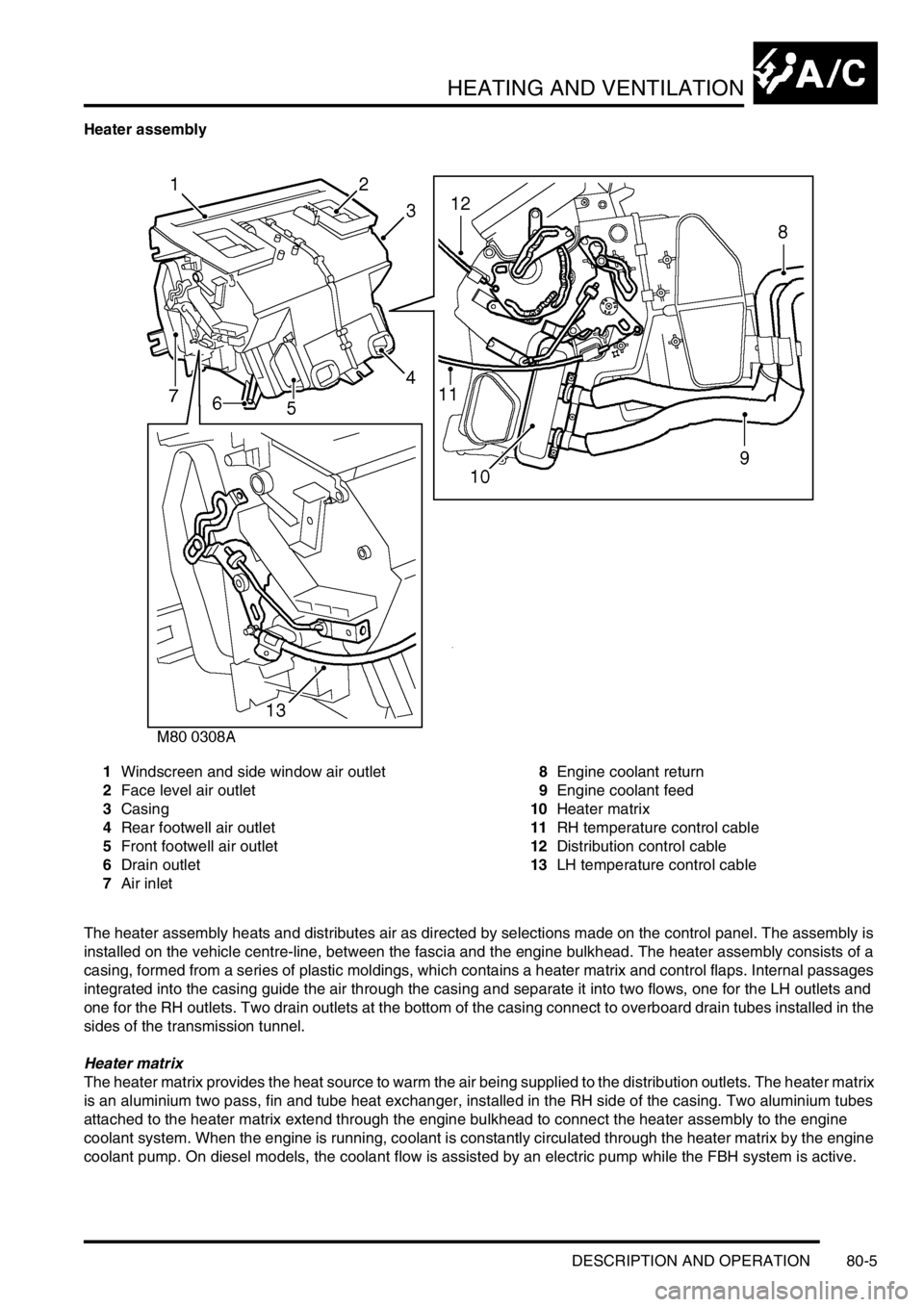
HEATING AND VENTILATION
DESCRIPTION AND OPERATION 80-5
Heater assembly
1Windscreen and side window air outlet
2Face level air outlet
3Casing
4Rear footwell air outlet
5Front footwell air outlet
6Drain outlet
7Air inlet8Engine coolant return
9Engine coolant feed
10Heater matrix
11RH temperature control cable
12Distribution control cable
13LH temperature control cable
The heater assembly heats and distributes air as directed by selections made on the control panel. The assembly is
installed on the vehicle centre-line, between the fascia and the engine bulkhead. The heater assembly consists of a
casing, formed from a series of plastic moldings, which contains a heater matrix and control flaps. Internal passages
integrated into the casing guide the air through the casing and separate it into two flows, one for the LH outlets and
one for the RH outlets. Two drain outlets at the bottom of the casing connect to overboard drain tubes installed in the
sides of the transmission tunnel.
Heater matrix
The heater matrix provides the heat source to warm the air being supplied to the distribution outlets. The heater matrix
is an aluminium two pass, fin and tube heat exchanger, installed in the RH side of the casing. Two aluminium tubes
attached to the heater matrix extend through the engine bulkhead to connect the heater assembly to the engine
coolant system. When the engine is running, coolant is constantly circulated through the heater matrix by the engine
coolant pump. On diesel models, the coolant flow is assisted by an electric pump while the FBH system is active.
Page 1253 of 1529

WIPERS AND WASHERS
84-18 DESCRIPTION AND OPERATION
Front flick wipe
Flick wipe operation will only activate when the following conditions are met:
lIgnition switch is in position I or II.
lFront flick switch is operated.
Pressing the flick wipe switch operates the front wiper motor at high speed. The front wiper motor operates as long
as the flick switch is activated. Releasing the flick switch causes the front wiper motor to run through the park switch
circuitry. The park switch only permits low speed operation. Thus if the flick switch is pressed and immediately
released, the wipers operate at low speed.
Rear intermittent wipe variable delay
The rear intermittent wipe variable delay operation allows the driver to adjust the interval between wipes to suit local
conditions. Rear variable delay operation only activates if the following conditions are met:
lIgnition switch in position I or II.
lFront wash/ wipe switch on intermittent.
lRear wipe switch is operated.
The BCU determines the desired delay interval based on the setting of the variable delay switch. The rear wash/ wipe
delay is nominally twice as long as that of the front. This information passes from the IDM to the rear wiper relay and
activates the rear wiper motor.
If the delay duration is decreased during operation of the rear wiper, the wipers immediately operate once and the
delay cycle is reset.
If the delay duration is increased during operation of the rear wiper, the delay cycle is automatically increased by the
BCU.
Reverse wiping
Reverse wiping operates the rear wiper motor when reverse gear is selected. The transmission must be in reverse
for longer then 0.5 seconds before reversing wipe activates. Reversing wipe activates if the following conditions are
met:
lIgnition switch is in position II.
lReverse gear is selected.
lRear wiper or front wipers operating.
If the rear wiper is active in any mode when reverse gear is selected, the rear wiper activates for 4 second. After 4
seconds the rear wiper operates in a delay operation at the same delay interval set by the variable delay switch until
reverse gear is deselected.
If the front wipers are operating on either low or high speed when reverse gear is selected, the rear wiper activates
continuously until reverse gear is deselected.
In order to enable reversing wipe functions, the BCU utilises the reversing light switch located within the transmission
to determine when reverse gear has been selected.
If the front intermittent wipe is active when reverse gear is selected, the rear wiper completes 2 cycles before operating
at the same intermittent delay as the front wipers.
Rear wipe
Rear wipe operation will only activate when the following conditions are met:
lIgnition switch is in position II.
lRear wipe switch is operated.
Operating the rear wiper switch provides an earth input to the BCU. The BCU tells the IDM to activate the rear wiper
relay, which provides battery voltage to the wiper motor through the normally closed contacts of the park switch.
Page 1298 of 1529

BODY CONTROL UNIT
DESCRIPTION AND OPERATION 86-3-11
Programmable options
The BCU can be programmed with a number of options to satisfy specific market requirements and customer
preferences. The options can be set using TestBook.
Function Option Details
Transmission Manual The vehicle is fitted with manual transmission.
Automatic The vehicle is fitted with automatic transmission.
Front fog lamps None The vehicle is not fitted with front fog lamps.
Main The front fog lamps will operate if the headlamps are on main beam.
No main The front fog lamps will not operate if the headlamps are on main
beam.
Interlocks None The vehicle is not fitted with key, shift or transfer box interlocks.
Shift The vehicle is fitted with key, shift and transfer box interlocks.
No transfer The vehicle is fitted with key and shift interlocks, but not a transfer box
interlock.
Daylight running lamps None The vehicle is not fitted with daylight running lamps.
No main The daylight running lamps are on if the headlamp main beams are off.
No heads The daylight running lights are on with headlamp main and dipped
beams off and the gearbox not in Park.
Programmed wash/ wipe Normal The front wipers operate if the front wash is operated.
No wipe The front wipers do not operate if the front wash is operated.
Key-in warning Disabled The ignition key in audible warning is disabled.
Enabled The ignition key in audible warning is generated if the ignition key is in
and the driver's door is open.
Electric front seats None The vehicle is not fitted with electric front seats.
Normal Electric seat adjustment is available for 45 seconds after the driver's
door opens or if the ignition is on.
Ignition II Electric seat adjustment is available if the ignition is on.
Electric front windows Driver cancel The front windows will be disabled 44 seconds after the driver's door
is opened.
All cancel The front windows will be disabled 44 seconds after any door is
opened.
No cancel The front windows will be disabled when the ignition is turned off.
Heated front screen Fitted The vehicle is fitted with heated front screens.
None The vehicle is not fitted with heated front screens.
Rear windows and sunroof Driver cancel The rear windows and sunroof will be disabled 44 seconds after the
driver's door is opened.
All cancel The rear windows and sunroof will be disabled 44 seconds after any
door is opened.
No cancel The rear windows and sunroof will be disabled when the ignition
switch is turned off.
Gear position indicator
illuminationAlways The automatic gearbox selector illumination is on when the ignition is
on.
Sidelights The automatic gearbox selector illumination is on when the ignition is
on and the sidelights are off.
Hill descent control None The vehicle is not fitted with hill descent control.
Fitted The vehicle is fitted with hill descent control.
Courtesy headlamps Disabled The vehicle is not fitted with courtesy headlamps.
Enabled The vehicle is fitted with courtesy headlamps.
Odometer error warning Disabled The odometer will not flash if there is an odometer error.
Enabled The odometer will flash if there is an odometer error.
Page 1303 of 1529

BODY CONTROL UNIT
86-3-16 DESCRIPTION AND OPERATION
Cruise control
The BCU processes several signals used for cruise control:
lWhen the brake pedal is pressed, a low voltage brake lamp signal is sent via the BCU to the cruise control ECU.
lThe gear position switch sends an input via the BCU to the cruise control ECU if the selector lever is in Park,
Neutral or Reverse.
lA voltage supply is fed from the BCU to the cruise control SET+ switch.
lA voltage supply is fed from the BCU to the cruise control RES switch.
On vehicles with automatic transmission, if the BCU receives an input from the gear position switch or the brake pedal
switch, the BCU sends a signal to the cruise control ECU to cancel or inhibit cruise control operation.
+ ENGINE MANAGEMENT SYSTEM - Td5, DESCRIPTION AND OPERATION, Description.
+ ENGINE MANAGEMENT SYSTEM - V8, DESCRIPTION AND OPERATION, Description - cruise control.
Shift interlock (where fitted)
On automatic gearbox models, the BCU and IDM combine with an interlock relay located in the passenger
compartment fuse box to operate a shift interlock solenoid, so that the gear selector lever cannot be moved out of
Park until certain logical conditions have been satisfied. Operation of the interlock may be affected, if the battery
becomes discharged.
+ AUTOMATIC GEARBOX - ZF4HP22 - 24, DESCRIPTION AND OPERATION, Description.
Ignition key interlock (where fitted)
On automatic gearbox models, the ignition key interlock solenoid prevents removal of the ignition key from the ignition
switch when the transmission gear selector is not in the Park position. The logic control operation for this is performed
by the BCU.
Transfer box interlock (where fitted)
On automatic gearbox models, a transfer box interlock solenoid is controlled by the IDM to prevent transfer box shift
lever being moved out of high or low range unless certain conditions have been satisfied. The IDM controls the
operation of the transfer box relay which is located in the passenger compartment fuse box.
+ TRANSFER BOX - LT230SE, DESCRIPTION AND OPERATION, Description.
Gear position switch
A gear position switch is located on the automatic gearbox and is used to inform the BCU of the gear selector lever
position. The BCU has four sensing inputs from the gear position switch contacts W, X, Y, Z, which are used to
determine the gearbox drive status at any particular instance. The BCU gives an output corresponding to the gearbox
status derived from the gear position switch inputs. The logic states defining the gear selector positions are listed in
the table below, where Z1, Z2, Z3 and Z4 represent intermediate states which exist as the selector lever position is
changed:
Gear position Switch contacts
WX Y Z
P (Park) 1 0 0 0
Z11100
R (Reverse) 0 1 0 0
Z11100
N (Neutral) 1 1 1 0
Z21010
D (Drive) 1 0 1 1
Z31111
30111
Z40011
20001
Z40011
10010
Page 1304 of 1529

BODY CONTROL UNIT
DESCRIPTION AND OPERATION 86-3-17
The existence of an intermediate state causes a fault code to be detected by the BCU. To reduce the chances of the
fault condition occurring while changing selector lever position, the inputs are debounced and only considered valid
when they have existed for at least 33 ms.
Transmission neutral selector
The transmission neutral sensor provides an earth signal to the BCU when the transfer box is in neutral. The earth
signal causes the BCU to operate an audible warning when the transfer box is in neutral with the ignition switched on.
+ TRANSFER BOX - LT230SE, DESCRIPTION AND OPERATION, Description.
Self levelling suspension and ABS
The BCU communicates with the SLABS ECU for several functions:
lAn output is provided from the SLABS ECU to the BCU to provide the logic conditions for issuing the SLS audible
warning.
lThe BCU receives an input from the SLABS ECU relating to the raise/ lower command from the remote handset.
+ REAR SUSPENSION, DESCRIPTION AND OPERATION, Description - SLS.
Hill descent control
The BCU provides an output signal to the SLABS ECU for automatic transmission in neutral for HDC control. The
BCU checks the status of the ignition and 'gearbox state' inputs and provides a 'Neutral selected' output. If the ignition
is on and 'gearbox state' is Neutral, the 'Neutral selected' output is on, otherwise 'Neutral selected' is off.
+ BRAKES, DESCRIPTION AND OPERATION, Description.
Heated screens
The Heated Front Screen (HFS) is fitted for some market destinations and is operated from a non-latching switch
located on the instrument pack cowl. The BCU will only allow the heated front screen to operate when the engine is
running and controls the time-out period for switching the circuit off.
The heated front screen operation can also be controlled from the Automatic Temperature Control (ATC) ECU on
vehicles fitted with air conditioning.
The heated rear window will only function when the engine is running, and is operated by a non-latching switch on the
instrument pack cowl. The heated rear window can also be operated by the ATC ECU on vehicles fitted with air
conditioning.
Interior courtesy lamps
The BCU controls the operation of the interior courtesy lamps. The courtesy lamps are situated in the front, mid and
rear areas of the headlining.
Fuel flap actuator
The BCU provides an earth path to the fuel flap release solenoid to allow the fuel filler flap to be opened. This is only
allowed if the alarm system is not set and all other conditions have been satisfied. The fuel flap release switch is
located in the fascia switch pack on vehicles up to 2003 model year or in the instrument pack binacle on vehicles from
2003 model year. The switch receives a voltage supply from the passenger compartment fuse box.