ad blue LAND ROVER DISCOVERY 2002 User Guide
[x] Cancel search | Manufacturer: LAND ROVER, Model Year: 2002, Model line: DISCOVERY, Model: LAND ROVER DISCOVERY 2002Pages: 1672, PDF Size: 46.1 MB
Page 326 of 1672
EMISSION CONTROL - TD5
DESCRIPTION AND OPERATION 17-1-5
Exhaust gas recirculation
The exhaust gas recirculation (EGR) valve permits a controlled amount of exhaust gas to combine with the fresh air
entering the engine. The exhaust gas reduces the combustion temperature by delaying the fuel burning rate, which
assists in reducing the quantity of oxides of nitrogen.
On EU3 models, an EGR cooler is employed to further reduce the combustion temperature. By passing the exhaust
gas through a bundle of pipes flooded by coolant, the density of the exhaust gas going into the engine is increased.
This process further reduces the amount of oxygen, which in turn, further reduces the amount of NO
2 in the exhaust.
Recirculating too much exhaust gas can result in higher emissions of soot, HC and CO due to insufficient air. The
recirculated exhaust gas must be limited so that there is sufficient oxygen available for combustion of the injected fuel
in the combustion chamber, to do this the Engine Control Module (ECM) is used to control the precise quantity of
exhaust gas to be recirculated in accordance with the prevailing operating conditions. Influencing factors include:
lthe mass of air flow detected by the mass air flow sensor.
+ ENGINE MANAGEMENT SYSTEM - Td5, DESCRIPTION AND OPERATION, Description.
lthe ambient air pressure, determined by the ambient air pressure sensor which is used to initiate adjustments
to reduce the amount of smoke produced at high altitudes.
+ ENGINE MANAGEMENT SYSTEM - Td5, DESCRIPTION AND OPERATION, Description.
Other factors which are taken into consideration by the engine management system for determining the optimum
operating condition include:
lManifold inlet air temperature
lCoolant temperature
lEngine speed
lFuel delivered
The main components of the EGR system are as follows.
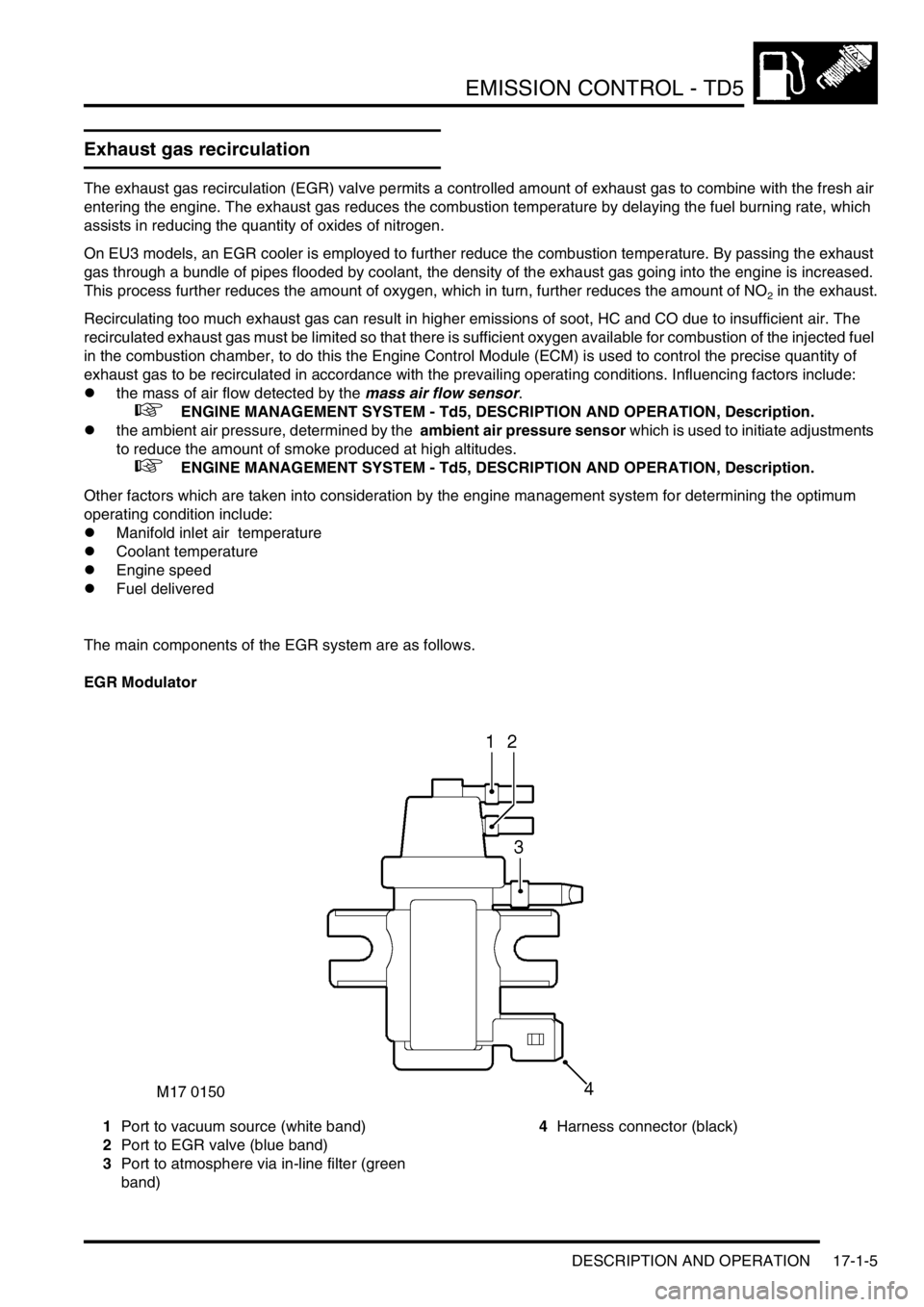
EGR Modulator
1Port to vacuum source (white band)
2Port to EGR valve (blue band)
3Port to atmosphere via in-line filter (green
band)4Harness connector (black)
Page 327 of 1672
EMISSION CONTROL - TD5
17-1-6 DESCRIPTION AND OPERATION
The EGR modulator is located on a plate fixed to the inner wing on the RH side of the engine. The modulator is
attached to the plate by two through-studs, each with two nuts which secure the modulator assembly to a rubber
mounting which helps to reduce noise. The modulator must be mounted in the vertical orientation with the two vacuum
ports uppermost.
The modulator operation is controlled by a signal from the ECM which determines the required amount of EGR
needed in response to inputs relating to air flow and engine operating and ambient conditions. The modulator has a
black two-pin connector at its base to connect it to the ECM through the engine harness.
Each modulator features three ports:
lThe top port of the EGR modulator is identified by a white band and connects to a 'T'-piece in the vacuum line
via a small-bore brown plastic hose. On type 2 systems the brown hose is connected in parallel with the vacuum
source to the ILT modulator.
The other two ports on the 'T'-piece connects vacuum line hoses of black vinyl tubing between the vacuum pump
and the brake-servo assembly attached to the bulkhead. The vacuum pump end of the vacuum line tubing
terminates in a rubber elbow, which gives a vacuum tight seal on the suction port of the vacuum pump. The
brake-servo end of the vacuum line tubing terminates with a non-return valve in a plastic housing which plugs
into the front face of the brake-servo housing.
lThe middle port of the EGR modulator is identified by a blue band and connects to the suction port on the EGR
valve through a small-bore blue plastic hose.
lThe lower port of the EGR modulator is identified by a green band and connects to atmosphere through an in-
line filter via a small-bore green plastic hose. On type 2 models a 3 way connector is fitted to vent both modulators
through a single filter. The other port of the in-line filter vents directly to atmosphere.
The blue and brown vacuum hoses are protected by corrugated plastic sheaths. The ends of the hoses are fitted with
rubber boots to ensure vacuum tight seals at the component ports.
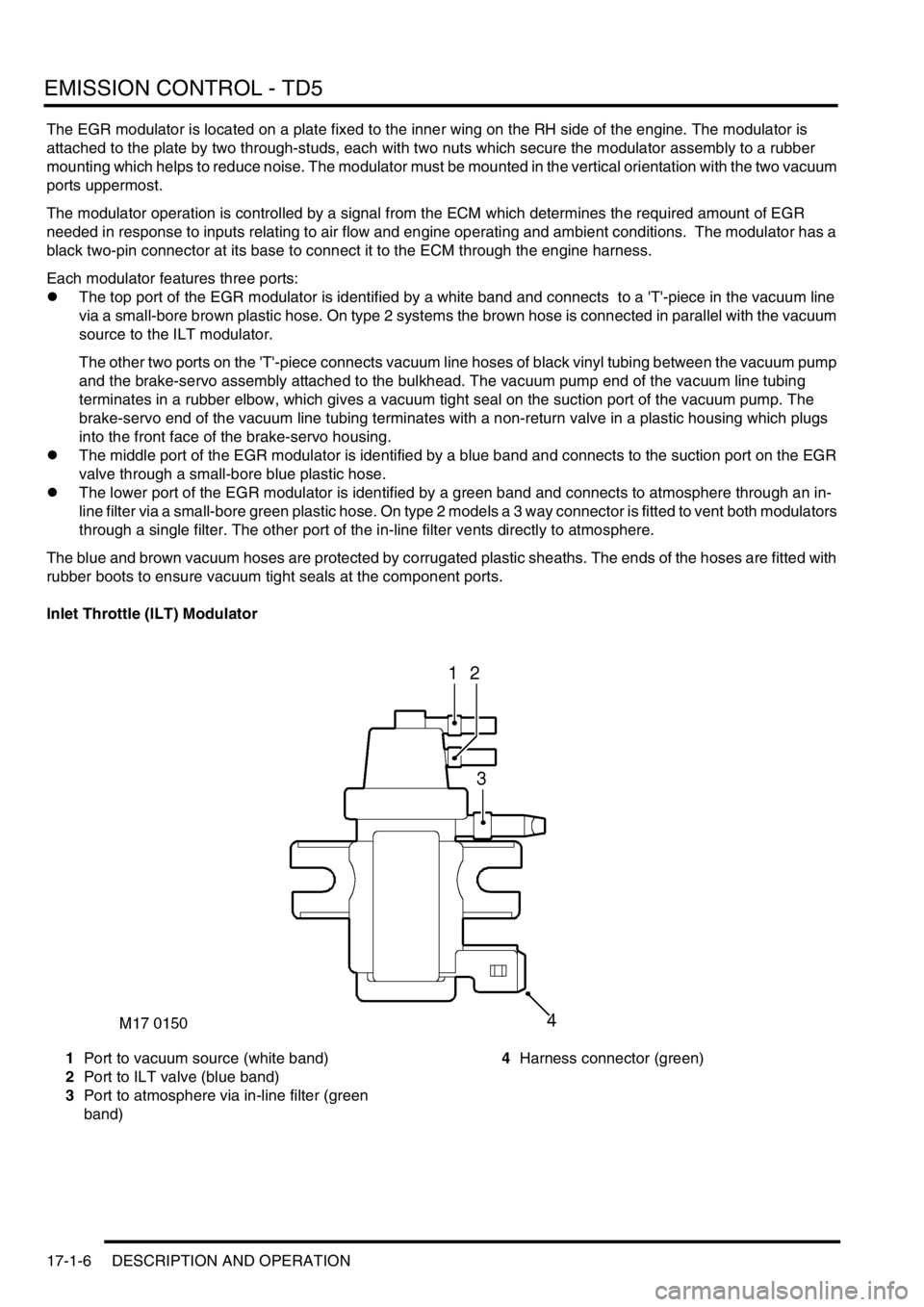
Inlet Throttle (ILT) Modulator
1Port to vacuum source (white band)
2Port to ILT valve (blue band)
3Port to atmosphere via in-line filter (green
band)4Harness connector (green)
Page 328 of 1672
EMISSION CONTROL - TD5
DESCRIPTION AND OPERATION 17-1-7
The ILT modulator is located on a plate fixed to the inner wing on the RH side of the engine below the EGR modulator.
The modulator is attached to the plate by two through-studs, each with two nuts which secure the modulator assembly
to a rubber mounting which helps to reduce noise. The modulator must be mounted in the vertical orientation with the
two vacuum ports uppermost.
The modulator operation is controlled by a signal from the ECM which determines the required ratio of exhaust gas
to fresh inlet air needed in response to inputs relating to air flow and engine operating and ambient conditions. The
modulator has a green two-pin connector at its base to connect it to the ECM through the engine harness.
The ILT valve modulator features three ports:
lThe top port is identified by a white band and connects to a 'T'-piece in the vacuum line via a small-bore brown
plastic hose where it is connected in parallel with the vacuum source line to the EGR valve modulator. The two
other ports on the 'T'-piece connect vacuum line hoses of black vinyl tubing between the vacuum pump attached
to the alternator and the brake-servo assembly attached to the bulkhead.
lThe middle port is identified by a blue band and connects to the suction port on the ILT valve through a small-
bore blue plastic hose.
lThe lower port is identified by a green band and connects to atmosphere through an in-line filter via a green
plastic hose and a three-way connector positioned in-line between the modulators and the filter. The ILT
modulator hose is connected opposite to the two parallel ports at the three-way connector which connect the vent
lines to the EGR valve modulator and the in-line filter. The other port of the in-line filter vents directly to
atmosphere.
The blue and brown vacuum hoses are protected by corrugated plastic sheaths. The ends of the hoses are fitted with
rubber boots to ensure vacuum tight seals at the component ports.
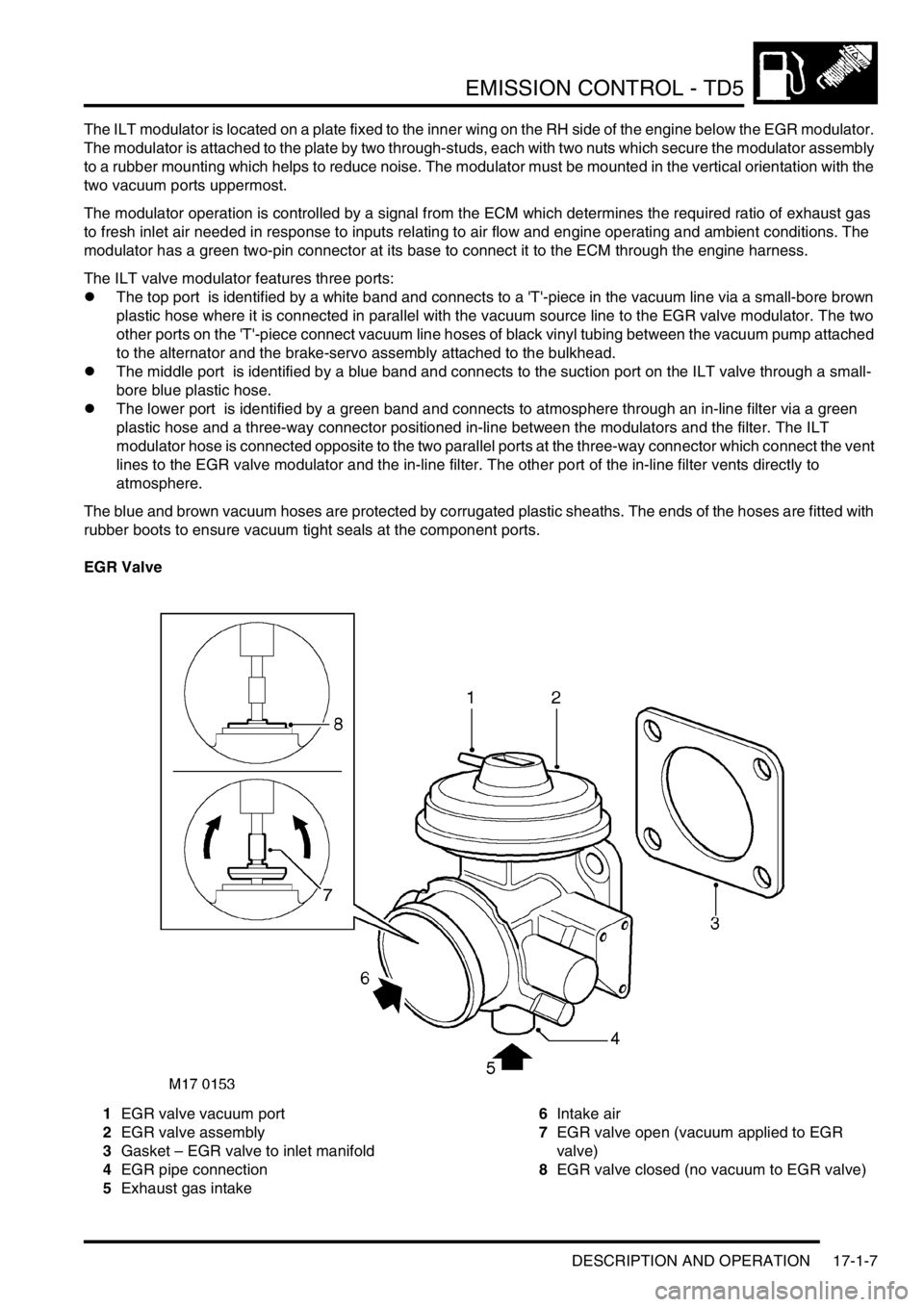
EGR Valve
1EGR valve vacuum port
2EGR valve assembly
3Gasket – EGR valve to inlet manifold
4EGR pipe connection
5Exhaust gas intake6Intake air
7EGR valve open (vacuum applied to EGR
valve)
8EGR valve closed (no vacuum to EGR valve)
Page 329 of 1672
EMISSION CONTROL - TD5
17-1-8 DESCRIPTION AND OPERATION
The EGR valve is a cast and machined assembly which locates on the front end of the inlet manifold assembly. The
machined faces of the EGR assembly and the inlet manifold are attached together using four screws passing through
the four corners of a flange in the EGR assembly to tappings in the front face of the inlet manifold. A gasket is used
to seal the interface between the EGR valve and the front face of the inlet manifold. The gasket should be changed
every time the EGR valve assembly is removed from the air intake manifold.
The intake side of the EGR valve allows the passage of fresh intercooled air through to the inlet manifold via a rubber
hose which is attached to the front face of the EGR valve assembly by a metal band clamp. The bottom port of the
EGR valve is connected to the EGR pipe using a metal band clamp.
A vacuum port on top of the EGR valve connects to the EGR modulator through a blue, small-bore suction hose. When
a vacuum is applied to the EGR valve suction port it causes a spindle with sealing disc (EGR valve) to be raised,
thereby opening the port at the EGR pipe to allow the recirculated exhaust gas to pass through into the inlet manifold.
When the vacuum is removed from the suction port the EGR valve returns to its rest position under the influence of a
spring to tightly close the exhaust gas port. Thus controlled opening of the EGR valve determines the mass of
recirculated exhaust gas allowed to flow through to the inlet manifold.
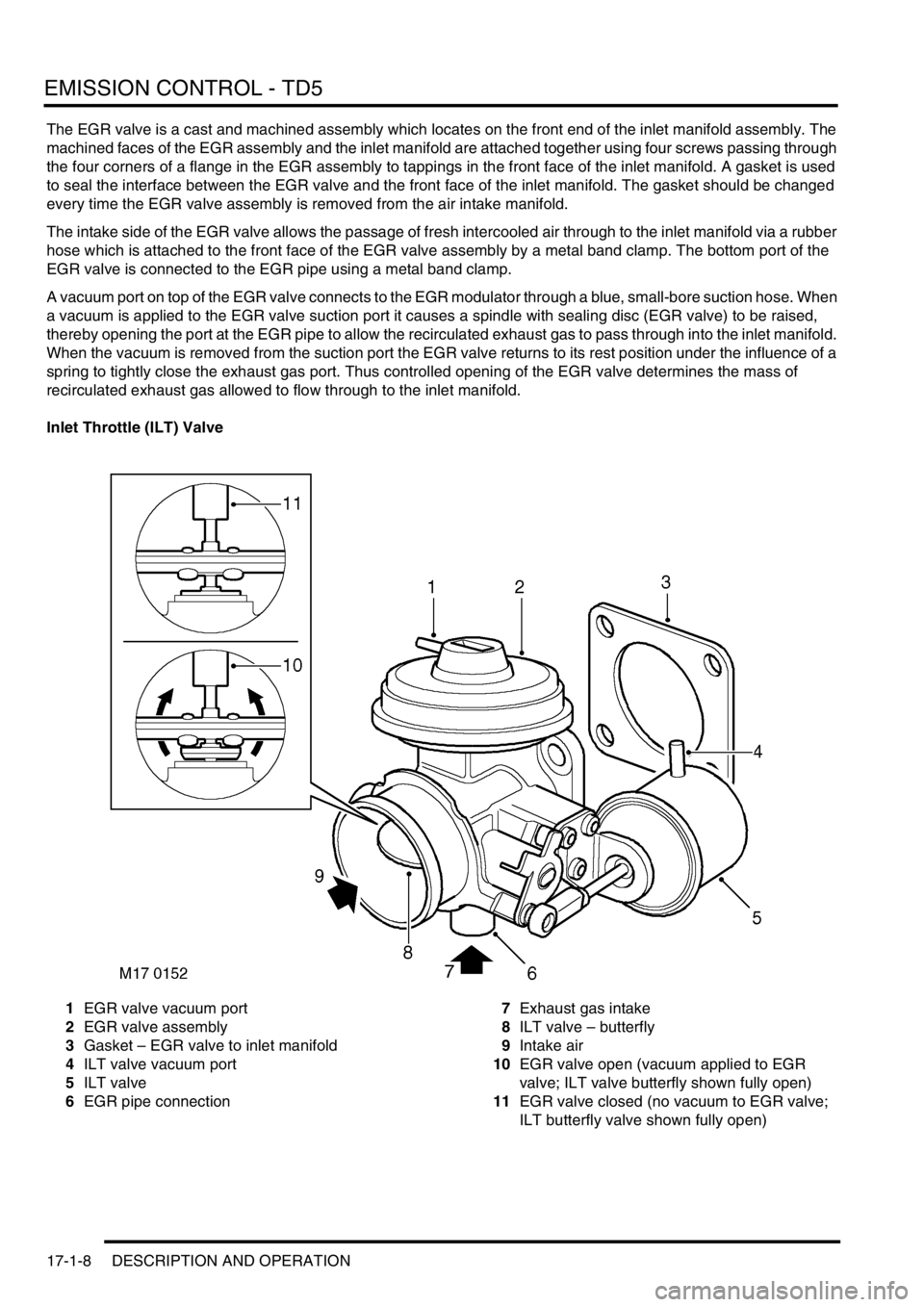
Inlet Throttle (ILT) Valve
1EGR valve vacuum port
2EGR valve assembly
3Gasket – EGR valve to inlet manifold
4ILT valve vacuum port
5ILT valve
6EGR pipe connection7Exhaust gas intake
8ILT valve – butterfly
9Intake air
10EGR valve open (vacuum applied to EGR
valve; ILT valve butterfly shown fully open)
11EGR valve closed (no vacuum to EGR valve;
ILT butterfly valve shown fully open)
Page 330 of 1672

EMISSION CONTROL - TD5
DESCRIPTION AND OPERATION 17-1-9
The ILT valve is used on certain exhaust gas recirculation systems in addition to the standard EGR valve described
above. The ILT valve assembly is mounted at right angles to the EGR valve on the left hand side of the EGR valve
assembly. It is fixed to the EGR valve assembly by three screws.
A vacuum port on top of the ILT valve connects to the ILT modulator though a blue, small-bore suction hose. When
a vacuum is applied to the inlet throttle (ILT) valve suction port, a butterfly valve in the inlet manifold closes via a
spindle and lever mechanism, limiting the supply of fresh intercooled air and creating a depression in the intake
manifold which in turn causes a greater suction at the open port to the EGR delivery pipe. When the vacuum source
is removed from the ILT valve suction port, a spring returns the butterfly to its fully open position. The ILT valve and
EGR valve are operated in conjunction to control the proportional masses of fresh intake air and recirculated exhaust
gas that is allowed to flow through to the inlet manifold.
The EGR valve and ILT valve should be replaced as a single assembly.
In-line air filter - Pre EU3 models
1To modulator vent port
2Filter element
3To atmosphere
The in-line air filter is placed in the ventilation line to the EGR modulator (and the ILT modulator where fitted). The
modulators need to be able to vent to atmosphere in order to release the vacuum supplied to the EGR and ILT valves.
The filter prevents contamination entering the modulators via the vent port which could cause failure; the filter should
be periodically changed in accordance with recommended service intervals. The filter is attached to the rear side of
the mounting plate used to hold the vacuum modulators at the inner wing on the RH side of the engine. The filter is
held in position by a clamping bracket which is attached to the mounting plate through a nut and bolt. The filter must
be mounted in the vertical position.
Note: EU3 models are not fitted with an in-line filter, the ventilation line connects directly to the air cleaner housing,
where it vents to atmosphere.
Page 549 of 1672
FUEL DELIVERY SYSTEM - TD5
19-1-4 DESCRIPTION AND OPERATION
Fuel tank breather system
The filler tube incorporates a tank vent which allows air and fuel vapour displaced from the tank when filling to vent to
atmosphere via the filler neck.
A breather spout within the tank controls the tank 'full' height. When fuel covers the spout it prevents fuel vapour and
air from escaping from the tank. This causes the fuel to 'back-up' in the filler tube and shuts off the filler gun. The
position of the spout ensures that when the filler gun shuts off, a vapour space of approximately 10% of the tanks total
capacity remains. The vapour space ensures that the Roll Over Valve (ROV) is always above the fuel level and vapour
can escape and allow the tank to breathe.
The ROV is welded on the top surface of the tank. The ROV is connected by a tube to the filler tube, which in turn is
connected to the atmospheric vent pipe. The ROV allows fuel vapour to pass through it during normal vehicle
operation. In the event of the vehicle being overturned the valve shuts off, sealing the tank and preventing fuel from
spilling from the atmospheric vent pipe.
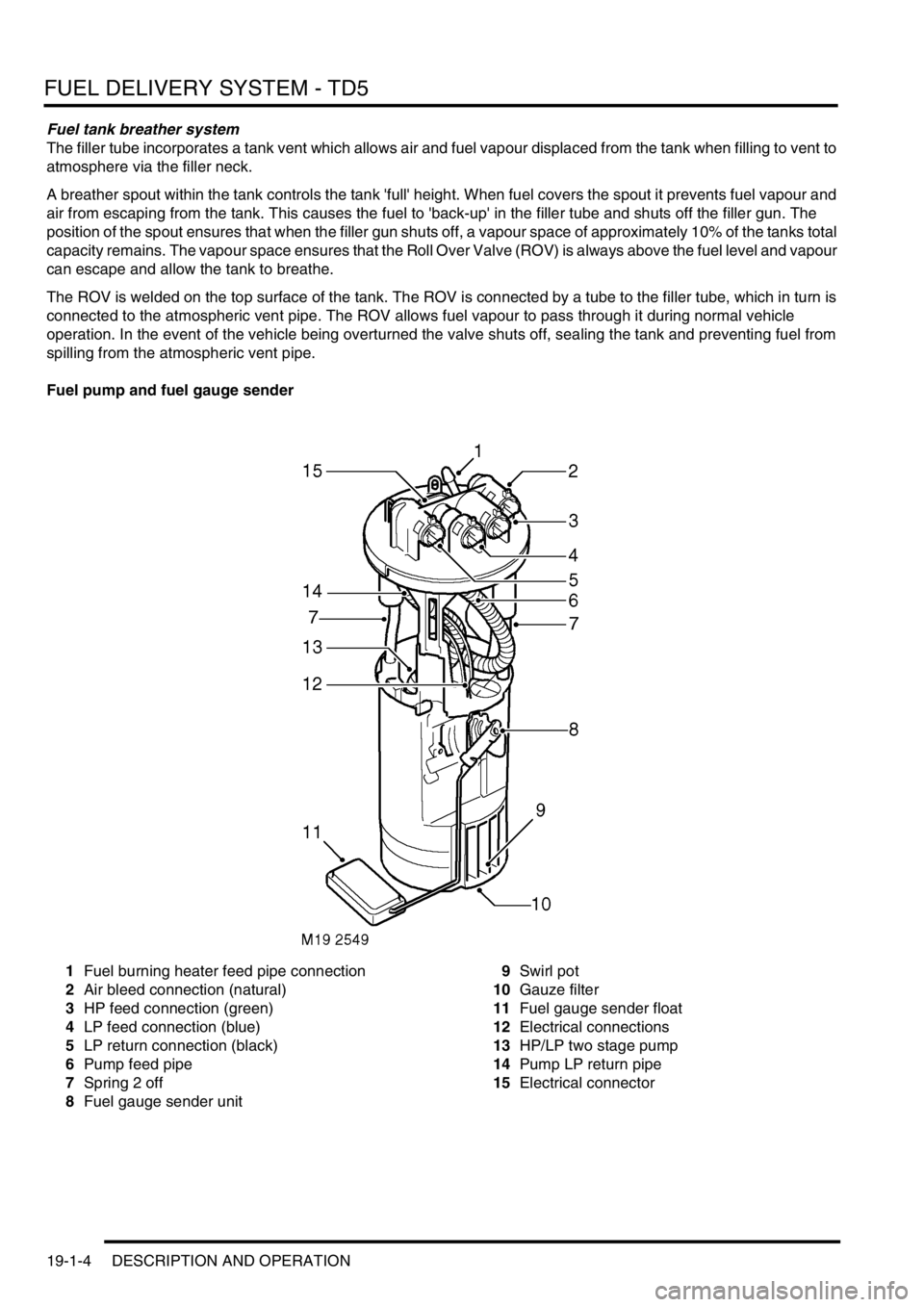
Fuel pump and fuel gauge sender
1Fuel burning heater feed pipe connection
2Air bleed connection (natural)
3HP feed connection (green)
4LP feed connection (blue)
5LP return connection (black)
6Pump feed pipe
7Spring 2 off
8Fuel gauge sender unit9Swirl pot
10Gauze filter
11Fuel gauge sender float
12Electrical connections
13HP/LP two stage pump
14Pump LP return pipe
15Electrical connector
Page 873 of 1672
REAR AXLE
51-14 OVERHAUL
47.Tighten bearing cap bolts to 90 Nm (66.5 lbf.ft).
48.Secure adjusting nuts with new roll pins.
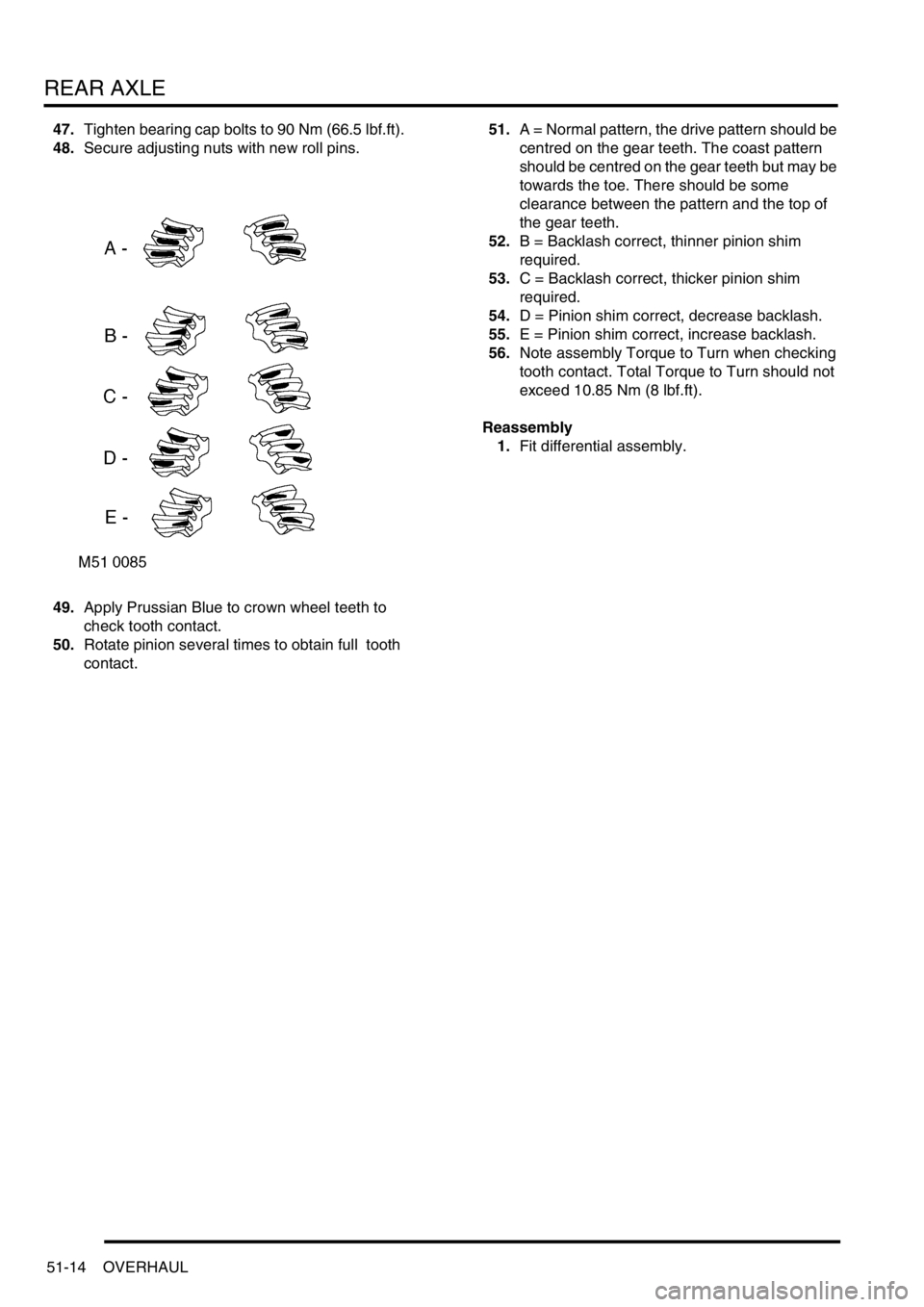
49.Apply Prussian Blue to crown wheel teeth to
check tooth contact.
50.Rotate pinion several times to obtain full tooth
contact.51.A = Normal pattern, the drive pattern should be
centred on the gear teeth. The coast pattern
should be centred on the gear teeth but may be
towards the toe. There should be some
clearance between the pattern and the top of
the gear teeth.
52.B = Backlash correct, thinner pinion shim
required.
53.C = Backlash correct, thicker pinion shim
required.
54.D = Pinion shim correct, decrease backlash.
55.E = Pinion shim correct, increase backlash.
56.Note assembly Torque to Turn when checking
tooth contact. Total Torque to Turn should not
exceed 10.85 Nm (8 lbf.ft).
Reassembly
1.Fit differential assembly.
Page 945 of 1672

FRONT SUSPENSION
60-6 DESCRIPTION AND OPERATION
Spring Data
The following table shows spring fitment applicablity.
Spring Fitment Applicability
The following table shows standard springs and uprated springs required when a front winch is fitted.
Winch Fitment Spring Applicability
Panhard rod
A Panhard rod is used to ensure that the axle remains centrally located. The Panhard rod has bushes pressed into
housings at each end which provide for the attachment to the axle and chassis. One end of the Panhard rod locates
in a fabricated bracket on the axle and is secured with a bolt and locknut. The opposite end is attached to a fabricated
bracket on the chassis and is also secured with a bolt and a locknut. The Panhard rod is shaped at one end to allow
clearance for the axle casing.
The attachment bolts for the Panhard rod are coated with a clear, dry wax which reduces friction on the bolt and allows
the correct torque to be applied to the clamping of the bushes. The bolts can be re-used, but if bolt replacement is
necessary the correct bolt with the wax coating must be used.
On models from 03 Model Year, the Panhard rod is shortened by 30 mm (1.18 in). This modification was introduced
to enhance the suspension bump steer characteristics in line with other suspension improvements introduced
simultaneously. The change to the Panhard rod also required the relocation of the attachment brackets on the axle
casing and the chassis.
Colour Code Total No. of Coils Free Length
Red/Purple 7.4 371 mm (14.6 in)
Yellow/Purple 7.4 378.4 mm (14.9 in)
Blue/Purple 7.4 365 mm (14.4 in)
Grey/Purple 7.4 387 mm (15.2 in)
Purple/Purple 7.4 373.8 mm (14.7 in)
Yellow/Orange 7.4 394.6 mm (15.5 in)
Green/Orange 7.4 382.6 mm (15 in)
Pink/Brown 7.6 405.6 mm (15.9 in)
Left Hand Drive Right Hand Drive
RH side LH side RH side LH side
Red/Purple Red/Purple Yellow/Purple Blue/Purple
Yellow/Purple Yellow/Purple Grey/Purple Purple/Purple
Grey/Purple Grey/Purple Yellow/Orange Green/Orange
Standard Spring Winch Fitted Spring
RH Side LH Side Both Sides
Red/Purple Red/Purple Grey/Purple
Yellow/Purple Blue/Purple Yellow/Orange
Yellow/Purple Yellow/Purple Yellow/Orange
Grey/Purple Purple/Purple Green/Orange
Grey/Purple Grey/Purple Green/Orange
Yellow/Orange Green/Orange Pink/Brown
Page 1012 of 1672

REAR SUSPENSION
DESCRIPTION AND OPERATION 64-7
Coil springs (vehicles without SLS)
On vehicles without SLS fitted, coil springs are fitted between the rear axle and the chassis in place of the SLS air
springs. Each spring is located at its base by the lower spring seat which is secured to a fabricated platform on the
rear axle with two bolts. The top of each spring is located in the upper spring seat. The upper spring seat comprises
a pressed metal plate with an outer coating of natural rubber bonded to the plate. The upper spring seat is retained
in position by the compression of the spring.
Coil Spring Specifications – Models up to 03 Model Year
The rear coil springs are of the variable rate type and are manufactured from silicon manganese 16.5 mm (0.65 in.)
diameter bar. Each spring has 9 coils and a free length of 385 mm (15.1 in.). The variable rate of the spring is achieved
by the active coils at one end being closer together. The rear coil spring is identified by a purple stripe painted on a
number of coils.
Coil Spring Specifications – Models From 03 Model Year
The introduction of the 03MY vehicle introduced a range of additional rear coil spring fitments. These were introduced
as a package to optimise vehicle trim heights.
The coil springs are manufactured from silicon manganese 16.35 mm (0.64 in.) diameter bar for springs on five seater
models and 16.57 mm (0.65 in.) diameter bar on seven seater models. The following spring data table shows the
colour codes, number of coils and spring free length.
Spring Data
The following table shows spring fitment applicability.
Spring Fitment Applicability
Watts linkage
A Watts linkage is used to ensure that the rear axle remains centrally located. The Watts linkage comprises two
transverse links and a pivot housing. The transverse links and pivot housing allow the rear axle to move vertically
without any transverse movement.
The transverse links are made from fabricated and welded steel. Each transverse link has a bush press fitted into a
housing at one end. The opposite end has a forked bracket with two cross holes.
The pivot housing is made from cast iron. Three bushes are press fitted in the housing, one in the centre and one at
each end.
Colour Code Total No. of Coils Free Length Model
Brown/Orange 8.73 384.7 mm (15.14 in) 5 Seat
Grey/Orange 8.73 392 mm (15.43 in) 5 Seat
Yellow/Grey 8.73 376.6 mm (14.82 in) 5 Seat
Pink/Grey 8.73 400.3 mm (15.75 in) 5 Seat
Blue/Grey 9.10 387.8 mm (15.26 in) 7 Seat
Green/Grey 9.10 395.2 mm (15.55 in) 7 Seat
White/Grey 9.10 380.6 mm (14.98 in) 7 Seat
Left Hand Drive Right Hand Drive
Both Sides RH Side LH Side
Brown/Orange Grey/Orange Yellow/Grey
Grey Orange Pink/Grey Brown/Orange
Blue/Grey Green/Grey White/Grey
Page 1018 of 1672

REAR SUSPENSION
DESCRIPTION AND OPERATION 64-13
Air supply unit
1Compressor electrical connector
2Electric motor
3Air intake hose
4Compressor
5Air dryer
6Pressure limiting valve
7Exhaust hose
8Exhaust valve electrical connector (black
harness connector)
9Exhaust valve10LH air valve electrical connector (blue harness
connector)
11LH air valve
12LH air spring supply pipe
13Air supply/exhaust pipe
14RH air spring supply pipe
15RH air valve
16RH air valve electrical connector (natural
harness connector)
17Housing
The air supply unit is located in a central position on the outside of the left hand chassis longitudinal. The unit is
contained in a plastic housing attached to the chassis. The housing has a removable lid which is secured with Dzus
fasteners for access to the unit.