fuel Lexus CT200h 2013 (in English) Owner's Guide
[x] Cancel search | Manufacturer: LEXUS, Model Year: 2013, Model line: CT200h, Model: Lexus CT200h 2013Pages: 688
Page 283 of 688
281
4 4-6. Driving tips
Driving
CT200h_OM_OM76102E_(EE)
Hybrid vehicle driving tips
Using Eco drive mode
When using Eco drive mode, the torque corresponding to the accelera-
tor pedal depression amount can be generated more smoothly than it is
in normal conditions. In addition, the operation of the air conditioning
system (heating/cooling) will be minimized, improving the fuel econ-
omy. (P. 267)
Use of Hybrid System Indicator
The Eco-friendly driving is possible by keeping the indicator needle of
Hybrid System Indicator within Eco area. (P. 107)
Shift lever operation
Shift the shift position to D when stopped at a traffic light, or driving in
heavy traffic etc. Shift the shift position to P when parking. When
using the N position, there is no positive effect on fuel consumption. In
the N position, the gasoline engine operates but electricity cannot be
generated. Also, when using the air conditioning system, etc., the
hybrid battery (traction battery) power is consumed.
Accelerator pedal/brake pedal operation
Drive your vehicle smoothly. Avoid abrupt acceleration and deceler-
ation. Gradual acceleration and deceleration will make more effec-
tive use of the electric motor (traction motor) without having to use
gasoline engine power.
Avoid repeated acceleration. Repeated acceleration consumes
hybrid battery (traction battery) power, resulting in poor fuel con-
sumption. Battery power can be restored by driving with the acceler-
ator pedal slightly released.
When braking
Make sure to operate the brakes gently and in a timely manner. A
greater amount of electrical energy can be retained when slowing
down.
For economical and ecological driving, pay attention to the following
points:
Page 284 of 688

2824-6. Driving tips
CT200h_OM_OM76102E_(EE)
Delays
Repeated acceleration and deceleration, as well as long waits at traffic
lights, will lead to bad fuel economy. Check traffic reports before leav-
ing and avoid delays as much as possible. When driving in a traffic
jam, gently release the brake pedal to allow the vehicle to move for-
ward slightly while avoiding overuse of the accelerator pedal. Doing so
can help control excessive gasoline consumption.
Highway driving
Control and maintain the vehicle at a constant speed. Before stopping
at a toll booth or similar, allow plenty of time to release the accelerator
and gently apply the brakes. A greater amount of electrical energy can
be regenerated when slowing down.
Air conditioning
Use the air conditioning only when necessary. Doing so can help
reduce excessive gasoline consumption.
In summer: When the ambient temperature is high, use the recirculated
air mode. Doing so will help to reduce the burden on the air condition-
ing system and reduce fuel consumption as well.
In winter: Because the gasoline engine will not automatically cut out
until it and the interior of the vehicle are warm, it will consume fuel.
Fuel consumption can be improved by avoiding overuse of the heater.
Checking tire inflation pressure
Make sure to check the tire inflation pressure frequently. Improper tire
inflation pressure can cause poor fuel economy.
Also, as snow tires can cause large amounts of friction, their use on dry
roads can lead to poor fuel economy. Use tires that are appropriate for
the season.
Page 285 of 688

2834-6. Driving tips
4
Driving
CT200h_OM_OM76102E_(EE)
Luggage
Carrying heavy luggage will lead to poor fuel economy. Avoid carrying
unnecessary luggage. Installing a large roof rack will also cause poor
fuel economy.
Warming up before driving
Since the gasoline engine starts up and cuts out automatically when
cold, warming up the engine is unnecessary. Moreover, frequently
driving short distances will cause the engine to repeatedly warm up,
which can lead to excess fuel consumption.
Page 454 of 688

4506-1. Using the air conditioning system and defogger
CT200h_OM_OM76102E_(EE)
When the outside temperature is low
The dehumidification function may not operate even when “A/C” is pressed or
“A/C” is selected.
Operation of the air conditioning system in Eco drive mode
In the Eco drive mode, the air conditioning system is controlled as follows to
prioritize fuel efficiency
• Engine speed and compressor operation controlled to restrict heating/cooling
capacity
• Fan speed restricted when automatic mode is selected
To improve air conditioning performance, perform the following operations
• Adjust the fan speed
• Turn off Eco drive mode
• Customize the air conditioning control of Eco drive mode. (P. 658)
Ventilation and air conditioning odors
To let fresh air in, set the air conditioning system to the outside air mode.
During use, various odors from inside and outside the vehicle may enter into
and accumulate in the air conditioning system. This may then cause odor to be
emitted from the vents.
To reduce potential odors from occurring:
• It is recommended that the air conditioning system be set to outside air mode
prior to turning the vehicle off.
• The start timing of the blower may be delayed for a short period of time
immediately after the air conditioning system is started in automatic mode.
Air conditioning filter
P. 527
Customization
Settings (e.g. A/C automatic mode switch operation) can be changed.
(Customizable features: P. 650)
Page 461 of 688

4576-1. Using the air conditioning system and defogger
CT200h_OM_OM76102E_(EE)
6
Interior features
When the outside temperature is low
The dehumidification function may not operate even when “A/C” is pressed.
Operation of the air conditioning system in Eco drive mode
In the Eco drive mode, the air conditioning system is controlled as follows to
prioritize fuel efficiency
• Engine speed and compressor operation controlled to restrict heating/cooling
capacity
• Fan speed restricted when automatic mode is selected
To improve air conditioning performance, perform the following operations
• Adjust the fan speed
• Turn off Eco drive mode
• Customize the air conditioning control of Eco drive mode. (P. 658)
Ventilation and air conditioning odors
To let fresh air in, set the air conditioning system to the outside air mode.
During use, various odors from inside and outside the vehicle may enter into
and accumulate in the air conditioning system. This may then cause odor to be
emitted from the vents.
To reduce potential odors from occurring:
• It is recommended that the air conditioning system be set to outside air mode
prior to turning the vehicle off.
• The start timing of the blower may be delayed for a short period of time
immediately after the air conditioning system is started in automatic mode.
Air conditioning filter
P. 527
Customization
Settings (e.g. A/C automatic mode switch operation) can be changed.
(Customizable features: P. 650)
Page 484 of 688
4807-1. Maintenance and care
CT200h_OM_OM76102E_(EE)
Cleaning and protecting the vehicle exterior
Working from top to bottom, liberally apply water to the vehicle body,
wheel wells and underside of the vehicle to remove any dirt and dust.
Wash the vehicle body using a sponge or soft cloth, such as a chamois.
For hard-to-remove marks, use car wash soap and rinse thoroughly
with water.
Wipe away any water.
Wax the vehicle when the waterproof coating deteriorates.
If water does not bead on a clean surface, apply wax when the vehicle body is
cool.
Self-restoring coat
The vehicle body has a self-restoring coating that is resistant to small surface
scratches caused in a car wash etc.
The coating lasts for 5 to 8 years after the coating has been performed.
The restoration time differs depending on the depth of the scratch and outside
temperature. The restoration time may become shorter when the coating is
warmed by applying warm water.
Deep scratches caused by keys or coins cannot be restored.
Do not use wax that contain abrasives.
Automatic car washes
Fold the mirrors before washing the vehicle. Start washing from the front of the
vehicle. Make sure to extend the mirrors before driving.
Brushes used in automatic car washes may scratch the vehicle surface and harm
your vehicle’s paint.
Rear spoiler may not be washable in some automatic car washes. There may
also be an increased risk of damage to vehicle.
High pressure car washes
Do not allow the nozzles of the car wash to come within close proximity of the
windows.
Before using the car wash, check that the fuel filler door on your vehicle is
closed properly.
Perform the following to protect the vehicle and maintain it in prime con-
dition:
Page 495 of 688
4917-3. Do-it-yourself maintenance
CT200h_OM_OM76102E_(EE)
7
Maintenance and care
WA R N I N G
The engine compartment contains many mechanisms and fluids that may move
suddenly, become hot, or become electrically energized. To avoid death or seri-
ous injury, observe the following precautions.
When working on the engine compartment
Make sure that the indicator on the power switch and the “READY” indicator
are both off.
Keep hands, clothing and tools away from the moving fan.
Be careful not to touch the engine, power control unit, radiator, exhaust mani-
fold, etc. right after driving as they may be hot. Oil and other fluids may also
be hot.
Do not leave anything that may burn easily, such as paper and rags, in the
engine compartment.
Do not smoke, cause sparks or expose an open flame to fuel. Fuel fumes are
flammable.
Take care because brake fluid can harm your hands or eyes and damage
painted surfaces. If fluid gets on your hands or in your eyes, flush the affected
area with clean water immediately. If you still experience discomfort, consult
a doctor.
When working near the electric cooling fans or radiator grille
Be sure the power switch is off.
With the power switch in ON mode, the electric cooling fans may automati-
cally start to run if the air conditioning is on and/or the coolant temperature is
high. (P. 502)
Safety glasses
Wear safety glasses to prevent flying or falling material, fluid spray, etc. from
getting in your eyes.
NOTICE
If you remove the air cleaner filter
Driving with the air cleaner filter removed may cause excessive engine wear
due to dirt in the air.
If the fluid level is low or high
It is normal for the brake fluid level to go down slightly as the brake pads wear
or when the fluid level in the accumulator is high.
If the reservoir needs frequent refilling, it may indicate a serious problem.
Page 527 of 688
5237-3. Do-it-yourself maintenance
CT200h_OM_OM76102E_(EE)
7
Maintenance and care
Tire inflation pressure
Effects of incorrect tire inflation pressure
Driving with incorrect tire inflation pressure may result in the following:
Reduced fuel efficiency
Reduced driving comfort and tire life
Reduced safety
Damage to the drive train
If a tire needs frequent inflating, have it checked by any authorized Lexus dealer
or repairer, or another duly qualified and equipped professional.
Instructions for checking tire inflation pressure
When checking tire inflation pressure, observe the following:
Check only when the tires are cold.
If your vehicle has been parked for at least 3 hours or has not been driven for
more than 1.5 km or 1 mile, you will get an accurate cold tire inflation pressure
reading.
Always use a tire pressure gauge.
The appearance of the tire can be misleading. In addition, tire inflation pressure
that is even just a few pounds off can affect ride quality and handling.
Do not reduce tire inflation pressure after driving. It is normal for tire inflation
pressure to be higher after driving.
Never exceed the vehicle capacity weight.
Passengers and luggage weight should be placed so that the vehicle is balanced.
Make sure to maintain proper tire inflation pressure. Tire inflation pres-
sure should be checked at least once per month. However, Lexus recom-
mends that tire inflation pressure be checked once every two weeks.
(P. 645)
Page 574 of 688
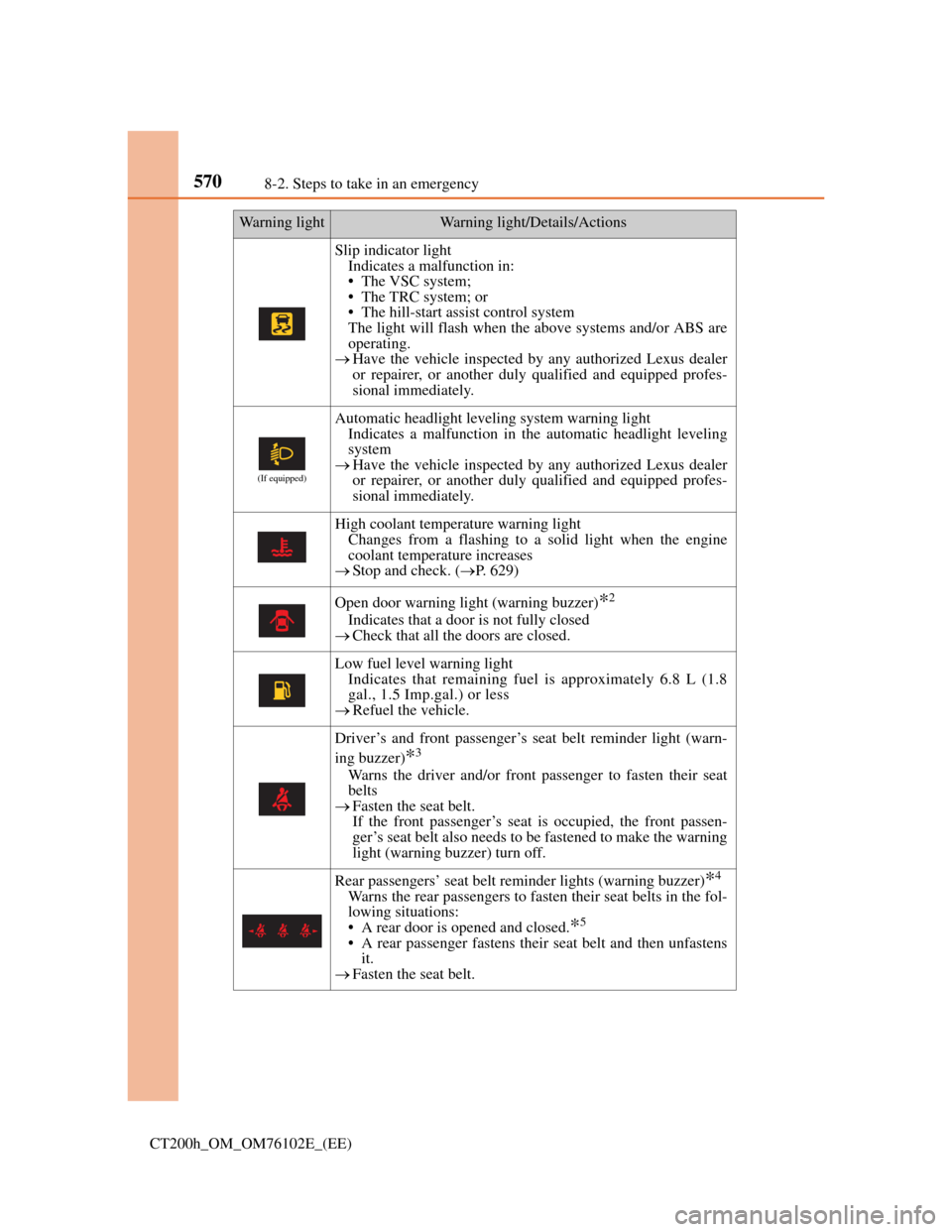
5708-2. Steps to take in an emergency
CT200h_OM_OM76102E_(EE)
Slip indicator light
Indicates a malfunction in:
• The VSC system;
• The TRC system; or
• The hill-start assist control system
The light will flash when the above systems and/or ABS are
operating.
Have the vehicle inspected by any authorized Lexus dealer
or repairer, or another duly qualified and equipped profes-
sional immediately.
(If equipped)
Automatic headlight leveling system warning light
Indicates a malfunction in the automatic headlight leveling
system
Have the vehicle inspected by any authorized Lexus dealer
or repairer, or another duly qualified and equipped profes-
sional immediately.
High coolant temperature warning light
Changes from a flashing to a solid light when the engine
coolant temperature increases
Stop and check. (P. 629)
Open door warning light (warning buzzer)*2
Indicates that a door is not fully closed
Check that all the doors are closed.
Low fuel level warning light
Indicates that remaining fuel is approximately 6.8 L (1.8
gal., 1.5 Imp.gal.) or less
Refuel the vehicle.
Driver’s and front passenger’s seat belt reminder light (warn-
ing buzzer)
*3
Warns the driver and/or front passenger to fasten their seat
belts
Fasten the seat belt.
If the front passenger’s seat is occupied, the front passen-
ger’s seat belt also needs to be fastened to make the warning
light (warning buzzer) turn off.
Rear passengers’ seat belt reminder lights (warning buzzer)*4
Warns the rear passengers to fasten their seat belts in the fol-
lowing situations:
• A rear door is opened and closed.
*5
• A rear passenger fastens their seat belt and then unfastens
it.
Fasten the seat belt.
Warning lightWarning light/Details/Actions
Page 576 of 688

5728-2. Steps to take in an emergency
CT200h_OM_OM76102E_(EE)
Front passenger detection sensor, seat belt reminder and warning buzzer
If luggage is placed on the front passenger seat, the front passenger detection
sensor may cause the warning light to flash and the warning buzzer to sound
even if a passenger is not sitting in the seat.
If a cushion is placed on the seat, the sensor may not detect a passenger, and the
warning light may not operate properly.
Electric power steering system warning light (warning buzzer)
When the 12-volt battery charge becomes insufficient or the voltage temporarily
drops, the electric power steering system warning light may come on and the
warning buzzer may sound.
If the malfunction indicator lamp comes on while driving
The malfunction indicator lamp will come on if the fuel tank becomes com-
pletely empty. If the fuel tank is empty, refuel the vehicle immediately. The mal-
function indicator lamp will go off after several trips.
If the malfunction indicator lamp does not go off, contact any authorized Lexus
dealer or repairer, or another duly qualified and equipped professional as soon as
possible.
When the tire pressure warning light comes on (vehicles with the tire pressure
warning system)
Inspect the appearance of the tire to check that the tire is not punctured.
If the tire is punctured: P. 591, 605
If the tire is not punctured:
Carry out the following procedure after the tire temperature has lowered suffi-
ciently.
Check the tire inflation pressure and adjust to the appropriate level.
If the warning light does not go out even after several minutes, check that the
tire inflation pressure is at the specified level and carry out initialization. (P.
512)
The warning light may come on again if the above operations are conducted
without first allowing the tire temperature to lower sufficiently.
The tire pressure warning light may come on due to natural causes (vehicles with
the tire pressure warning system)
The tire pressure warning light may turn on due to natural causes such as natural
air leaks or tire inflation pressure changes caused by temperature. In this case,
adjusting the tire inflation pressure will turn off the warning light (after a few
minutes).